
Chapter 7: Culture, Cognition, Reasoning
Chapter Overview
We all think the same way, right? Research into human cognition along with studies about
culture’s influence on thought, reasoning, and understanding shows us that the answer is
actually, no.
The key questions covered in Chapter 7 will focus on: What have recent neuroscience findings
told us about the connection of culture and cognition? Why might people from different
cultures approach reasoning in different ways? What are some of the cultural patterns for
communicating? How might language play a role in what and how we communicate?
LEARNING OBJECTIVE
This chapter looks at non-Western views of intercultural communication by providing culture-
specific examples to illuminate human cognition across cultures and why this matters in
KEY TAKEAWAYS
• Historical and societal impact on humans results in different methods of reasoning.
• A culture’s language influences what, how, and why things are communicated.
LEADERSHIP APPLICATIONS
Introduction
• Neuroscience and culture
Neuroscience and Culture
The field of neuroscience is opening up new explanations between the connections of the
biological brain with human behavior.
• There is now a specific field in the area of cultural neuroscience that studies the
interchange between neural and cultural forces, which promote human cognition,
Neuroscientists have found that social factors such as group norms and expectations impact the
brain regarding the reptilian complex, which is the most basic part of the brain for all breathing
creatures.
Cognition
• Deductive and inductive reasoning
• Systemic and linear perceiving
• A case of linear versus systemic thinking
Cognition
Our thinking style—or cognition—relates to how we reason and perceive. It’s the way we
process information, react to it, and create our own meaning from that information.
Deductive Reasoning
In deductive thinking a person instinctively looks for theories and general concepts—to this
person it is more important to analyze theories before getting into the details of the data.
• Think of Einstein and his high-level theory of relativity.
• A deductive thinker would analyze the overarching theory instead of the details
associated with it.
Cultural Orientations Approach
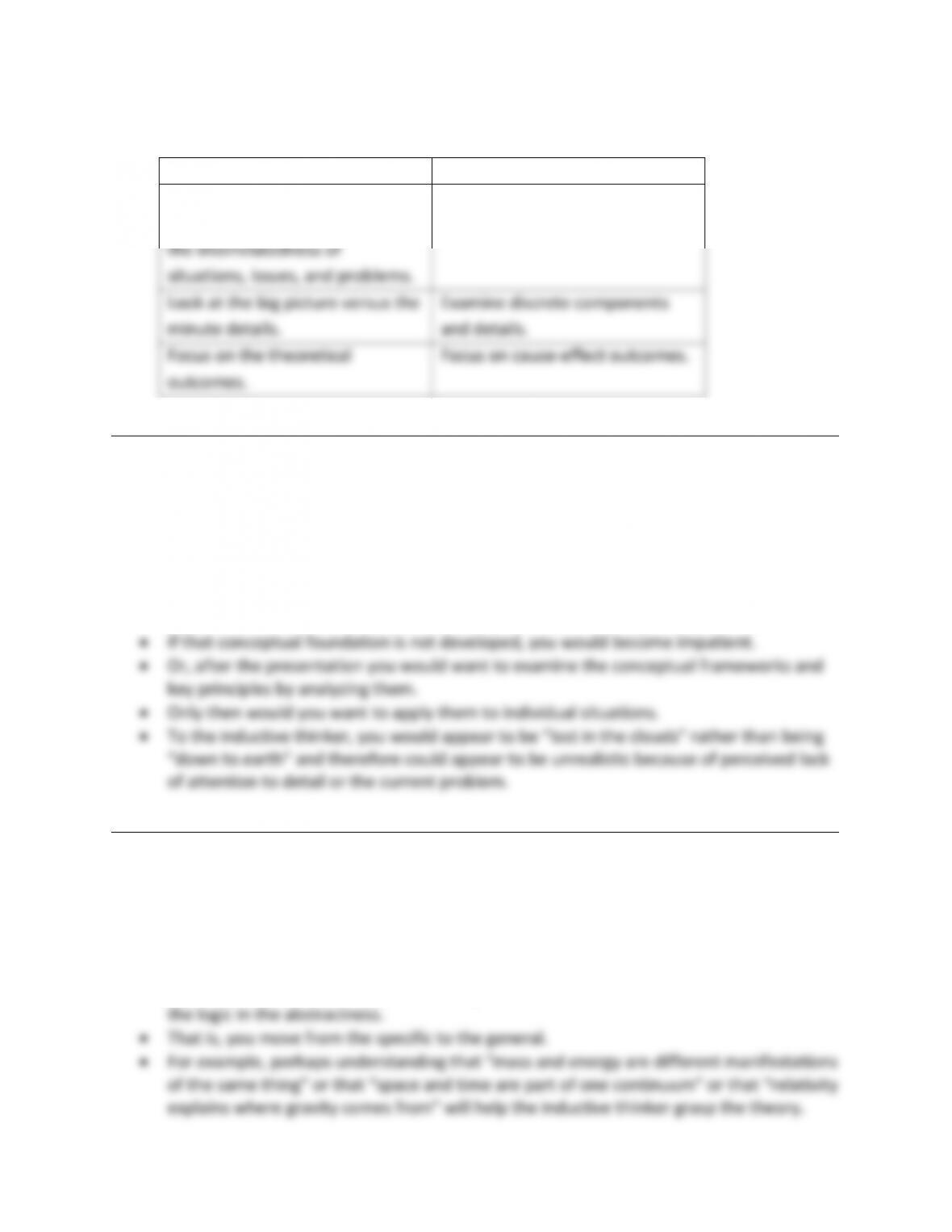
Adapted from Cultural Navigator
Systemic Thinker
Linear Thinker
Communicate your point using
complexity that demonstrates
the interrelatedness of
situations, issues, and problems.
Communicate sequentially and
focus on each issue one by one.
Look at the big picture versus the
minute details.
Examine discrete components
and details.
Focus on the theoretical
outcomes.
Focus on cause-effect outcomes.
Deductive at Work
At work the deductive thinker would mean that you move from the general to the specific
understanding of a situation. The deductive thinker is all about the conceptualization of a
project or idea rather than its application to particular situations.
• For example, when listening to a presentation, you would focus on the quality of the
arguments and its credibility because the speaker uses a strong conceptual foundation.
Inductive Reasoning
In inductive thinking a person is more attuned with specific examples and prefers to analyze the
details in the data before moving on to the general concepts.
• An inductive thinker would want to create a mind-map of this theory to map out its
specifics, because without understanding the details, the inductive thinker could not see
Inductive at Work
At work, inductive thinking would mean that you are interested in the specific situations and
details surrounding a problem, issue, or event.
• You are pragmatic and want to interpret the data or information involved with that
Systemic Reasoning
The two forms of perceiving are systemic and linear. If reasoning is the process of thinking
about something in order to form a conclusion, perceiving is the way you think about
something—how you are able to grasp its essence.
Systemic at Work
In the workplace, you would tend to take a “big picture” view of a problem, focusing on the
relationships of its various concepts or components.
Linear Reasoning
Linear thinking looks at the individual components of a problem or situation, structuring one’s
thoughts and solutions possibly using a cause and effect structure.

Linear at Work
Linear thinking got Mattel into trouble with their launch of House of Barbie in Shanghai.
Historical and Philosophical Backgrounds of the East and West
• Eastern orientation
o Eastern orientation in religion and philosophy
▪ Confucius
• Western orientation
Historical and Philosophical Backgrounds of the East and West
Richard Nisbett’s experiment with cognitive differences between Westerners and East Asians.
• Anglo European (US and Canada) or Asian students (China, Japan, South Korea) weren’t
Findings:
• Field dependence: indicates that a person’s perception of an object will be influenced by
Eastern Orientation
Chinese personal agency focuses on harmony.

• Throughout history, the Chinese person was first and foremost a member of several
collectives (family, clan, village). Individuals did not claim unique and independent
Rice Farming—A Collective Endeavor
Rice farming is an example of collective and interdependent worldviews.
• Families bond into clans, which make up the villages, and each community needs to
Harmony at Work is Important
Japanese collectivism: “Deru kui wa utareru,” 出る杭は打たれる, “The stake that sticks up is
pounded down.”
• This implies that one must fit in with the social environment.
Eastern Orientation in Religion and Philosophy
The Eastern orientation toward life blends Confucianism, Daoism, and Buddhism, all of which
focus on harmony with people and nature.
Confucius (552-479 BC) lived during the Early Autumn Era:
• He helped restore societal order and harmony during a tumultuous time.
• His teachings created a system of social and political ethics meant to guide people about
how to behave properly in everyday life.

Confucius
Filial piety, kinship, and loyalty as an indication of the important obligations within hierarchical
relationships:
• Emperor to subject
• Husband to wife
Confucius
The main principles are:
• 仁“ren” = into benevolence
• “lĭ” 礼 = good character
Buddhism
Buddhism teaches that we need to overcome our negative states of mind, which cause
suffering, in favor of positive states of mind, which brings happiness.
• Buddhism is a major religion, practiced in India, Cambodia, Taiwan, South Korea, Sri
Lanka, Myanmar, Vietnam, Thailand, Japan, and China.

Daoism
Daoism is a philosophical system that focuses on becoming one with the environment. It is
about balance—there must be spiritual harmony within an individual and also between that
individual and nature.
• It is considered a religion and is attributed to Laozi, a Chinese philosopher and poet
Summary of Eastern Worldview
These three belief systems are complementary to each other and were instrumental in shaping
the worldview of people from Eastern orientations as described by Nisbett.
• Confucianism is an ethical and philosophical system that guides people toward
harmonious living.
Eastern Orientation in Communication—Asia-Centric
• Eurocentric view of the world:
o Core values include rationality, individual agency, and linear logic
• Five propositions regarding an Asia-centric worldview:
o Yoshitaka Miike contrasts Asia-centric with the Eurocentric worldview in order to
understand different perspectives for perceiving, reasoning, and communication.
• Circularity
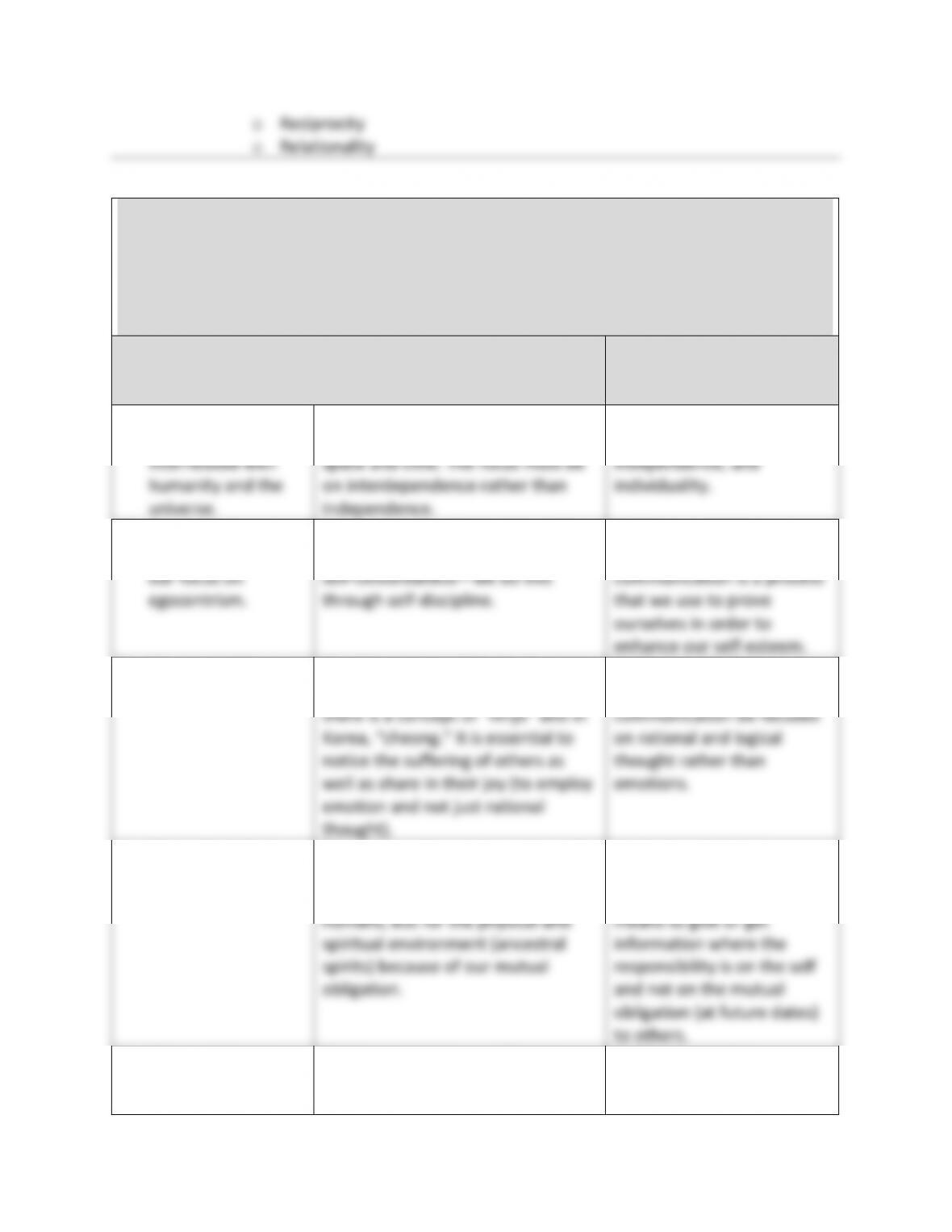
Adapted from Miike: Harmony Without Uniformity
Asian-centric Communication
DISCUSSION: Compare/contrast these five Asia-centric propositions to the
Eurocentric/Western viewpoint of communication. How might the Asian-centric and
Eurocentric propositions complement each other? What application would they have for you
in the workplace?
PROPOSTIONS: Asian-centric view of communication that
demonstrates: Communication is a process in which…
PROPOSITIONS:
Eurocentric view of
communication
1. We are
interdependent and
interrelated with
humanity and the
universe.
It is the universe that connects
everyone with everything across
space and time. The focus must be
on interdependence rather than
independence.
1. Western thinking
proposes self-expression,
independence, and
individuality.
2. Our goal is to
diminish self and rid
our focus on
egocentrism.
To coexist with others, we need to
release our innate tendency for
self-centeredness—we do this
through self-discipline.
2. Western thinking
proposes that
communication is a process
that we use to prove
ourselves in order to
enhance our self-esteem.
3. We connect to
others who suffer.
The Chinese term “rénqíng” means
“whole heartedness.” In Japan,
there is a concept of “ninjo” and in
Korea, “cheong.” It is essential to
notice the suffering of others as
well as share in their joy (to employ
emotion and not just rational
thought).
3. Western thinking
proposes that
communication be focused
on rational and logical
thought rather than
emotions.
4. We realized that
what we get we
must also give back.
Since our existence depends on all
beings—we must show gratitude
and respect not only for fellow
humans, but for the physical and
spiritual environment (ancestral
spirits) because of our mutual
obligation.
4. Western thinking
proposes that
communication is used as a
means to give or get
information where the
responsibility is on the self
and not on the mutual
obligation (at future dates)
to others.
5. We consider our
moral obligation
This is an ethical appeal for our
sense of duty to cooperate and
demonstrate moral integrity—we
the sake of self-interest
5. Western thinking
proposes that we speak for
within society and
the universe.
must be outward versus inward
focused through whole-hearted
concern (rénqíng) for all.
(e.g., “debating in the public
square,” as Aristotle stated).
Miike, Y. (2009). Harmony without Uniformity: An Asiacentric Worldview and its
Communicative Implications. In Samovar, L. A., & Porter, R. E. (Eds.), Intercultural
Communication: A Reader (12th ed.) (37). Belmont, CA: Wadsworth.
Western Orientation
• Western philosophy (Socrates, Plato, and Aristotle)
o The formation of agency was on the individual versus the group.
o Greek personal agency was based upon individuality—unique individuals with
distinct attributes and goals.
Worldview Revisited as Cognitive Themes
• The Ethno-Semantic Test
Worldview Revisited as Cognitive Themes
What do cows, women, and girls have in common? Depending on your worldview, they could
have a lot in common or nothing at all!
The Ethno-Semantic Test
How would YOU group these words?

Once you have grouped them, come up with a category description for each group—for
example, animals or make-believe things.
Discussion of Worldview
Masai Worldview in Kenya
Word Domains
The words in any given language will reflect the
things that are important to its people.
Man
Woman
Rock
God/god
Lion
Girl
Sand
Angel
Whale
Cow
Tree
Demon
Bush
Ancestor
Fish
Virus
Deer
Examples of Cognition and Reasoning Across Cultures
• An Indian perspective
Examples of Cognition and Reasoning Across Cultures
Ideologic Communication and Pragmatism Communication
Communication Patterns in India:
• An ideological communicator: assumes that everyone has the same point of view.
• A pragmatic communicator’s reason for communicating is to achieve a particular goal.
Examples of Cognition and Reasoning Across Cultures
Associative Communication and Abstractive Communicator
• Associative communicator
• Sees a person as a whole—both as a person and a professional, these two
aspects go hand in hand.
• An abstractive communicator sees a person in two ways—first, the professional who has
to get the work done, and second, as a person.
o If the professional doesn’t do the job right, then that person should be told
Summary
Culture and cognition are interconnected, influencing problem-solving approaches and patterns
of thought.
• Neuroscience indicates people from different cultures approach reasoning and
perceiving differently.
Eastern Philosophy

Culture and philosophy are interconnected, influencing how people approach social and
physical environments.
• Eastern philosophy focuses on harmony within the family, the group, and even the
environment.
Western Philosophy
Culture and philosophy are interconnected, influencing how people approach social and
physical environments.
• Western philosophy focuses on the independent self.
***
CASES: Groupon
ACTIVITY: Connotative/Denotative Meanings