International Arbitrage and Interest Rate Parity ❖ 13
interest arbitrage, whether the investor would buy or sell euros forward, and how that affects the
forward rate of the euro.
36. IRP and Changes in the Forward Rate. Assume that interest rate parity exists. As of this
morning, the 1-month interest rate in Canada was lower than the 1-month interest rate in the
U.S.. Assume that as a result of the Fed’s monetary policy this afternoon, the one-month
interest rate in the U.S. declined this afternoon, but was still higher than the Canadian one-
month interest rate. The one-month interest rate in Canada remained unchanged. Based on the
information, the forward rate of the Canadian dollar exhibited a ________ [discount or
premium] this morning that _________[increased or decreased] this afternoon. Explain.
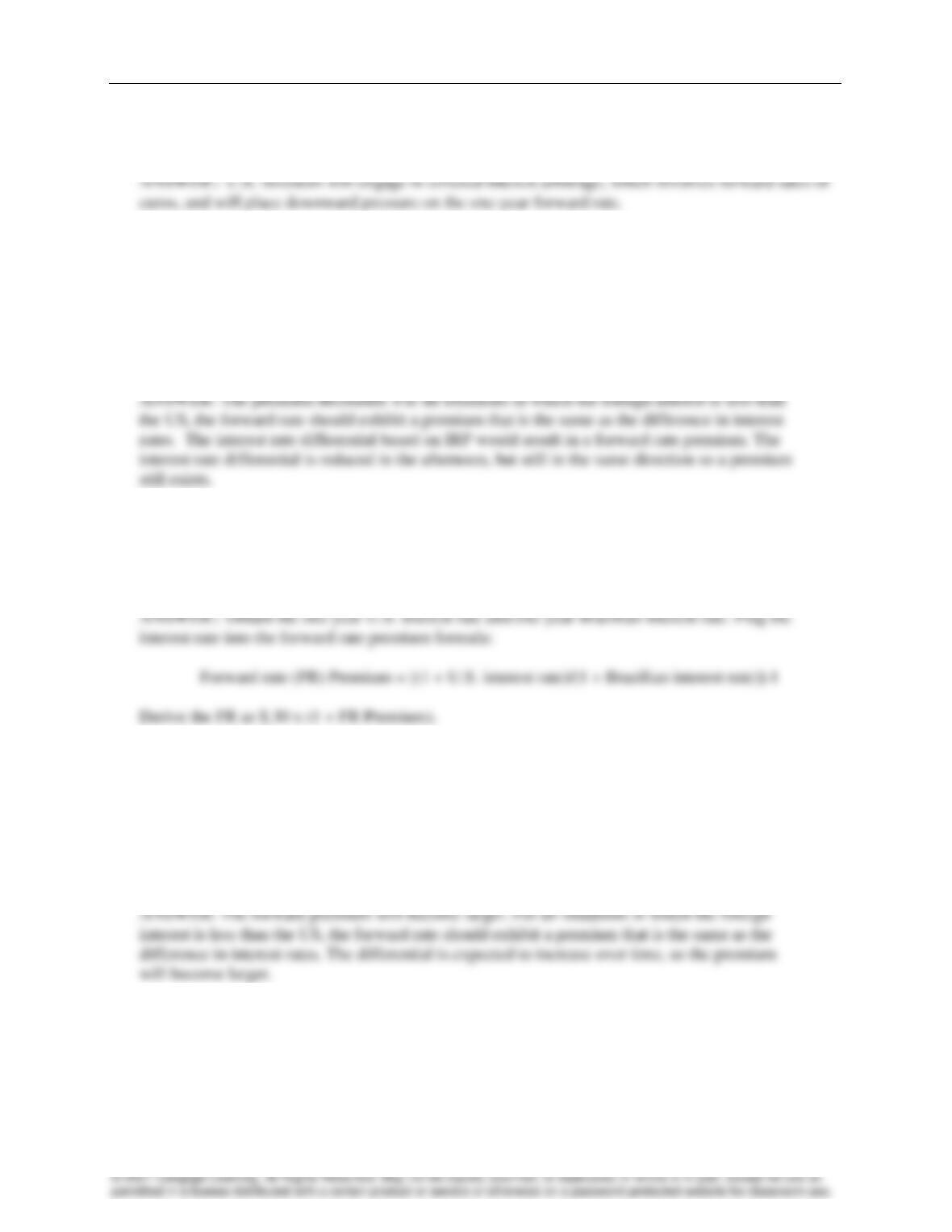
37. Deriving the Forward Rate Premium. Assume that the spot rate of the Brazilian real is $.30
today. Assume that interest rate parity exists. Obtain the interest rate data you need from
Bloomberg.com to derive the one-year forward rate premium (or discount), and then determine the
one-year forward rate of the Brazilian real.
38. Change in the Forward Premium Over Time. Assume that interest rate parity exists and
will continue to exist. As of today, the one-year interest rate of Singapore is 4%; the
corresponding rate is 7% in the U.S. The Singapore central bank is expected to decrease
interest rates in the future so that as of December 1, you expect that the one-year interest rate in
Singapore will be 2%. The U.S. interest rate is not expected to change over time. Based on the
information, explain how the forward premium (or discount) is expected to change by
December 1.
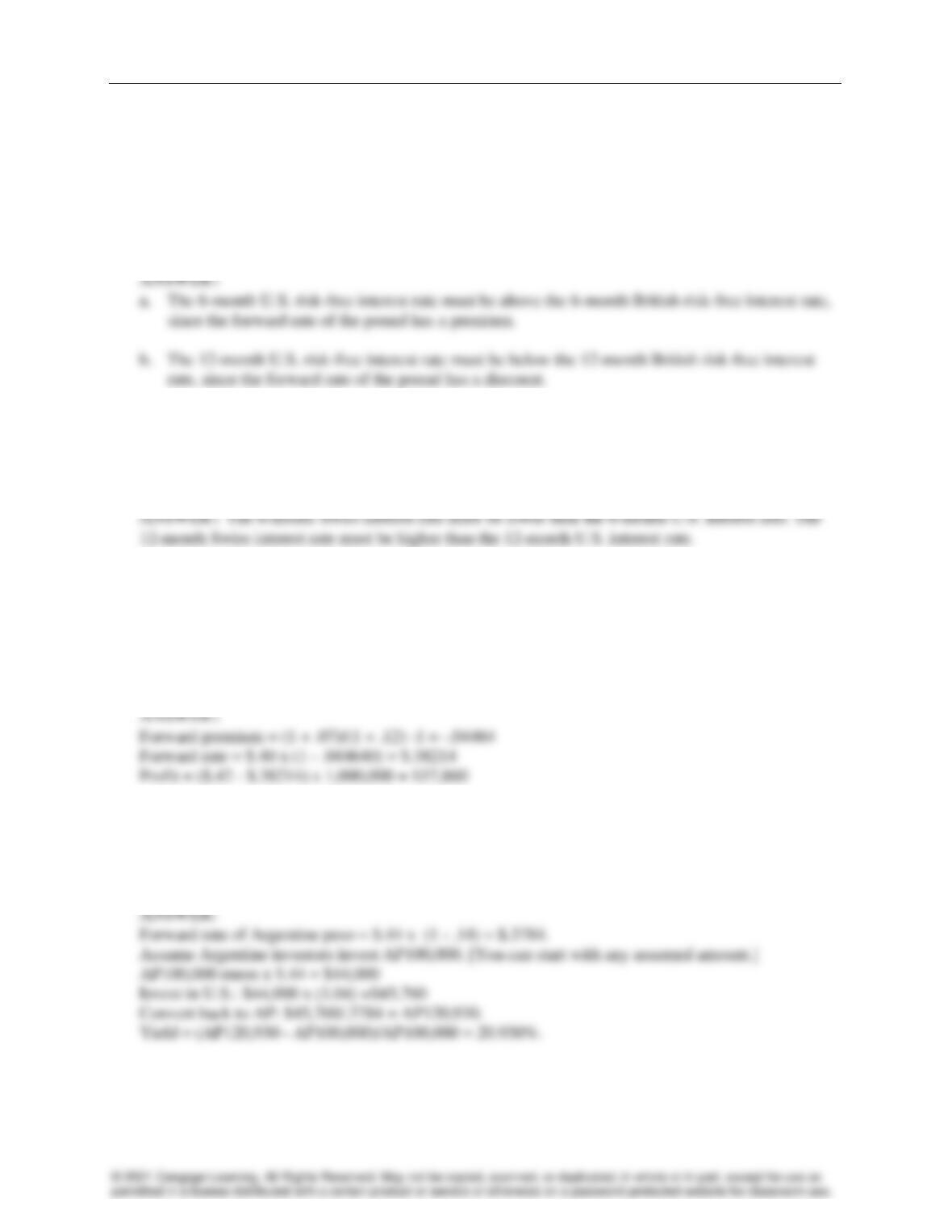
39. Forward Rates for Different Time Horizons. Assume that interest rate parity (IRP) exists, along
with the following information:
Spot rate of British pound = $1.80
6-month forward rate of pound=$1.82
International Arbitrage and Interest Rate Parity ❖ 14
12-month forward rate of pound=$1.78
a. Is the annualized 6-month U.S. risk-free interest rate greater than, less than, or equal to the British
risk-free interest rate?
b. Is the 12-month U.S. risk-free interest rate greater than, less than, or equal to the British risk-free
interest rate?
40. Interpreting Forward Rate Information. Assume that interest rate parity exists. The 6-month
forward rate of the Swiss franc has a premium whereas the 12-month forward rate of the Swiss franc
has a discount. What does this tell you about the relative level of Swiss interest rates versus U.S.
interest rates?
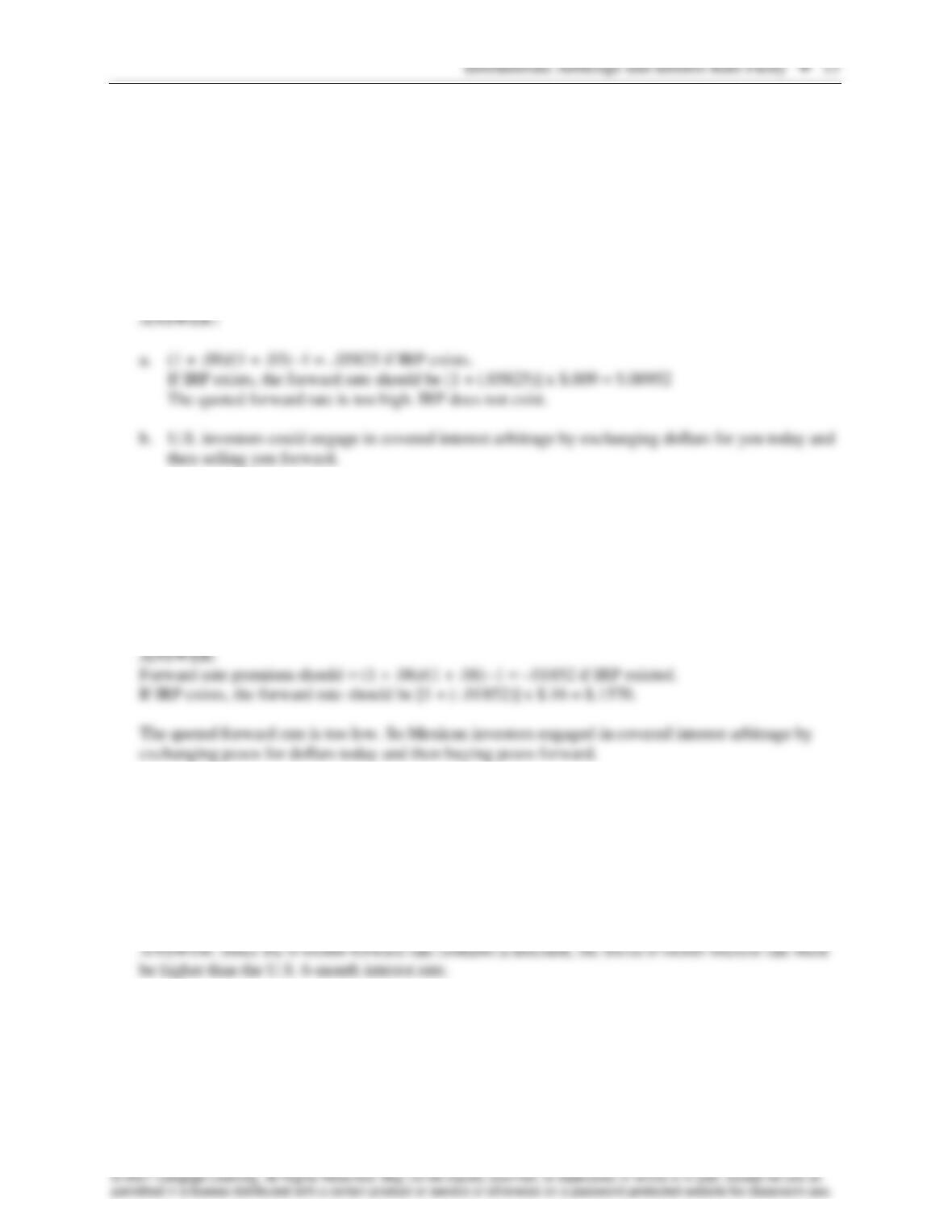
41. IRP and Speculation in Currency Futures. Assume that interest rate parity exists. The spot rate
of the Argentine peso is $.40. The one-year interest rate in the U.S. is 7%; the comparable rate is 12%
in Argentina. Assume the futures price is equal to the forward rate. An investor purchased futures
contracts on Argentine pesos, representing a total of 1,000,000 pesos. Determine the total dollar
amount of profit or loss from this futures contract based on the expectation that the Argentine peso
will be worth $.42 in one year.
42. Profit from Covered Interest Arbitrage. Today, the one-year U.S. interest rate is 4%,
while the corresponding one-year interest rate in Argentina is 17%. The spot rate of the
Argentine peso (AP) is $.44. The one-year forward rate of the AP exhibits a 14% discount.
Determine the yield (percentage retrun on investment) to an investor from Argentina who
engages in covered interest arbitrage.
International Arbitrage and Interest Rate Parity ❖ 16
interest arbitrage and whether these investors would buy or sell yen forward, and how that affects the
forward rate of the yen.]
ANSWER: Japanese investors will be able to engage in covered interest rate arbitrage and take
47. Profit from Triangular Arbitrage. The bank is willing to buy dollars for 0.9 euros per dollar.
It is willing to sell dollars for .91 euros per dollar. Also consider the following information:
You can sell Australian dollars (A$) to the bank for $.72.
You can buy Australian dollars from the bank for $.74.
The bank is willing to buy Australian dollars (A$) for 0.68 euros per A$.
The bank is willing to sell Australian dollars (A$) for 0.70 euros per A$.
You have $100,000. Estimate your profit or loss if you were to attempt triangular arbitrage by
converting your dollars to Australian dollars, and then converting your Australian dollars to euros,
and then converting your euros to U.S. dollars.
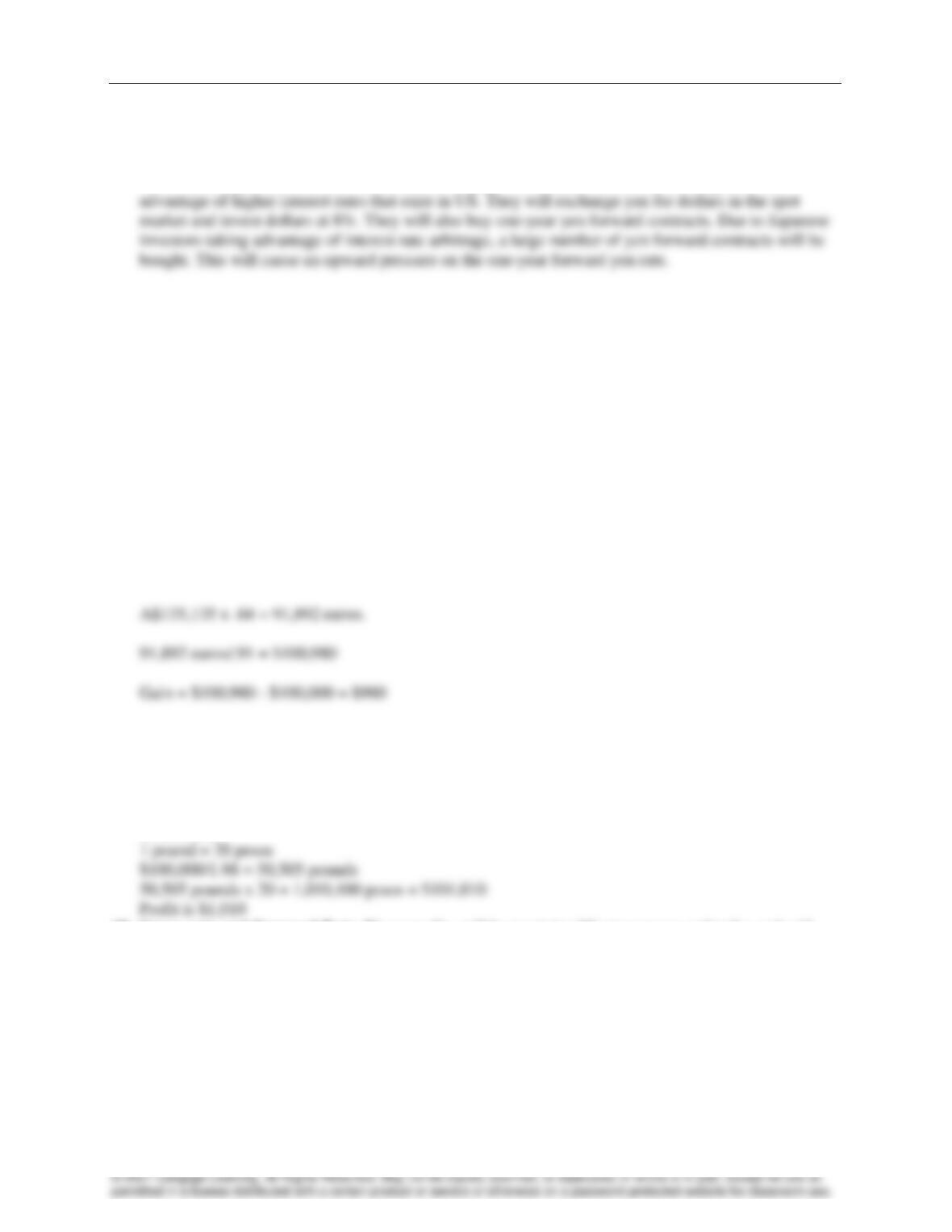
ANSWER:
$100,000/$.74=A$135,135
48. Profit from Triangular Arbitrage. Alabama Bank is willing to buy or sell British pounds for $1.98.
The bank is willing to buy or sell Mexican pesos at an exchange rate of 10 pesos per dollar. It is
willing to purchase British pounds at an exchange rate of 1 peso = .05 British pounds. Show how you
can make a profit from triangular arbitrage and what your profit would be if you had $100,000.
ANSWER:
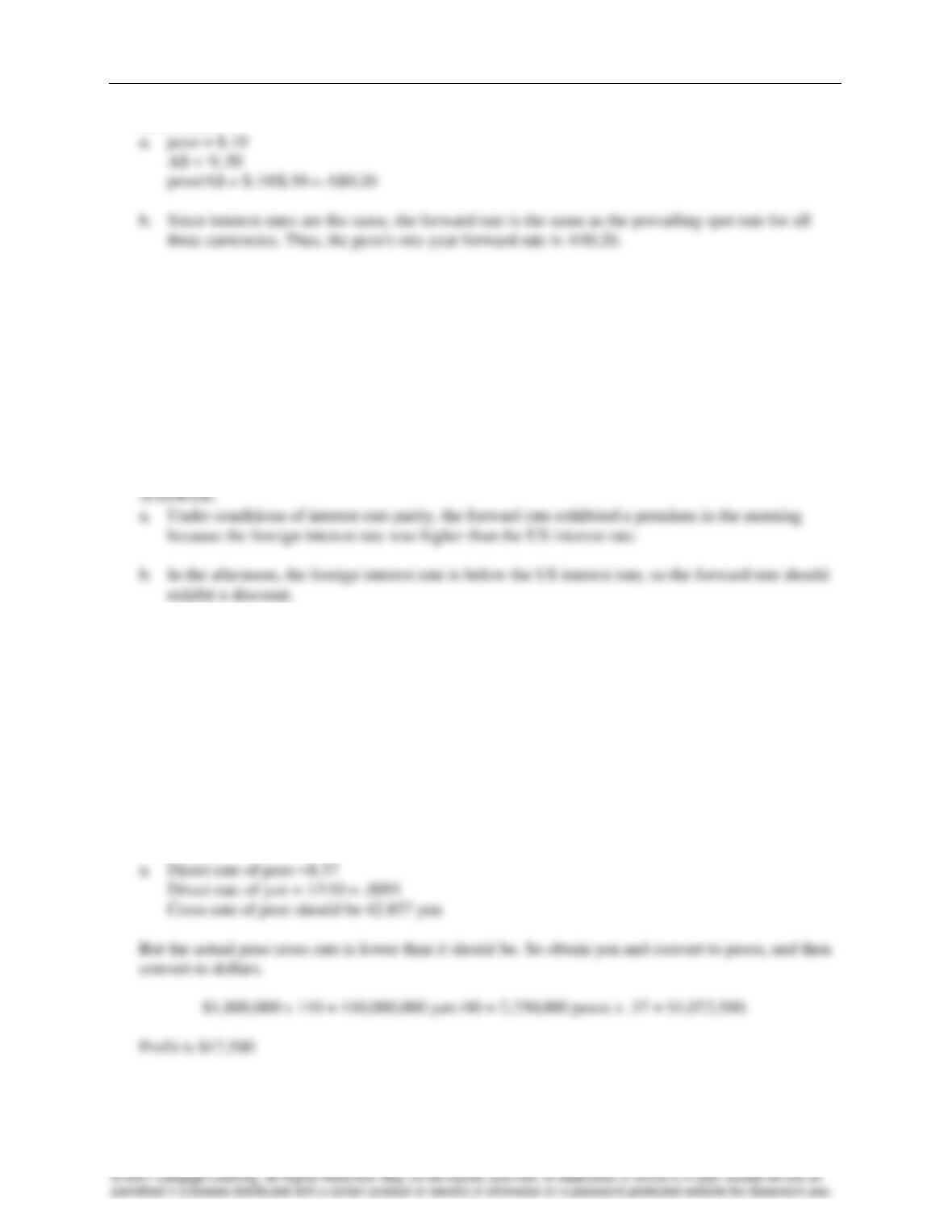
49. Cross-rate and Forward Rate. Biscayne Co. will be receiving Mexican pesos and today and will
need to convert them into Australian dollars. Today, a U.S. dollar can be exchanged for 10 Mexican
pesos. Also, an Australian dollar is worth one-half of a U.S. dollar.
a. What is the spot rate of a Mexican peso in Australian dollars?
b. Assume that interest rate parity exists and that the annual risk-free interest rate in the U.S.,
Australia, and Mexico is 7 percent. What is the one-year forward rate of a Mexican peso in
Australian dollars?
International Arbitrage and Interest Rate Parity ❖ 17
ANSWER:
50. Changes in the Forward Rate. Assume that interest rate parity exists and will continue to exist. As
of this morning, the 1-month interest rate in the U.S. was higer than the 1-month interest rate in the
eurozone. Assume that as a result of the European Central Bank’s monetary policy this afternoon, the
one-month interest rate of the euro increased and is now higher than the U.S. one-month interest rate.
The one-month interest rate in the U.S. remained unchanged.
a. Based on the information, do you think the one-month forward rate of the euro exhibited a
discount or premium this morning?
b. How did the forward premium change this afternoon?
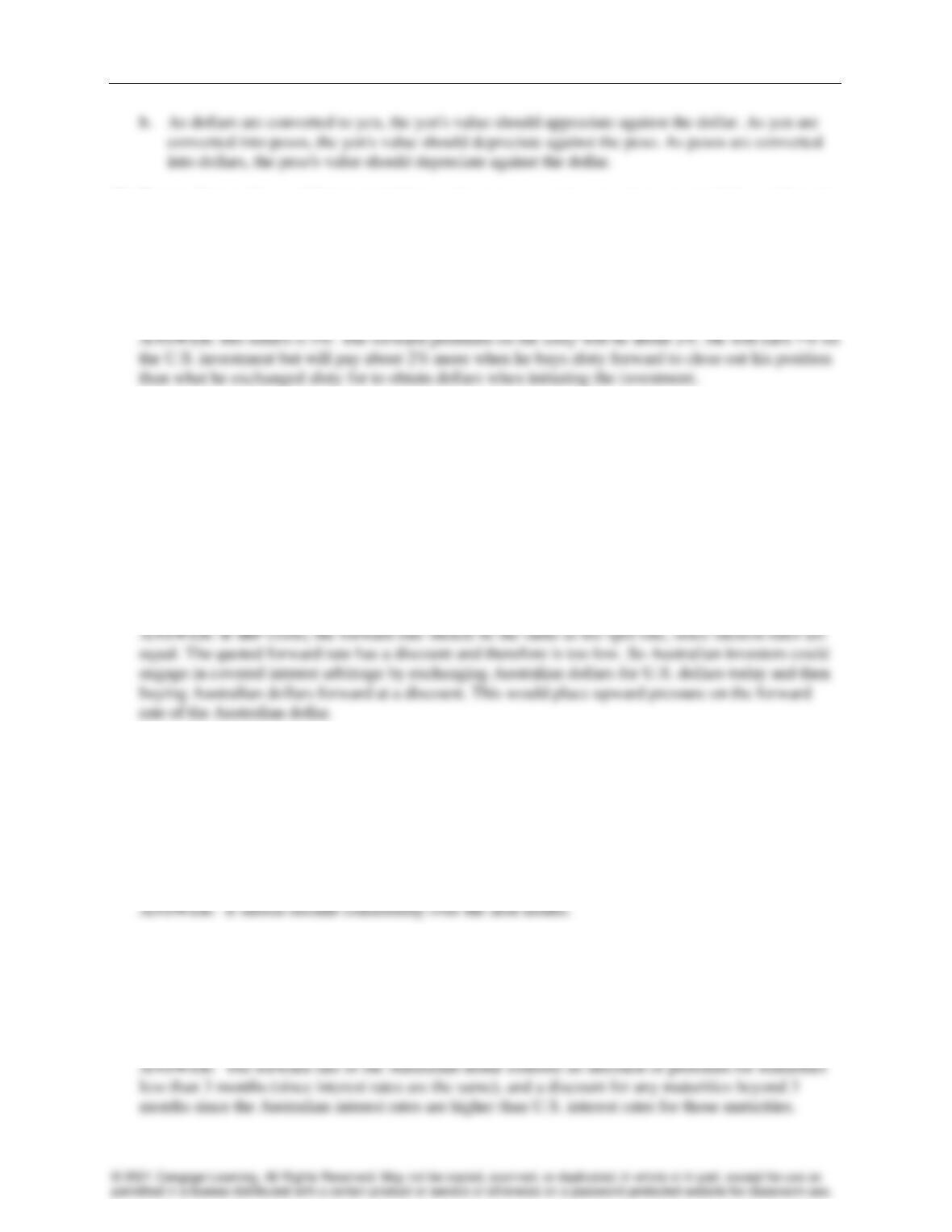
51. Forces of Triangular Arbitrage. You obtain the following quotes from different banks. One bank is
willing to buy or sell Japanese yen at an exchange rate of 110 yen per dollar. A second bank is willing
to buy or sell the Argentine peso at an exchange rate of $.37 per peso. A third bank is willing to
exchange Japanese yen at an exchange rate of 1 Argentine peso = 40 yen.
a. Show how you can make a profit from triangular arbitrage and what your profit would be if you
had $1,000,000.
b. As investors engage in triangular arbitrage, explain how their actions affect each of the exchange
rates until triangular arbitrage is no longer possible.
ANSWER:
International Arbitrage and Interest Rate Parity ❖ 18
© 2021 Cengage Learning. All Rights Reserved. May not be copied, scanned, or duplicated, in whole or in part, except for use as
permitted in a license distributed with a certain product or service or otherwise on a password-protected website for classroom use.
b. As dollars are converted to yen, the yen’s value should appreciate against the dollar. As yen are
converted into pesos, the yen’s value should depreciate against the peso. As pesos are converted
into dollars, the peso’s value should depreciate against the dollar.
52. Return Due to Covered Interest Arbitrage. Interest rate parity exists between the U.S. and Poland
(its currency is the zloty). The one-year risk-free CD (deposit) rate in the U.S. is 7%. The one-year
risk-free CD rate in Poland is 5%; it is denominated in zloty. Assume that there is zero probability of
any financial or political problem in either country such as a bank default or government restrictions
on bank deposits or currencies. Myron is from Poland and plans to invest in the U.S. What is Myron’s
return if he invests in the U.S. and covers the risk of his investment with a forward contract?
53. Forces of Covered Interest Arbitrage. As of now, the nominal interest rate is 6% in the U.S. and
6% in Australia. The spot rate of the Australian dollar is $.58, whereas the one-year forward rate of
the Australian dollar exhibits a discount of 2%. Assume that as covered interest arbitrage occurred
this morning, neither the interest rates nor the spot rate of the Australian dollar was not affected, but
the forward rate of the Australian dollar was affected, and consequently interest rate parity now
exists. Explain the forces that caused the forward rate of the Australian dollar to change by
completing this sentence: The ___________ [Australian or U.S.?] investors could benefit from
engaging in covered interest arbitrage; their arbitrage would involve ___________ [buying or
selling?] Australia dollars forward, which would cause the forward rate of the Australian dollar to
____________ [increase or decrease?].]
54. Change in Forward Premium Over Time. Assume that the one-year interest rate in the U.K. is 9
percent, whereas the one-year interest in the U.S is 4%. The spot rate of the pound is $1.50. Assume
that interest rate parity exists. The quoted one-year interest in the U.K. is expected to rise
consistently over the next month. Meanwhile, the quoted one-year interest rate in the U.S. is expected
to decline consistently over the next month. Assume that the spot rate does not change over the
month. Based on this information, how will the quoted one-year forward rate change over the next
month?
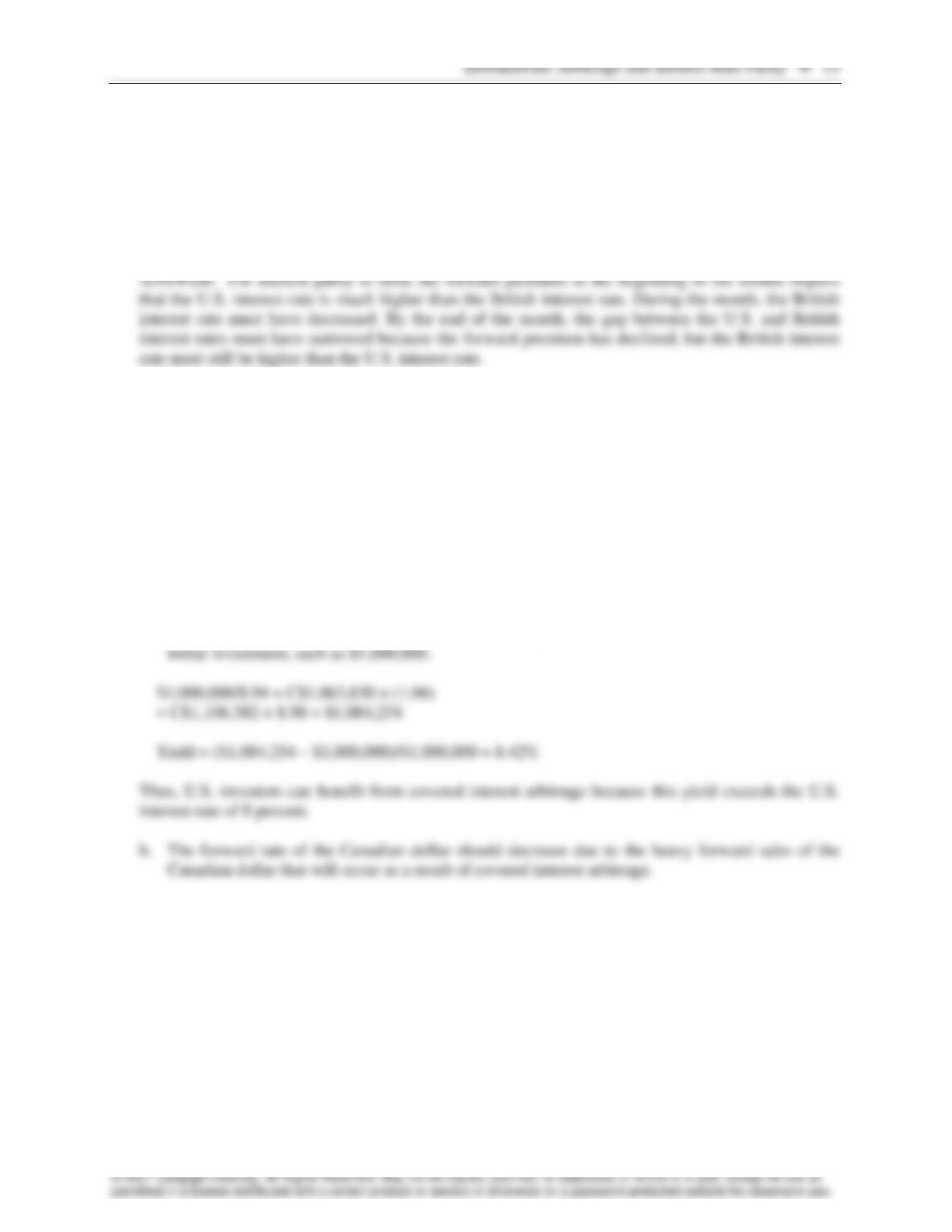
55. Forward Rate Premiums Among Maturities. Today, the annualized interest rate in the U.S. is 4% for any
debt maturity. The annualized interest rate in Australia is 4% for debt maturities of 3 months or less, is 5%
for debt maturities between 3 months and 6 months, and is 6% for debt maturities more than 6 months.
Assume that interest rate parity exists. Does the forward rate quoted today for the Australian dollar exhibit a
premium, or a discount, or does your answer vary with specific conditions? Briefly explain.
International Arbitrage and Interest Rate Parity ❖ 20
CRITICAL THINKING
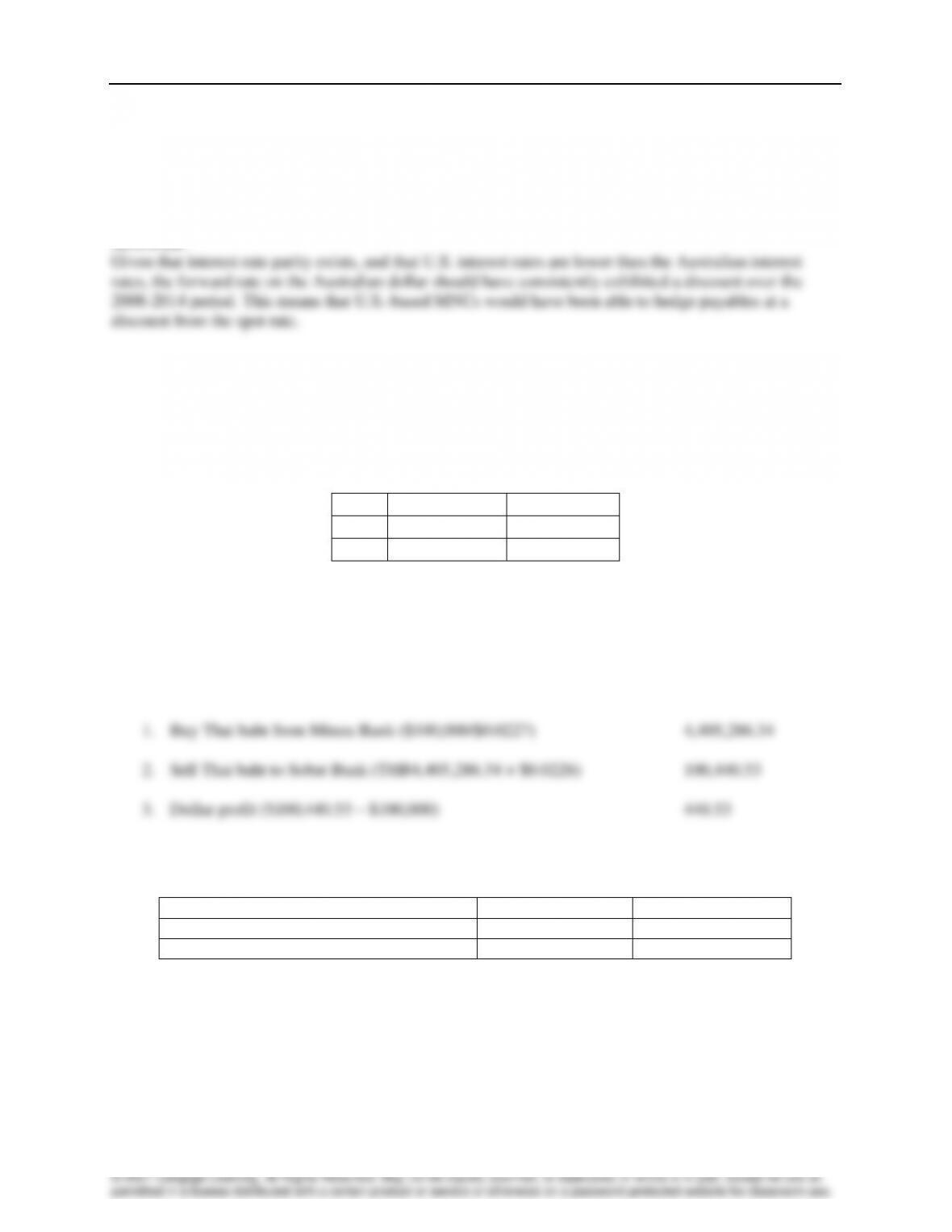
IRP Implications Since the International Credit Crisis During the period from 2008 (when the
international credit crisis occurred) and 2014, the U.S. government maintained interest rates at extremely
low levels. Assume that interest rate parity existed over that time period. Write a short essay on what the
interest rate conditions in the U.S. imply about the forward rate of the Australian dollars over this period.
ANSWER
Solution to Continuing Case Problem: Blades, Inc.
1. The first arbitrage opportunity relates to locational arbitrage. Holt has obtained spot rate quotations
from two banks in Thailand, Minzu Bank and Sobat Bank, both located in Bangkok. The bid and ask
prices of Thai baht for each bank are displayed in the table below:
Minzu Bank
Sobat Bank
Bid
$0.0224
$0.0228
Ask
$0.0227
$0.0229
Determine whether the foreign exchange quotations are appropriate. If they are not appropriate,
determine the profit you could generate by withdrawing $100,000 from Blades’ checking account and
engaging in arbitrage before the rates are adjusted.
ANSWER: Locational arbitrage is possible:
Locational Arbitrage
1. Buy Thai baht from Minzu Bank ($100,000/$0.0227)
4,405,286.34
2. Sell Thai baht to Sobat Bank (THB4,405,286.34 × $0.0228)
100,440.53
3. Dollar profit ($100,440.53 – $100,000)
440.53
2. Besides the bid and ask quotes for the Thai baht provided in the previous question, Minzu Bank has
provided the following quotations for the U.S. dollar and the Japanese yen:
Quoted Bid Price
Quoted Ask Price
Value of a Japanese yen in U.S. dollars
$0.0085
$0.0086
Value of a Thai baht in Japanese yen
¥2.69
¥2.70
Determine whether the cross exchange rate between the Thai baht and Japanese yen is appropriate. If
it is not appropriate, determine the profit you could generate for Blades Inc, by withdrawing $100,000
from Blades’ checking account and engaging in triangular arbitrage before the rates are adjusted.
International Arbitrage and Interest Rate Parity ❖ 21
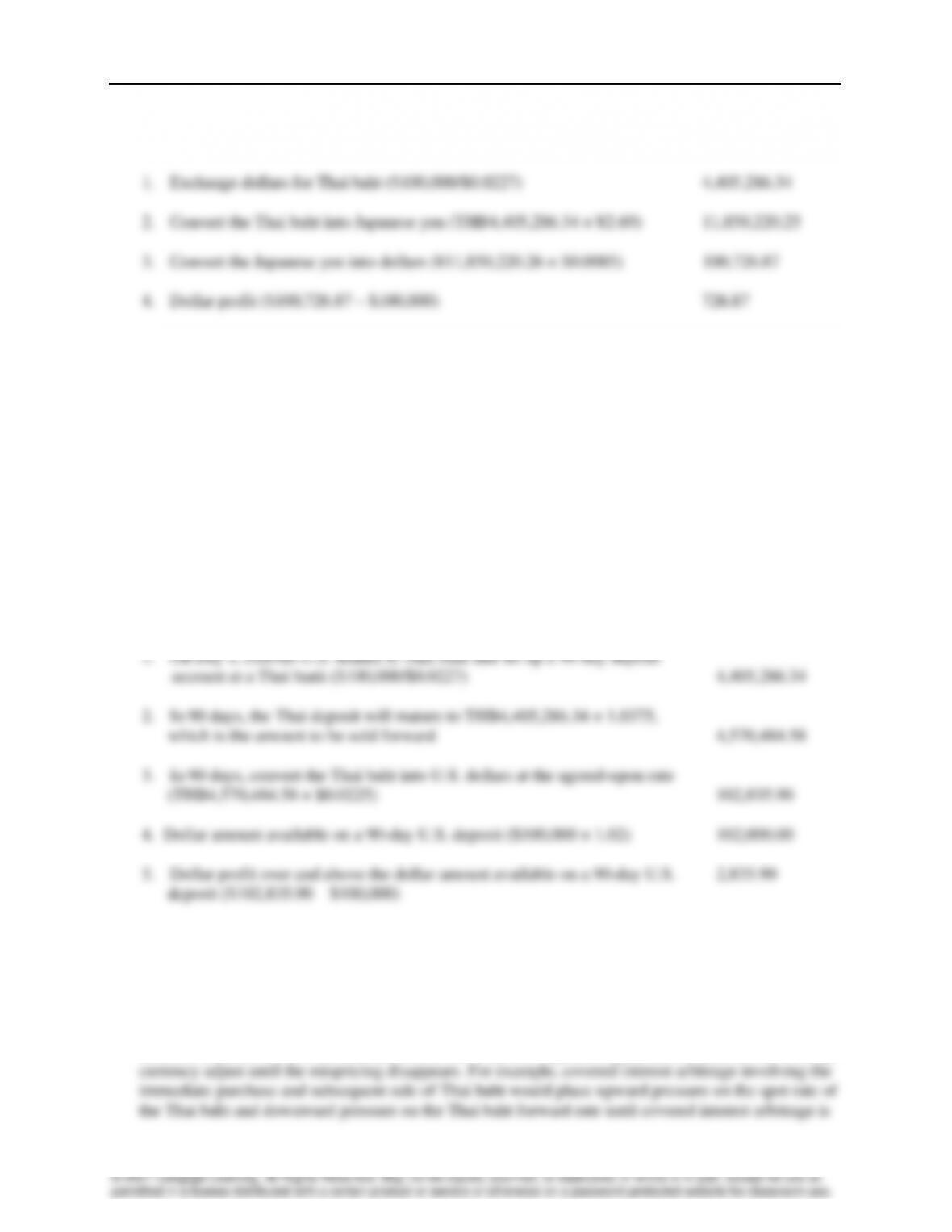
ANSWER: Triangular arbitrage is possible.
Triangular Arbitrage
1. Exchange dollars for Thai baht ($100,000/$0.0227)
4,405,286.34
2. Convert the Thai baht into Japanese yen (THB4,405,286.34 × ¥2.69)
11,850,220.25
3. Convert the Japanese yen into dollars (¥11,850,220.26 × $0.0085)
100,726.87
4. Dollar profit ($100,726.87 – $100,000)
726.87
3. Ben Holt has obtained several forward contract quotations for the Thai baht to determine whether
covered interest arbitrage may be possible. He was quoted a forward rate of $0.0225 per Thai baht for
a 90-day forward contract. The current spot rate is $0.0227. Ninety-day interest rates available to
Blades in the U.S. are 2 percent, whereas 90-day interest rates in Thailand are 3.75 percent (these
rates are not annualized). Holt is aware that covered interest arbitrage, unlike locational and triangular
arbitrage, requires an investment of funds. Thus, he would like to be able to estimate the dollar profit
resulting from arbitrage over and above the dollar amount available on a 90-day U.S. deposit.
Determine whether the forward rate is priced appropriately. If it is not priced appropriately, determine
the profit you could generate for Blades by withdrawing $100,000 from Blades’ checking account and
engaging in covered interest arbitrage. Measure the profit as the excess amount above the return you
could generate by investing in the U.S. money market.
ANSWER: Covered interest arbitrage is possible.
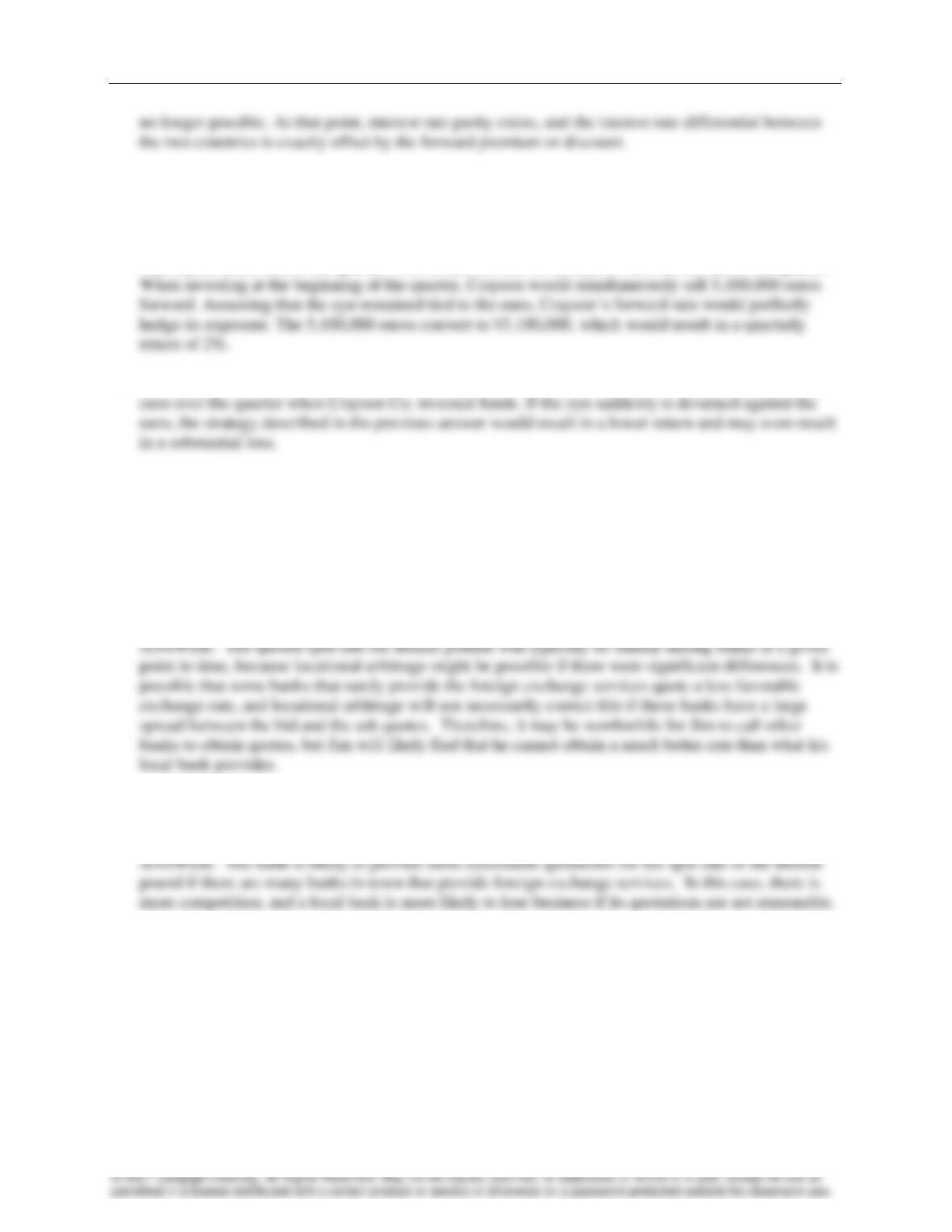
Covered Interest Arbitrage
1. On Day 1, convert U.S. dollars to Thai baht and set up a 90-day deposit
account at a Thai bank ($100,000/$0.0227)
4,405,286.34
2. In 90 days, the Thai deposit will mature to THB4,405,286.34 × 1.0375,
which is the amount to be sold forward
4,570,484.58
3. In 90 days, convert the Thai baht into U.S. dollars at the agreed-upon rate
(THB4,570,484.58 × $0.0225)
102,835.90
4. Dollar amount available on a 90-day U.S. deposit ($100,000 × 1.02)
102,000.00
5. Dollar profit over and above the dollar amount available on a 90-day U.S.
deposit ($102,835.90 – $100,000)
2,835.90
4. Why are arbitrage opportunities likely to disappear soon after they have been discovered? To
illustrate your answer, assume that covered interest arbitrage involving the immediate purchase and
forward sale of baht is possible. Discuss how the baht’s spot and forward rates would adjust until
covered interest arbitrage is no longer possible. What is the resulting equilibrium state called?
ANSWER: Arbitrage opportunities are likely to disappear soon after they have been discovered
because of market forces. Due to the actions taken by arbitrageurs, supply and demand for the foreign
International Arbitrage and Interest Rate Parity ❖ 22
© 2021 Cengage Learning. All Rights Reserved. May not be copied, scanned, or duplicated, in whole or in part, except for use as
permitted in a license distributed with a certain product or service or otherwise on a password-protected website for classroom use.
no longer possible. At that point, interest rate parity exists, and the interest rate differential between
the two countries is exactly offset by the forward premium or discount.
Solution to Supplemental Case: Crayson Co.
a. Crayson could invest its $5 million in 10 million zyn, earn 2% over the quarter, and would receive
10,200,000 at the end of the quarter. This should convert to 5,100,000 euros at the end of the quarter.
b. The strategy described in the previous answer could backfire if the zyn does not remain tied to the
Small Business Dilemma
Assessment of Prevailing Spot and Forward Rates by the Sports Exports Company
1. Do you think Jim will be able to find a bank that provides him with a more favorable spot rate than
his local bank? Explain.
2. Do you think that Jim’s bank is likely to provide more reasonable quotations for the spot rate of the
British pound if it is the only bank in town that provides foreign exchange services? Explain.
3. Jim is considering using a forward contract to hedge the anticipated receivables in pounds next
month. His local bank quoted him a spot rate of $1.65 and a one-month forward rate of $1.6435.
Before Jim decides to sell pounds one month forward, he wants to be sure that the forward rate is
reasonable, given the prevailing spot rate. A one-month Treasury security in the United States
currently offers a yield (not annualized) of 1 percent, while a one-month Treasury security in the
United Kingdom offers a yield of 1.4 percent. Do you believe that the one-month forward rate is
reasonable given the spot rate of $1.65?
International Arbitrage and Interest Rate Parity ❖ 23
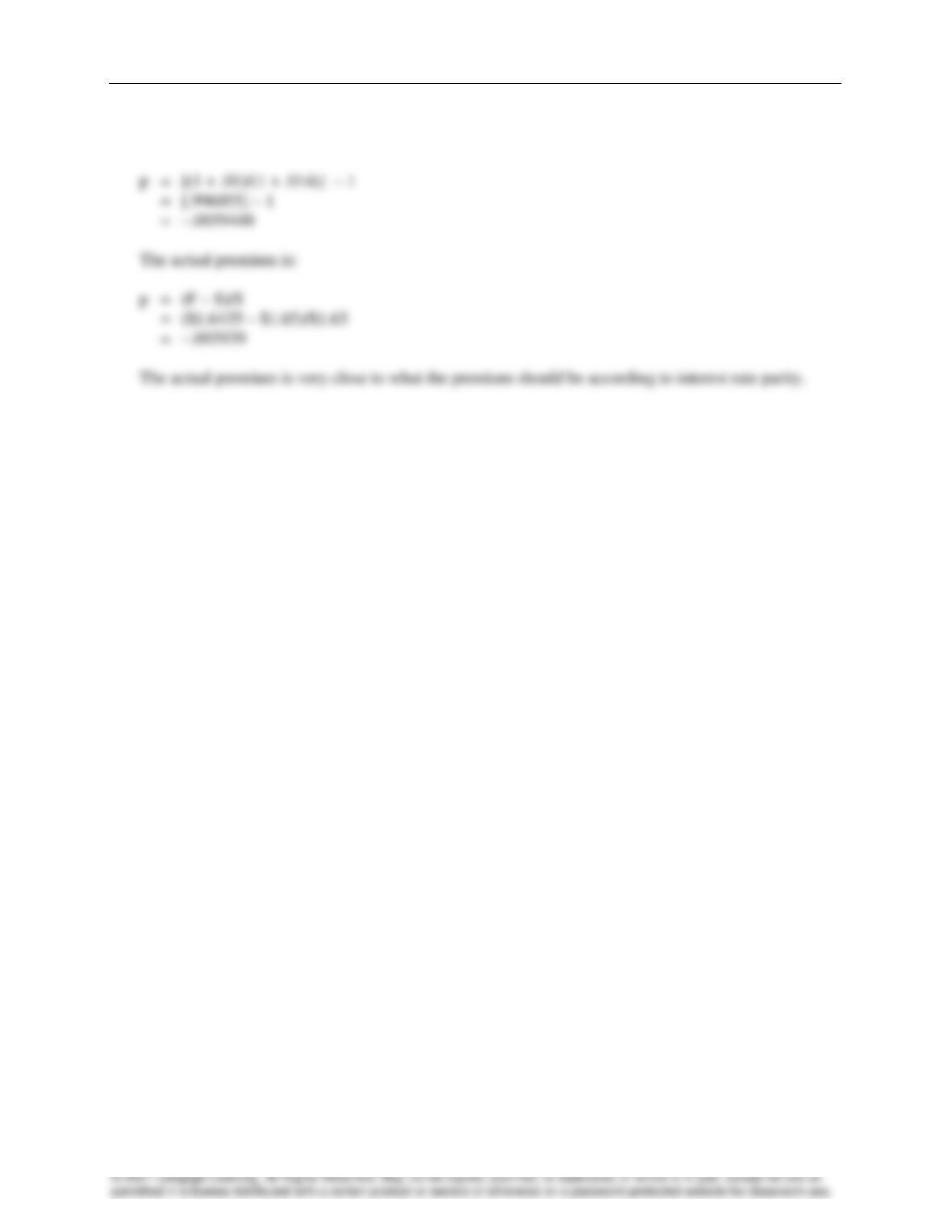
ANSWER: Yes. According to interest rate parity, the forward rate premium should be based on the
differential between interest rates: