Instructor Resource
Baack et al., International Marketing, 2e
SAGE Publishing, 2019
Review and Discussion Questions
Chapter 7: International Positioning
Review questions
1. Define product positioning.
a. Product positioning is creating a perception in the consumer’s mind regarding the
creates a unique place for the product in comparison to competitors.
2. What are the two key elements of product positioning?
a. Two key elements of product position are: (1) the way customers view the product
3. Define differentiation. What are some examples?
a. Differentiation results from emphasizing a unique benefit or component of a product
that separates it from competitors. Differentiation notes the specific benefit or
attribute that makes the product unique when compared to competitors. This
4. How does differentiation help create brand equity?
Brand equity is the unique benefits that a product enjoys due solely to its brand name.
These benefits can be created or highlighted using differentiation. The sources of
Instructor Resource
Baack et al., International Marketing, 2e
SAGE Publishing, 2019
5. Define brand parity and give an example.
Brands without points of difference or unique benefits are inclined to experience
perceptions of brand parity. Brand parity exists when brands within one product category
6. In what ways does technology influence global positioning?
a. International positioning has been strongly influenced by the development of new
technologies, some of which improve a nation’s infrastructure. One of the primary
changes has been that marketing messages transmitted in one country will be seen in
others. Television and radio signals in Italy are likely to reach Switzerland, Austria,
and France. Consequently, consistency has become a key element in successful
international product and brand positioning. Positioning statements help maintain
7. Define the country-of-origin effect.
The country-of-origin effect summarizes the response a consumer has to a product due to
the country that is the source, in the consumer’s mind, of the product. Depending on the
home country and the country being entered, the country-of–origin effect can drastically
Instructor Resource
Baack et al., International Marketing, 2e
SAGE Publishing, 2019
alter the position of the product in the minds of consumers. Country-of-origin effects
originate in four different conceptual areas
Home country – The influence of a consumer’s home country on his/her beliefs.
Origin country – The country which the consumer generally associates with a
certain product.
8. What do the terms animosity and ethnocentrism mean?
a. Ethnocentrism is the view that one’s home country is the best and that it is better than
other countries. Consumers exhibiting high levels of ethnocentrism, the attitude that
their country is better than others, pay more attention to country-of-origin labels and
are more likely to buy products produced in their home countries
9. Define nationalism. How is it different from animosity?
a. Nationalism refers to the strong pride and devotion citizens have in a country or
nation.
10. Define sovereignty.
Sovereignty means that the government has authority or control within its state. Foreign
11. What are the different country-of-origin label options?
a. Product of
b. Made in
c. Designed in
Instructor Resource
Baack et al., International Marketing, 2e
12. What are the complicating factors for identifying country-of–origin?
a. Some products are ‘produced’ or handled in many countries. This creates the
complication of which country to put on the label.
13. What is product versus product positioning?
At the most basic level, a product first competes with similar products. This is when your
14. Define product line.
A product line consists of similar products within a particular category.
15. What is product line versus product line positioning?
When companies have similar product lines they compete based on product lines versus
product line positioning. Product lines compete with depth and breadth, both of which
16. What is the difference between brand versus brand positioning and company versus
company positioning?
Brand versus brand positioning is between well-known brands with brand equity.
17. How does positioning relate to price?
Price is often used to represent price/quality inferences. The higher the price, the higher
assumed quality the product is.
Instructor Resource
Baack et al., International Marketing, 2e
SAGE Publishing, 2019
18. Describe tangible product benefits and intangible product benefits concepts.
a. Tangible product benefits are the value drawn from the physical components of the
product. Taste is a tangible benefit.
19. How do positioning maps show differentiation?
Product attributes can be used on the axes to show differences in consumers attitudes
20. What is the difference between share of mind and share of heart?
a. Share of mind refers to the product’s position in terms of brand awareness. A product
with low share of mind is not readily recalled when a consumer considers brands in a
product category. A brand with high share of mind will immediately come to mind
when a consumer thinks about the same category.
21. What are the different ways to enhance a product’s position?
a. Enhancing position involves all standard and non-traditional marketing approaches.
b. Reinforce or enhance the original position
c. Highlight a unique attribute and create a competitive advantage
d. Position yourself against your competitors
Instructor Resource
Baack et al., International Marketing, 2e
SAGE Publishing, 2019
j. Bottom-of-the-pyramid positioning
22. Define repositioning.
Repositioning is the process of changing consumer perceptions of a brand relative to
competitors. It involves a sweeping process that must be implemented at the strategic
level, thereby affecting every part of the company.
23. Define greenwashing and name the seven deadly sins of greenwashing.
a. Greenwashing is the practice where company leaders exaggerate or even fabricate the
degree of the sustainable or green activities taking place in the organization. Treating
sustainability as a fad, instead of a core value of the company, can lead to
24. What is the change in focus some companies need to make when positioning at the
bottom–of-the pyramid?
Make sure these consumers believe they can afford the product. Positioning in the
bottom–of-the pyramid involves educating consumers about the steps the company has
Instructor Resource
Baack et al., International Marketing, 2e
25. What ethical concerns does positioning present?
a. In the area of positioning, two ethical concerns have arisen. The first is the role of
positioning can play in encouraging consumption. This may drive consumers to
purchase things they do not need or to envy those who can afford the product. In
essence, positioning may be viewed as leading to envy and greed.
Discussion questions
1. There are at least six effective methods for positioning products: (1) competitors, (2) use
or application, (3) price-quality relationship, (4) product user, (5) product class, and (6)
cultural symbol. Identify two brands associated with the following countries: United States,
Mexico, United Kingdom, Japan and Holland.
Identify the positioning strategy each uses. Then, suggest an alternative strategy.
United States – Southwest Airlines and Sevens Jeans
Instructor Resource
Baack et al., International Marketing, 2e
Mexico – Corona Beer and Patron Tequila
o Corona is positioned using use or application – it’s positioned the relaxation or
vacation beer. They could try to position based upon the product user.
o Patron Tequila is a premium tequila positioned using the product user. They could
try to position it based upon the price–quality relationship.
United Kingdom – Burberry and H&M clothing store
Japan – Toyota and Lexus
o Toyota is positions as an affordable quality option (price-quality relationship).
They could position based on attributes.
o Lexus is positions as top quality, luxury option (price-quality relationship). They
could also position based on attributes.
Holland – Grolsh beer and Senseo coffee machine
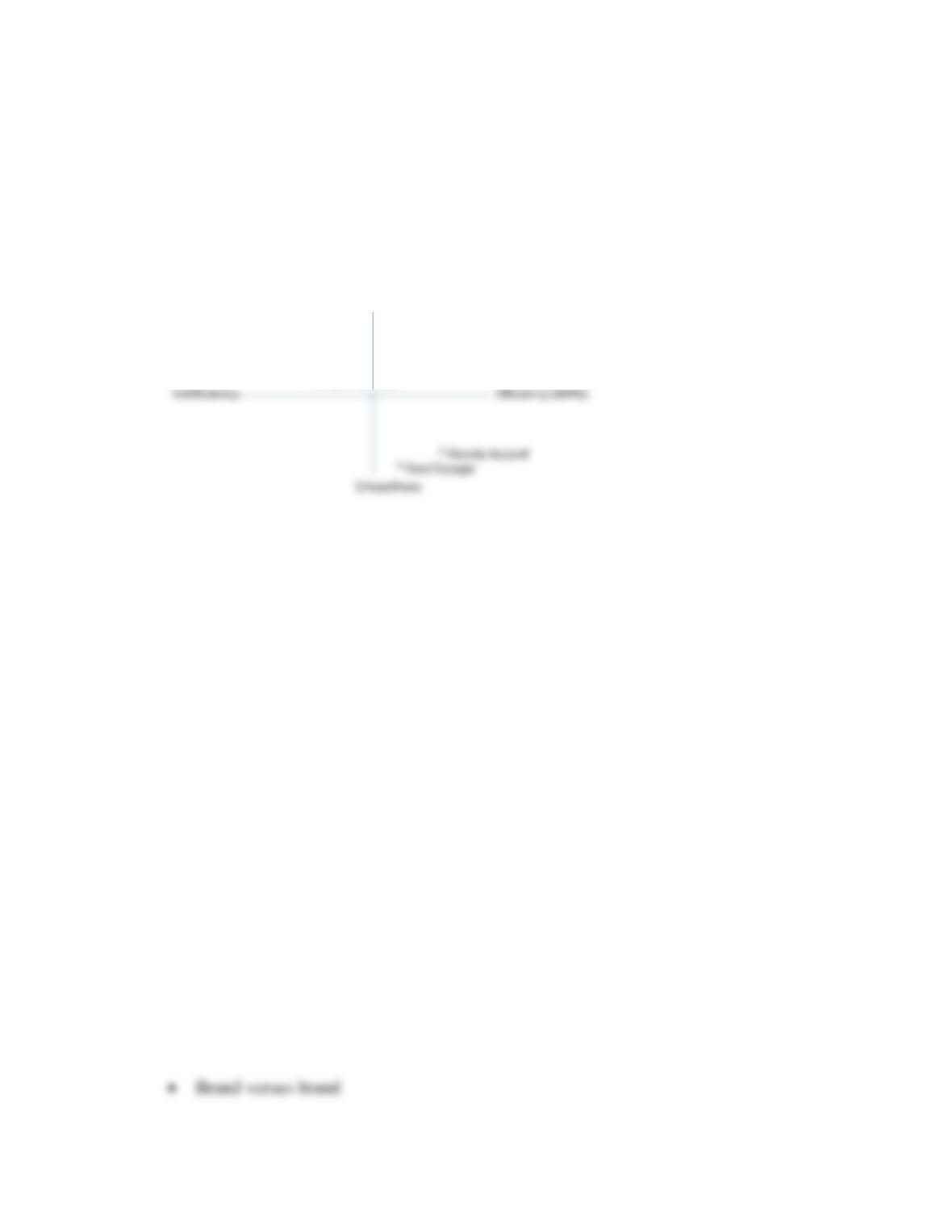
2. Choose a product category and make a list of five brands, three of which are not made in
the United States. Identify two attributes that are common across these five brands. Using
the perspective of a college student (meaning you are part of the target market), create a
positioning map for these brands. Then interpret the map.
Instructor Resource
Baack et al., International Marketing, 2e
SAGE Publishing, 2019
Automobiles. Audi A8, Ford Escape, Dodge Durango, Mini Cooper, Honda
Accord.
Coolness
* Audi A8
* Dodge Durango
* Mini Cooper
3. Identify two products that compete at each of the following levels, in at least two
countries besides the United States. Explain how the competition might influence
positioning strategies.
Product versus product
o Soy sauce. Here products have tried to position based upon different attributes such
as low sodium varieties.
o Automobiles. Car makers often try to position based on price quality relationships.
Product line versus product line
o Sodas. Soda makers hope that if you like one of their sodas you will try more – they
position based on attributes – brand equity.
o Potato chips – same as sodas.
Instructor Resource
Baack et al., International Marketing, 2e
4. Ethnocentrism, animosity, nationalism, and religiosity all influence consumer perceptions
of products. Consider how these factors influence positioning for the following brands
when entering France, Thailand, and Saudi Arabia:
Royal Dutch Shell – the oil and gas company. Dutch and registered in the UK.
o France and Thailand– ethnocentrism shouldn’t be a problem, oil and gas companies
often create animosity so they should try to position themselves as a responsible
gas company.
o Saudi Arabia – Shell should be most concerned with ethnocentrism, nationality and
animosity because they are an outside gas company – they should not position
themselves against their competitors.
Instructor Resource
Baack et al., International Marketing, 2e
SAGE Publishing, 2019
Carrefour
o France – Is a French company – they will benefit from nationalism and should
position themselves using this advantage.
o Thailand and Saudi Arabia – may face ethnocentrism, animosity and nationalism.
They should carry local products in these markets. Position themselves based on
price-quality.
5. Visit a local retailer and find five products with country–of-origin labels. What countries
are they from? How does country-of-origin relate to product attributes or sophistication?
How does it influence the position for the product?
I went to a local store.
I found a toy labeled Made in China – this makes me think the toy is cheap and not
very sophisticated. This toy was positioned more on price than quality.
I found lettuce that said grown in Mexico. This label made me think to be careful to
wash the lettuce carefully, but did not relate to product attributes or sophistication. This
was the only type of lettuce available, so it didn’t influence the position for the product.

Instructor Resource
Baack et al., International Marketing, 2e
SAGE Publishing, 2019