Chapter 6: Culture and Worldview
Chapter Overview
Most of us can articulate what our belief system consists of—whether it is religious, secular,
philosophical, or something else—we all have a motivation for living, which helps us get up
each morning, go to work, and then guides us throughout the day. In this chapter, we will
examine the importance of worldview, which asks basic questions about life in terms of reality,
human nature, truth, and values.
LEARNING OBJECTIVE
Chapter 6: Culture and Worldview returns to the discussion of attitudes, beliefs, and values by
looking at the concept of worldview.
KEY TAKEAWAYS
• Worldviews can be invisible forces that impact our lives and professions.
• Explain how culture influences the way individuals view the world.
LEADERSHIP APPLICATIONS
• You will be challenged to consider how to adapt your leadership/communication style to
interact more effectively with someone with whom you work. You will be able to consider:
Introduction
• Nike Air Bakin’ goes up in flames.
Opening Scenario
Nike Air Bakin’ goes up in flames.
• In 1997 Nike created a design to go on the back of one of its basketball shoes—the Air
Bakin’—which were fiery flames on the back of the shoe that said, “Air.”
Discussion Questions:
1. Why didn’t Nike do its due diligence? How could this happen to a multinational
company?
2. Why did Nike “not get it right” after supposedly fixing the design?
3. Was the Muslim community upset unnecessarily?
4. What lessons can we learn about intercultural communication from this example?
Worldview
• Definition
Worldview
Definition
A worldview is basically a person’s beliefs about life and the universe—one’s core assumptions
of what is.
• All worldviews attempt to answer four basic questions about humans and the universe:
o What is reality?
o Who is man?
o What is truth?
o What values are important?
The word “worldview” comes from the German word “weltanschauung,” which is “welt”
(world) + “anschauung” (perception, or view).
Value Orientations
Kluckhohn & Strodtbeck Orientations
• Much of the field of intercultural communication comes from anthropology.
• Clyde Kluckhohn and Frederick Strodtbeck were anthropologists who tried to make
sense of human worldview via their work in the Southwestern US in the 1940s and
1950s through the Harvard Values Project.
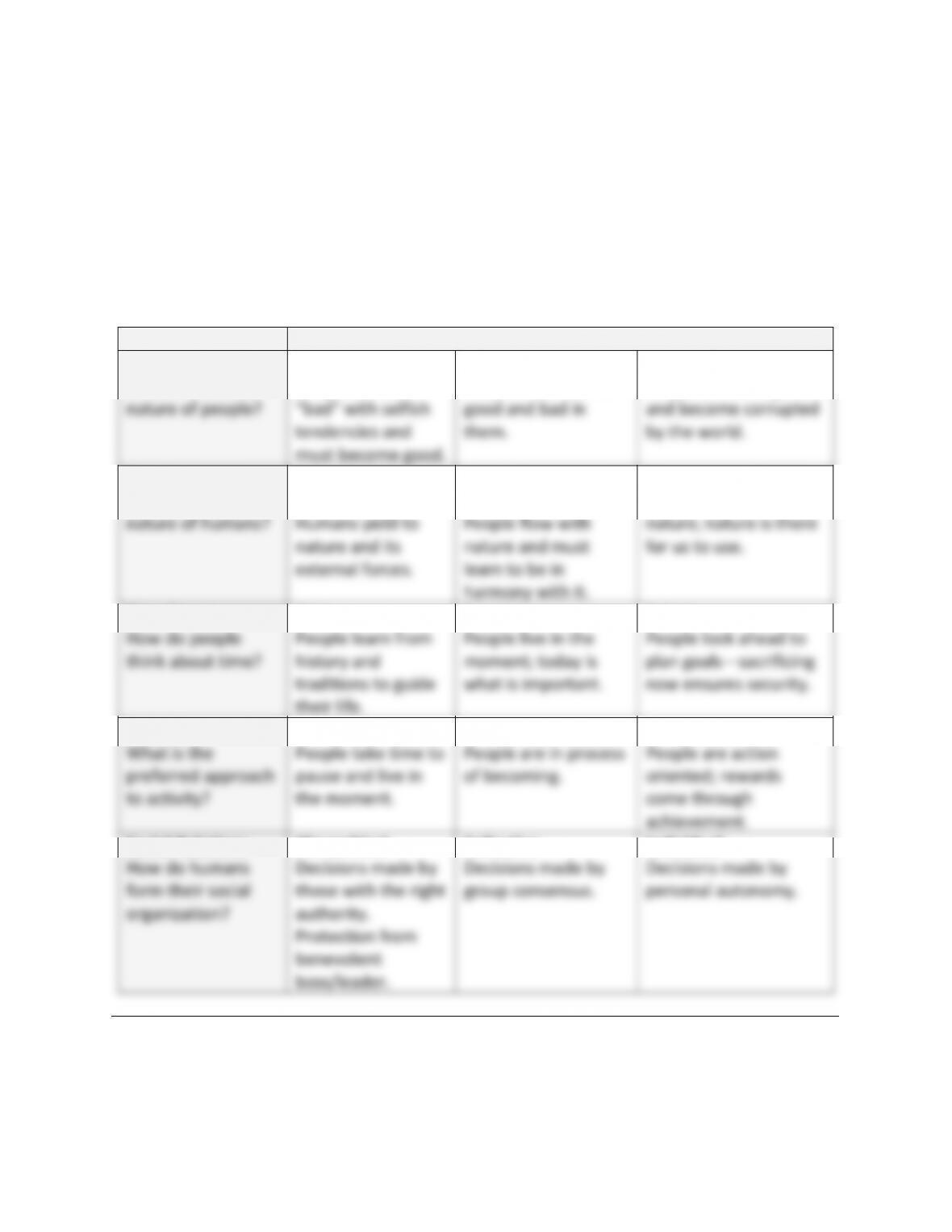
Value Orientations Model
• Kluckhohn & Strodtbeck orientations
• Examples of value orientations
Kluckhohn & Strodtbeck Value Orientations Model
Adapted from Ting-Toomey, S. 1999. Communicating across cultures. New York: Guillford Press.
ORIENTATION
RANGE
Human Nature
What is the basic
nature of people?
Evil
People are born
“bad” with selfish
tendencies and
must become good.
Mixed
People have a bit of
good and bad in
them.
Good
People are born good
and become corrupted
by the world.
People and Nature
What is the basic
nature of humans?
Subordination to
Nature
Humans yield to
nature and its
external forces.
Live in Harmony with
Nature
People flow with
nature and must
learn to be in
harmony with it.
Mastery over Nature
People try to control
nature; nature is there
for us to use.
Time Sense
How do people
think about time?
Past
People learn from
history and
traditions to guide
their life.
Present
People live in the
moment; today is
what is important.
Future
People look ahead to
plan goals—sacrificing
now ensures security.
Activity
What is the
preferred approach
to activity?
Being
People take time to
pause and live in
the moment.
Becoming
People are in process
of becoming.
Doing
People are action
oriented; rewards
come through
achievement.
Social Relations
How do humans
form their social
organization?
Hierarchical
Decisions made by
those with the right
authority.
Protection from
benevolent
boss/leader.
Collective
Decisions made by
group consensus.
Individual
Decisions made by
personal autonomy.
Overview of World Religions and Belief Systems
• Hinduism

• Buddhism
• Judaism
• Christianity
• Islam
• Other religions and belief systems
Overview of World Religions and Belief Systems
How many religions or belief systems exist in the world today?
There are anywhere between 4,000–6,000.
A 2010 Pew Research Center study examined the size of major religious and non-religious
groups in the world based upon global population and came up with the following:
• Christians: 2.2 billion (32%)
• Muslims: 1.6 billion (23%)
• Non-religious affiliations: 1.1 billion (16%)
• Hindus: 1 billion (15%)
• Buddhists: 500 million (7%)
• Folk/traditional religions: 400 million (6%), including African traditional religions,
Chinese folk religions, Native Amrican religions, Australian aboriginal religions
• Other religions: 58 million (1%), including Baha’i, Jainism, Sikhism, Shintoism, Taoism
Zoroastrianism.
• Jews: 14 million (0.2%)
For Discussion
How might religions be analyzed according to the Kluckhohn-Strodtbeck Model?
See the Big Religions Chart:
Summary Table of World Religions
Canadian Ecumenical Foundation:
————–——–——–—————–——–—–——————–—————-——————-——
Discussion—Have you ever thought about this?
What Is: Islam, Muslim, Arab, Arabic Speaker?
• Islam is a religion.
• A Muslim is a person who follows the religion of Islam.
Perception and Culture
• The science of perception
• Culture’s influence on perception
• Games of perception
• Food and perception
Perception and Culture
The Science of Perception
Perception is the neural process involving how our brains select, evaluate, and organize stimuli,
thus enabling us to experience the world around us.
Culture’s Influence on Perception
Psychologists also tell us that culture influences our perception.

Figure/Ground (Gestalt) Theory
• This is the Figure-Ground Perception Theory, (also known as the Gestalt Theory: the
whole is more (or different) than the sum of its parts.
• Gestalt comes from German meaning “form” or “shape.”
Discussion: What are other images that you have seen regarding perception?
Public Domain Images:
Stereotypes and Mental Representations
• Definition of stereotype
• Prototypes
• Stereotypes and generalizations
• Sophisticated stereotypes
Mental Representations
Mental representations (schema) come from the field of psychology.
• Cognitive psychologists tell us that this same categorizing occurs when we encounter a
new culture.
• We create mental categories, called cognitive maps, which help us categorize what is
If we couldn’t make generalizations and put similar items into categories, we couldn’t make
sense of any unfamiliar subject.

Definition of Stereotype
The concept of a stereotype comes from the historical development in printing where little
metal pieces called “type” are set together in a frame or mold, and once ink is applied, the type
is identically reproduced in another frame.
• The definition has come to mean a fixed or rigid perception of something that does not
Prototypes
Prototypes: models that are not rigid.
• They are also mental representations based on general characteristics but are NOT fixed
Stereotypes and Generalizations
• A stereotype is a belief about a person or group that puts everyone into a category.
o When you make a stereotype, you tend to reject contradictory information by
using selective perception and refusing to change your attitude.
• A generalization is an idea that has a general rather than specific application that is a
hypothesis to be tested and observed.
o You analyze the data and constantly test your ideas by being open, curious, and
Universalism and Particularism
• Definitions
• Example
Universalism and Particularism
Universalism: follow the letter of the law.
Particularism: bend the law based on circumstances.
Fons Trompenaars:
Organizational behavior expert with a PhD from Wharton, a highly respected cross-cultural
management consultant, and author of the popular book Riding the Waves of Culture:
Understanding Cultural Diversity in Business.
He describes Universalism Particularism through this story:
“You are in a car with a friend who is driving. Your friend hits a pedestrian who
was walking on the street. You know that your friend was going 50/80 mph/kph
This is a dilemma:
• Do you stay loyal to the universals of not lying under oath?
• Are you loyal to the particulars of your friend? Dilemmas force us to embrace seemingly
contradictory values while aiming for long-term goals.
Trompenaars says, “Once you become aware of cultural differences, you see that everything is
one big dilemma.
Characteristics of Universalism and Particularism
Universalism
Strategies
Particularism
Strategies
Rules or laws that
can be applied to
everyone.
Explain that you are
using an objective
process to others.
Emphasis is placed on
friendships. Friends will
look at the situation to
determine what is right
or ethically acceptable.
Take time to build
relationships, slowly
and over time.
Agreements and
contracts are used
as the basis for
doing business.
Provide clear
instructions
regarding your
expectations of all
involved.
Deals are made based
upon friendships;
agreements are
changeable.
Be flexible with
instructions and be
prepared to make
compromises.
Rules are used to
determine what is
right; contracts
should not be
altered.
Be consistent by
keeping promises
and giving people
adequate time in
their decision-
making.
Different people hold
different views about
reality.
Respect the needs of
others based upon
your growing
relationship and
knowledge gained.
Examples
In universalistic cultures people place a strong value on laws, rules, and obligations and put
rules before friendships.
In particularistic cultures people put the relationship before the rules, believing that each
circumstance and relationship determines how one should behave.
Discussion: Does this mean that particularistic cultures never use contracts?
Summary
This chapter explained how everyone has a worldview or the vantage point to survey her or his
world.
• As we try to make sense of the world, each of us uses the process of perception to make
sense of the external stimuli coming at all five senses.
• We take in these stimuli, process them, and create mental representations, or schema,
***
CASE: Nike Air Bakins’
ACTIVITY: The Parable Exercise