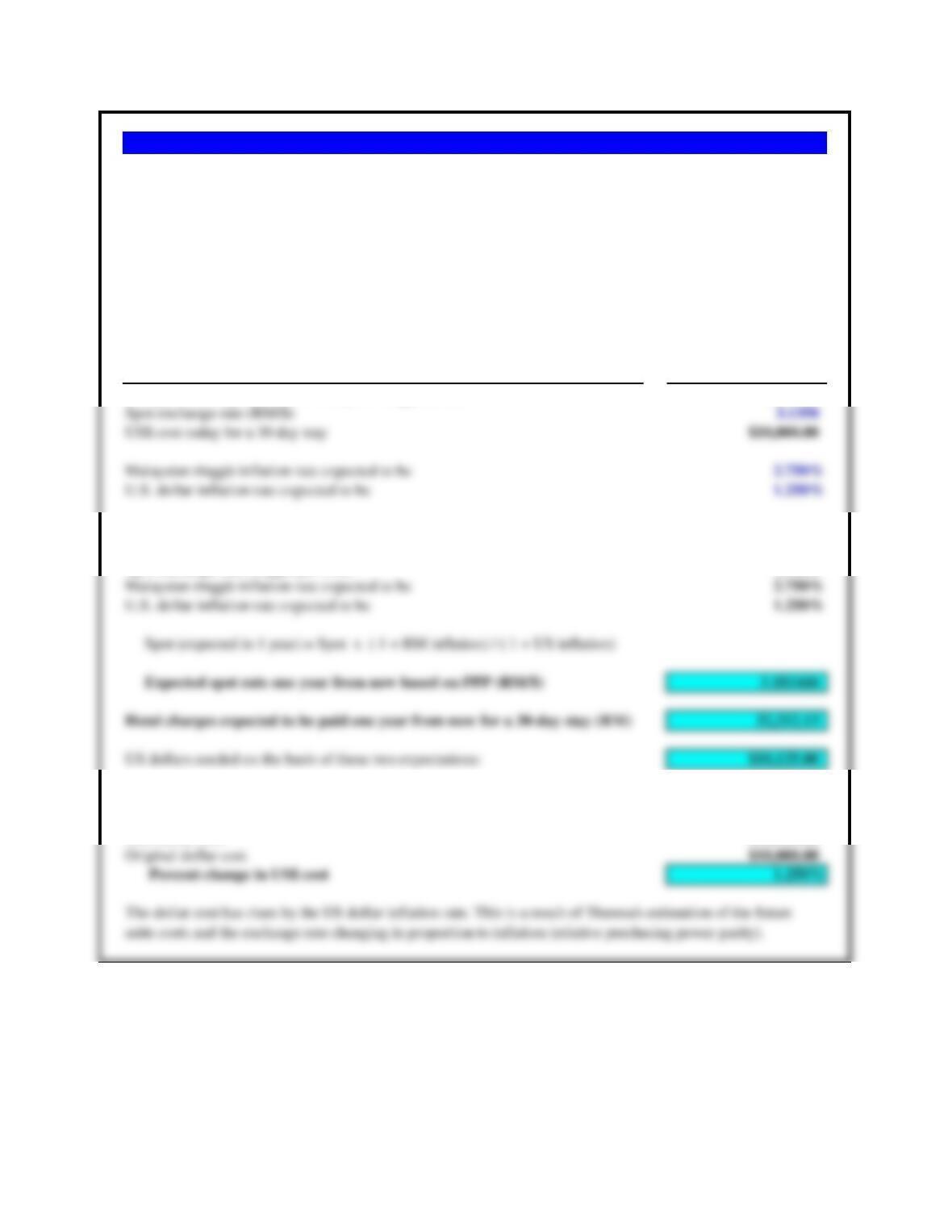
a. How many dollars might Theresa expect to need one year hence to pay for her 30-day vacation?
b. By what percent has the dollar cost gone up? Why?
Assumptions Value
Charge for suite plus meals in Malaysian ringgit (RM)
1,045.00
a. How many dollars might you expecte to need one year hence for your 30-day vacation?
Spot exchange rate (ringgit per US$)
3.1350
Expected spot rate one year from now based on PPP (RM/$) 3.181444
Hotel charges expected to be paid one year from now for a 30-day stay (RM) 32,212.13
$10,125.00
b. By what percent has the dollar cost gone up? Why?
New dollar cost
$10,125.00
$10,000.00
Problem 6.1 Pulau Penang Island Resort
Theresa Nunn is planning a 30-day vacation on Pulau Penang, Malaysia, one year from now. The present charge
for a luxury suite plus meals in Malaysian ringgit (RM) is RM1,045/day. The Malaysian ringgit presently trades
at RM3.1350/$. She figures out the dollar cost today for a 30-day stay would be $10,000. The hotel informed
her that any increase in its room charges will be limited to any increase in the Malaysian cost of living.
Malaysian inflation is expected to be 2.75% per annum, while U.S. inflation is expected to be only 1.25%.
$10,000.00
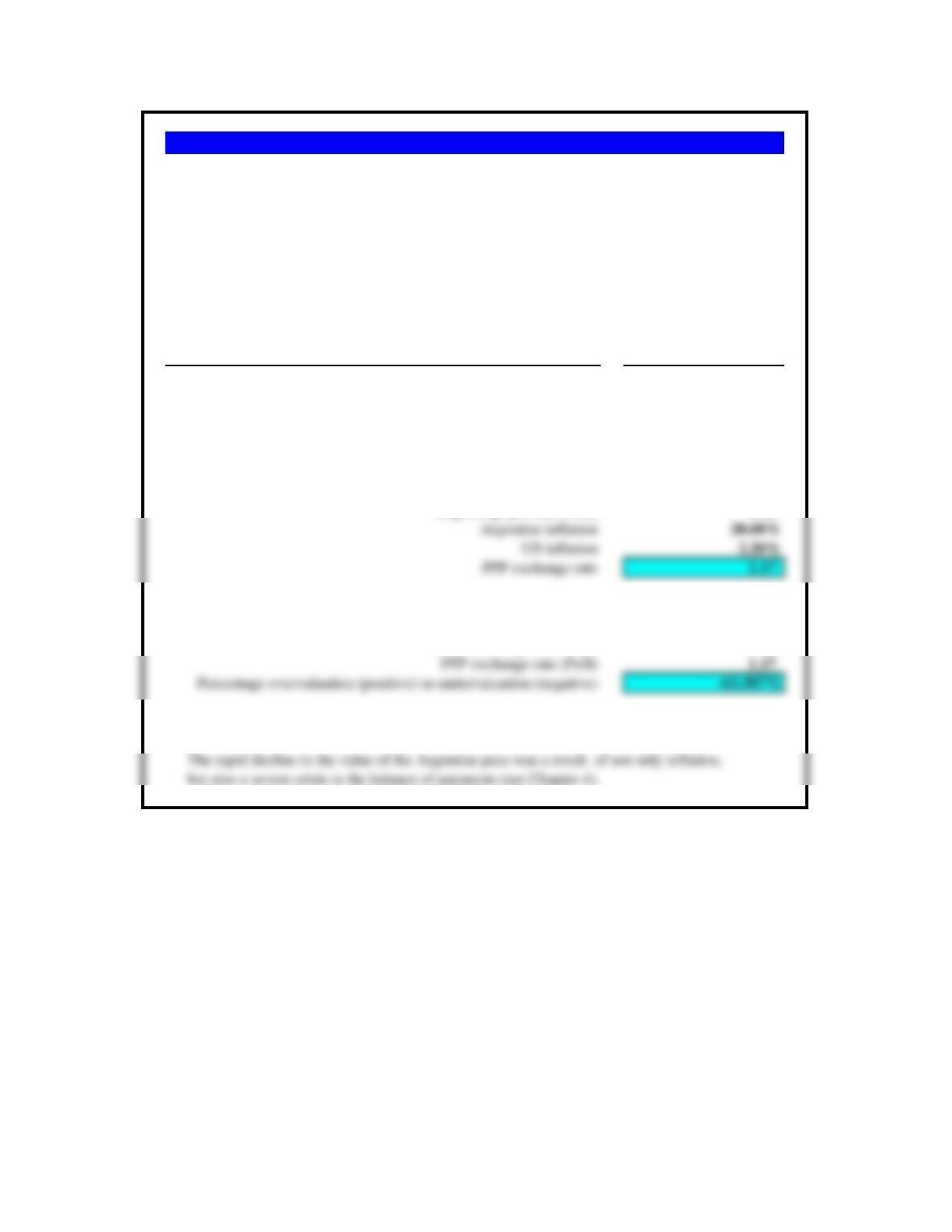
a. What should have been the exchange rate in January 2003 if PPP held?
b. By what percentage was the Argentine peso undervalued on an annualized basis?
c. What were the probable causes of undervaluation?
Assumptions Value
Spot exchange rate, fixed peg, early January 2002 (Ps/$)
1.0000
Spot exchange rate, January 29, 2003 (Ps/$)
3.2000
US inflation for year (per annum)
2.20%
Argentine inflation for year (per annum)
20.00%
a. What should have been the exchange rate in January 2003 if PPP held?
Beginning spot rate (Ps/$)
1.00
b. By what percentage was the Argentine peso undervalued on an annulized basis?
Actual exchange rate (Ps/$)
3.20
1.17
c. What were the probable causes of undervaluation?
Problem 6.2 Argentine Tears
The Argentine peso was fixed through a currency board at Ps1.00/$ throughout the 1990s. In
January 2002 the Argentine peso was floated. On January 29, 2003 it was trading at Ps3.20/$.
During that one year period Argentina’s inflation rate was 20% on an annualized basis. Inflation in
the United States during that same period was 2.2% annualized.
1.17
Assumptions Value
Forecast annual rate of inflation for Japan 1.100%
Forecast annual rate of inflation for United States 5.900%
a.
↕ ↕ ↕
↕
↕ ↕ ↕
↕ ↕ ↕
↕
Interest rate ↔ ↔ Difference in nominal ↔ ↔ Fisher
parity (D) interest rates effect (B)
-4.8%
(higher in United States)
Forcasted change in exchange rates
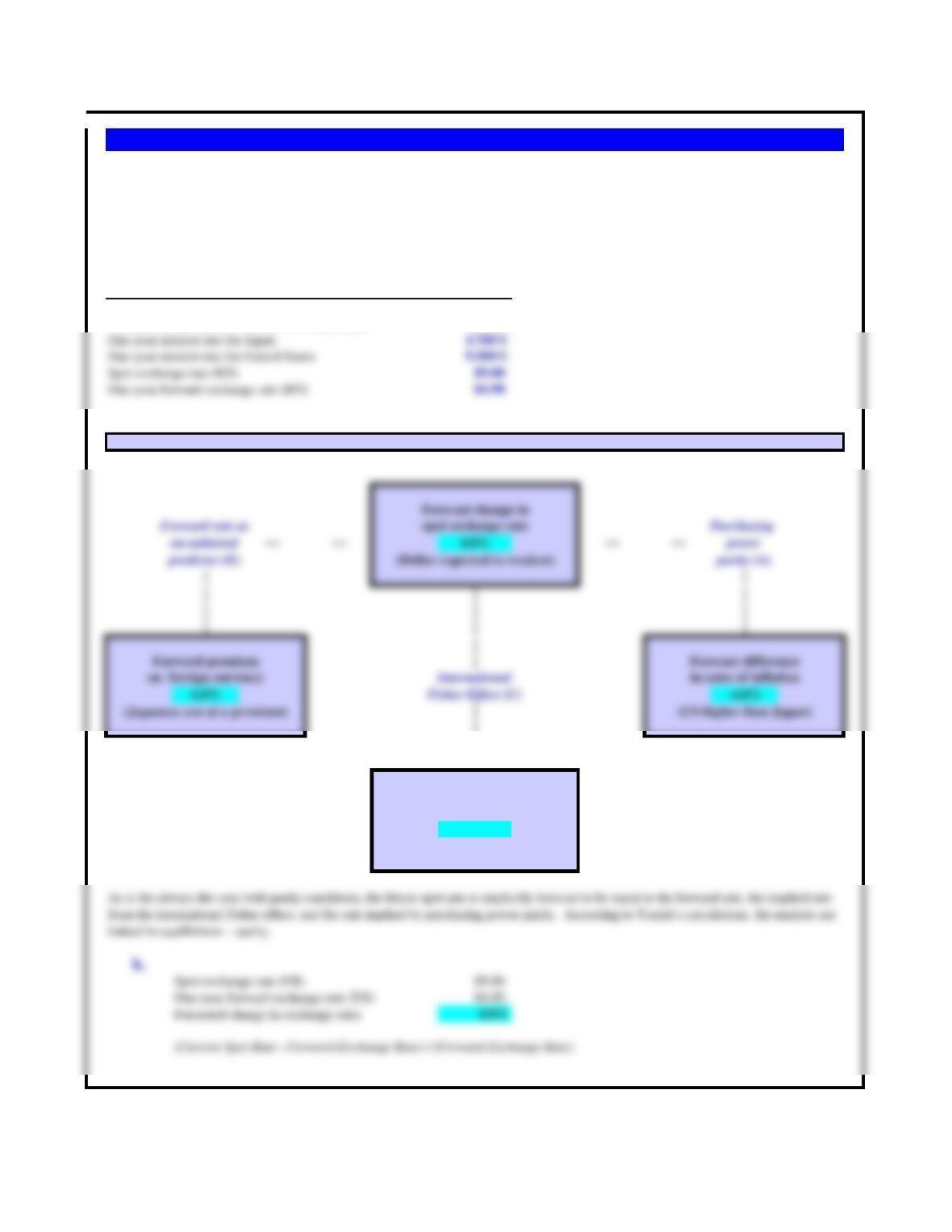
Problem 6.3 Derek Tosh and Yen-Dollar Parity
Approximate Form
Derek Tosh is attempting to determine whether US/Japanese financial conditions are at parity. The current spot rate is a flat ¥89.00/$,
while the 360-day forward rate is ¥84.90/$. Forecast inflation is 1.100% for Japan, and 5.900% for the US. The 360-day euro-yen
deposit rate is 4.700%, and the 360-day euro-dollar deposit rate is 9.500%.
a. Diagram and calculate whether international parity conditions hold between Japan and the United States.
b. Find the forecasted change in the Japanese yes/U.S. dollar (¥/$) exchange rate one year from now.
One-year interest rate for Japan 4.700%
One-year interest rate for United States 9.500%
Spot exchange rate (¥/$) 89.00
One-year forward exchange rate (¥/$) 84.90
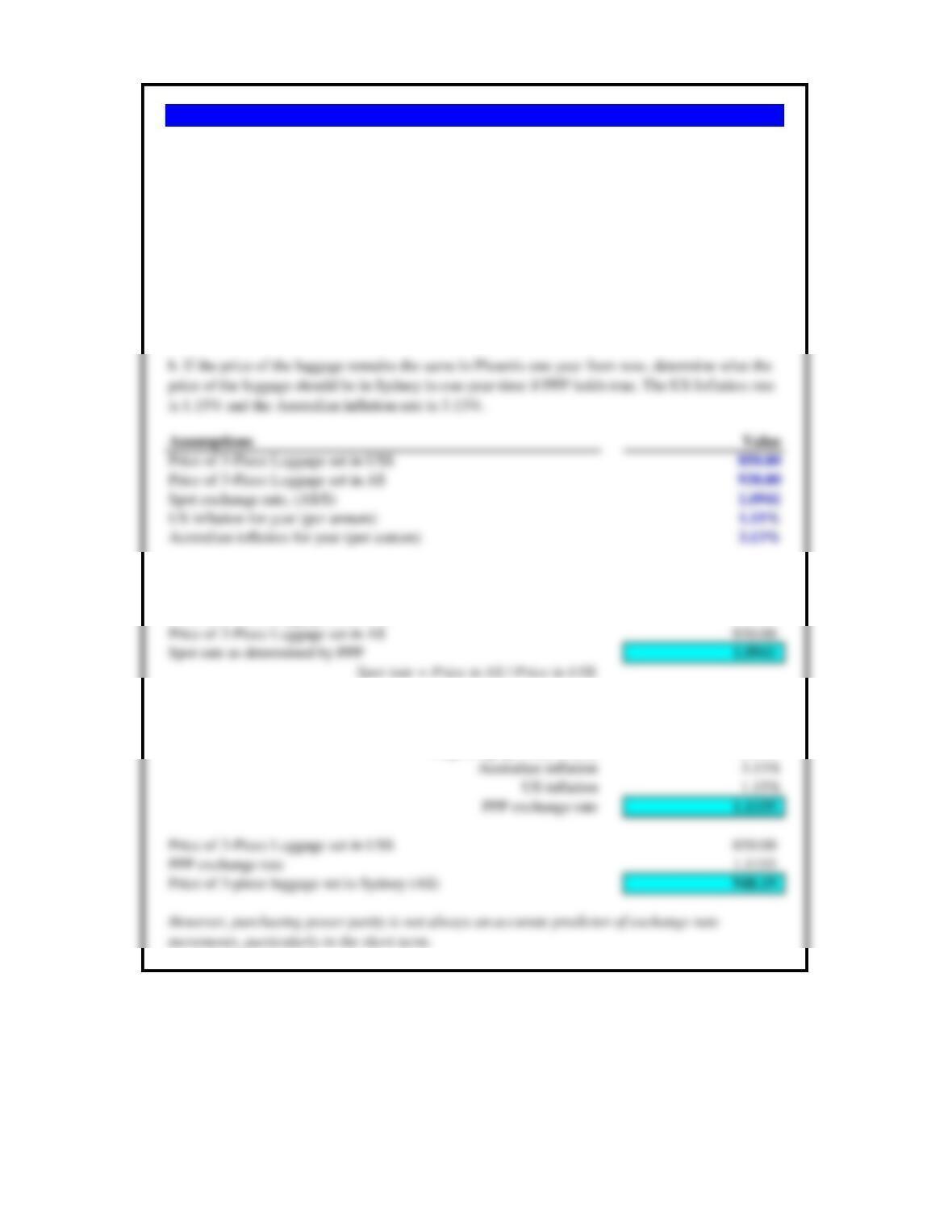
a. Is the spot rate accurate given both luggage prices?
Price of 3-Piece Luggage set in US$ 850.00
b. What should be the price of the luggage set in A$ in 1-year if PPP holds?
Beginning spot rate (A$/$) 1.0941
Problem 6.4 Sydney to Phoenix
Terry Lamoreaux has homes in both Sydney, Australia and Phoenix, United States. He travels
between the two cities at least twice a year. Because of his frequent trips he wants to buy some
new, high quality luggage. He’s done his research and has decided to go with a Briggs & Riley
brand three-piece luggage set. There are retails stores in both Phoenix and Sydney. Terry was a
finance major and wants to use purchasing power parity to determine if he is paying the same price
no matter where he makes his purcahse.
a. If the price of the 3-piece luggage set in Phoenix is $850 and the price of the same 3-piece set in
Sydney is $930, using purchasing power parity, is the price of the luggage truly equal if the spot
rate is A$1.0941/$?
Assumptions Value
Spot exchange rate (Kn/$)
5.6288
Problem 6.5 Starbucks in Croatia
Starbucks opened its first store in Zagreb, Croatia in October 2010. The price of a tall vanilla latte
in Zagreb is 25.70kn. In New York City, the price of a tall vanilla latte is $2.65. The exchange
rate bewteen Croatian kunas (kn) and U.S. dollars is kn5.6288/$. According to purchasing power
parity, is the Croatian kuna overvalued or undervalued?
a. What was the export price for the Corolla at the beginning of the year expressed in U.S. dollars?
b. Assuming purchasing power parity holds, what should the exchange rate be at the end of the year?
c. Assuming 100% pass-through of exchange rate, what will the dollar price of a Corolla be at the end of the year?
d. Assuming 75% pass-through, what will the dollar price of a Corolla be at the end of the year?
Steps Value
Initial spot exchange rate (¥/$)
87.60
Initial price of a Toyota Corolla (¥)
2,150,000
Expected US dollar inflation rate for the coming year
2.200%
Expected Japanese yen inflation rate for the coming year
0.000%
Desired rate of pass through by Toyota
75.000%
a. What was the export price for the Corolla at the beginning of the year?
Year-beginning price of an Corolla (¥)
2,150,000
b. What is the expected spot rate at the end of the year assuming PPP?
Initial spot rate (¥/$)
87.60
85.71
c. Assuming complete pass through, what will the price be in US$ in one year?
Price of Corolla at beginning of year (¥)
2,150,000
2,150,000
85.71
d. Assuming partial pass through, what will the price be in US$ in one year?
Price of Corolla at end of year (¥)
2,150,000
Problem 6.6 Corolla Exports and Pass-Through
Assume that the export price of a Toyota Corolla from Osaka, Japan is ¥2,150,000. The exchange rate is ¥87.60/$. The
forecast rate of inflation in the United States is 2.2% per year and is 0.0% per year in Japan. Use this data to answer the
following questions on exchange rate pass through.
87.60
Value Yen Equivalent
Arbitrage funds available $5,000,000 593,000,000
Spot rate (¥/$) 118.60
Difference in interest rates ( i ¥ – i $) -1.400%
Forward premium on the yen 1.358%
CIA profit potential -0.042%
U.S. dollar interest rate (180 days)
4.800%
5,000,000$ → → 1.0240 → → 5,120,000$
↑ ↓
↑ ↓
↑ ↓
↑ ↓
↑ ↓
↑ ↓
3.400%
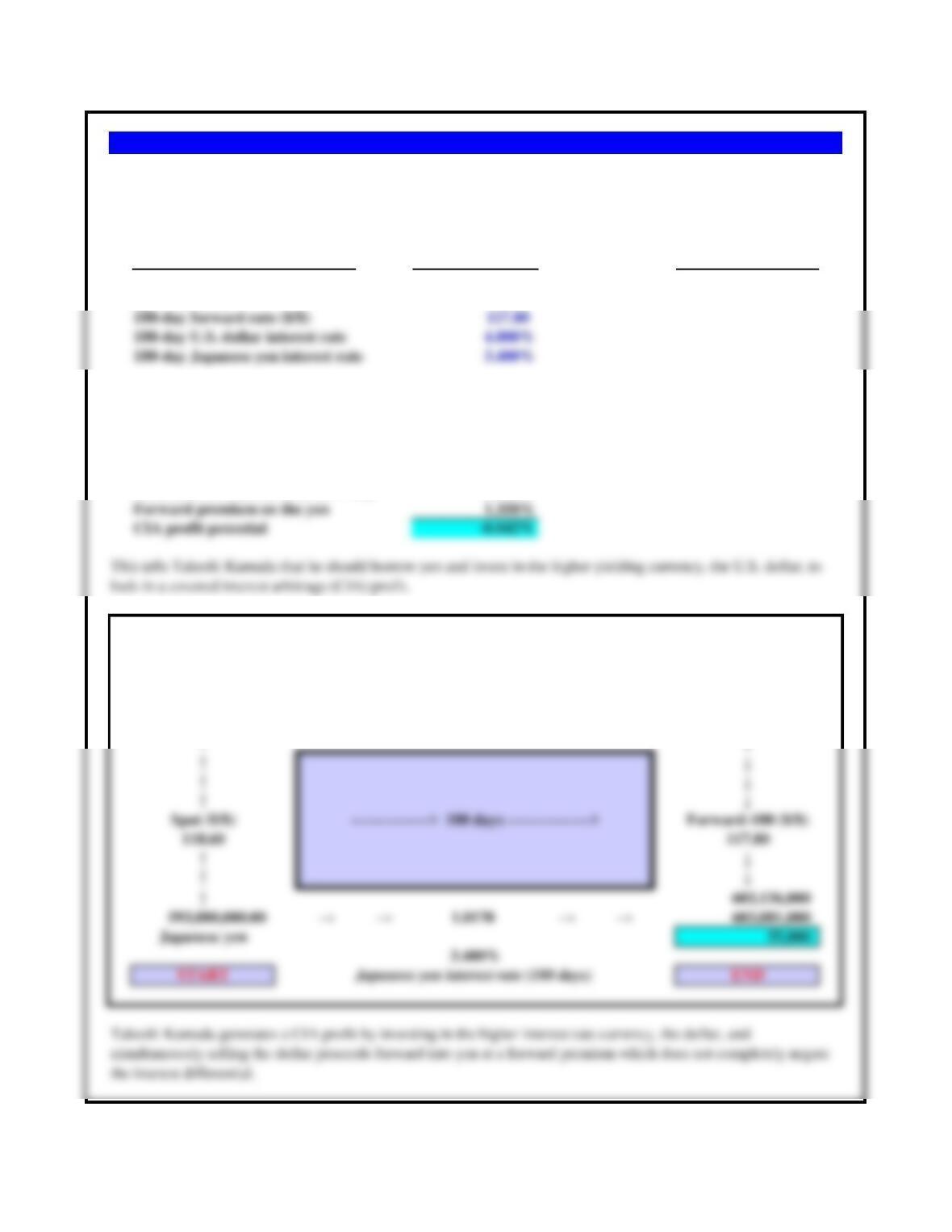
Problem 6.7 Takeshi Kamada — CIA Japan (A)
Assumptions
Arbitrage Rule of Thumb: If the difference in interest rates is greater than the forward premium/discount, or
expected change in the spot rate for UIA, invest in the higher interest yielding currency. If the difference in interest
rates is less than the forward premium (or expected change in the spot rate), invest in the lower yielding currency.
Takeshi Kamada, a foreign exchange trader at Credit Suisse (Tokyo), is exploring covered interest arbitrage
possibilities. He wants to invest $5,000,000 or its yen equivalent, in a covered interest arbitrage between U.S. dollars
and Japanese yen. He faced the following exchange rate and interest rate quotes.
180-day forward rate (¥/$) 117.80
180-day U.S. dollar interest rate 4.800%
180-day Japanese yen interest rate 3.400%
Value Yen Equivalent
Arbitrage funds available $5,000,000 593,000,000
Spot rate (¥/$) 118.60
Difference in interest rates ( i ¥ – i $) -1.400%
Expected gain (loss) on the spot rate 1.017%
UIA profit potential -0.383%
U.S. dollar interest rate (180 days)
4.800%
$5,000,000 → → 1.0240 → → $5,120,000
↑ ↓
↑ ↓
↑ ↓
3.400%
a) Takeshi Kamada generates an uncovered interest arbitrage (UIA) profit of ¥1,079,000 if his expectations about the
future spot rate, the one in effect in 180 days, prove correct.
This tells Takeshi Kamada that he should borrow yen and invest in the higher yielding currency, the U.S. dollar, to
potentially gain on an uncovered basis (UIA).
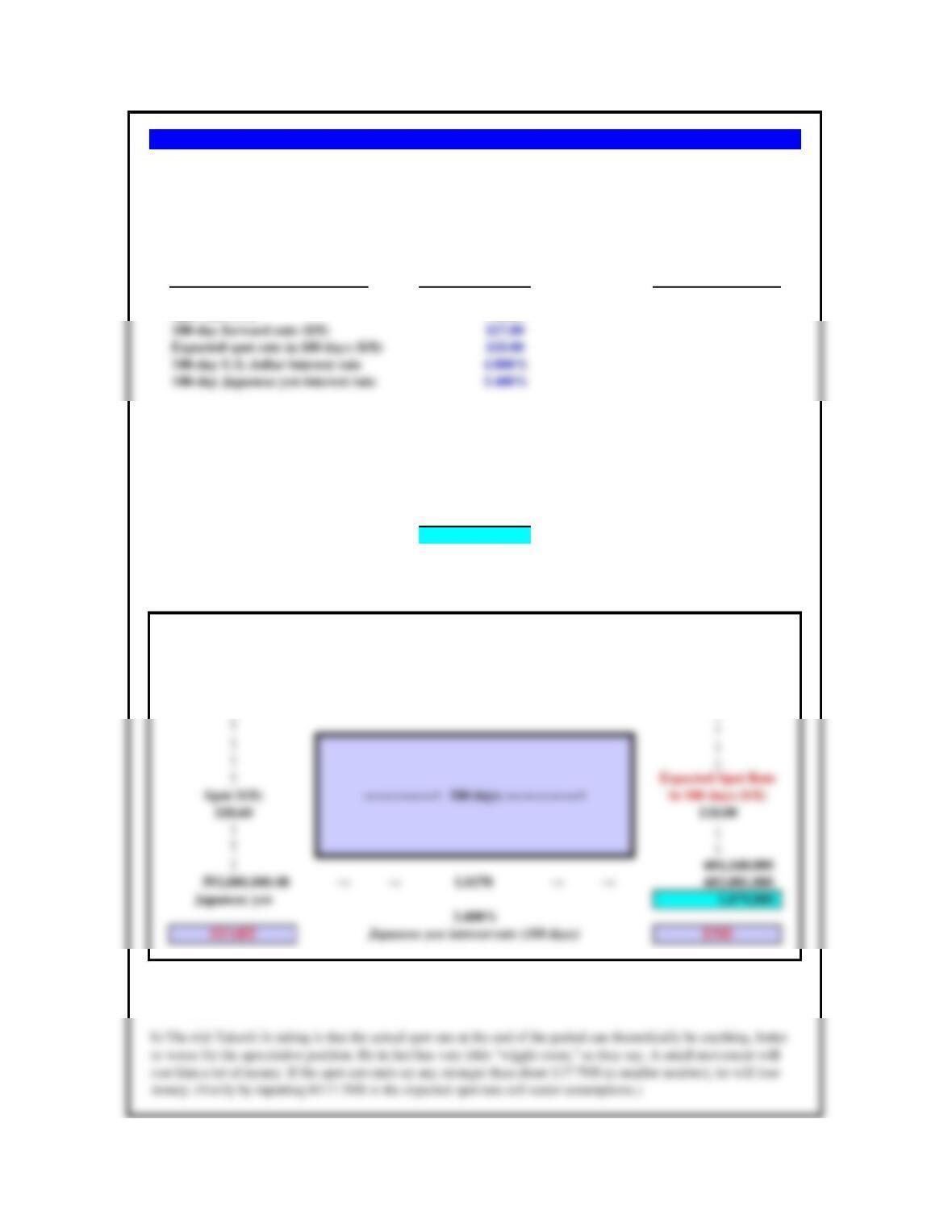
Problem 6.8 Takeshi Kamada — UIA Japan (B)
Assumptions
Takeshi Kamada, Credit Suisse (Tokyo), observes that the ¥/$ spot rate has been holding steady, and both dollar and
yen interest rates have remained relatively fixed over the past week. Takeshi wonders if he should try an uncovered
interest arbitrage (UIA) and thereby save the cost of forward cover. Many of Takeshi’s research associates — and
their computer models — are predicting the spot rate to remain close to ¥118.00/$ for the coming 180 days. Using the
same data as in the previous problem, analyze the UIA potential.
Arbitrage Rule of Thumb: If the difference in interest rates is greater than the forward premium/discount, or
expected change in the spot rate for UIA, invest in the higher interest yielding currency. If the difference in interest
rates is less than the forward premium (or expected change in the spot rate), invest in the lower yielding currency.
180-day forward rate (¥/$) 117.80
Expected spot rate in 180 days (¥/$) 118.00
180-day U.S. dollar interest rate 4.800%
180-day Japanese yen interest rate 3.400%
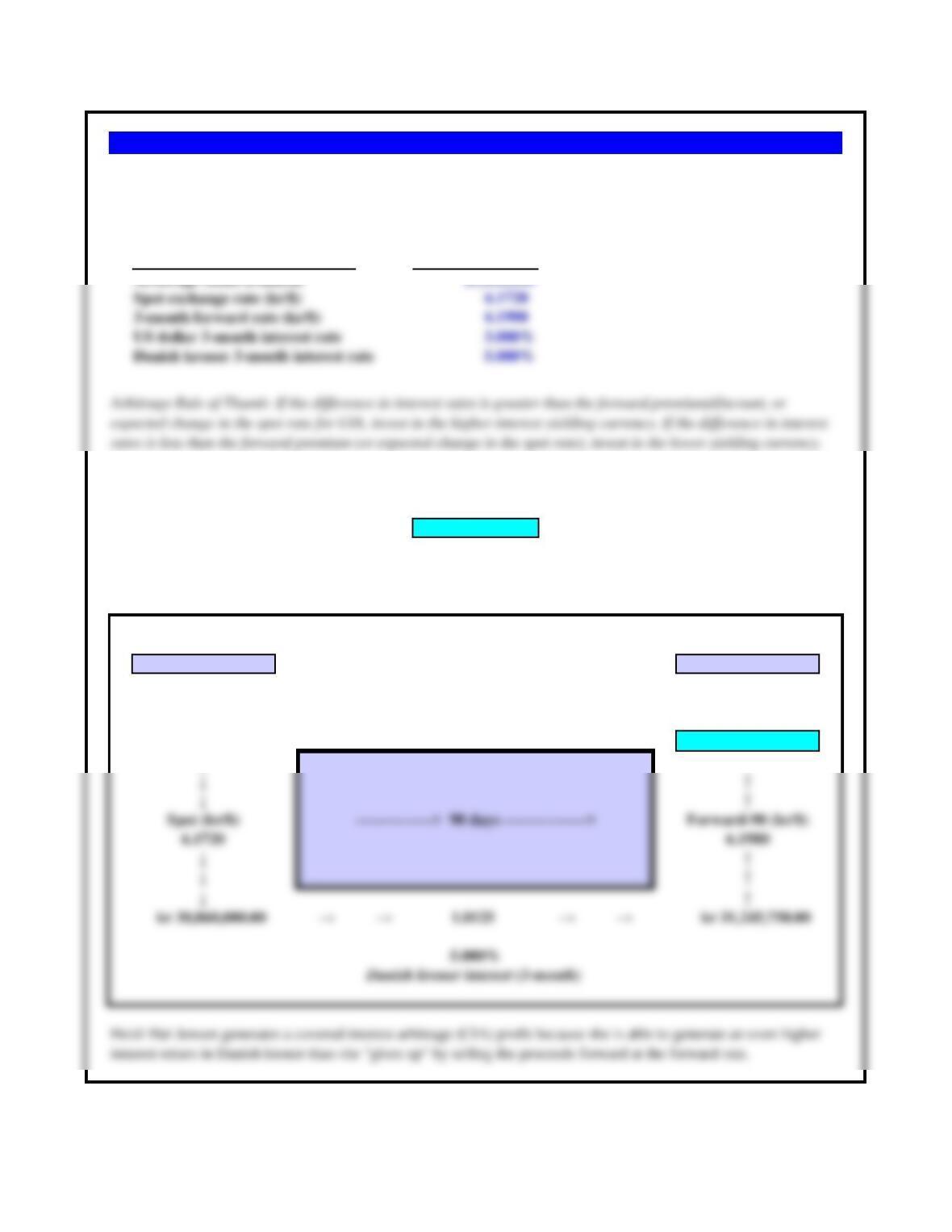
Value
Difference in interest rates (ikr – i$) 2.000%
Forward discount on the krone -1.678%
CIA profit potential 0.322%
U.S. dollar interest rate (3-month)
START 3.000% END
5,000,000.00$ → → 1.0075 → → 5,037,500.00$
↓5,041,263.31
↓3,763.31$
↓ ↑
Heidi Høi Jensen generates a covered interest arbitrage (CIA) profit because she is able to generate an even higher
Problem 6.9 Copenhagen Covered (A)
Heidi Høi Jensen, a foreign exchange trader at J.P. Morgan Chase, can invest $5 million, or the foreign currency
equivalent of the bank’s short term funds, in a covered interest arbitrage with Denmark. Using the following quotes
can Heidi make covered interest arbitrage (CIA) profit?
Assumptions
This tells Heidi Høi Jensen that he should borrow dollars and invest in the higher yielding currency the Danish
kroner, for CIA profit.
Arbitrage funds available $5,000,000
US dollar 3-month interest rate 3.000%
Danish kroner 3-month interest rate 5.000%
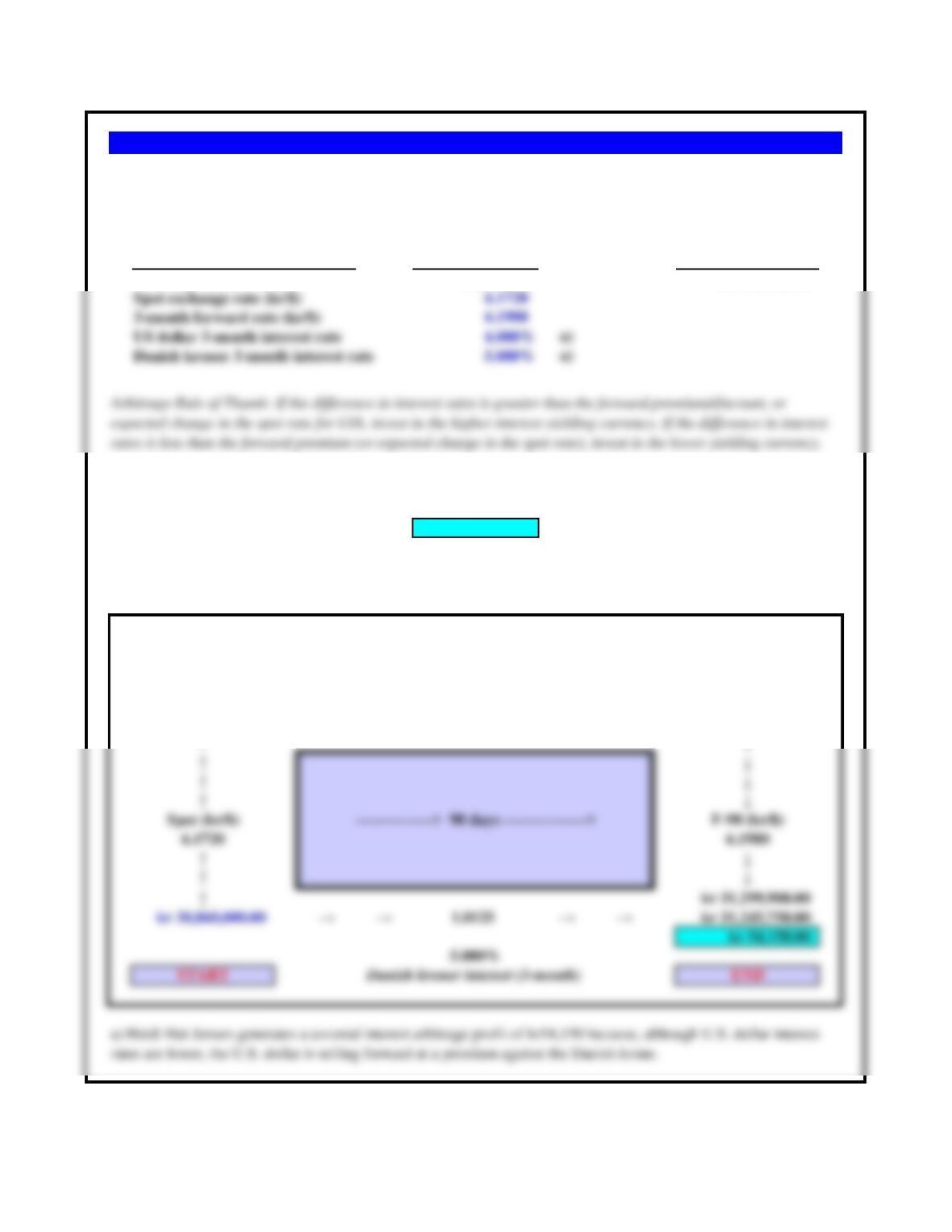
Value kr Equivalent
Arbitrage funds available $5,000,000 kr 30,860,000
Difference in interest rates (ikr – i$) 1.000%
Forward discount on the krone -1.678%
CIA profit potential -0.678%
U.S. dollar interest rate (3-month)
4.000%
5,000,000.00$ → → 1.0100 → → 5,050,000.00$
↑ ↓
↑ ↓
↑ ↓
↑ ↓
↑ ↓
↑ ↓
5.000%
a) Heidi Høi Jensen generates a covered interest arbitrage profit of kr54,150 because, although U.S. dollar interest
Problem 6.10 Copenhagen Covered (B)
Heidi Høi Jensen is now evaluating the arbitrage profit potential in the same market after interest rates change. (Note
that anytime the difference in interest rates does not exactly equal the forward premium, it must be possible to make
CIA profit one way or another.)
Assumptions
This tells Heidi that she should borrow Danish kroner and invest in the LOWER interest rate currency, the dollar,
gaining on the re-exchange of dollars for kroner at the end of the period.
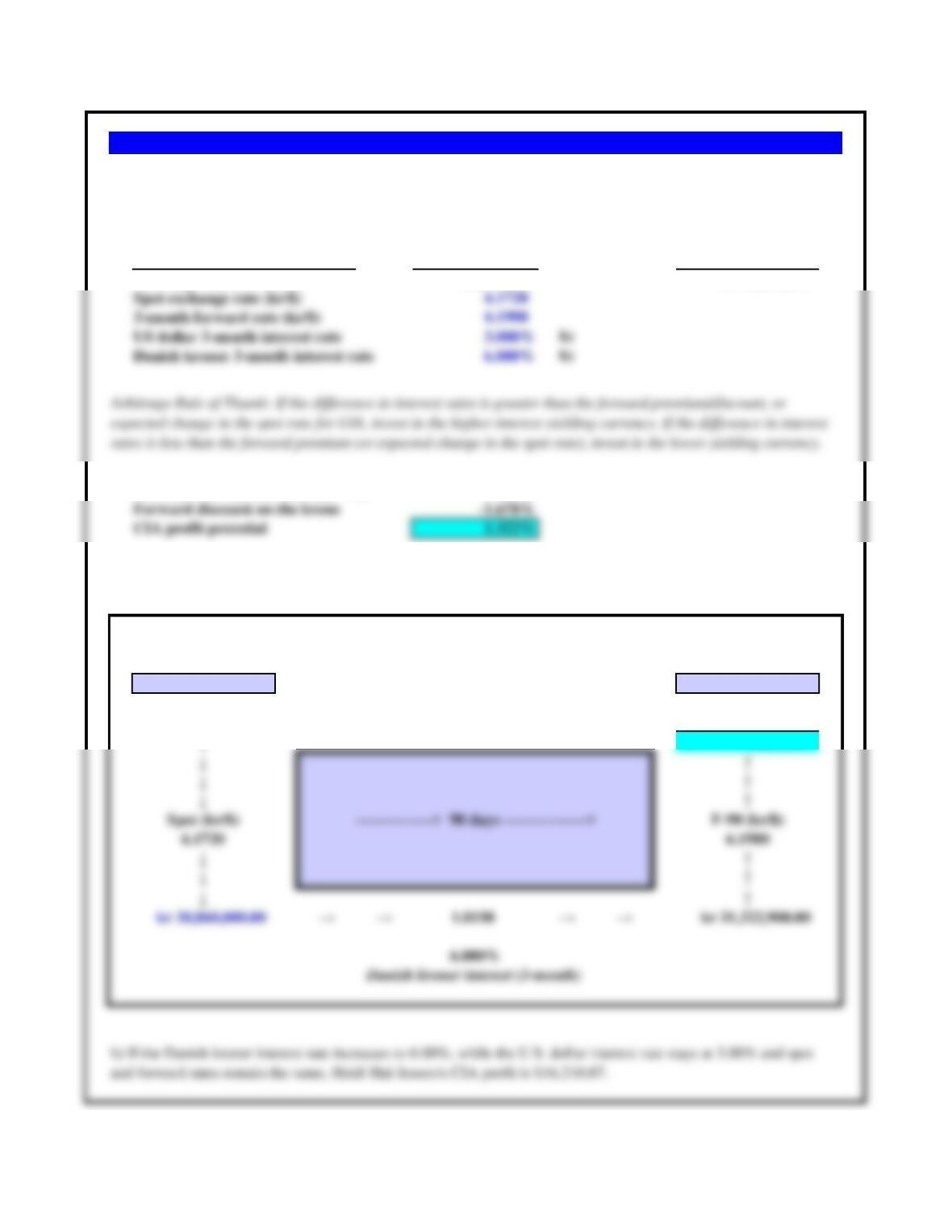
Value kr Equivalent
Arbitrage funds available $5,000,000 kr 30,860,000
Difference in interest rates (ikr – i$) 3.000%
Forward discount on the krone -1.678%
CIA profit potential 1.322%
U.S. dollar interest rate (3-month)
3.000%
START END
$5,000,000 → → 1.0075 → → 5,037,500.00$
↓5,053,710.87$
↓16,210.87$
6.000%
This tells Heidi Høi Jensen that she should borrow US dollars and invest in the HIGHER interest rate currency, the
kroner, gaining on the re-exchange of kroner for dollars at the end of the period.
Problem 6.11 Copenhagen Covered ( C )
Heidi Høi Jensen is now evaluating the arbitrage profit potential in the same market after interest rates change. (Note
that anytime the difference in interest rates does not exactly equal the forward premium, it must be possible to make
CIA profit one way or another.)
Assumptions
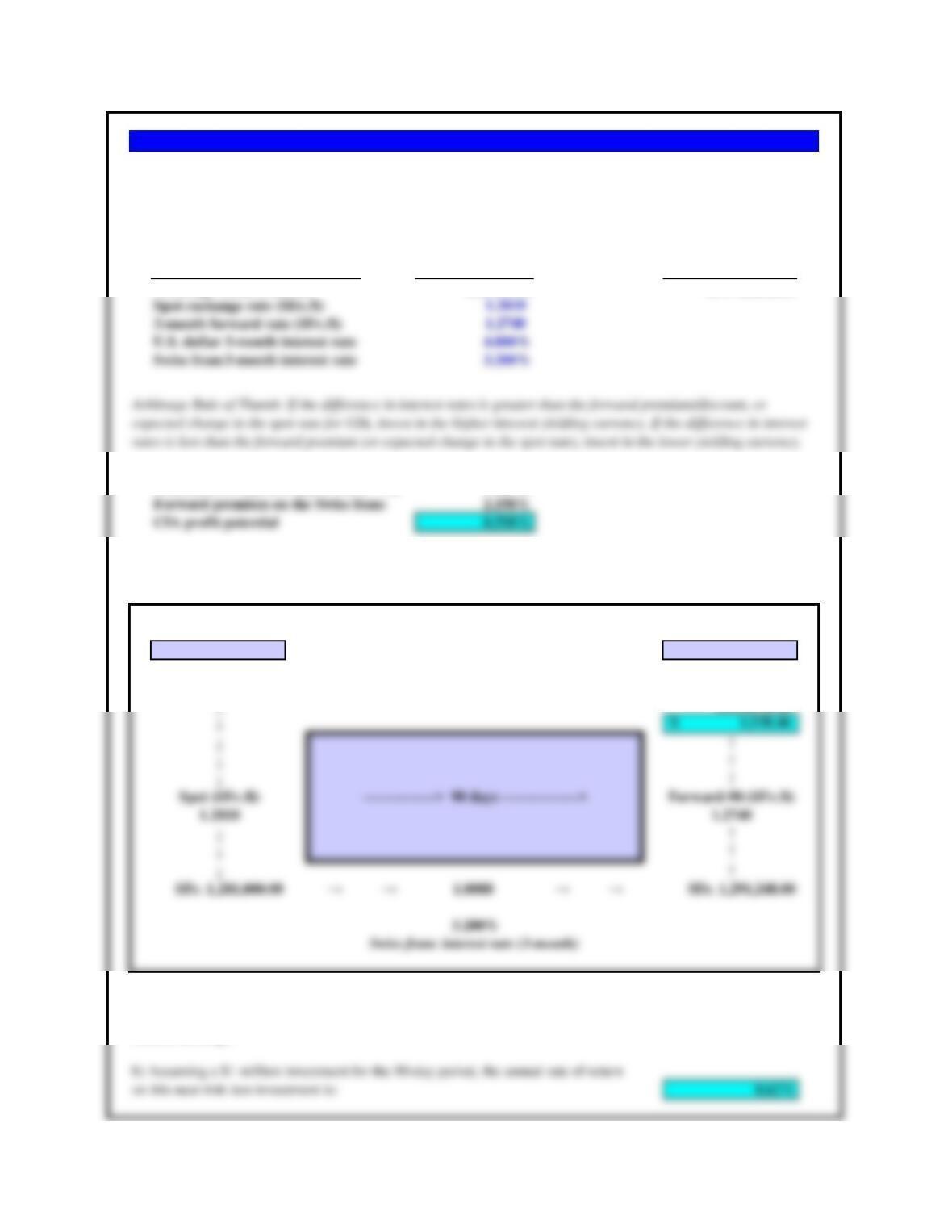
Value SFr. Equivalent
Arbitrage funds available $1,000,000 SFr. 1,281,000
Difference in interest rates ( i SFr. – i $) -1.600%
Forward premium on the Swiss franc 2.198%
CIA profit potential 0.598%
U.S. dollar interest rate (3-month)
START 4.800% END
1,000,000.00$ → → 1.0120 → → 1,012,000.00$
↓1,013,538.46
Swiss franc interest rate (3-month)
Problem 6.12 Casper Landsten — CIA (A)
Assumptions
Casper Landsten is a foreign exchange trader for a bank in New York. He has $1 million (or its Swiss franc
equivalent) for a short term money market investment and wonders if he should invest in U.S. dollars for three
months, or make a covered interest arbitrage investment in the Swiss franc. He faces the following quotes:
This tells Casper Landsten he should borrow U.S. dollars and invest in the LOWER yielding currency, the Swiss
franc, in order to earn covered interest arbitrage (CIA) profits.
a) Casper Landsten makes a net profit, a covered interest arbitrage profit, of $1,538.46 on each million he invests in
the Swiss franc market (by going around the box). He should therefore take advantage of it and perform covered
interest arbitrage.
U.S. dollar 3-month interest rate 4.800%
Swiss franc3-month interest rate 3.200%