CHAPTER 6
INTERNATIONAL PARITY CONDITIONS
1. Law of One Price. Define the law of one price carefully, noting its fundamental
assumptions. Why are these assumptions so difficult to find in the real world in order
to apply the theory?
If identical products or services can be sold in two different markets, and no
restrictions exist on the sale or transportation of product between markets, the
product’s price should be the same in both markets. This is called the law of one price.
where the price of the product in U.S. dollars, P$, multiplied by the spot exchange
rate (
¥$
S
, yen per U.S. dollar), equals the price of the product in Japanese yen, P¥.
Conversely, if the prices of the two products were stated in local currencies, and
markets were efficient at competing away a higher price in one market relative to the
other, the exchange rate could be deduced from the relative local product prices:
¥
¥$ $
P
SP
=
2. Purchasing Power Parity. Define the following terms:
a. The law of one price. The law of one prices states that producers’ prices for
goods or services of identical quality should be the same in different markets; i.e.,
different countries (assuming no restrictions on the sale and allowing for
b. Absolute purchasing power parity. If the law of one price were true for all
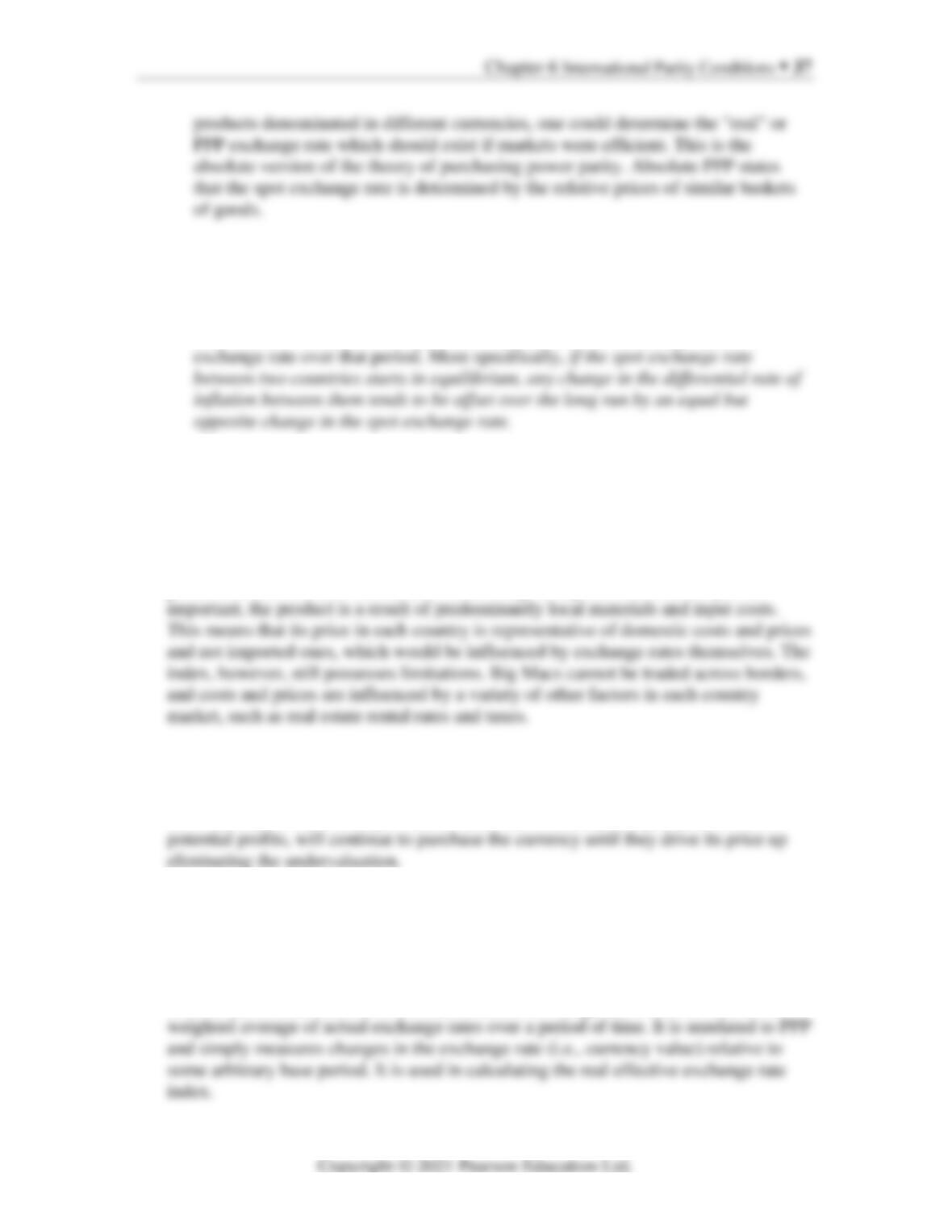
c. Relative purchasing power parity. If the assumptions of the absolute version of
PPP theory are relaxed a bit more, we observe what is termed relative purchasing
power parity. This more general idea is that PPP is not particularly helpful in
determining what the spot rate is today, but that the relative change in prices
between two countries over a period of time determines the change in the
3. Big Mac Index. How close does the Big Mac Index conform to the theoretical
requirements for a one price measurement of purchasing power parity?
The Big Mac may be a good candidate for the application of the law of one price and
measurement of under or overvaluation for a number of reasons. First, the product
itself is nearly identical in each market. This is the result of product consistency,
process excellence, and McDonald’s brand image and pride. Second, and just as
4. Undervaluation and Purchasing Power Parity. According to the theory of
purchasing power parity, what should happen to a currency which is undervalued?
Theoretically, if the currency is undervalued then market participants, in search of
5. Nominal Effective Exchange Rate Index. Explain how a nominal effective
exchange rate index is constructed.
An exchange rate index is an index that measures the value of a given country’s
exchange rate against all other exchange rates in order to determine if that currency is
overvalued or undervalued. A nominal effective exchange rate index is based on a
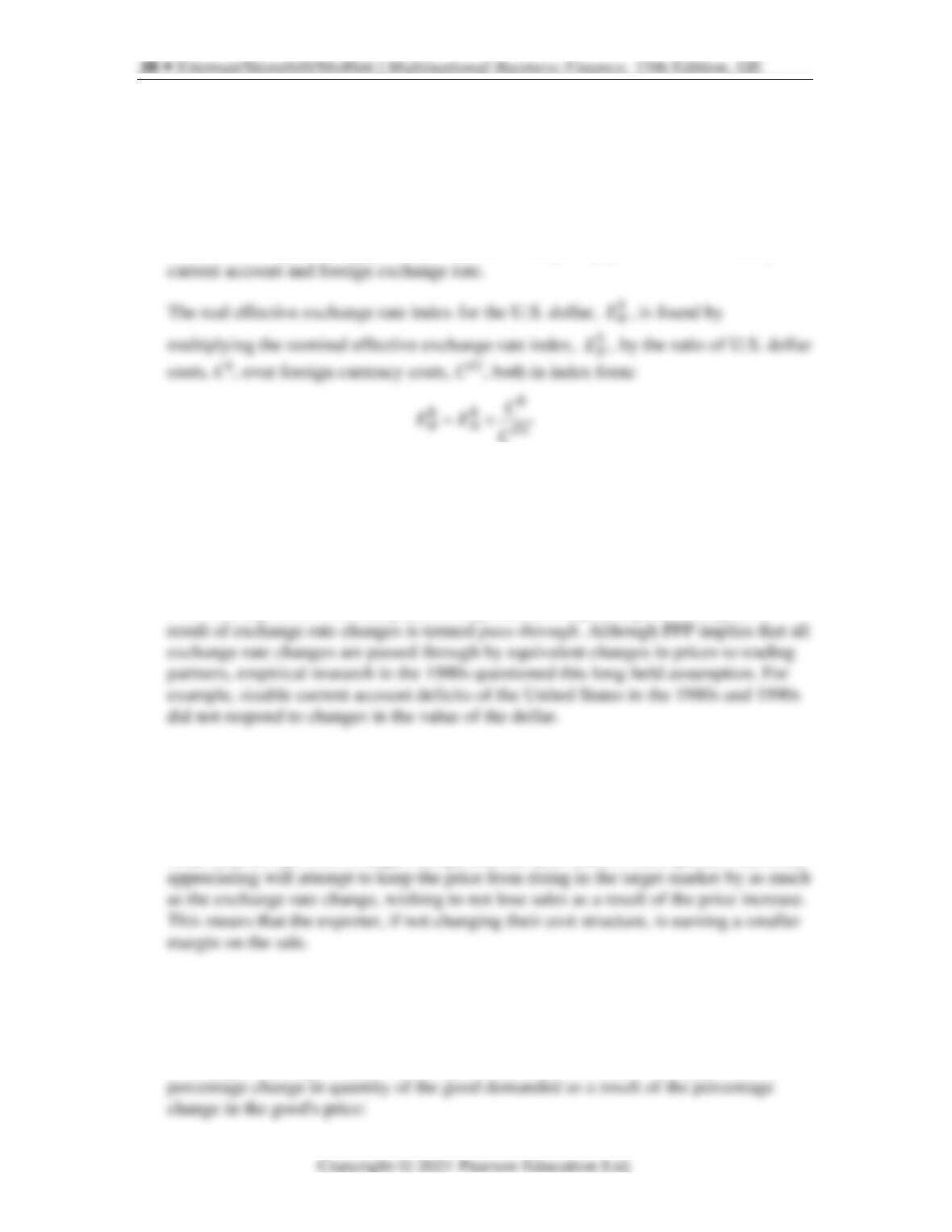
6. Real Effective Exchange Rate Index. What formula is used to convert a nominal
effective exchange rate index into a real effective exchange rate index?
A real effective exchange rate index adjusts the nominal effective exchange rate
index to reflect differences in inflation. The adjustment is achieved by multiplying the
nominal index by the ratio of domestic costs to foreign costs. The real index measures
deviation from purchasing power parity, and consequently pressures on a country’s
7. Exchange Rate Pass-Through. Incomplete exchange rate pass-through is one
reason that a country’s real effective exchange rate can deviate for lengthy periods
from its purchasing power equilibrium level of 100. What is meant by the term
exchange rate pass-through?
Incomplete exchange rate pass-through is one reason that a country’s real effective
exchange rate index can deviate for lengthy periods from its PPP-equilibrium level of
100. The degree to which the prices of imported and exported goods change as a
8. Partial Exchange Rate Pass-Through. What is partial exchange rate pass-through,
and how can it occur in efficient global markets?
Partial pass-through is when prices of imported products rise by less than the full
percentage change in the imported product’s currency. Many times an exporter that
finds its price has risen in target foreign markets as a result of the exporter’s currency
9. Price Elasticity of Demand. How is the price elasticity of demand relevant to
exchange rate pass-through?
The concept of price elasticity of demand is useful when determining the desired
level of pass-through. Recall that the price elasticity of demand for any good is the
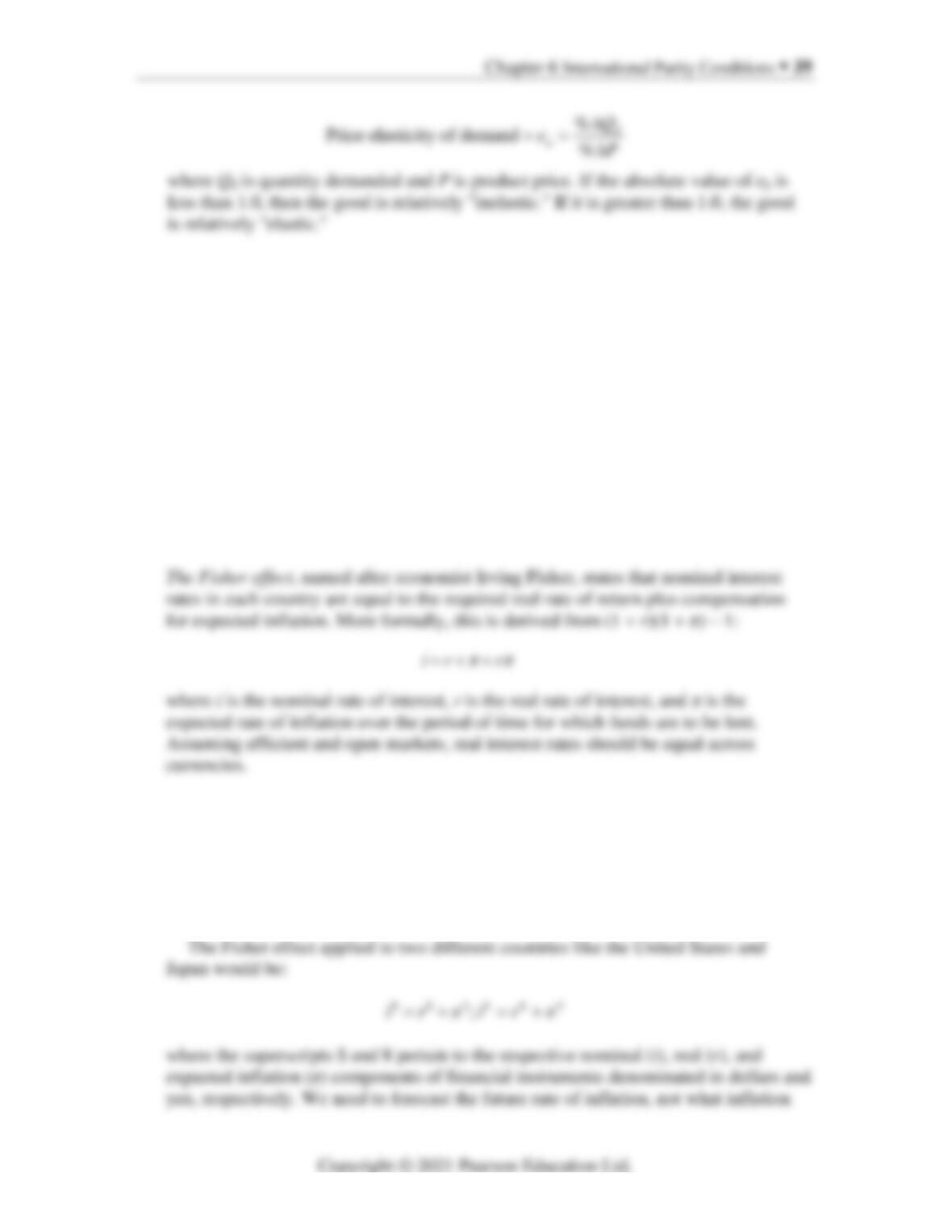
A German product that is relatively price-inelastic, meaning that the quantity
demanded is relatively unresponsive to price changes, may often demonstrate a high
degree of pass-through. This is because a higher dollar price in the United States
market would have little noticeable effect on the quantity of the product demanded by
consumers. Dollar revenue would increase, but euro revenue would remain the same.
However, products that are relatively price-elastic would respond in the opposite way.
If the 20% euro appreciation resulted in 20% higher dollar prices, U.S. consumers
would decrease the number of BMWs purchased. If the price elasticity of demand for
BMWs in the United States were greater than one, total dollar sales revenue of
BMWs would decline.
10. The Fisher Effect. Define the Fisher effect. What would it say about real interest
rates if markets are open and efficient?
11. Approximate Form of Fisher Effect.
The final compound term, r times π, is frequently dropped from consideration due to
its relatively minor value. The Fisher effect then reduces to (approximate form):
ir
=+
12. The International Fisher Effect. Define the international Fisher effect. Would it
discourage local investors from capitalizing on higher foreign interest rates?
13. Interest Rate Parity. Define interest rate parity. What would it say about interest
rates if spot rates and forward rates were the same?
The theory of interest rate parity (IRP) provides the linkage between the foreign
14. Covered Interest Arbitrage. Ignoring transaction costs, under what conditions will
covered interest arbitrage be plausible?
Covered interest arbitrage (CIA) involves an investment in a currency that is covered
15. Uncovered Interest Arbitrage. Define uncovered interest arbitrage and explain
what expectations an investor or speculator would need to undertake an uncovered
interest arbitrage investment?
A deviation from covered interest arbitrage is uncovered interest arbitrage (UIA),
wherein investors borrow in countries and currencies exhibiting relatively low interest
rates and convert the proceeds into currencies that offer much higher interest rates.
The transaction is “uncovered” because the investor does not sell the higher yielding
16. Forward Rate Calculation. If someone you were working with argued that the
current forward rate quoted on a currency pair is the market’s expectation of where
the future spot rate will end up, what would you say?
17. Forward Rate as an Unbiased Predictor of the Future Spot Rate. Some
forecasters believe that foreign exchange markets for the major floating currencies are
“efficient” and forward exchange rates are unbiased predictors of future spot
exchange rates. What is meant by “unbiased predictor” in terms of how the forward
rate performs in estimating future spot exchange rates?
Exhibit 6.10 demonstrates the meaning of “unbiased prediction” in terms of how the
forward rate performs in estimating future spot exchange rates. If the forward rate is
an unbiased predictor of the future spot rate, the expected value of the future spot rate
at time 2 equals the present forward rate for time 2 delivery, available now, E(S2) = F1.
The rationale for this relationship is based on the hypothesis that the foreign exchange
market is reasonably efficient. Market efficiency assumes that a) all relevant
information is quickly reflected in both the spot and forward exchange markets, b)
transaction costs are low, and c) instruments denominated in different currencies are
perfect substitutes for one another.
18. Transaction Costs. If transaction costs for undertaking covered or uncovered
interest arbitrage were large, how do you think it would influence arbitrage activity?
It would result in large discrepancies between market rates and quotes, as a higher
19. Carry Trade. The term carry trade is used quite frequently in the business press.
What does it mean, and what conditions and expectations do investors need to hold to
undertake carry trade transactions?
20. Market Efficiency. Many academics and professionals have tested the foreign
exchange and interest rate markets to determine their efficiency. What have they
concluded?
Tests of foreign exchange market efficiency conclude that either exchange market
efficiency is untestable or, if it is testable, that the market is not efficient. The