Assumptions Value
Charge for suite plus meals in Malaysian ringgit (RM) 1,045.00
Spot exchange rate (RM/$) 3.1350
US$ cost today for a 30 day stay $10,000.00
Malaysian ringgit inflation rate expected to be 2.750%
U.S. dollar inflation rate expected to be 1.250%
a. How many dollars might you expecte to need one year hence for your 30-day vacation?
Spot exchange rate (ringgit per US$) 3.1350
Malaysian ringgit inflation rate expected to be 2.750%
Hotel charges expected to be paid one year from now for a 30-day stay (RM) 32,212.13
US dollars needed on the basis of these two expectations: $10,125.00
b. By what percent has the dollar cost gone up? Why?
New dollar cost $10,125.00
Original dollar cost $10,000.00
Problem 6.1 Malaysian Island Resort
Theresa Nunn is planning a 30-day vacation on Pulau Penang, Malaysia, one year from now. The present charge
for a luxury suite plus meals in Malaysian ringgit (RM) is RM1,045/day. The Malaysian ringgit presently trades
at RM3.1350/$. She figures out the dollar cost today for a 30-day stay would be $10,000. The hotel informed
her that any increase in its room charges will be limited to any increase in the Malaysian cost of living.
Malaysian inflation is expected to be 2.75% per annum, while U.S. inflation is expected to be only 1.25%.
a. What should have been the exchange rate in January 2003 if PPP held?
Assumptions Value
Spot exchange rate, fixed peg, early January 2002 (Ps/$) 1.0000
Spot exchange rate, January 29, 2003 (Ps/$) 3.2000
US inflation for year (per annum) 2.20%
Argentine inflation for year (per annum) 20.00%
a. What should have been the exchange rate in January 2003 if PPP held?
Beginning spot rate (Ps/$) 1.00
b. By what percentage was the Argentine peso undervalued on an annulized basis?
c. What were the probable causes of undervaluation?
The rapid decline in the value of the Argentine peso was a result of not only inflation,
Problem 6.2 Argentine Float
The Argentine peso was fixed through a currency board at Ps1.00/$ throughout the 1990s. In
January 2002 the Argentine peso was floated. On January 29, 2003 it was trading at Ps3.20/$.
During that one year period Argentina’s inflation rate was 20% on an annualized basis. Inflation in
the United States during that same period was 2.2% annualized.
Assumptions Value
Forecast annual rate of inflation for Japan
1.100%
Forecast annual rate of inflation for United States
5.900%
4.700%
9.500%
Spot exchange rate (¥/$)
a.
Forecast change in
Forward rate as spot exchange rate Purchasing
an unbaised
↔ ↔
4.8% ↔ ↔ power
predictor (E)
(Dollar expected to weaken) parity (A)
↕ ↕
↕ ↕ ↕
↕ ↕ ↕
↕ ↕ ↕
↕ ↕ ↕
↕
Interest rate ↔ ↔
Difference in nominal ↔ ↔ Fisher
parity (D)
interest rates effect (B)
-4.8%
(higher in United States)
Spot exchange rate (¥/$)
Forcasted change in exchange rates
As is the always the case with parity conditions, the future spot rate is implicitly forecast to be equal to the forward rate, the implied rate
from the international Fisher effect, and the rate implied by purchasing power parity. According to Yazzie’s calculations, the markets are
indeed in equilibrium — parity.
Problem 6.3 Derek Tosh and Yen-Dollar Parity
Approximate Form
Derek Tosh is attempting to determine whether US/Japanese financial conditions are at parity. The current spot rate is a flat ¥89.00/$,
while the 360-day forward rate is ¥84.90/$. Forecast inflation is 1.100% for Japan, and 5.900% for the US. The 360-day euro-yen deposit
rate is 4.700%, and the 360-day euro-dollar deposit rate is 9.500%.
a. Diagram and calculate whether international parity conditions hold between Japan and the United States.
b. Find the forecasted change in the Japanese yes/U.S. dollar (¥/$) exchange rate one year from now.
Assumptions Value
Price of 3-Piece Luggage set in C$ 950.00
Price of 3-Piece Luggage set in HK$ 5,650.00
a. Is the spot rate accurate given both luggage prices?
Price of 3-Piece Luggage set in C$ 950.00
b. What should be the price of the luggage set in HK$ in 1-year if PPP holds?
Beginning spot rate (HK$/C$) 6.0000
Hong Kong inflation 3.50%
Canada inflation 2.00%
PPP exchange rate 6.0882
Problem 6.4 Chan’s Homes: Hong Kong to Toronto
Albert Chan owns homes in Toronto, Canada and Hong Kong. He travels between the two cities at
least four times a year. Because of his frequent trips, he wants to buy some high-quality luggage.
He has done some research and has decided to purchase a Samsonite three-piece luggage set.
There are retail stores in Toronto and Hong Kong that carry the luggage set he intends to purchase.
Albert was a finance major and wants to use purchasing power parity to determine if he is paying
the same price regardless of where he makes his purchase.
a. a.If the price of the three-piece luggage set in Toronto is C$950 and the price of the same
three-piece set is HK$5,650, using purchasing power parity, is the price of the luggage truly equal
if the spot rate is HK$6.0000/C$?
Assumptions Value
Spot exchange rate (Kn/$) 5.6288
Price of vanilla latter in Zagreb (kn) 25.70
Problem 6.5 Starbucks (Croatia)
Starbucks opened its first store in Zagreb, Croatia in October 2010. The price of a tall vanilla latte
in Zagreb is 25.70kn. In New York City, the price of a tall vanilla latte is $2.65. The exchange
rate bewteen Croatian kunas (kn) and U.S. dollars is kn5.6288/$. According to purchasing power
parity, is the Croatian kuna overvalued or undervalued?
a. What was the export price for the Sonata at the beginning of the year expressed in Malaysian ringgit?
b. Assuming purchasing power parity holds, what should the exchange rate at the end of the year?
Steps Value
Initial spot exchange rate (KRW/MYR)
279.48
Initial price of a Hyundai Sonata (KRW)
23,460,000
Expected Malaysian ringgit inflation rate for the coming year
2.000%
Expected Korean won inflation rate for the coming year
1.500%
Desired rate of pass through by Hyundai
60.000%
a. What was the export price for the Sonata at the beginning of the year?
23,460,000
279.48
b. What is the expected spot rate at the end of the year assuming PPP?
Initial spot rate (KRW/MYR)
279.48
Expected Malaysian ringgit inflation
2.00%
1.50%
278.11
c. Assuming complete pass through, what will the price be in MYR in one year?
Price of Sonata at beginning of year (KRW)
23,460,000
Korean won inflation over the year
1.500%
23,811,900
278.11
d. Assuming partial pass through, what will the price be in MYR in one year?
Price of Sonata at end of year (KRW)
23,811,900
Amount of expected exchange rate change, in percent (from PPP)
0.493%
0.296%
Problem 6.6 Hyundai’s–Pass Through
Assume that the export price of a Hyundai Sonata from Seoul, South Korea is W23,460,000. It exports the car to
Malaysia. The exchange rate is W279.48/RM. The forecast inflation rate in Malaysia is 2.0% per year and in South
Korea it is 1.5% per year. Use these data to answer the following questions on exchange rate pass-through.
Value Yen Equivalent
Arbitrage funds available $5,000,000 593,000,000
Spot rate (¥/$) 118.60
180-day forward rate (¥/$) 117.80
180-day U.S. dollar interest rate 4.800%
180-day Japanese yen interest rate 3.400%
Difference in interest rates ( i ¥ – i $) -1.400%
Forward premium on the yen 1.358%
CIA profit potential -0.042%
U.S. dollar interest rate (180 days)
4.800%
5,000,000$ → → 1.0240 → → 5,120,000$
↑ ↓
↑ ↓
↑ ↓
↑ ↓
↑ ↓
↑ ↓
↑ ↓
3.400%
Problem 6.7 Kamada: CIA Japan (A)
Assumptions
Takeshi Kamada generates a CIA profit by investing in the higher interest rate currency, the dollar, and
simultaneously selling the dollar proceeds forward into yen at a forward premium which does not completely negate
the interest differential.
This tells Takeshi Kamada that he should borrow yen and invest in the higher yielding currency, the U.S. dollar, to
lock-in a covered interest arbitrage (CIA) profit.
Arbitrage Rule of Thumb: If the difference in interest rates is greater than the forward premium/discount, or
expected change in the spot rate for UIA, invest in the higher interest yielding currency. If the difference in interest
rates is less than the forward premium (or expected change in the spot rate), invest in the lower yielding currency.
Takeshi Kamada, a foreign exchange trader at Credit Suisse (Tokyo), is exploring covered interest arbitrage
possibilities. He wants to invest $5,000,000 or its yen equivalent, in a covered interest arbitrage between U.S.
dollars and Japanese yen. He faced the following exchange rate and interest rate quotes.
Value Yen Equivalent
Arbitrage funds available $5,000,000 593,000,000
Spot rate (¥/$) 118.60
180-day forward rate (¥/$) 117.80
Expected spot rate in 180 days (¥/$) 118.00
180-day U.S. dollar interest rate 4.800%
180-day Japanese yen interest rate 3.400%
Difference in interest rates ( i ¥ – i $) -1.400%
Expected gain (loss) on the spot rate 1.017%
UIA profit potential -0.383%
U.S. dollar interest rate (180 days)
4.800%
$5,000,000 → → 1.0240 → → $5,120,000
↑ ↓
↑ ↓
↑ ↓
↑ ↓
↑ ↓
↑ ↓
3.400%
a) Takeshi Kamada generates an uncovered interest arbitrage (UIA) profit of ¥1,079,000 if his expectations about
This tells Takeshi Kamada that he should borrow yen and invest in the higher yielding currency, the U.S. dollar, to
potentially gain on an uncovered basis (UIA).
Problem 6.8 Kamada: UIA Japan (B)
Assumptions
Takeshi Kamada, Credit Suisse (Tokyo), observes that the ¥/$ spot rate has been holding steady, and both dollar and
yen interest rates have remained relatively fixed over the past week. Takeshi wonders if he should try an uncovered
interest arbitrage (UIA) and thereby save the cost of forward cover. Many of Takeshi’s research associates — and
their computer models — are predicting the spot rate to remain close to ¥118.00/$ for the coming 180 days. Using
the same data as in the previous problem, analyze the UIA potential.
Arbitrage Rule of Thumb: If the difference in interest rates is greater than the forward premium/discount, or
expected change in the spot rate for UIA, invest in the higher interest yielding currency. If the difference in interest
rates is less than the forward premium (or expected change in the spot rate), invest in the lower yielding currency.

b) The risk Takeshi is taking is that the actual spot rate at the end of the period can theoretically be anything, better
or worse for his speculative position. He in fact has very little “wiggle room,” as they say. A small movement will
the future spot rate, the one in effect in 180 days, prove correct.
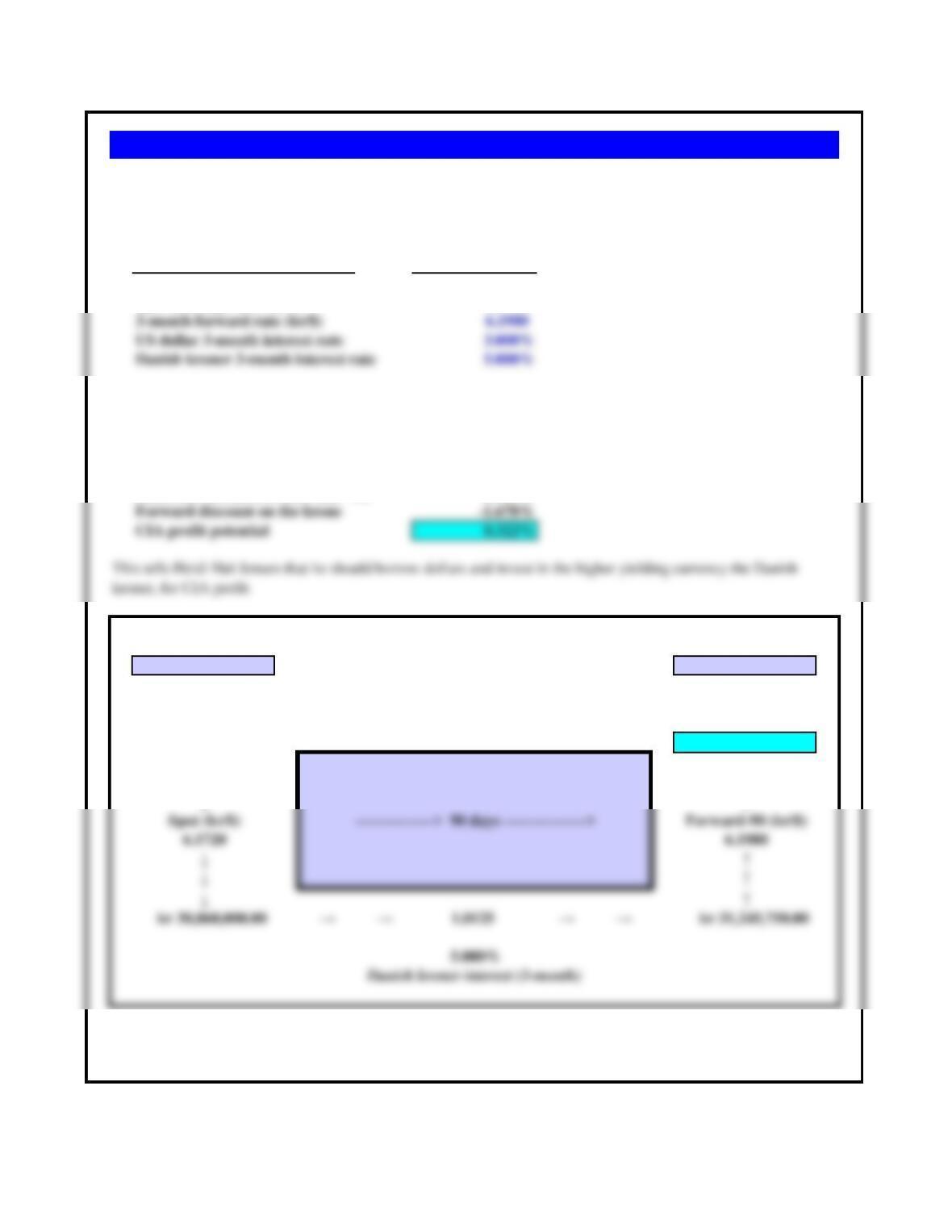
Value
Arbitrage funds available $5,000,000
Spot exchange rate (kr/$) 6.1720
3-month forward rate (kr/$) 6.1980
US dollar 3-month interest rate 3.000%
Danish kroner 3-month interest rate 5.000%
Difference in interest rates (ikr – i$) 2.000%
Forward discount on the krone -1.678%
CIA profit potential 0.322%
U.S. dollar interest rate (3-month)
START 3.000% END
5,000,000.00$ → → 1.0075 → → 5,037,500.00$
↓5,041,263.31
↓3,763.31$
↓ ↑
↓ ↑
↓ ↑
↓ ↑
Heidi Høi Jensen generates a covered interest arbitrage (CIA) profit because she is able to generate an even higher
interest return in Danish kroner than she “gives up” by selling the proceeds forward at the forward rate.
Problem 6.9 Copenhagen Covered (A)
Heidi Høi Jensen, a foreign exchange trader at J.P. Morgan Chase, can invest $5 million, or the foreign currency
equivalent of the bank’s short term funds, in a covered interest arbitrage with Denmark. Using the following quotes
can Heidi make covered interest arbitrage (CIA) profit?
Assumptions
Arbitrage Rule of Thumb: If the difference in interest rates is greater than the forward premium/discount, or
expected change in the spot rate for UIA, invest in the higher interest yielding currency. If the difference in interest
rates is less than the forward premium (or expected change in the spot rate), invest in the lower yielding currency.
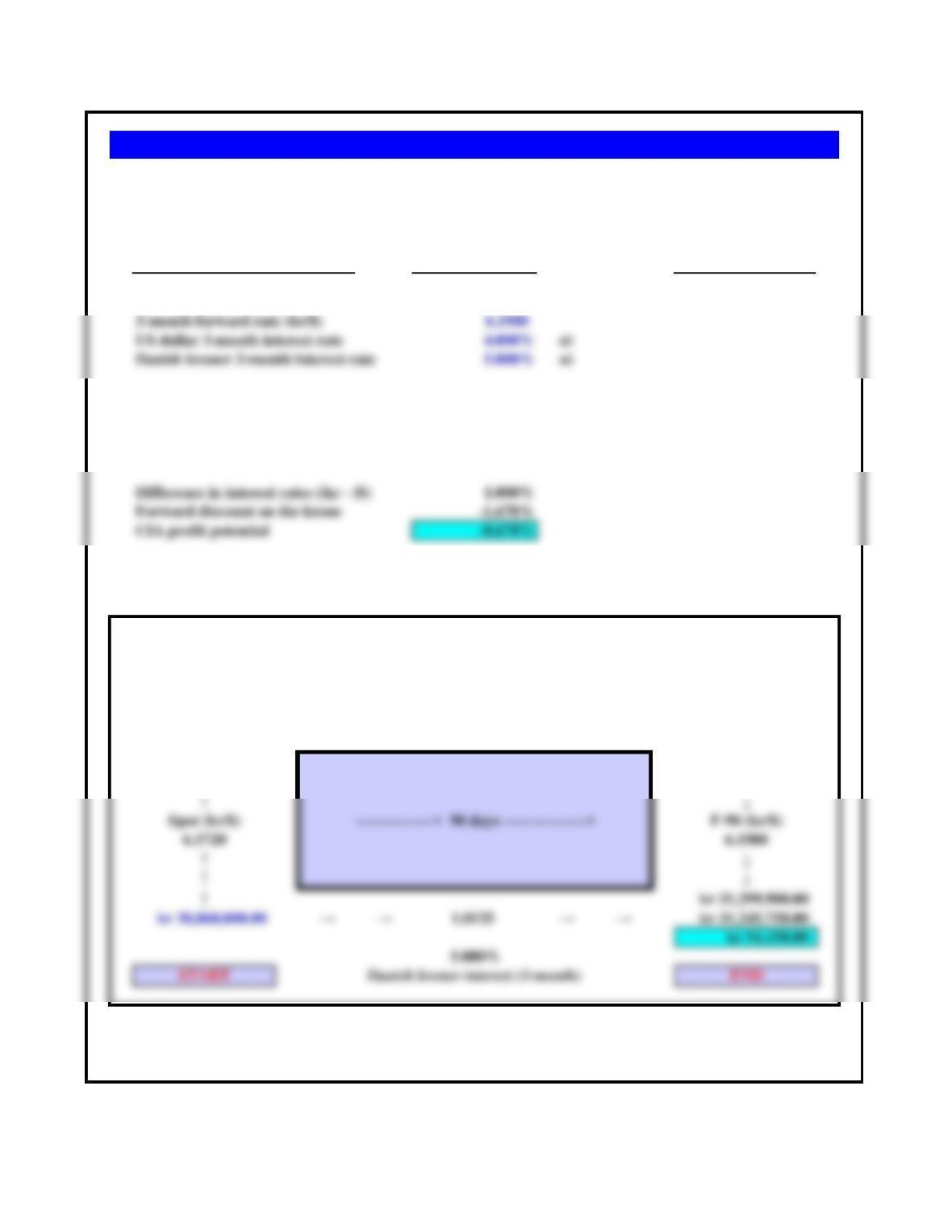
Value kr Equivalent
Arbitrage funds available $5,000,000 kr 30,860,000
Spot exchange rate (kr/$) 6.1720
3-month forward rate (kr/$) 6.1980
US dollar 3-month interest rate 4.000% a)
Danish kroner 3-month interest rate 5.000% a)
Difference in interest rates (ikr – i$) 1.000%
Forward discount on the krone -1.678%
CIA profit potential -0.678%
U.S. dollar interest rate (3-month)
4.000%
5,000,000.00$ → → 1.0100 → → 5,050,000.00$
↑ ↓
↑ ↓
↑ ↓
↑ ↓
↑ ↓
↑ ↓
↑ ↓
5.000%
a) Heidi Høi Jensen generates a covered interest arbitrage profit of kr54,150 because, although U.S. dollar interest
rates are lower, the U.S. dollar is selling forward at a premium against the Danish krone.
Problem 6.10 Copenhagen Covered (B)
Heidi Høi Jensen is now evaluating the arbitrage profit potential in the same market after interest rates change. (Note
that anytime the difference in interest rates does not exactly equal the forward premium, it must be possible to make
CIA profit one way or another.)
Assumptions
This tells Heidi that she should borrow Danish kroner and invest in the LOWER interest rate currency, the dollar,
gaining on the re-exchange of dollars for kroner at the end of the period.
Arbitrage Rule of Thumb: If the difference in interest rates is greater than the forward premium/discount, or
expected change in the spot rate for UIA, invest in the higher interest yielding currency. If the difference in interest
rates is less than the forward premium (or expected change in the spot rate), invest in the lower yielding currency.
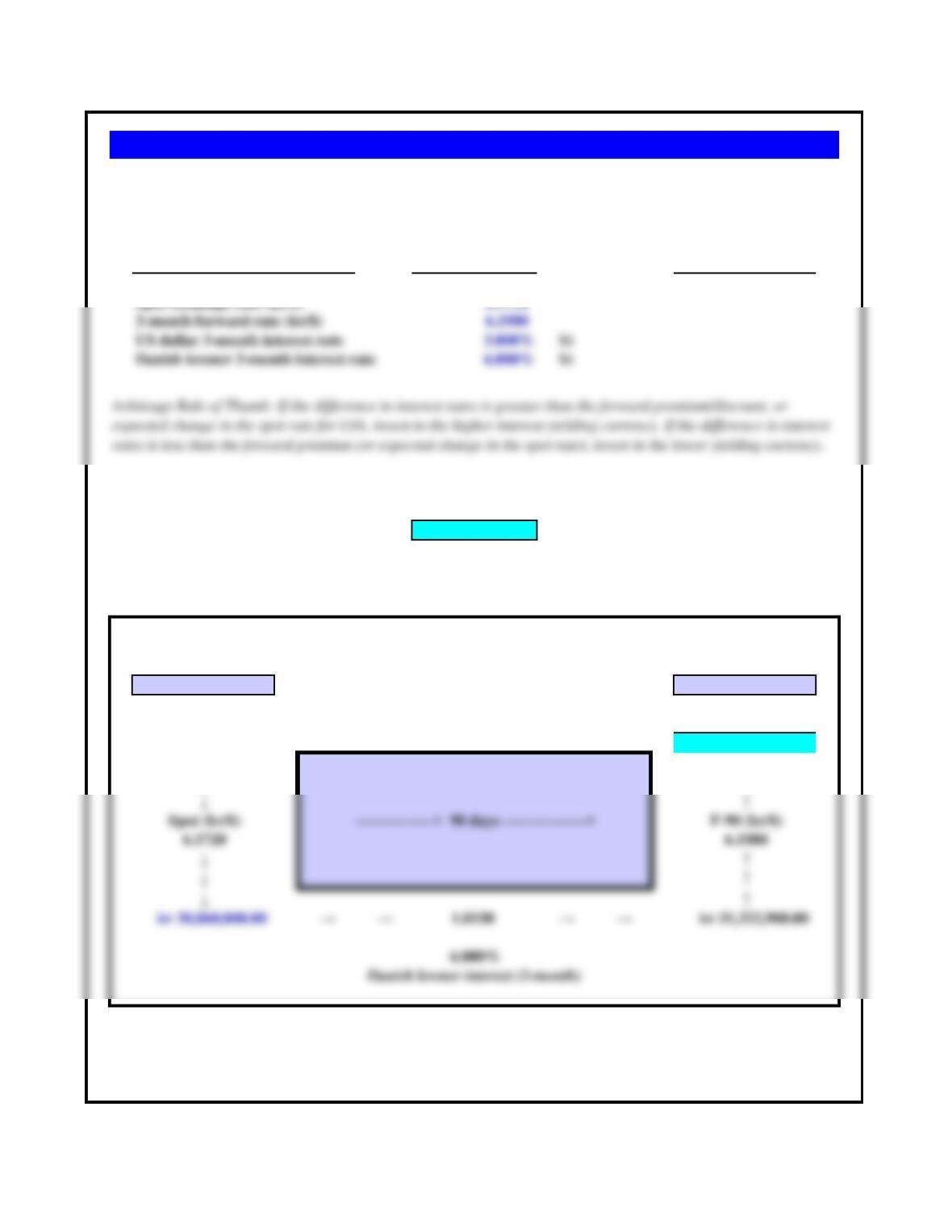
Value kr Equivalent
Arbitrage funds available $5,000,000 kr 30,860,000
Difference in interest rates (ikr – i$) 3.000%
Forward discount on the krone -1.678%
CIA profit potential 1.322%
U.S. dollar interest rate (3-month)
3.000%
START END
$5,000,000 → → 1.0075 → → 5,037,500.00$
↓5,053,710.87$
↓16,210.87$
↓ ↑
↓ ↑
↓ ↑
↓ ↑
6.000%
This tells Heidi Høi Jensen that she should borrow US dollars and invest in the HIGHER interest rate currency, the
kroner, gaining on the re-exchange of kroner for dollars at the end of the period.
b) If the Danish kroner interest rate increases to 6.00%, while the U.S. dollar interest rate stays at 3.00% and spot
and forward rates remain the same, Heidi Høi Jensen’s CIA profit is $16,210.87.
Problem 6.11 Copenhagen Covered ( C )
Heidi Høi Jensen is now evaluating the arbitrage profit potential in the same market after interest rates change. (Note
that anytime the difference in interest rates does not exactly equal the forward premium, it must be possible to make
CIA profit one way or another.)
Assumptions
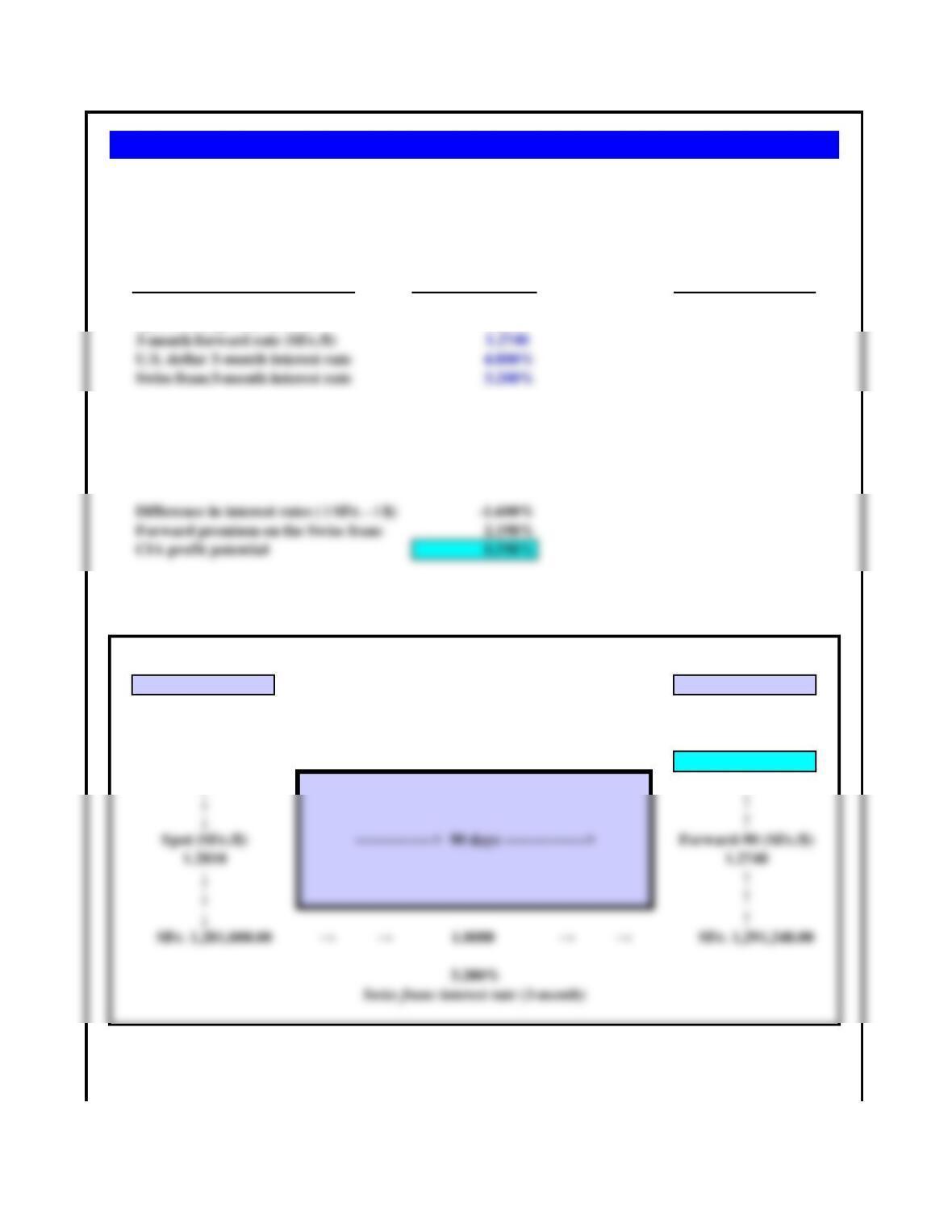
Value SFr. Equivalent
Arbitrage funds available $1,000,000 SFr. 1,281,000
Spot exchange rate (SFr./$) 1.2810
3-month forward rate (SFr./$) 1.2740
U.S. dollar 3-month interest rate 4.800%
Swiss franc3-month interest rate 3.200%
Difference in interest rates ( i SFr. – i $) -1.600%
Forward premium on the Swiss franc 2.198%
CIA profit potential 0.598%
U.S. dollar interest rate (3-month)
START 4.800% END
1,000,000.00$ → → 1.0120 → → 1,012,000.00$
↓1,013,538.46
↓1,538.46$
↓ ↑
Swiss franc interest rate (3-month)
Problem 6.12 Casper Landsten — CIA (A)
Assumptions
Casper Landsten is a foreign exchange trader for a bank in New York. He has $1 million (or its Swiss franc
equivalent) for a short term money market investment and wonders if he should invest in U.S. dollars for three
months, or make a covered interest arbitrage investment in the Swiss franc. He faces the following quotes:
This tells Casper Landsten he should borrow U.S. dollars and invest in the LOWER yielding currency, the Swiss
franc, in order to earn covered interest arbitrage (CIA) profits.
Arbitrage Rule of Thumb: If the difference in interest rates is greater than the forward premium/discount, or
expected change in the spot rate for UIA, invest in the higher interest yielding currency. If the difference in interest
rates is less than the forward premium (or expected change in the spot rate), invest in the lower yielding currency.
a) Casper Landsten makes a net profit, a covered interest arbitrage profit, of $1,538.46 on each million he invests in
the Swiss franc market (by going around the box). He should therefore take advantage of it and perform covered
interest arbitrage.

Value SFr. Equivalent
Arbitrage funds available $1,000,000 SFr. 1,281,000
Spot exchange rate (SFr./$) 1.2810
U.S. dollar 3-month interest rate 4.800%
Swiss franc3-month interest rate 3.200%
START U.S. dollar interest rate (3-month) END
4.800%
1,000,000$ → → 1.0120 → → 1,012,000.00$
1,012,029.16$
↓29.16$
↓ ↑
↓ ↑
↓ ↑
↓ ↑
3.200%
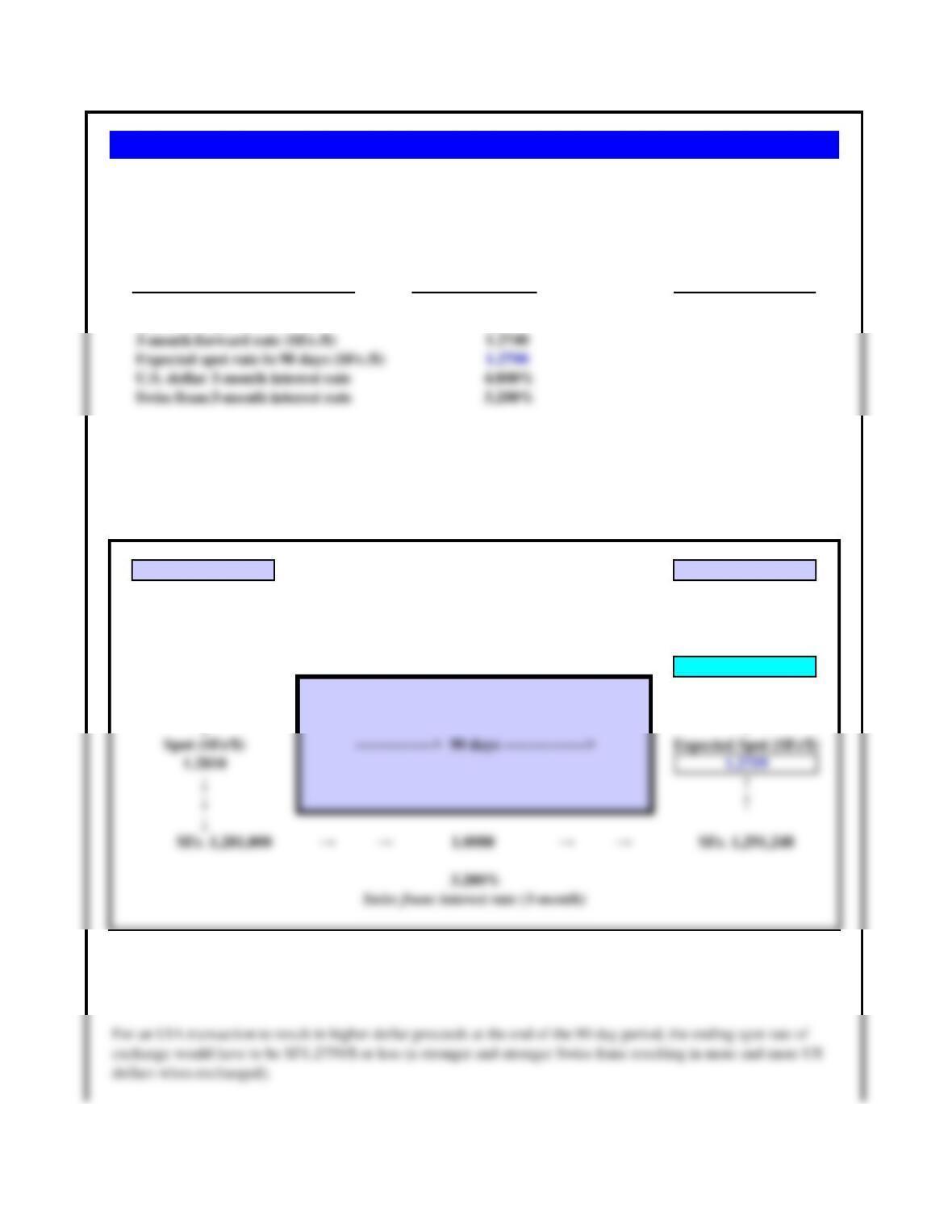
Since Casper is in the US market (starting point), if he were to undertake uncovered interest arbitrage he would be
first exchange dollars for Swiss francs, investing the Swiss francs for 90 days, and then exchanging the Swiss franc
proceeds (principle and interest) back into US dollars at whatever the spot rate of exchange is at that time. In this
case Casper will have to — at least in his mind — make some assumption as to what the exchange rate will be at the
end of the 90 day period.
Problem 6.13 Casper Landsten — UIA (B)
Assumptions
Casper Landsten, using the same values and assumptions as in the previous question, now decides to seek the full
4.800% return available in US dollars by not covering his forward dollar receipts — an uncovered interest arbitrage
(UIA) transaction. Assess this decision.
If Casper assumed the spot rate at the end of 90 days were the same as the current spot rate (SFr1.2810/$), the UIA
transaction would not make much sense. The lower Swiss franc interest rate would yield final dollar proceeds of
only $1,008,000, a full $4,000 less than simply investing in the US (straight across the top of the box).