Instructor Resource
Baack et al., International Marketing, 2e
SAGE Publishing, 2019
1
Review and Discussion Questions
Chapter 6: Markets and Segmentation in an International Context
Review Questions
1. Define markets.
A market consists of people with wants and needs, money to spend, and the
2. Define market segment and market segmentation.
Market segmentation consists of identifying all potential customer groups that are
viable for the purposes of marketing products. International market segmentation is
the process of identifying specific segments – whether they are country groups, other
businesses or individual consumer groups – of potential customers with homogeneous
attributes across different countries, or within a single foreign market, that are likely
to exhibit similar responses to a company’s marketing mix. When identifying market
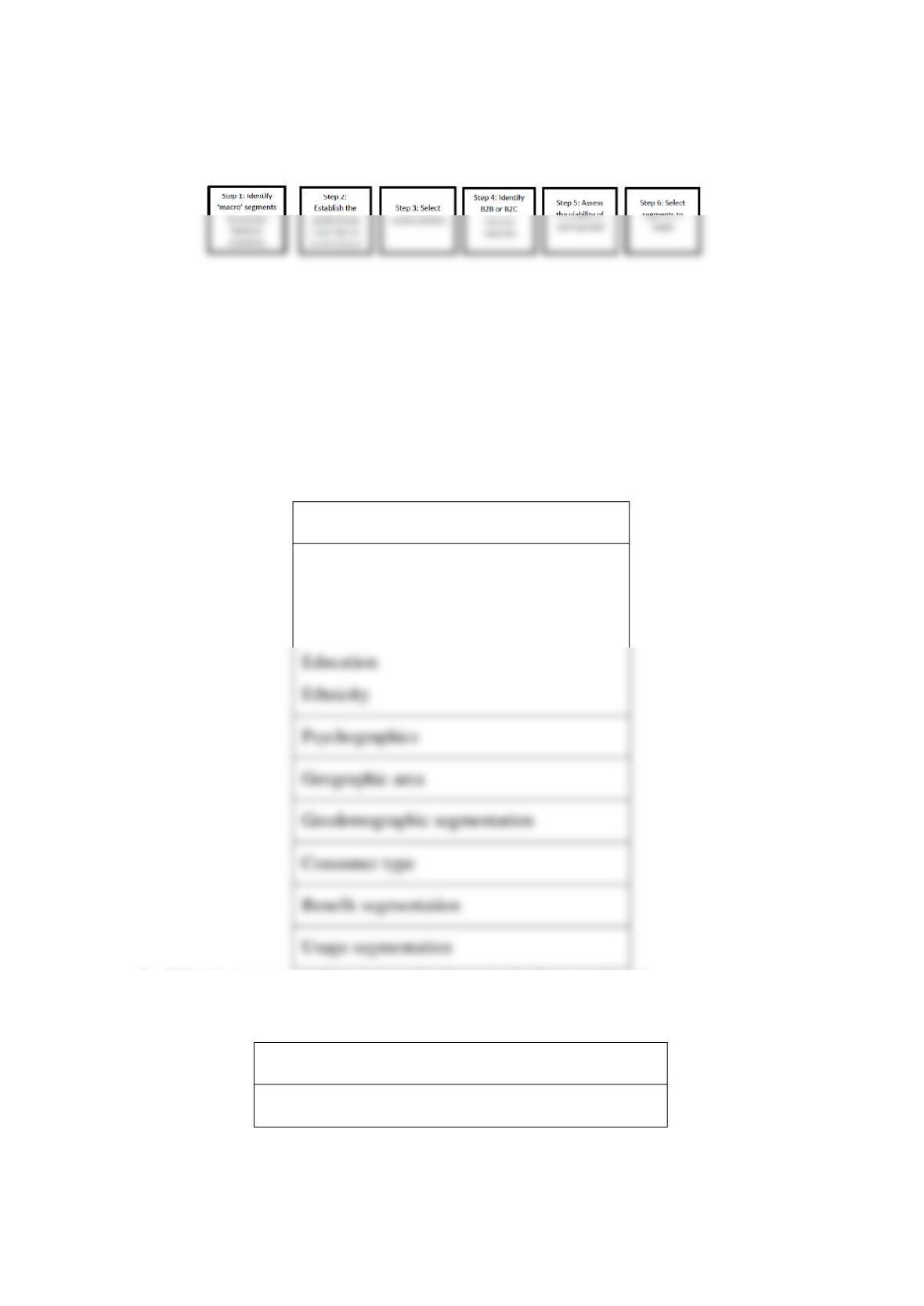
3. Describe the usual steps in international market segmentation process.
Hierarchy of steps in international market segmentation for a firm with an existing
product/service.
Instructor Resource
Baack et al., International Marketing, 2e
SAGE Publishing, 2019
2
4. What factors are used to identify consumer market segments?
When consumers, or end users, are the primary target market for a firm’s offerings,
the consumer market segmentation approaches listed in Figure 6.5 are the most
common. These groups or categories may be combined in international marketing
efforts.
Figure: Consumer market segmenting variables
Demographics
Gender
Age
Income
Psychographics
Geographic area
Geodemographic segmentation
Consumer type
Benefit segmentation
Usage segmentation
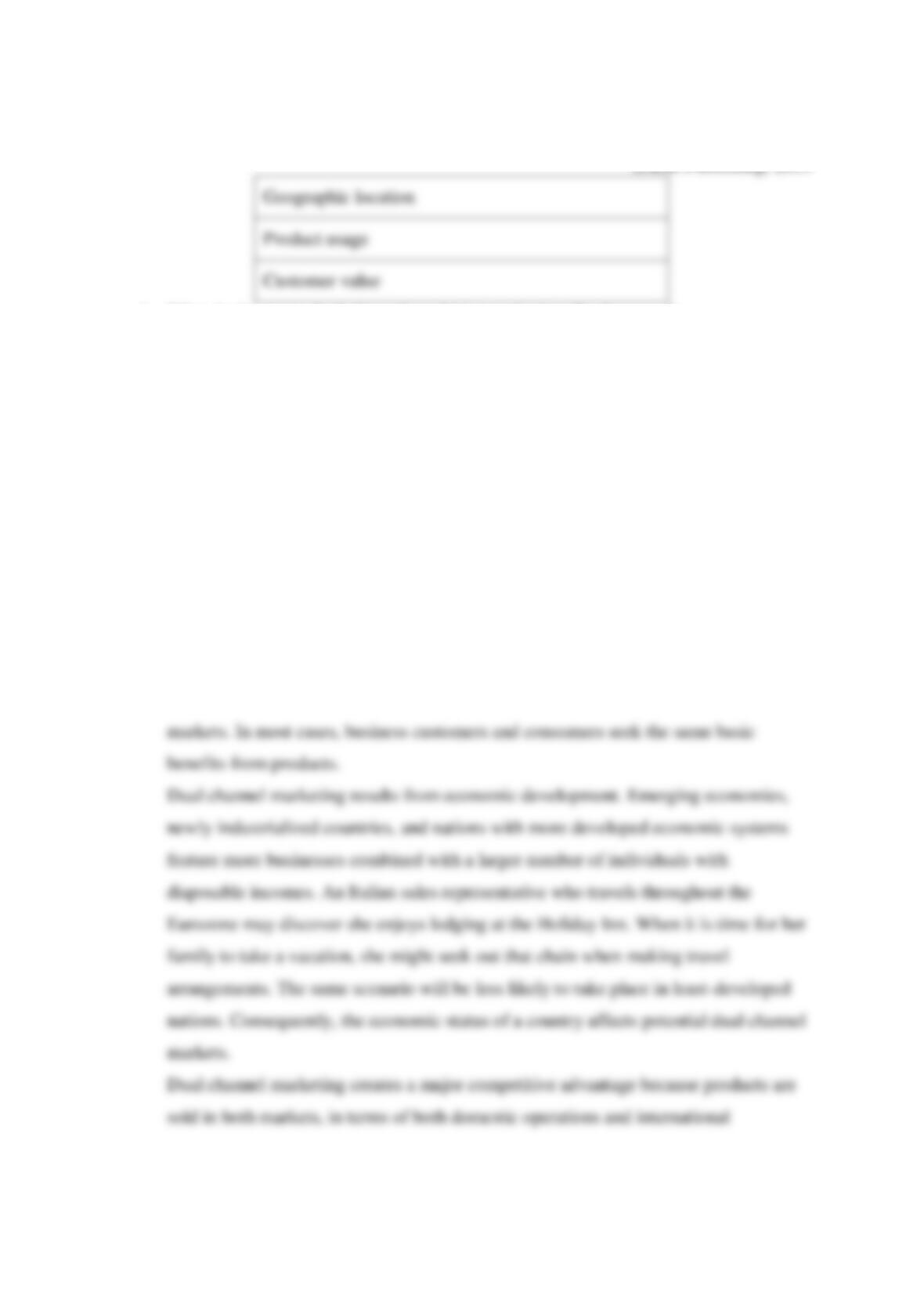
5. What factors are used to segment business-to–business markets?
Figure: Criteria of segmenting business-to-business markets
Industry
Size
Instructor Resource
Baack et al., International Marketing, 2e
3
6. What do the terms dual channel marketing and spin-off sales mean?
Dual channel marketing
Firms that sell virtually the same goods or services to both consumers and businesses
engage in dual channel marketing. The approach fits several situations. One common
scenario occurs when a product sold in business markets is then adapted to consumer
markets. Products including digital cameras, calculators, computers, fax machines,
and cell phones were first sold to businesses and then later to consumers. Also, when
individuals who buy a particular brand at work have positive experiences and, as a
result, purchase the same brand for personal use, spin-off sales occur.
One marketing decision involves how to represent the product in each channel.
Similarities between the two markets may be featured unless there are significant
differences. When consumers and business buyers value different product attributes or
desire different benefits, the marketing team customizes messages for the separate
Instructor Resource
Baack et al., International Marketing, 2e
SAGE Publishing, 2019
4
7. Define the global consumers, local consumers, and glocal consumer concepts.
Global consumers
Many consumers in different nations earn similar incomes and hold the same social
status levels. These individuals often exhibit similar purchasing patterns, suggesting
the presence of an international market segment consisting of global consumers.
Global consumers typically live in developed countries; however, this segment also
includes wealthy consumers in developing and even less-developed countries,
Glocal consumers
The word “glocal” combines the words “global” and “local.” It reflects dual
consumption patterns. Glocal consumers buy global products, but the purchase
represents a special occasion rather than a typical purchase. They may be inclined to
purchase products that mimic global products but ones that are priced slightly lower.
Instructor Resource
Baack et al., International Marketing, 2e
5
Local consumers
Local consumers rarely consume foreign products. For either economic or taste
reasons, these consumers maintain traditional consumption patterns. Many local
consumers live in rural settings where they only infrequently have the opportunity to
purchase foreign goods. These consumers often exhibit high levels of ethnocentrism,
or the strongly held belief that one’s culture is superior to others. Ethnocentrism is, in
8. How is cosmopolitanism related to ethnocentrism?
Ethnocentrism is, in many ways, the opposite of cosmopolitanism. Ethnocentric
consumers generally exhibit a tendency to avoid purchasing foreign-produced
9. How can the marketing mix be adjusted to meet the needs of those at the bottom-of–
the-pyramid?
Segmentation and the bottom-of-the-pyramid
The final global segment consists of the 4 billion people worldwide that live on $2 per
day or less, the bottom-of-the-pyramid consumers (see Figure 6.7 in the textbook).
These individuals experience wants and needs but with only limited money to spend.
Still, opportunities do exist. Even with a small profit margin, the large size and
Instructor Resource
Baack et al., International Marketing, 2e
6
Products
One approach to marketing to bottom-of-the-pyramid consumers involves changing
the product, either in terms of the design of the item to meet a slightly different need
Pricing
Pricing may be adjusted to match a market segment. While it is important to lower the
price to allow for expression of demand, some evidence suggests that persons at the
bottom–of-the-pyramid are also brand conscious. Therefore, pricing based on price-
quality relationships remains viable.
Exchange systems, or the methods of facilitating payment, vary within the economies
of bottom-of-the-pyramid countries. For example, more extensive use of barter
whereby an individual trades one good or service for another often takes place. Use of
money or currency will be limited to the customers who are able to accumulate
sufficient amounts to make payments. Further, debit cards rather than actual currency
Instructor Resource
Baack et al., International Marketing, 2e
SAGE Publishing, 2019
7
cream in India in order to reach low-income consumers. Realizing that refrigeration
constitutes 40% of the cost, the company introduced a salt-based heat shield that was
less expensive to produce, provided more insulation, and contained fewer pollutants,
which reduced costs and the price.
Delivery
Reaching target markets involves finding delivery systems that match a local region.
This includes identifying traffic systems, the presence of electricity on a routine basis,
Promotion
Promoting products to market segments at the bottom-of-the-pyramid creates distinct
challenges. These consumers are less likely to be exposed to mass media and may not
be reachable in most ways. Literacy and overall levels of education may be limiting
10. What types of consumers are most likely to buy green or sustainable products in
industrialized countries?
Recently, an increasing number of more environmentally friendly products have been
developed in the international arena. When conducting a market segmentation
program for these items, the distinction may be drawn between consumer preferences
for green products when as a matter of choice versus when it becomes a matter of
necessity.
Consumer preferences
One of the primary challenges facing green marketers has been consumer
unwillingness to spend more for environmentally-safe products. In essence, the
Instructor Resource
Baack et al., International Marketing, 2e
SAGE Publishing, 2019
8
Green by necessity
In bottom-of-the-pyramid nations, sustainability often becomes a driving force in
purchases. Any item that saves or reuses water, runs on solar power or renewable
batteries, or helps in some other way to preserve natural resources has a better chance
of being accepted and purchased. Part of the reason is that such products also save the
consumer money. A growing amount of evidence suggests that sustainable products
create one of the largest marketing opportunities in nations where the majority of
citizens live below the poverty line.
11. What ethical issues are present in market segmentation processes?
Many of the ethical issues associated with domestic markets also appear in
discussions of international segmentation. For example, one common complaint is
that any segmentation program featuring demographics reinforces stereotypes. This
tendency might emerge when ethnicity becomes the basis for a market segment,
especially when marketing messages play to stereotypical images, both in the
dominant culture and in any subculture or counterculture.
Instructor Resource
Baack et al., International Marketing, 2e
SAGE Publishing, 2019
9
Discussion questions
1. Three methods can be used to select employees to sell products or manage marketing
operations in foreign markets. Expatriates are persons employed by the exporting
company who are asked to move or travel to foreign lands. Locals are individuals
from the target country. Third-party nationals are persons who live in neither the
home country nor the target country. Which do you think would be best suited to use
in an international marketing program focusing on developing new target markets?
Why?
Many approaches are available. Depending on the specific objectives of the
international marketing program, the overall business strategy or branding strategy.
2. Think of circumstances (industries or products) that serve as examples of when to use
the following types of business segmentation:

Instructor Resource
Baack et al., International Marketing, 2e
SAGE Publishing, 2019
10
Industry
Car manufacturer
Size
Supermarkets, small and medium enterprises