Chapter 6
Interest Rate Parity
QUESTIONS
1. Explain the concepts of present value and future value.
2. If the dollar interest rate is positive, explain why the value of $1,000,000 received every
year for 10 years is not $10,000,000 today.
( )
k
k=1
3. Describe how you would calculate a 5-year forward exchange rate of yen per dollar if
you knew the current spot exchange rate and the prices of 5-year pure discount bonds
denominated in yen and dollars. Explain why this has to be the market price.
Chapter 6: Interest Rate Parity
2
( )
5
4. If interest rate parity is satisfied, there are no opportunities for covered interest
arbitrage. What does this imply about the relationship between spot and forward
exchange rates when the foreign currency money market investment offers a higher
return than the domestic money market investment?
5. It is often said that interest rate parity is satisfied when the differential between the
interest rates denominated in two currencies equals the forward premium or discount
between the two currencies. Explain why this is an imprecise statement when the
interest rates are not continuously compounded.
Answer: Interest rate parity requires the equality of returns from investing directly in the
domestic money market versus converting domestic currency into foreign currency, investing
the foreign currency, and selling the foreign currency forward. Symbolically, we have
( ) ( )
1
1 + i(t,DC) = × 1 + i(t,FC) × F(t,DC/FC)
S(t,DC/FC)
If we divide by
( )
1 + i(t,FC)
on both sides and subtract one from both sides, we get
( )
i(t,DC) – i(t,FC) F(t,DC/FC) – S(t,DC/FC)
=
1 + i(t,FC) S(t,DC/FC)
The left-hand side is the interest differential between the domestic and foreign rates adjusted
for the denominator term and the right-hand side is the forward premium or discount on the
foreign currency in terms of the domestic currency.
6. What do economists mean by the external currency market?
©2017 Cambridge University Press
7. What determines the bid–ask spread in the external currency market? Why is it usually
so small?
8. Explain why the absence of covered interest arbitrage possibilities can be characterized
by two inequalities in the presence of bid–ask spreads in the foreign exchange and
external currency markets.
Answer: Because there are bid-ask spreads in the foreign exchange market and in the external
currency market, we do not convert from one currency to another at the same spot or forward
exchange rates, and we do not borrow at the same rate at which we lend. The absence of
9. Describe the sequence of transactions required to do a covered interest arbitrage out of
Japanese yen and into U.S. dollars.
Answer: To do a covered interest arbitrage out of Japanese yen and into U.S. dollars, one
would borrow yen from the bank at the bank’s ask interest rate. You would owe interest on
the yen and would have to return the yen principal at the end of the investment horizon. You
©2017 Cambridge University Press
10. Suppose you saw a set of quoted prices from a U.S. bank and a French bank such that
you could borrow dollars, sell the dollars in the spot foreign exchange market for euros,
deposit the euros for 90 days, and make a forward contract to sell euros for dollars and
make a guaranteed profit. Would this be an arbitrage opportunity? Why or why not?
11. The interest rates on U.S. dollar–denominated bank accounts in Mexican banks are
often higher than the interest rates on bank accounts in the United States. Can you
explain this phenomenon?
12. What is a money market hedge? How is it constructed?
Chapter 6: Interest Rate Parity
6
PROBLEMS
1. In the entry forms for its contests, Publisher’s Clearing House states, “You may have
already won $10,000,000.” If the Prize Patrol visits your house to inform you that you
have won, it offers you $333,333.33 each and every year for 30 years. If the interest rate
is 8% p.a., what is the actual present value of the $10,000,000 prize?
Answer: The present value of 30 annual payments of $333,333.33 when discounted at 8% is
30
1
$333,333.33 $3,752,594.41
1.08k
k=
=
This value can be found in Excel by using the function NPV(rate, cashflows), where rate =
8% and cashflows refers to a sequence of 30 cells that all have the value $333,333.33.
2. Suppose the 5-year interest rate on a dollar-denominated pure discount bond is 4.5%
p.a., whereas in France, the euro interest rate is 7.5% p.a. on a similar pure discount
bond denominated in euros. If the current spot rate is $1.08/€, what is the value of the
forward exchange rate that prevents covered interest arbitrage?
Answer: We know that the 5-year forward rate must satisfy
( )
( )
55
55
1+i(t,5,$) 1.045
F(t,5,$/€) = S(t,$/€)× = $1.08/€ × = $0.9375/€
1.075
1+i(t,5,€)
3. Carla Heinz is a portfolio manager for Deutsche Bank. She is considering two
alternative investments of EUR10,000,000: 180-day euro deposits or 180-day Swiss
francs (CHF) deposits. She has decided not to bear transaction foreign exchange risk.
Suppose she has the following data: 180-day CHF interest rate, 8% p.a., 180-day EUR
interest rate, 10% p.a., spot rate EUR1.1960/CHF, 180-day forward rate,
EUR1.2024/CHF. Which of these deposits provides the higher euro return in 180 days?
If these were actually market prices, what would you expect to happen?
Answer: The euro return to investing directly in euros is
180
5% 10% 360
=
, so the euros
©2017 Cambridge University Press
4. If the 30-day yen interest rate is 3% p.a., and the 30-day euro interest rate is 5% p.a., is
there a forward premium or discount on the euro in terms of the yen? What is the
magnitude of the forward premium or discount?
Answer: We know that the high interest rate currency must sell at a forward discount when
priced in the low interest rate currency to prevent a covered interest arbitrage. Therefore the
euro is at a discount in the forward market. To determine the magnitude of the discount,
5. Suppose the spot rate is CHF1.4706/$ in the spot market, and the 180-day forward rate
is CHF1.4295/$. If the 180-day dollar interest rate is 7% p.a., what is the annualized
180-day interest rate on Swiss francs that would prevent arbitrage?
Answer: Interest rate parity requires equality of the return to investing in CHF versus
converting the CHF principal into dollars, investing the dollars, and selling the dollar
principal plus interest in the forward market for CHF:
( ) ( )
1
1 + i(CHF) = × 1 + i($) × F(CHF/$)
S(CHF/$)
If we de-annualize the dollar interest rate, we find that the 180 day interest rate is 0.035.
Hence, the Swiss franc interest rate that prevents arbitrage is
1
i(CHF) = × 1.035 × CHF1.4295/$ – 1 = 0.0061
CHF1.4706/$
Chapter 6: Interest Rate Parity
8
6. As a trader for Goldman Sachs you see the following prices from two different banks:
1-year euro deposits/loans:
6.0% – 6.125% p.a.
1-year Malaysian ringgit deposits/loans:
10.5% – 10.625% p.a.
Spot exchange rates:
MYR 4.6602 / EUR – MYR 4.6622 / EUR
1-year forward exchange rates:
MYR 4.9500 / EUR – MYR 4.9650 / EUR
The interest rates are quoted on a 360-day year. Can you do a covered interest
arbitrage?
Answer: We need to check the two inequalities that characterize the absence of covered
EUR MYR4.9650/EUR
Thus, it is not profitable to try to arbitrage in this direction as the amount that we would
owe is greater than the amount that we would gain.
7. As an importer of grain into Japan from the United States, you have agreed to pay
$377,287 in 90 days after you receive your grain. You face the following exchange rates
and interest rates: spot rate, ¥106.35/$, 90-day forward rate ¥106.02/$, 90-day USD
interest rate, 3.25% p.a., 90-day JPY interest rate, 1.9375% p.a.
a. Describe the nature and extent of your transaction foreign exchange risk.
Chapter 6: Interest Rate Parity
9
b. Explain two ways to hedge the risk.
c. Which of the alternatives in part b is superior?
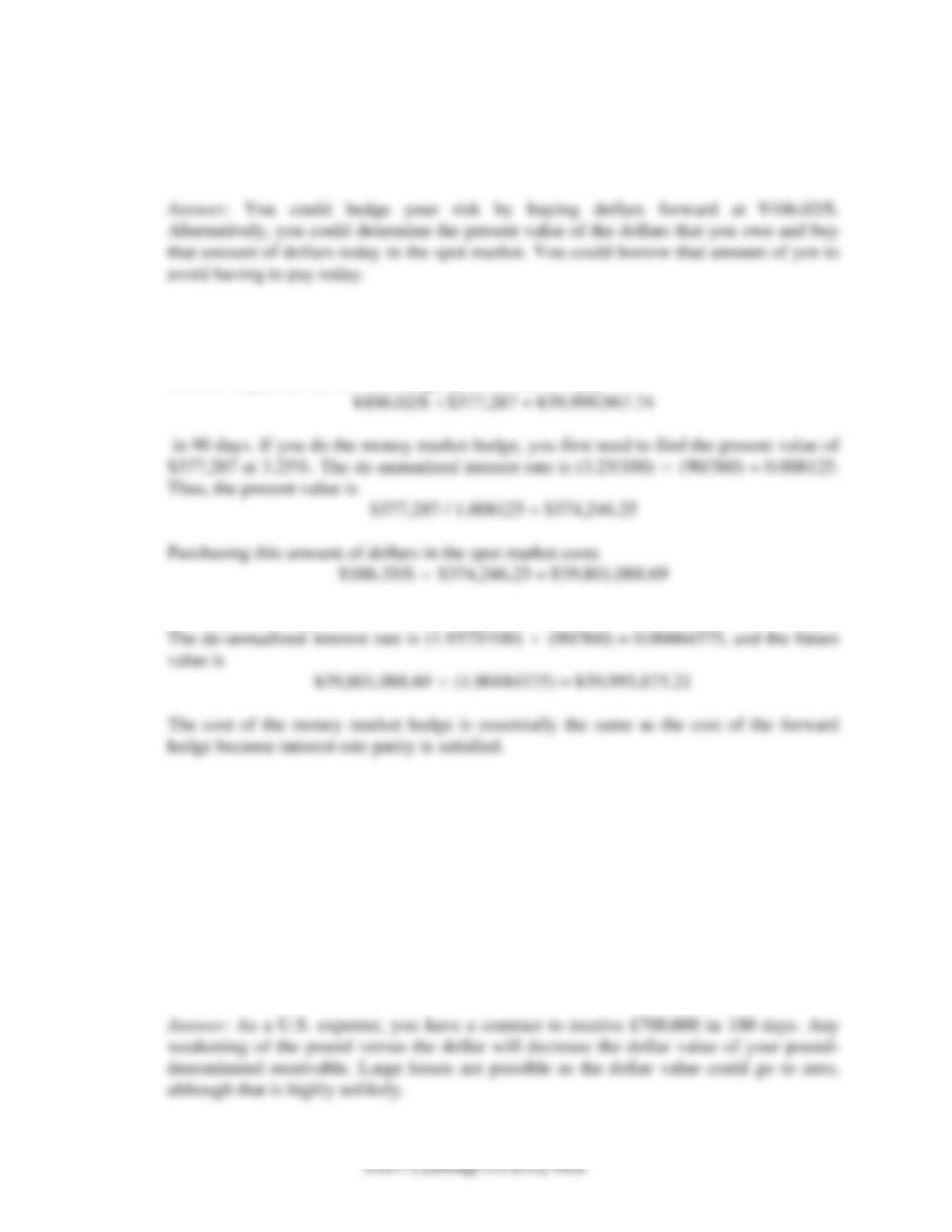
Answer: If you do the forward hedge, you will have to pay
To compare this value to the forward hedge, we must take its future value at 1.9375% p.a.
8. You are a sales manager for Google Nexus and export cellular phones from the United
States to other countries. You have just signed a deal to ship phones to a British
distributor. The deal is denominated in pounds, and you will receive £700,000 when the
phones arrive in London in 180 days. Assume that you can borrow and lend at 7% p.a.
in U.S. dollars and at 10% p.a. in British pounds. Both interest rate quotes are for a
360-day year. The spot exchange rate is $1.4945/£, and the 180-day forward exchange
rate is $1.4802/£.
a. Describe the nature and extent of your transaction foreign exchange risk.
Chapter 6: Interest Rate Parity
10
b. Describe two ways of eliminating the transaction foreign exchange risk.
c. Which of the alternatives in part b is superior?
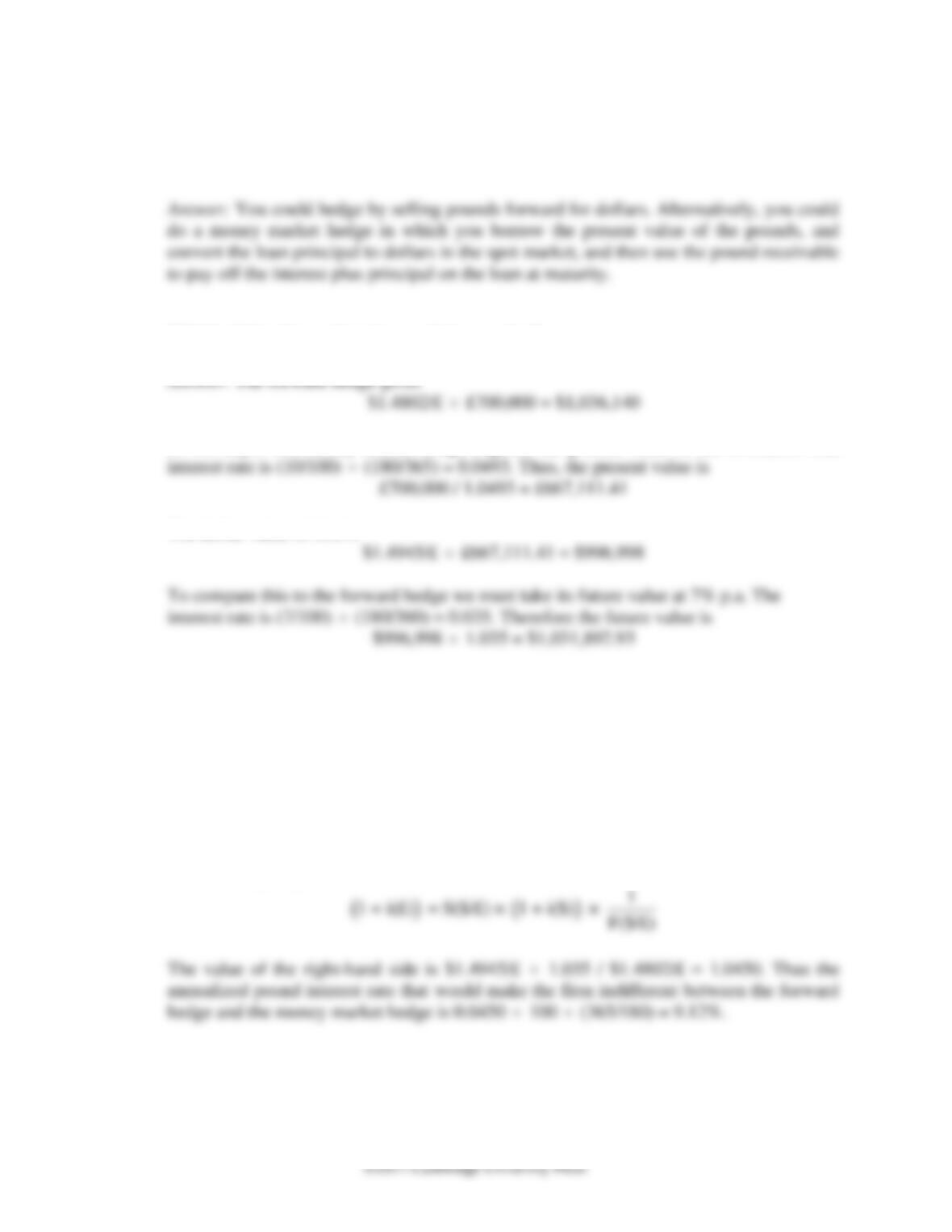
in 180 days. The money market hedge requires the present value of the £700,000. The
The dollar value of this is
The forward hedge provides slightly more dollar revenue.
d. Assume that the dollar interest rate and the exchange rates are correct. Determine
what sterling interest rate would make your firm indifferent between the two
alternative hedges.
Answer: We know that if interest rate parity is satisfied, the money market hedge and the
forward hedge will provide the same revenue. The pound interest rate that satisfies
interest rate parity is
( ) ( )
1
1 + i(£) = S($/£) × 1 + i($) × F($/£)
The value of the right-hand side is $1.4945/£
1.035 / $1.4802/£ = 1.0450. Thus the
annualized pound interest rate that would make the firm indifferent between the forward
hedge and the money market hedge is 0.0450
100
(365/180) = 9.12%.
9. Suppose that there is a 0.5% probability that the government of Argentina will
nationalize its banking system and freeze all foreign deposits indefinitely during the
Chapter 6: Interest Rate Parity
11
next year. If the dollar deposit interest rate in the United States is 5%, what dollar
interest would Argentine banks have to offer in order to attract deposits from foreign
investors?
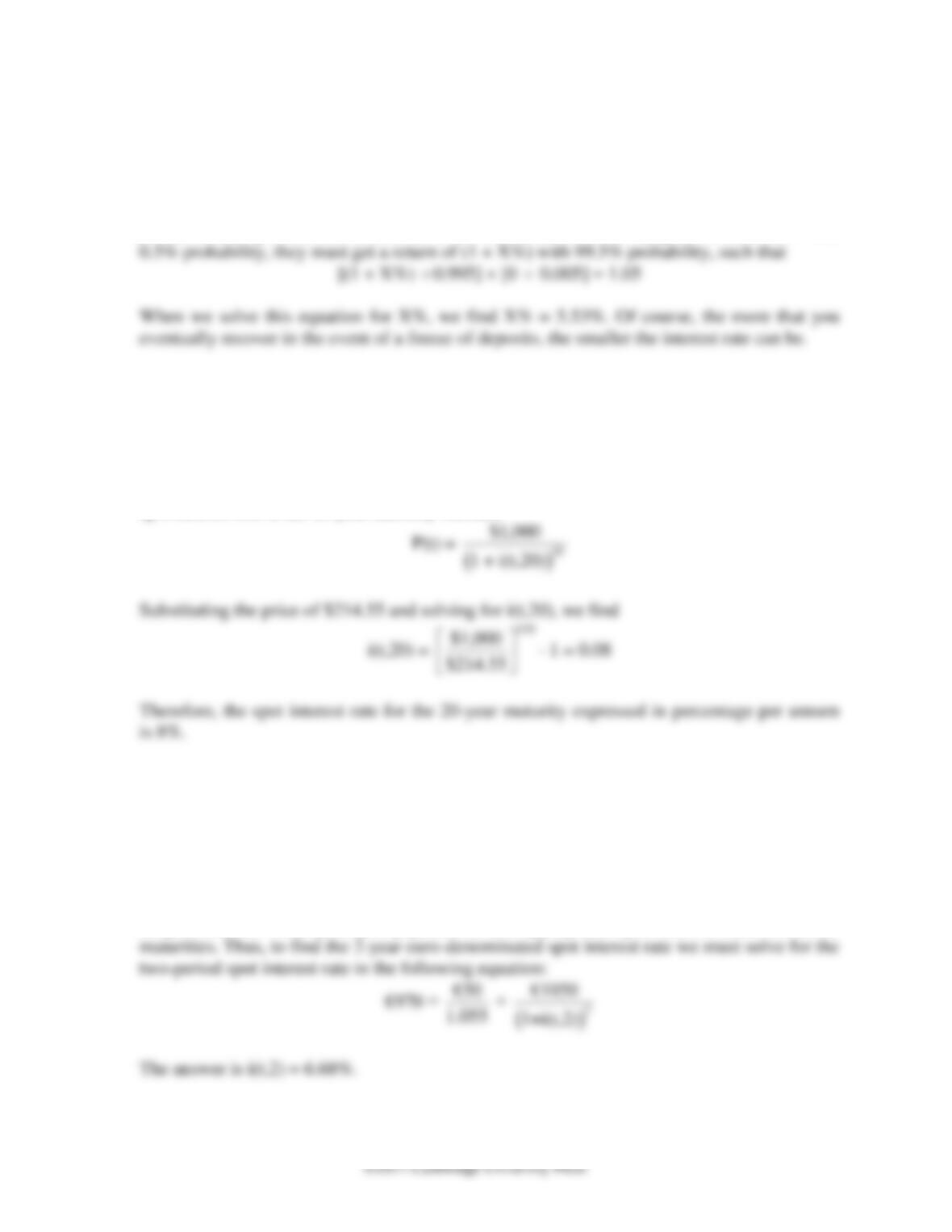
Answer: If the freezing of deposits is an idiosyncratic event, then the expected value of the
return should equal the risk free return of 5%. If investors effectively get a return of zero with
10. Suppose the market price of a 20-year pure discount bond with a face value of $1,000 is
$214.55. What is the spot interest rate for the 20-year maturity expressed in percentage
per annum?
Answer: We know that the relationship between the price of a pure discount bond and the
spot interest rate at the 20 year maturity satisfies
( )
20
$1,000
P(t) = 1 + i(t,20)
Substituting the price of $214.55 and solving for i(t,20), we find
1/20
$1,000
i(t,20) = – 1 = 0.08
$214.55
Therefore, the spot interest rate for the 20-year maturity expressed in percentage per annum
is 8%.
11. Consider a 2-year euro-denominated bond that has a current market price of €970, a
face value of €1,000, and an annual coupon of 5%. Suppose the 1-year euro-
denominated spot interest rate is 5.5%. What is the 2-year euro-denominated spot
interest rate?
Answer: The present value of a coupon paying bond is found by discounting each annual
coupon and the final principal payment at the appropriate spot interest rates for those