INTERNATIONAL ECONOMICS, 7TH EDITION
Study Resources: Questions for Study & Review
Chapter 6
1. Explain how import restrictions affect domestic producers and consumers. How are the
concepts of producers’ surplus and consumers’ surplus useful in demonstrating these
effects?
2. You are given the following information about copper in the European Union:
Situation with tariff Situation without tariff
World price e1.50 per kg e1.50 per kg
Tariff (specific) e0.15 per kg 0
E.U. domestic price e1.65 per kg e1.50 per kg
E.U. consumption 200 million kg 230 million kg
E.U. production 160 million kg 100 million kg
Draw a supply–demand diagram on the basis of these data and indicate imports with
and without the tariff. Calculate:
a. The gain to E.U. consumers from removing the tariff.
b. The loss to E.U. producers from removing the tariff.
c. The loss of tariff revenue to government when the tariff is removed.
d. The net gain or loss to the E.U. economy as a whole.
Explain briefly the meaning of each calculation. In the case of (d), what implicit
assumptions do you make in reporting a net result?
3. Problem 2 assumes that the E.U. acts as a small country in the world copper market,
because the world price remains constant at 1.50 euros per kilo. Assume instead that
with the €0.15 tariff the world price becomes €1.45 per kilo, E.U. consumption falls to
210 million kilos and E.U. production rises to 140 million kilos. Show that new situation
diagrammatically and calculate the effect of the tariff on E.U. consumers, E.U.
producers, government, and the economy as a whole.
4. Suppose the domestic steel industry faces severe competition from a country that is
not a member of the WTO. The industry asks you to prepare a position paper its
lobbyist can use to seek government assistance. Contrast the consequences of
imposing a quota, negotiating a VER, and providing a production subsidy.
5. At free-trade prices, half of the value of leather shoes is accounted for by leather, and
all other intermediate inputs account for 20 percent of the value. The tariff rates on

shoes, leather, and other intermediate inputs are 18 percent, 10 percent, and 5
percent, respectively.
a. Calculate the effective rate of protection for leather shoes.
b. For shoes sold in the protected domestic market, what does this ERP value imply
about payments to labor and capital in shoe production in this country compared to
those payments when production occurs at world prices?
c. The tariff structure above implies tariff escalation. Explain some of the
consequences of such escalation on the effective rate of protection received by
the shoe industry.
6. A country imposes a tariff rate quota (TRQ) on imports of tuna fish. Suppose that for
imports up to 3,000 tons the tariff is $0, and for imports greater than 3,000 tons the
tariff is $175 per ton.
a. If the demand for imports of tuna is Q = 5,000 – 4P, and the supply of imported
tuna is Q = 200 + 8P, what is the price paid by consumers? Compare this solution
to the free trade equilibrium. Be sure to comment on the role of the TRQ.
b. If the demand curve becomes Q = 6,000 – 4P, due to the alleged benefits of tuna
consumption to ensure long life and improved intellectual acuity, what influence
does that have on the price and quantity of imports? Again, comment on the role
of the TRQ. (Hint: if P represents the price paid by consumers, then the foreign
supplier now receives P – $175.)
c. If foreign productivity in tuna fish production rises so that the new foreign supply
curve is
Q = 1,000 + 8P, how does productivity improvement get shared between
producers and consumers, compared to the solution you found in part (b)? Again,
comment on the role of the TRQ.
7. You observe the following information reported by the USITC regarding imports of
butter: the within-quota landed, duty-paid price of butter is $2.798 per kilogram, and
the comparable over-quota price is $3.299. The within-quota tariff is 13.3 cents per
kilogram, and the over-quota tariff is 154.1 cents per kilogram. What do these numbers
suggest about the portion of the tariff equivalent of the quota that is captured by
foreign suppliers?
8. Given your understanding of the different effects of tariffs and quotas, what benefit
would you expect from the World Trade Organization’s success in converting quotas
and other quantitative restrictions into tariffs?
9. Who gains and who loses from the imposition of an export tax? For countries that have
constitutional prohibitions against imposing export taxes, have they lost an effective
trade policy tool? Explain. If a country bans the export of a product, why does that not
make effective use of its market power internationally?
10. Why does a small country lose less from an export subsidy than a large country? Can
a country gain from an export subsidy in a perfectly competitive industry?
INTERNATIONAL ECONOMICS, 7TH
EDITION
Study Resources: Questions for Study &
Review
Chapter 6: Answers
1. Import restrictions raise domestic prices, which benefit producers and hurt
consumers. A quantitative measure of these gains and losses can be made from
Sworld + Tariff
SEU
€1.65
2.
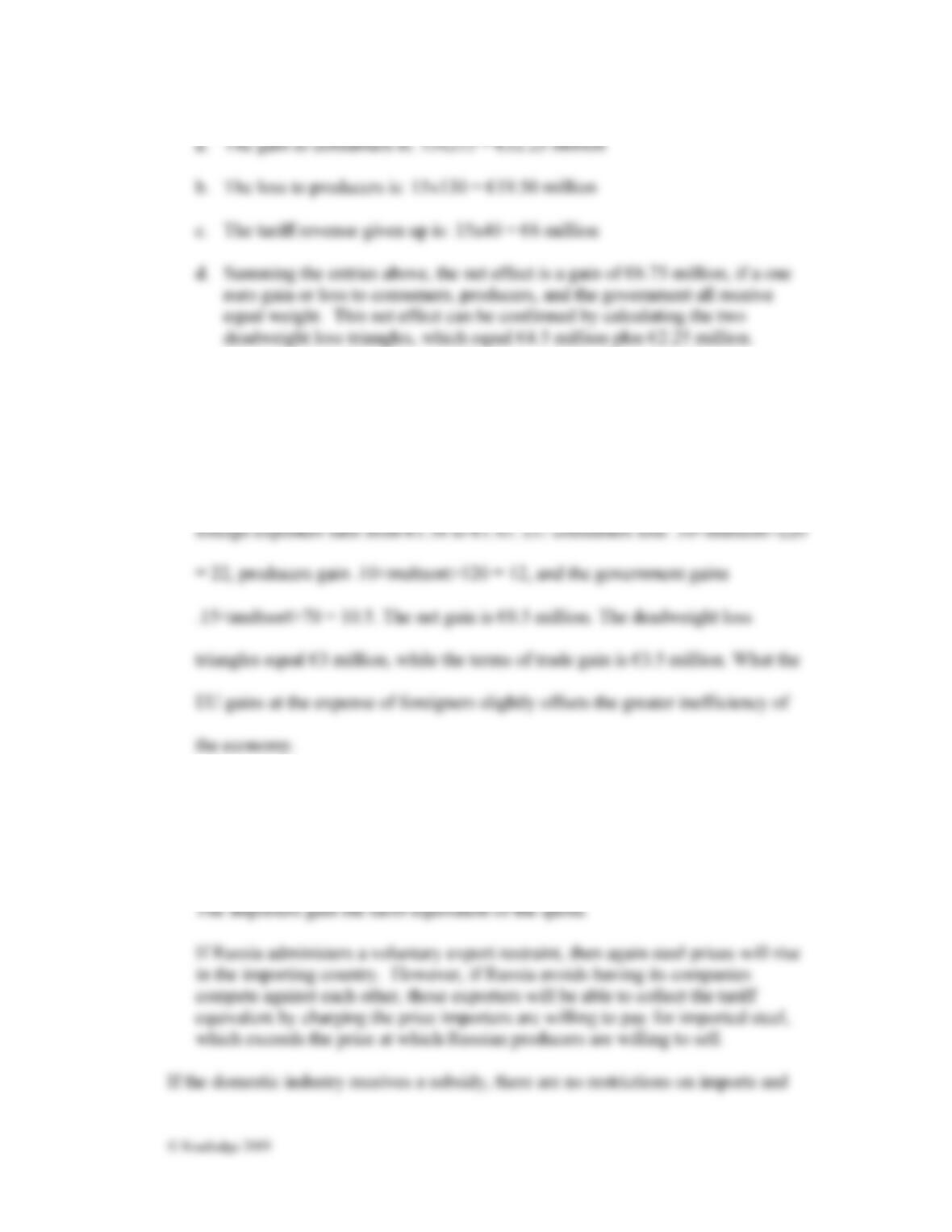
3. Imports fall from 130 million to 70 million as the price to consumer rises from
€1.50 to €1.60. The country’s terms of trade improve, because the price paid to
4. Under a quota, steel prices will rise as fewer imports are allowed into the country.
If there are many competing steel producers in Russia (a country that had not yet
joined the WTO in 2009), then domestic buyers (importers) are more likely to be
able to purchase at a low price in Russia and then sell at a high price at home.
5. a. The ERP for shoes equals [.18 – (0.5<multsort>0.10 +
b. For shoes sold in the protected domestic market, payments to capital and labor
a. 6. From the free trade equilibrium where quantity supplied equals quantity
demanded, the desired quantity is 3,400 tons and the price $400. That
quantity exceeds the tariff-free quota, and therefore it cannot represent an
equilibrium. Rather, if only 3,000 tons enter, then from the demand curve the
price consumers are willing to pay is $500. [That is, 3000 = 5000 – 4P, and
$100. Price does not fall by $100, however. The new price equilibrium is P =
$533.33 [from 6,000 – 4P = 1000 + 8(P-175), and 6,400 = 12 P]. Thus,
7. The gap between the two landed prices is not as large as the gap between the two
specific tariff rates.[$0.501 versus $0.832]. That situation suggests that foreign
8. Under a tariff, the importing country will be able to increase the quantity imported
if its demand rises due to faster growth or if it experiences a negative domestic
9. If a country imposes an export tax, its producers of that good lose and domestic
consumers will benefit from a lower domestic price. In the rest of the world, the
10. As shown in Figure 6.8, a large country that subsidizes exports suffers a terms of
trade loss because foreigners are able to pay a lower price for the exported good.
A small country that subsidizes exports transfers income from taxpayers to
exporters, and increases the quantity of goods exported, but the price paid by the