Chapter 5
Currency Derivatives
Lecture Outline
Forward Market
How MNCs Use Forward Contracts
Bank Quotations on Forward Rates
Premium or Discount on Forward Rate
Movements in the Forward Rate Over Time
Currency Futures Market
Contract Specifications
Trading Currency Futures
Credit Risk of Currency Futures Contracts
Comparing Currency Futures Contracts to Forward Contracts
How MNCs Use Currency Futures Contracts
Speculation with Currency Futures
Currency Options Market
Currency Options Exchanges
Conditional Currency Options
European Currency Options
Currency Derivatives ❖ 2
Chapter Theme
This chapter provides an overview of currency derivatives, which are sometimes referred to as
“speculative.” Yet, firms are increasing their use of these instruments for hedging purposes. The chapter
Topics to Stimulate Class Discussion
1. What advantage do currency options offer that are not available with futures or forward contracts?
2. What are some disadvantages of currency option contracts?
3. Why do currency futures prices change over time?
POINT/COUNTER-POINT:
Should Speculators Use Currency Futures or Options?
POINT: Speculators should use currency futures because they can avoid a substantial premium. To the
extent that they are willing to speculate, they must have confidence in their expectations. If they have
sufficient confidence in their expectations, they should bet on their expectations without having to pay a
large premium to cover themselves if they are wrong. If they do not have confidence in their expectations,
they should not speculate at all.
COUNTER-POINT: Speculators should use currency options to fit the degree of their confidence. For
example, if they are very confident that a currency will appreciate substantially, but want to limit their
investment, they can buy deep out-of-the-money options. These options, which have a high exercise price
but a low premium, require a relatively small investment. Alternatively, speculators can buy options that
have a lower exercise price (higher premium), which will likely generate a greater return if the currency
appreciates. Speculation involves risk. Speculators must recognize that their expectations may be wrong.
While options require a premium, the premium is worthwhile as a means to limit the potential downside
risk. Options enable speculators to select the degree of downside risk that they are willing to tolerate.
WHO IS CORRECT? Use the Internet to learn more about this issue. Which argument do you support?
Offer your own opinion on this issue.
ANSWER: By comparing futures with options, students should recognize the tradeoff that is formed by
the two opposing arguments. The choice of options versus futures may depend on the probability
Currency Derivatives ❖ 3
© 2021 Cengage Learning. All Rights Reserved. May not be copied, scanned, or duplicated, in whole or in part, except for use as
permitted in a license distributed with a certain product or service or otherwise on a password-protected website for classroom use.
but want to cover against possible depreciation may be willing to buy call options so that their downside
risk is limited to what they pay for the call option.
Answers to End of Chapter Questions
1. Forward versus Futures Contracts. Compare and contrast forward and futures contracts.
2. Using Currency Futures.
a. How can corporations use currency futures?
ANSWER: U.S. corporations that desire to lock in a price at which they can sell a foreign currency
b. How can speculators use currency futures?
3. Currency Options. Differentiate between a currency call option and a currency put option.
4. Forward Premium. Compute the forward discount or premium for the Mexican peso whose 90-day
forward rate is $.102 and spot rate is $.10. State whether your answer is a discount or premium.
5. Effects of a Forward Contract. How can a forward contract backfire?
6. Hedging with Currency Options. When would a U.S. firm consider purchasing a call option on
euros for hedging? When would a U.S. firm consider purchasing a put option on euros for hedging?
© 2021 Cengage Learning. All Rights Reserved. May not be copied, scanned, or duplicated, in whole or in part, except for use as
permitted in a license distributed with a certain product or service or otherwise on a password-protected website for classroom use.
7. Speculating with Currency Options. When should a speculator purchase a call option on Australian
dollars? When should a speculator purchase a put option on Australian dollars?
8. Currency Call Option Premiums. List the factors that affect currency call option premiums and
briefly explain the relationship that exists for each. Do you think an at-the-money call option in euros
has a higher or lower premium than an at-the-money call option in Mexican pesos (assuming the
expiration date and the total dollar value represented by each option are the same for both options)?
ANSWER: These factors are listed below:
• The higher the existing spot rate relative to the strike price, the greater is the call option value,
9. Currency Put Option Premiums. List the factors that affect currency put options and briefly explain
the relationship that exists for each.
ANSWER: These factors are listed below:
10. Speculating with Currency Call Options. Randy Rudecki purchased a call option on British pounds
for $.02 per unit. The strike price was $1.45 and the spot rate at the time the option was exercised
was $1.46. Assume there are 31,250 units in a British pound option. What was Randy’s net profit on
this option?
ANSWER:
© 2021 Cengage Learning. All Rights Reserved. May not be copied, scanned, or duplicated, in whole or in part, except for use as
permitted in a license distributed with a certain product or service or otherwise on a password-protected website for classroom use.
15. Speculating with Currency Futures. Assume that the euro’s spot rate has moved in cycles over
time. How might you try to use futures contracts on euros to capitalize on this tendency? How could
you determine whether such a strategy would have been profitable in previous periods?
ANSWER: Use recent movements in the euro to forecast future movements. A cycle implies that a
16. Hedging with Currency Derivatives. Assume that the transactions listed in the first column of the
following table are anticipated by U.S. firms that have no other foreign transactions. Place an “X” in
the table wherever you see possible ways to hedge each of the transactions.
a. Georgetown Co. plans to purchase Japanese goods denominated in yen.
b. Harvard, Inc., sold goods to Japan, denominated in yen.
c. Yale Corp. has a subsidiary in Australia that will be remitting funds to the U.S. parent.
d. Brown, Inc., needs to pay off existing loans that are denominated in Canadian dollars.
e. Princeton Co. may purchase a company in Japan in the near future (but the deal may not go through).
ANSWER:
Forward Contract Futures Contract Options Contract
Forward Forward Buy Sell Purchase Purchase
Purchase Sale Futures Futures Calls Puts
17. Price Movements of Currency Futures. Assume that on November 1, the spot rate of the British
pound was $1.58 and the price on a December futures contract was $1.59. Assume that the pound
depreciated during November so that by November 30 it was worth $1.51.
a. What do you think happened to the futures price over the month of November? Why?
Currency Derivatives ❖ 7
b. If you had known that this would occur, would you have purchased or sold a December futures
contract in pounds on November 1? Explain.
ANSWER: You would have sold futures at the existing futures price of $1.59. Then as the spot rate
18. Speculating with Currency Futures. Assume that a March futures contract on Mexican pesos was
available in January for $.09 per unit. Also assume that forward contracts were available for the same
settlement date at a price of $.092 per peso. How could speculators capitalize on this situation,
assuming zero transaction costs? How would such speculative activity affect the difference between
the forward contract price and the futures price?
ANSWER: Speculators could purchase peso futures for $.09 per unit, and simultaneously sell pesos
19. Speculating with Currency Call Options. LSU Corp. purchased Canadian dollar call options for
speculative purposes. If these options are exercised, LSU will immediately sell the Canadian dollars
in the spot market. Each option was purchased for a premium of $.03 per unit, with an exercise price
of $.75. LSU plans to wait until the expiration date before deciding whether to exercise the options.
Of course, LSU will exercise the options at that time only if it is feasible to do so. In the following
table, fill in the net profit (or loss) per unit to LSU Corp. based on the listed possible spot rates of the
Canadian dollar on the expiration date.
ANSWER:
Possible Spot Rate Net Profit (Loss) per
of Canadian Dollar Unit to LSU Corporation
on Expiration Date if Spot Rate Occurs
20. Speculating with Currency Put Options. Auburn Co. has purchased Canadian dollar put options for
speculative purposes. Each option was purchased for a premium of $.02 per unit, with an exercise
price of $.86 per unit. Auburn Co. will purchase the Canadian dollars just before it exercises the
options (if it is feasible to exercise the options). It plans to wait until the expiration date before
deciding whether to exercise the options. In the following table, fill in the net profit (or loss) per unit
to Auburn Co. based on the listed possible spot rates of the Canadian dollar on the expiration date.
Currency Derivatives ❖ 8
ANSWER:
Possible Spot Rate Net Profit (Loss) per Unit
of Canadian Dollar to Auburn Corporation
on Expiration Date if Spot Rate Occurs
21. Speculating with Currency Call Options. Bama Corp. has sold British pound call options for
speculative purposes. The option premium was $.06 per unit, and the exercise price was $1.58.
Bama will purchase the pounds on the day the options are exercised (if the options are exercised) in
order to fulfill its obligation. In the following table, fill in the net profit (or loss) to Bama Corp. if the
listed spot rate exists at the time the purchaser of the call options considers exercising them.
ANSWER:
Possible Spot Rate at the Net Profit (Loss) per
Time Purchaser of Call Option Unit to Bama Corporation
Considers Exercising Them if Spot Rate Occurs
$1.53 $.06
1.57 .06
1.62 .02
22. Speculating with Currency Put Options. Bulldog, Inc., has sold Australian dollar put options at a
premium of $.01 per unit, and an exercise price of $.76 per unit. It has forecasted the Australian
dollar’s lowest level over the period of concern as shown in the following table. Determine the net
profit (or loss) per unit to Bulldog, Inc., if each level occurs and the put options are exercised at that
time.
ANSWER:
Possible Value Net Profit (Loss) to
of Australian Dollar Bulldog, Inc. if Value Occurs
$.72 –$.03
23. Hedging with Currency Derivatives. A U.S. professional football team plans to play an exhibition
game in the United Kingdom next year. Assume that all expenses will be paid by the British
government, and that the team will receive a check for 1 million pounds. The team anticipates that the
pound will depreciate substantially by the scheduled date of the game. In addition, the National Foot-
Currency Derivatives ❖ 9
ball League must approve the deal, and approval (or disapproval) will not occur for three months.
How can the team hedge its position? What is there to lose by waiting three months to see if the
exhibition game is approved before hedging?
ANSWER: The team could purchase put options on pounds in order to lock in the amount at which it
could convert the 1 million pounds to dollars. The expiration date of the put option should
Advanced Questions
24. Risk of Currency Futures. Currency futures markets are commonly used as a means of capitalizing
on shifts in currency values, because the value of a futures contract tends to move in line with the
change in the corresponding currency value. Recently, many currencies have appreciated against the
dollar. Most speculators anticipated that these currencies would continue to strengthen and took large
buy positions in currency futures. However, the Fed intervened in the foreign exchange market by
immediately selling foreign currencies in exchange for dollars, causing an abrupt decline in the values
of foreign currencies (as the dollar strengthened). Participants that had purchased currency futures
contracts incurred large losses. One prominent trader responded to the effects of the Fed’s
intervention by immediately selling 300 futures contracts on British pounds (with a value of about
$30 million). Such actions caused even more panic in the futures market.
a. Explain why the central bank’s intervention caused such panic among currency futures traders
with buy positions.
ANSWER: Futures prices on pounds rose in tandem with the value of the pound. However, when
central banks intervened to support the dollar, the value of the pound declined, and so did values of
futures contracts on pounds. So traders with long (buy) positions in these contracts experienced
losses because the contract values declined.
b. Explain why the prominent trader’s willingness to sell 300 pound futures contracts at the going
market rate aroused such concern. What might this action signal to other traders?
c. Explain why speculators with short (sell) positions could benefit as a result of the central bank’s
intervention.
Currency Derivatives ❖ 10
© 2021 Cengage Learning. All Rights Reserved. May not be copied, scanned, or duplicated, in whole or in part, except for use as
permitted in a license distributed with a certain product or service or otherwise on a password-protected website for classroom use.
purchasing the same contracts that they had sold earlier. Since the prices of futures contracts
declined, they would purchase the contracts for a lower price than the price at which they initially
sold the contracts.
d. Some traders with buy positions may have responded immediately to the central bank’s
intervention by selling futures contracts. Why would some speculators with buy positions leave
their positions unchanged or even increase their positions by purchasing more futures contracts in
response to the central bank’s intervention?
25. Estimating Profits from Currency Futures and Options. One year ago, you sold a put option
on 100,000 euros with an expiration date of one year. You received a premium on the put option of
$.04 per unit; the exercise price was $1.22. Assume that one year ago, the spot rate of the euro was
$1.20, the one-year forward rate exhibited a discount of 2%, and the one-year futures price was the
same as the one-year forward rate. From one year ago to today, the euro depreciated against the
dollar by 4 percent. Today the put option will be exercised (if it is feasible for the buyer to do so).
a. Determine the total dollar amount of your profit or loss from your position in the put option.
b. Now assume that instead of taking a position in the put option one year ago, you sold a futures
contract on 100,000 euros with a settlement date of one year. Determine the total dollar amount of
your profit or loss.
ANSWER:
a. The spot rate depreciated from $1.20 to $1.152.
26. Impact of Information on Currency Futures and Options Prices. Myrtle Beach Co. purchases
imports that have a price of 400,000 Singapore dollars and it has to pay for the imports in 90 days. It
can purchase a 90-day forward contract on Singapore dollars at $.50 or purchase a call option contract
on Singapore dollars with an exercise price of $.50 to cover its payables. This morning, the spot rate
of the Singapore dollar was $.50. At noon, the central bank of Singapore raised interest rates, while
there was no change in interest rates in the U.S. These actions immediately increased the degree of
uncertainty surrounding the future value of the Singapore dollar over the next three months. The
Singapore dollar’s spot rate remained at $.50 throughout the day.
a. Myrtle Beach Co. is convinced that the Singapore dollar will definitely appreciate substantially
over the next 90 days. Would a call option hedge or forward hedge be more appropriate given its
opinion?
b. Assume that Myrtle Beach uses a currency options contract to hedge rather than a forward
contract. If the company purchased a currency call option contract at the money on Singapore
dollars this afternoon, would its total U.S. dollar cash outflows be more than, less than, or the
Currency Derivatives ❖ 11
same as the total U.S. dollar cash outflows if it had purchased a currency call option contract at
the money this morning? Explain.
ANSWER:
a. A forward hedge would be more appropriate, because it can lock in payment at $.50 per unit with
27. Currency Straddles. Reska, Inc., has constructed a long euro straddle. A call option on euros with an
exercise price of $1.10 has a premium of $.025 per unit. A euro put option has a premium of $.017
per unit. Some possible euro values at option expiration are shown in the following table. (See
Appendix B in this chapter.)
Value of Euro at Option Expiration
$.90
$1.05
$1.50
$2.00
Call
Put
Net
a. Complete the worksheet and determine the net profit per unit to Reska Inc. for each possible
future spot rate.
b. Determine the break-even point(s) of the long straddle. What are the break-even points of a short
straddle using these options?
ANSWER:
a.
Value of Euro at Option Expiration
$.90
$1.05
$1.50
$2.00
Call
–$.025
–$.025
+$.375
+$.875
Put
+$.183
+$.033
–$.017
–$.017
Net
+$.158
+$.008
+$.358
+$.858
b. The break-even points for a long straddle can be found by subtracting and adding both premiums
28. Currency Straddles. Refer to the previous question but assume that the call and put option premiums
are $.02 per unit and $.015 per unit, respectively. (See Appendix B in this chapter.)
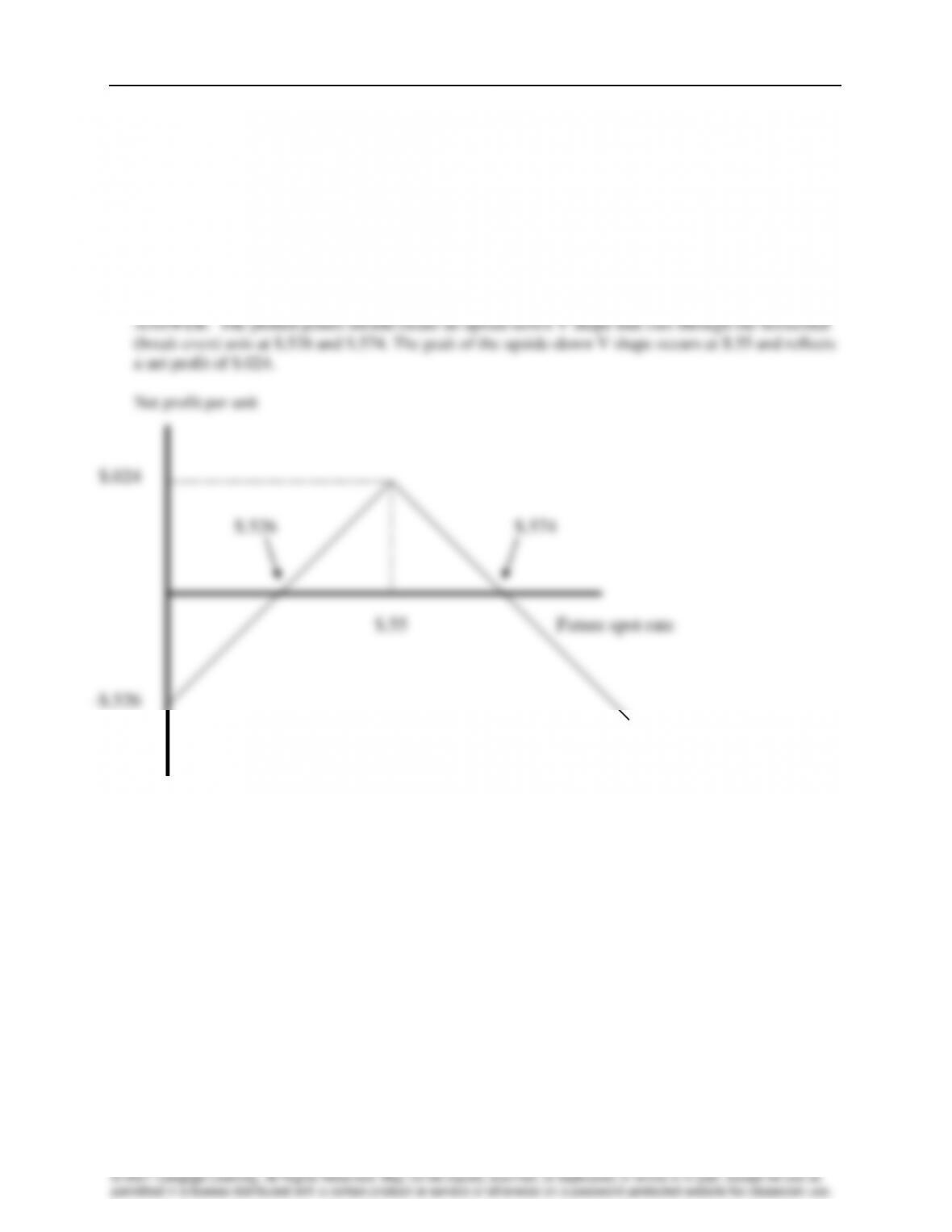
a. Construct a contingency graph for a long euro straddle.
b. Construct a contingency graph for a short euro straddle.
ANSWER:
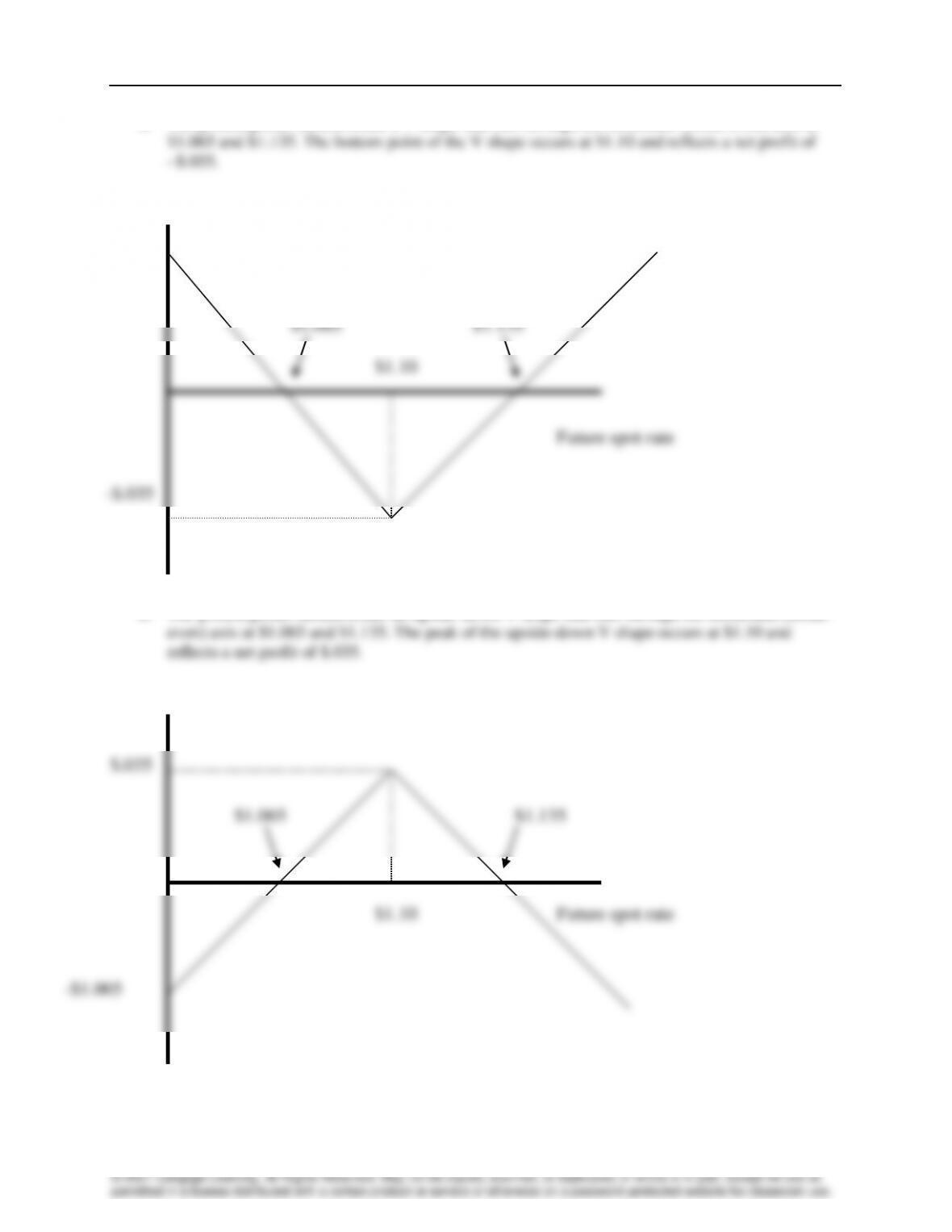
Currency Derivatives ❖ 12
a. The plotted points should create a V shape that cuts through the horizontal (break-even) axis at
Net profit per unit
b. The plotted points should create an upside-down V shape that cuts through the horizontal (break-
Net profit per unit
Future spot rate
$1.065
$1.135
$1.10
Future spot rate
$1.065
$1.135
$1.10
-$.035
$1.065
-$1.065
$.035
Currency Derivatives ❖ 13
29. Currency Option Contingency Graphs. (See Appendix B in this chapter.) The current spot rate of
the Singapore dollar (S$) is $.50. The following option information is available:
• Call option premium on Singapore dollar (S$) = $.015
• Put option premium on Singapore dollar (S$) = $.009
• Call and put option strike price = $.55
• One option contract represents S$70,000
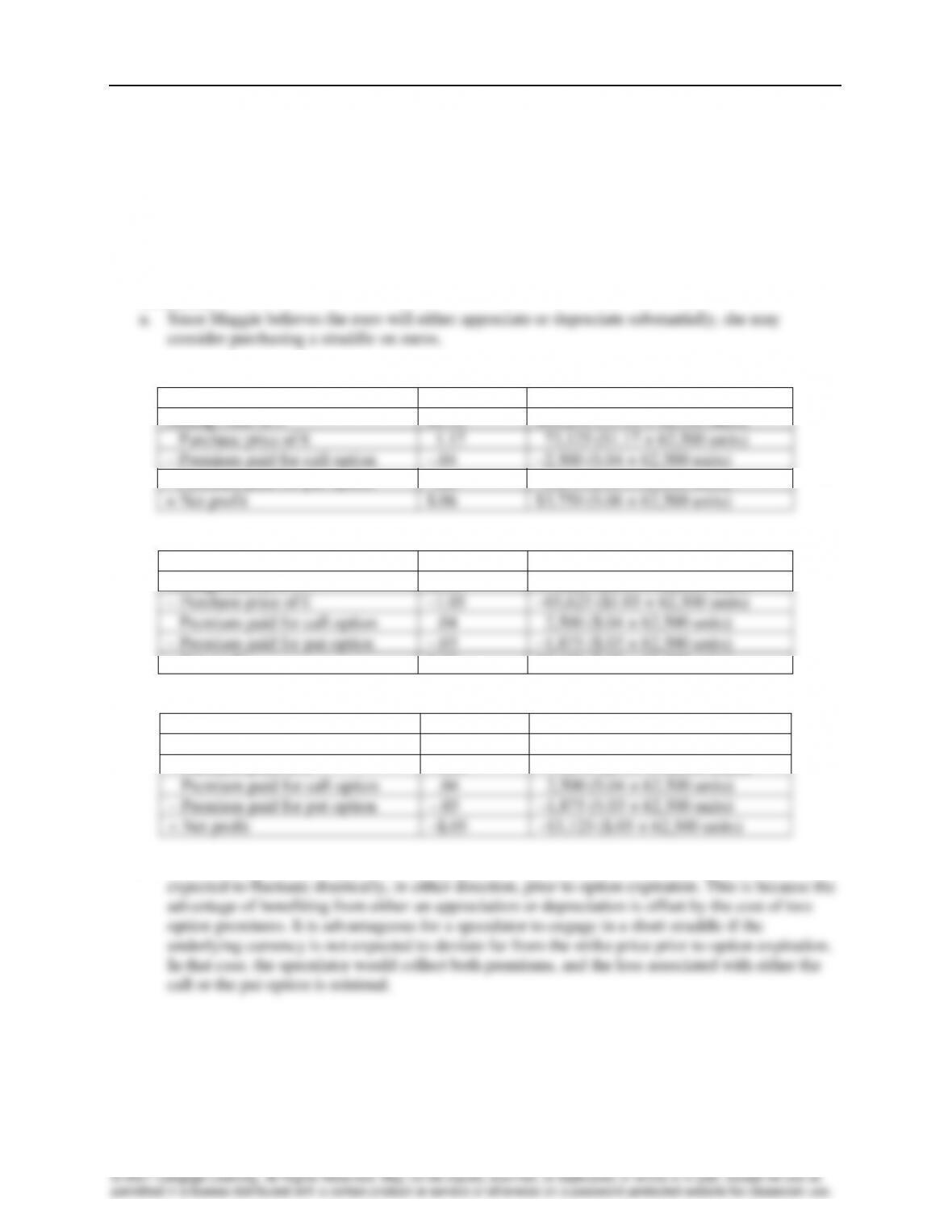
Construct a contingency graph for a short straddle using these options.
30. Speculating with Currency Straddles. Maggie Hawthorne is a currency speculator. She has noticed
recently that the euro has appreciated substantially against the U.S. dollar. The current exchange rate
of the euro is $1.15. After reading a variety of articles on the subject, Maggie believes that the euro
will continue to fluctuate substantially in the months to come. Although most forecasters expect that
the euro will depreciate against the dollar in the near future, Maggie thinks that there is also a good
possibility of further appreciation. Currently, a call option on euros is available with an exercise price
of $1.17 and a premium of $.04. A euro put option with an exercise price of $1.17 and a premium of
$.03 is also available. (See Appendix B in this chapter.)
a. Describe how Maggie could use straddles to speculate on the euro’s value.
b. At option expiration, the value of the euro is $1.30. What is Maggie’s total profit or loss from a
long straddle position?
Future spot rate
$.526
$.574
$.55
-$.526
$.024
Currency Derivatives ❖ 14
c. What is Maggie’s total profit or loss from a long straddle position if the value of the euro is $1.05
at option expiration?
d. What is Maggie’s total profit or loss from a long straddle position if the value of the euro at
option expiration is still $1.15?
e. Given your answers to the questions (b) through (d), when is it advantageous for a speculator to
engage in a long straddle? When is it advantageous to engage in a short straddle?
ANSWER:
b.
Per Unit
Per Contract
Selling Price of €
$1.30
$81,250 ($1.30 × 62,500 units)
– Purchase price of €
–1.17
–73,125 ($1.17 × 62,500 units)
– Premium paid for call option
–.04
–2,500 ($.04 × 62,500 units)
– Premium paid for put option
–.03
–1,875 ($.03 × 62,500 units)
= Net profit
$.06
$3,750 ($.06 × 62,500 units)
c.
Per Unit
Per Contract
Selling Price of €
$1.17
$73,125 ($1.17 × 62,500 units)
– Purchase price of €
–1.05
–65,625 ($1.05 × 62,500 units)
– Premium paid for call option
–.04
–2,500 ($.04 × 62,500 units)
– Premium paid for put option
–.03
–1,875 ($.03 × 62,500 units)
= Net profit
$.05
$3,125 ($.05 × 62,500 units)
d.
Per Unit
Per Contract
Selling Price of €
$1.17
$73,125 ($1.17 × 62,500 units)
– Purchase price of €
–1.15
–71,875 ($1.15 × 62,500 units)
– Premium paid for call option
–.04
–2,500 ($.04 × 62,500 units)
– Premium paid for put option
–.03
–1,875 ($.03 × 62,500 units)
= Net profit
–$.05
–$3,125 ($.05 × 62,500 units)
e. It is advantageous for a speculator to engage in a long straddle if the underlying currency is