CHAPTER 5
THE FOREIGN EXCHANGE MARKET
1. Definitions. Define the following terms:
a. Foreign exchange market. The foreign exchange market provides the physical and
institutional structure through which the money of one country is exchanged for
that of another country, the rate of exchange between currencies is determined,
and foreign exchange transactions are physically completed.
c. Foreign exchange. Foreign exchange means the money of a foreign country; that
is, foreign currency bank balances, bank notes, checks, and drafts.
2. Functions of the Foreign Exchange Market. What are the three major functions of
the foreign exchange market?
▪ To transfer purchasing power from one country and its currency to another.
Typical parties would be importers and exporters, investors in foreign securities,
and tourists.
3. Structure of the FX Market. How is the global foreign exchange market
structured? Is digital telecommunications replacing people?
One of the biggest changes in the foreign exchange market in the past decade has
been its shift from a two-tier market (the interbank or wholesale market, and the
client or retail market) to a single-tier market. Electronic platforms and the
development of sophisticated trading algorithms have facilitated market access by
traders of all kinds and sizes.
looking to profit from its future movements, while liquidity seekers simply wish to
secure currency for transactions. As a result, the profit seekers generally profit from
the liquidity seekers.
4. Market Participants. For each of the foreign exchange market participants, identify
their motive for buying or selling foreign exchange.
▪ Foreign exchange dealers are banks and a few non-bank institutions that “make a
market” in foreign exchange. They buy and sell foreign exchange in the wholesale
market and resell or re-buy it from customers at a slight change from the
wholesale price.
▪ Individuals and firms conducting international business consist primarily of three
categories: importers and exporters, companies making direct foreign
investments, and securities investors buying or selling debt or equity investments
for their portfolios.
▪ Speculators and arbitragers buy and sell foreign exchange for profit. Speculators
and arbitragers buy or sell foreign exchange on the basis of which direction they
believe a currency’s value will change in the immediate or speculative horizon.
5. Foreign Exchange Transaction. Define each of the following types of foreign
exchange transactions:
a. Spot. A spot transaction is an agreement between two parties to exchange one
currency for another, with the transaction being carried out at once for
commercial customers and on the second following business day for most
interbank (i.e., wholesale) trades.
forward for delivery in three months at $1.6820/£. The difference between the
buying price and the selling price is equivalent to the interest rate differential, i.e.,
interest rate parity, between the two currencies. Thus a swap can be viewed as a
technique for borrowing another currency on a fully collateralized basis.
6. Swap Transactions. Define and differentiate the different type of swap transactions
in the foreign exchange markets.
A swap transaction in the interbank market is the simultaneous purchase and sale of a
given amount of foreign exchange for two different value dates. Both purchase and
sale are conducted with the same counterparty. There are several types of swap
transactions.
Spot Against Forward. The most common type of swap is a “spot against forward.”
The dealer buys a currency in the spot market (at the spot rate) and simultaneously
Forward-Forward Swaps. A more sophisticated swap transaction is called a
forward-forward swap. For example, a dealer sells £20,000,000 forward for dollars
for delivery in, say, two months at $1.8420/£ and simultaneously buys £20,000,000
forward for delivery in three months at $1.8400/£. The difference between the buying
Nondeliverable Forwards (NDFs). Created in the early 1990s, the nondeliverable
forward (NDF), is now a relatively common derivative offered by the largest
providers of foreign exchange derivatives. NDFs possess the same characteristics and
7. Nondeliverable Forward. What is a nondeliverable forward and why does it exist?
The nondeliverable forward (NDF), is now a relatively common derivative offered by
the largest providers of foreign exchange derivatives. NDFs possess the same
characteristics and documentation requirements as traditional forward contracts,
are traded internationally using standards set by the International Swaps and
Derivatives Association (ISDA). Although originally envisioned to be a method of
currency hedging, it is now estimated that more than 70% of all NDF trading is for
speculation purposes.
8. Foreign Exchange Market Characteristics. With reference to foreign exchange
turnover in 2010:
a. Rank the relative size of spot, forwards, and swaps as of 2007. Ranking: 1.
Swaps; 2. Spot; 3. Forwards
9. Foreign Exchange Rate Quotations. Define and give an example of each of the
following quotes:
a. Bid rate quote.
b. Ask rate quote.
Interbank quotations are given as a bid and ask (also referred to as offer). A bid is the
price (i.e., exchange rate) in one currency at which a dealer will buy another currency.
An ask is the price (i.e., exchange rate) at which a dealer will sell the other currency.
Dealers bid (buy) at one price and ask (sell) at a slightly higher price, making their
profit from the spread between the buying and selling prices.
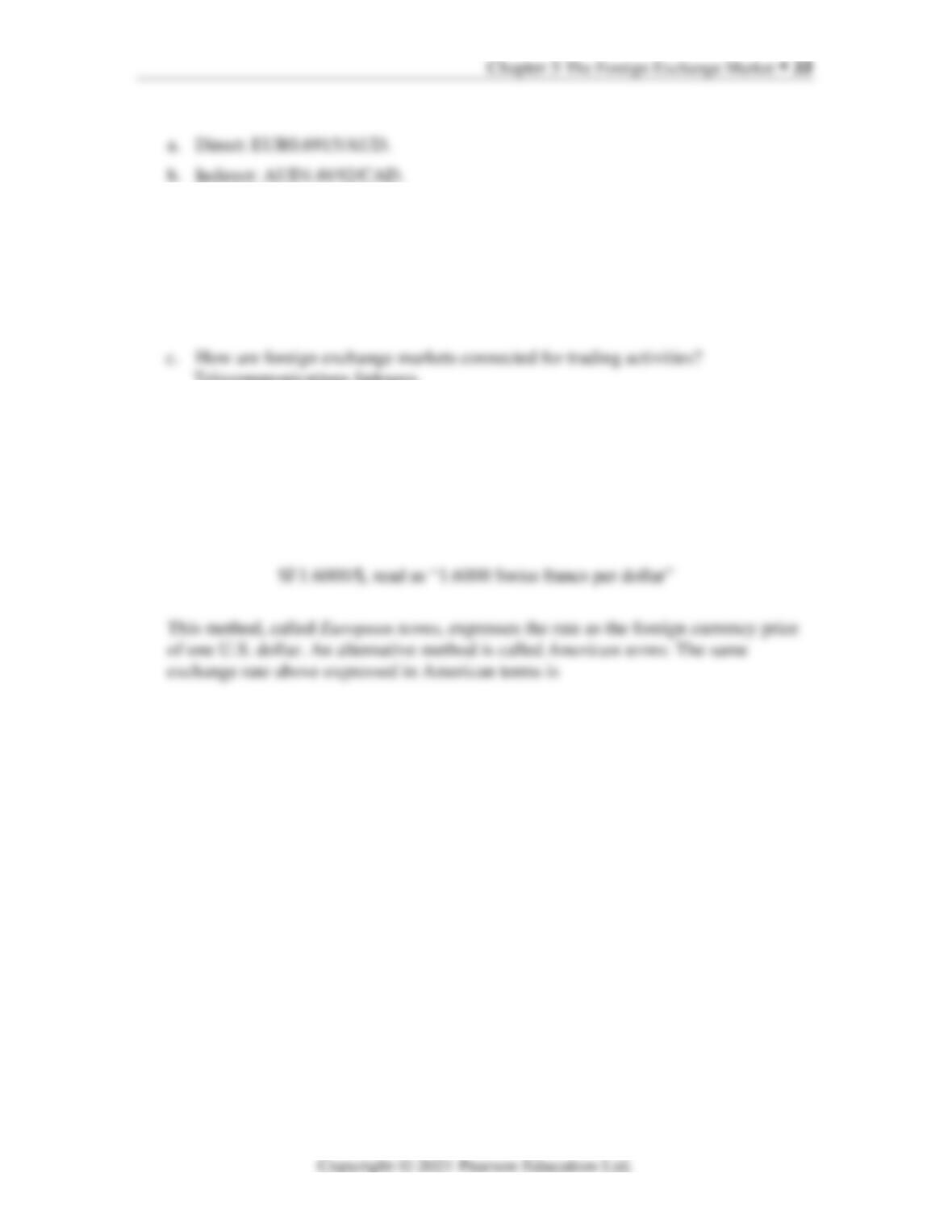
10. Reciprocals. Suppose that Australia is the home country. Determine whether the
following quotes are direct or indirect, and convert indirect (direct) quotes to direct
(indirect) quotes:
11. Geographical Extent of the Foreign Exchange Market.
a. What is the geographical location? All countries.
b. What are the two main types of trading systems? 1) Trading on an exchange or
exchange floor and 2) telecommunications linkages.
Telecommunications linkages.
12. American and European Terms. With reference to interbank quotations, what is the
difference between American terms and European terms?
Most foreign currencies in the world are stated in terms of the number of units of
foreign currency needed to buy one dollar. For example, the exchange rate between
U.S. dollars and Swiss franc is normally stated
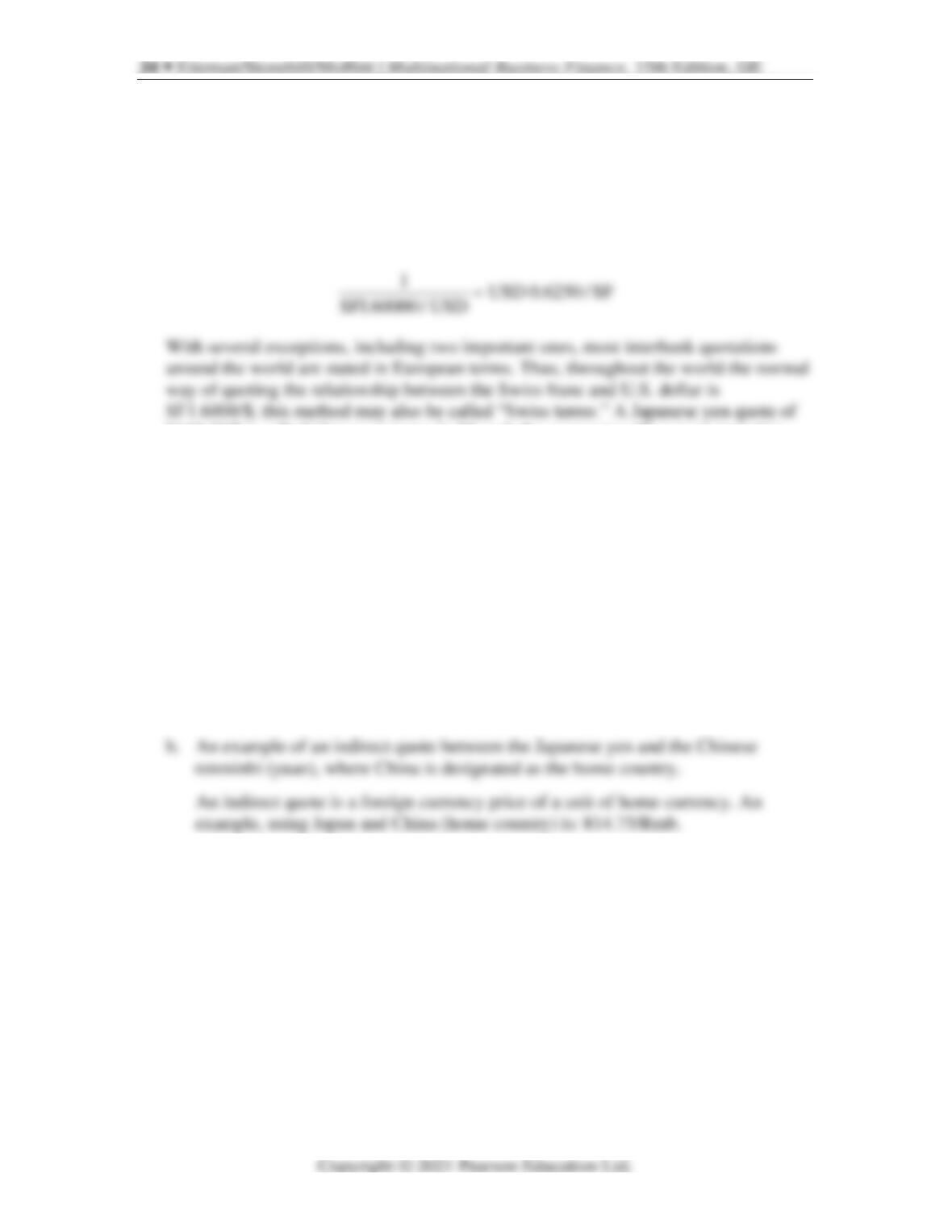
$0.6250/SF, read as “0.6250 dollars per Swiss franc”
Under American terms, foreign exchange rates are stated as the U.S. dollar price of
one unit of foreign currency. Note that European terms and American terms are
reciprocals:
¥118.32/$ is called “Japanese terms,” although the expression “European terms” is
often used as the generic name for Asian as well as European currency prices of the
dollar. European terms were adopted as the universal way of expressing foreign
exchange rates for most (but not all) currencies in 1978 to facilitate worldwide trading
through telecommunications
13. Direct and Indirect Quotes. Define and give an example of the following:
a. An example of a direct quote between the U.S. dollar and the Mexican peso,
where the United States is designated as the home country.
A direct quote is a home currency price of a unit of foreign currency. An example,
using Mexico and the United States (home country) is: $0.1050/Peso.
14. Base and Price Currency. Define base currency, unit currency, price currency, and
quote currency.
Foreign exchange quotations follow a number of principles, which at first may seem a
bit confusing or non-intuitive. Every currency exchange involves two currencies,
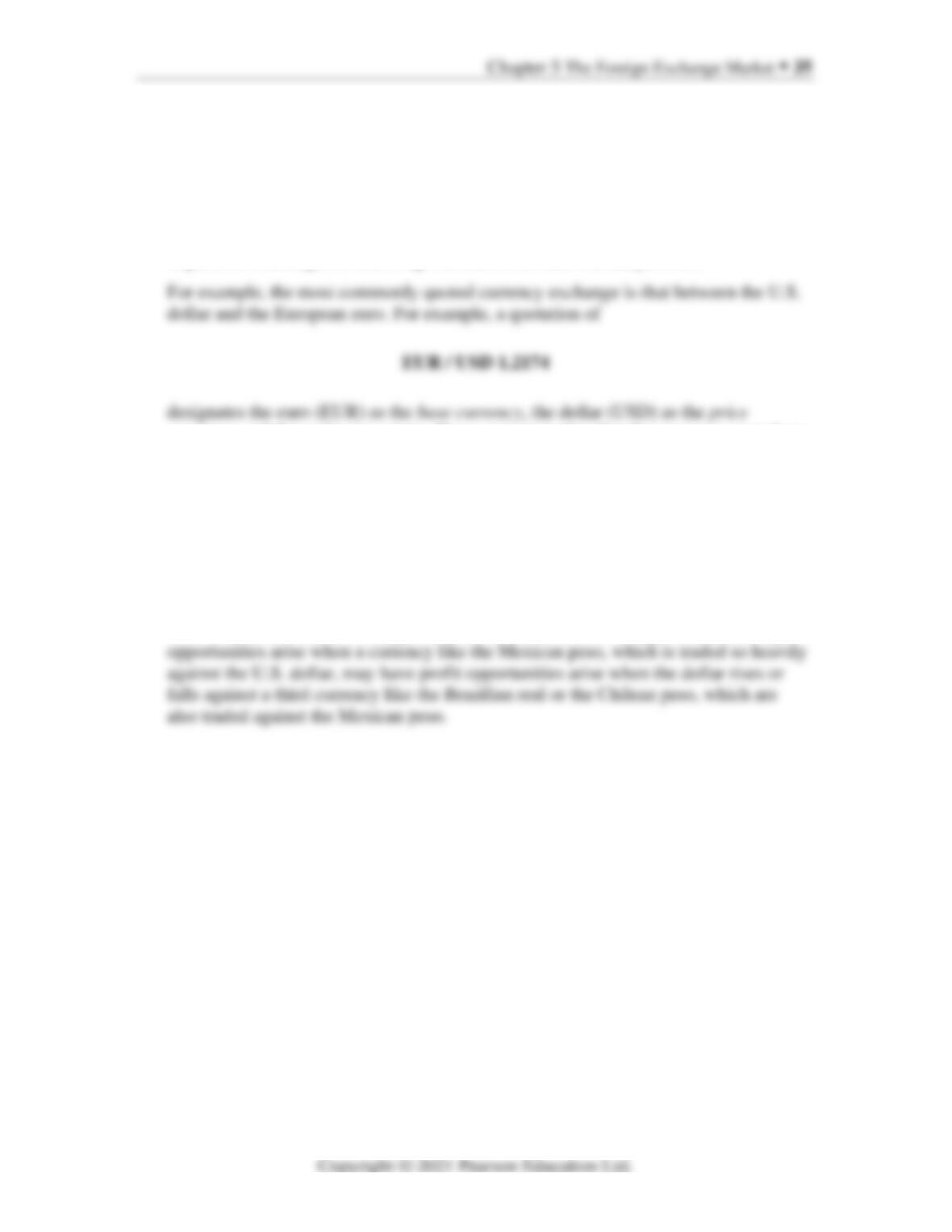
currency 1 (CUR1) and currency 2 (CUR2):
CUR1 / CUR2
The currency to the left of the slash is called the base currency or the unit currency.
The currency to the right of the slash is called the price currency or quote currency.
The quotation always indicates the number of units of the price currency, CUR2,
required in exchange for receiving one unit of the base currency, CUR1.
currency, and the exchange rate is If you can remember that the currency quoted on
the left of the slash is always the base currency, and always a single unit, you can
avoid confusion. Exhibit 5.6 provides a brief overview of the multitude of terms often
used around the world to quote currencies, through an example using the European
euro and U.S. dollar.
15. Cross Rates and Intermarket Arbitrage. Why are cross currency rates of special
interest when discussing intermarket arbitrage?
Because many currencies are traded in volume against a single other currency, cross
rates an be used to check on opportunities for intermarket arbitrage. These arbitrage