
Chapter 5 Growing and Internationalizing the Entrepreneurial Firm
Institution-Based Considerations
Whether entrepreneurship is facilitated or retarded significantly depends on formal institutions
governing how entrepreneurs start up new firms. A recent World Bank study reports some
striking differences in government regulations concerning start-ups such as registration,
licensing, incorporation, taxation, and inspection.
FIVE ENTREPRENEURIAL STRATEGIES
These five possible entrepreneurial strategies are not mutually exclusive; often pursued in
combination.
Growth
Attempt to utilize resources and capabilities more fully through entrepreneurial vision (the ability
to see new opportunities and areas of growth, entrepreneurial drive, and entrepreneurial
leadership.
Cautions: Avoid over-aggressiveness, embrace uncertainties, but protect against excessive
possible downsides. Interestingly, entrepreneurs of all nationalities have a tendency to be
overconfident.
Teaching Tip: Some students may recognize this phenomenon from cognitive psychology as the
“over confidence bias.” To some extent, this serves entrepreneurs well—they must believe that
they can make the venture a success; belief in themselves and their judgment is important for
Innovation
Innovation is at the heart of an entrepreneurial mindset. An innovation strategy is a specialized
form of differentiation strategy (see Chapter 2) and it allows for three advantages.
First, innovation allows for a potentially more sustainable basis for competitive advantage. Firms
first to introduce new goods or services are likely to earn (quasi) “monopoly profits” until
competitors emerge.
Second, innovation should be regarded broadly. Technological breakthroughs are not the only
innovations; less novel but still substantially new ways of doing business are also innovations.
Chapter 5 Growing and Internationalizing the Entrepreneurial Firm
firms. Of course, the innovators at entrepreneurial firms are better able to reap the financial gains
associated with innovations, thus fueling their motivation to charge ahead.
Teaching Tip: Intel was co-founded by Andy Grove, Robert Noyce, and Gordon Moore (of
Moore’s Law about the number of transistors on a microprocessor doubling approximately every
18 months). Interestingly, Robert Noyce was one of the “disloyal 8” that had left Shockley
Network
A network strategy refers to intentionally constructing and tapping into the relationships,
connections, and ties that individuals and organizations have. The two kinds of networks—
personal and organizational—are both important. Three attributes—urgency, intensity, and
impact—distinguish entrepreneurial networking.
First, entrepreneurial firms have a high degree of urgency to develop and leverage networks.
Essentially, they confront a liability of newness, defined as the inherent disadvantage that
entrepreneurial firms experience as new entrants.
A second characteristic that distinguishes entrepreneurial networking is its intensity. Network
relationships can be classified as either strong ties or weak ties. Strong ties are more durable,
reliable, and trustworthy relationships, whereas weak ties are less durable, reliable, and
trustworthy.
Entrepreneurs often rely on strong ties—typically five to twenty individuals—for advice,
assistance, and support. Strong ties can result in trust, which grows from a long history of
friendly interaction. Strong ties also lead to predictability, which refers to one party’s ability to
confidently predict how the other party will behave under new circumstances.
Not surprisingly, entrepreneurs often initially rely on strong ties, such as family members, old
classmates, and long-time friends, to accomplish organizational goals. This is something
popularly thought of as most common to business in East Asia, but is almost certainly used by
entrepreneurs everywhere.
Chapter 5 Growing and Internationalizing the Entrepreneurial Firm
Financing and Governance
All start-ups need to raise capital. Other than an entrepreneur’s own resources, strong ties—
especially family and friends—are the most likely sources of financing.
Here is a quiz (also a joke): Other than family and friends, who is the other “F” in the “3F”
model of entrepreneurial financing? The answer is . . . fools!
Teaching Tip: Ask students where they think the money for startups come from. The answer is
that it varies greatly depending on where the startup is and what business or industry it is
entering. In the West, only a handful of minority groups (such as Chinese and Korean
immigrants) can count on much financial support from family and friends, whereas in Asia, these
two “Fs” (of the “three Fs” referred to earlier) typically contribute a great deal more. This can be
explained by the informal cultural norms of collectivism and the lack of formal market-
supporting institutions such as venture capitalists and credit-reporting agencies in Asia.
Interestingly, this pattern persists after Asian immigrants arrive in the West. For example, one
study in Great Britain found that 33 percent of Asian immigrant entrepreneurs borrowed capital
from family and 49 percent of these entrepreneurs borrowed capital from friends. In contrast,
While dealing with strong-tie contacts can be informal (based on handshake deals or simple
contracts), working with weak-tie contacts is usually more formal. In the absence of a long
history of interaction, weak-tie investors, such as angels and venture capitalists, often demand a
more formal governance strategy to safeguard their investment, such as a significant percentage
of equity (for example, 20 to 40 percent), a corresponding number of seats on the board of
directors, and a set of formal rules and policies.
Given the well-known hazards associated with start-up failures, anything that entrepreneurs can
do to improve their odds is helpful. Research indicates that the odds for survival during the
crucial early years are significantly correlated with firm size—the larger the firm, the better.
Harvest and Exit
Entrepreneurial harvest and exit (selling off the business or somehow cashing out) can take a
number of routes: (1) selling an equity stake, (2) selling the business, (3) merging with another
firm, (4) considering an initial public offering (IPO), which is the first round of public trading of
company stock, and/or (5) declaring bankruptcy.
Chapter 5 Growing and Internationalizing the Entrepreneurial Firm
Third, when business is not doing well, merging with another company is another alternative.
The drawbacks are that the firm may lose its independence and some entrepreneurs may have to
personally exit the firm (after receiving some compensation) to leave room for executives from
another company.
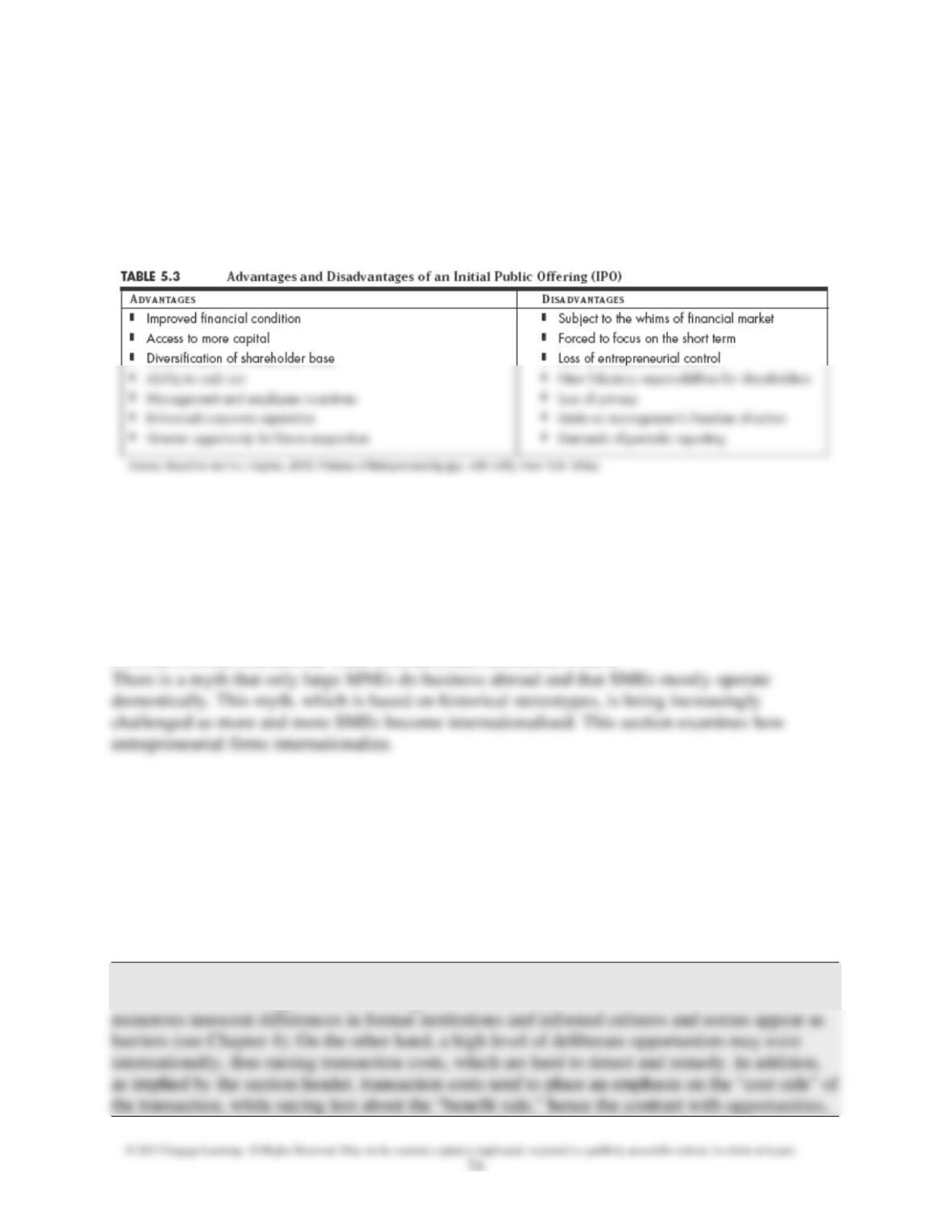
Fourth, entrepreneurs can take their firms through an IPO, which is the goal of many
entrepreneurs. An IPO has several advantages and disadvantages (Table 5.3 below).
Finally, while taking the firm through an IPO is the most triumphant way to harvest, many
failing entrepreneurial firms do not have such a luxury. The only viable exit is often to declare
bankruptcy. Approximately 38,000 U.S. businesses, most of which were start-ups, filed for
bankruptcy each year from 2000 to 2002. During the 1990s, the annual average number of
bankrupt firms was approximately 14,000 to 15,000 in Japan; 52,000 in France; 47, 000 in Great
Britain; and 21,100 in Germany.
Transaction Costs and Entrepreneurial Opportunities
Compared to transaction costs domestically, transaction costs internationally are qualitatively
higher. For example, if foreign payment is not arriving on time, it is difficult to assess whether
punctual payment is simply not the norm for firms in that country or whether that particular
buyer is being opportunistic. If the latter is the case, determining how to go after the
opportunistic foreign buyer becomes more than a headache. All these factors add to the
complexity and uncertainty of doing business abroad to such an extent that many firms,
especially SMEs, choose not to pursue international opportunities.
Teaching Tip: Students often have some problem keeping clear the relative importance of
transaction costs and opportunities. It is good to remind them of that here. On the one hand,
Chapter 5 Growing and Internationalizing the Entrepreneurial Firm
International Strategies for Entering Foreign Markets
There are three broad strategies for entering foreign markets: (1) direct exports, (2)
licensing/franchising, and (3) foreign direct investment.
First, direct exports entail selling products made by entrepreneurial firms in their home country
to customers in other countries. This strategy is attractive because entrepreneurial firms can
reach foreign customers directly. When domestic markets experience some downturns, sales
microwaveable and ready-made foods such as pizza that are difficult to buy (in single portions)
in that region. Li & Fung is also the regional franchiser for Toys R Us. Li & Fung’s expertise in
supply chain management and many connections have proved to be very helpful to these U.S.
retailers in the challenging East Asian environment.
However, a problem is that licensors and franchisors may suffer a loss of control over how their
technology and brand are used, so they must craft agreements to control the use and management
of their brand name and be ready to step in if problems are occurring in the international
location.
A third entry strategy is foreign direct investment (FDI), defined as a firm’s direct investment in
production and/or service activities abroad. FDI may entail strategic alliances with foreign
partners (such as joint ventures), foreign acquisitions, and/or “green–field” wholly owned
subsidiaries (that is, building new, foreign-based facilities from scratch).
Relative to licensing/franchising, a firm is better able to control how its proprietary technology
and brand name are used because it now directly participates in the management of foreign
operations. However, FDI’s major drawbacks are cost and complexity. FDI requires both a
nontrivial sum of capital and a significant managerial commitment. Some evidence supports that
in the long run, FDI by SMEs may lead to higher performance, and that some entrepreneurial
SMEs can come up with sufficient resources to engage in FDI.
Chapter 5 Growing and Internationalizing the Entrepreneurial Firm
Entrepreneurs from Switzerland and the United States established this firm and set up dual
headquarters in these two countries. R&D and manufacturing were initially split between
Switzerland and the United States, and then quickly spread to Ireland and Taiwan through FDI.
Logitech’s first commercial contract was with a Japanese company.
Since some very entrepreneurial SMEs seem to be “born global,” a key question is: What leads
to rapid internationalization? The key differentiator between rapidly and slowly (or not at all)
Teaching Tip: A related reason for firms being born global is the industry the entrepreneurial
firm is in. If the technology for that industry is primarily being developed in another country, that
firm may feel the necessity to have a presence in that country, to learn from the cutting-edge
firms there, to hire engineers and salespeople who know that business well, and to seek financing
from venture capitalists that are active in that industry and helped to finance it. In addition, some
of the best customers for the firm’s products may be located in a different country, which may
International Strategies for Staying in Domestic Markets
Entrepreneurial SMEs can choose from at least five strategies for internationalizing without
leaving their home countries: (1) indirect exports, (2) become suppliers of foreign firms, (3)
become licensees/franchisees of foreign brands, (4) become alliance partners of foreign direct
investors, and (5) harvest and exit through sell-offs.
First, firms can export through domestic-based export intermediaries (e.g., trading companies
and export management companies).
Second, an SME can become a supplier of foreign firms doing business in entrepreneurs’ home
country:
DEBATES AND EXTENSIONS
The recent boom in entrepreneurship throughout the world has continued to attract significant
controversies and debates. This section introduces three leading debates: (1) traits versus
Chapter 5 Growing and Internationalizing the Entrepreneurial Firm
institutions, (2) slow versus rapid internationalization, and (3) anti-failure biases versus
entrepreneur-friendly bankruptcy laws.
Traits versus Institutions
What motivates entrepreneurs to establish new firms, entrepreneur traits or country institutions?
Those who believe that personal traits of entrepreneurs are the primary motivating factor argue
that entrepreneurs have:
It is true some people are serial entrepreneurs, e.g., David Neelman who founded four airlines in
three countries.
Some hold the view that institutions are more important, that is, the environments that set formal
and informal rules are the primary facilitating and motivating force, not the personal traits of
entrepreneurs.
Micro societal-level institutions also matter. Socially or culturally disadvantaged groups may
have a hard time finding jobs and may be driven to become self-employed. Family background
and educational attainment are also associated with entrepreneurship; in the U.S., Korean
entrepreneurs have brought retail back to many inner cities where there had been little
commercial activity for years. This has also helped to spur local entrepreneurs, perhaps by
changing the “climate” and attitudes toward business.
Some other empirical evidence shows that children from wealthy families are more likely to start
new businesses, as are better educated people. Most scholars now agree that human behavior,
such as entrepreneurship, is a result of nature (traits) and nurture (institutions), as is most
behavior.
Slow Internationalizers Versus “Born Global” Startups
Another debate surrounds slow internationalizing firms versus the new “Born Global” startups. It
is possible for some SMEs to make very rapid progress in internationalization; but should SMEs
internationalize rapidly? Firms that internationalize slowly and in stages might have to overcome
Anti-Failure Bias Versus Entrepreneur-Friendly Bankruptcy Laws
Chapter 5 Growing and Internationalizing the Entrepreneurial Firm
Entrepreneurs, scholars, journalists and government officials share an “anti–failure” bias. From
an institutional perspective, it is important to ease the pain of failure and not punish failure in
perpetuity in order to encourage entrepreneurial activity. Bankruptcy laws vary by country in
terms of their tolerance of failure, as does the local venture capital and private equity industry.
In the US, entrepreneurs can walk away from debts incurred in failed/bankrupt ventures. In
THE SAVVY ENTREPRENEUR
As Economics professor and researcher Joseph Schumpeter wrote in the early 20th century,
entrepreneurs and their firms are the engines of the creative destruction process underpinning
global capitalism.
This chapter discusses insights on entrepreneurship from the three leading perspectives on
strategy—industry-based, resource-based, and institutional views.
Industry-based view
Resource-based view
Intangible resources (e.g., vision, drive, and willingness to take risk) fuel entrepreneurship
Institution-based view
Differences in entrepreneurial activity and economic development around the world can be
explained by the institutional frameworks that either promote or restrict entrepreneurship
Four fundamental questions in strategy are also addressed in the context of this chapter:
Why do firms differ?
How do firms behave?
Similarly, the behavior of entrepreneurs differs from non-entrepreneurs.
What determines the scope of the firm?
Entrepreneurs’ ability to employ growth, innovation, network and financing/governance
Chapter 5 Growing and Internationalizing the Entrepreneurial Firm
What determines the international success and failure of firms?
Entrepreneurs’ ability to select the right (growth) industry with appropriate barriers to entry.
Entrepreneurs’ ability to leverage resources and capabilities to enter that industry and to create
needed.
Chapter 5 Growing and Internationalizing the Entrepreneurial Firm
POSSIBLE ANSWERS TO CRITICAL DISCUSSION QUESTIONS
1. Why is entrepreneurship most often associated with SMEs, as opposed to larger firms?
SMEs have fewer ties to an existing customer base and product line. They can pursue
2. Given that most entrepreneurial start-ups fail, why do entrepreneurs found so many new
firms? Why are (most) governments interested in promoting more start-ups?
There is an inherent optimism bias for entrepreneurs—they feel they can succeed where
3. ON ETHICS: Your former high school buddy invites you to join a start-up that specializes in
making counterfeit products. She offers you the job of CEO and 10% of the equity of the firm.
The chances of getting caught are slim. You are currently unemployed. How would you
respond to her proposition?
economy, piracy might not be problematic.
TOPICS FOR EXPANDED PROJECTS
1. Some suggest that foreign markets are graveyards for entrepreneurial firms to overextend
themselves. Others argue that foreign markets represent the future for SMEs. If you were the
owner of a small, reasonably profitable firm, would you consider expanding overseas? Why
or why not? Write a short paper to state your case.
Answers might vary. The key issues are the background of the entrepreneur, the international
prospects, and the industry in which the SME is (can it benefit from overseas operations,
beyond just selling a few more machines?).
To invest in a foreign country is a risky proposition. Does the country have a stable political
2. ON ETHICS: Everything is the same as in Critical Discussion Question 3, except the
“counterfeit” products involved are more affordable generic drugs to combat HIV/AIDS.

Chapter 5 Growing and Internationalizing the Entrepreneurial Firm
Providing these drugs at a lower cost would potentially help millions of patients worldwide
who cannot afford the high-priced patented drugs. How would you respond? Write a short
paper to explain your answer.
Answers might vary. This question can lead to a very polemical debate. Most students might
3. ON ETHICS: Some argue that entrepreneur-friendly bankruptcy laws, which may allow
entrepreneurs to walk away from their debt, are unethical because they increase the cost of
financing for everybody. Review the arguments in the debate. Will you support more
entrepreneur-friendly bankruptcy laws? Present your answers in a short paper or a visual
presentation.
Bankruptcies are common. A majority of ventures fail and many end up in bankruptcy. The
challenge to policymakers is how to facilitate entrepreneurship in this context. The author of
investor or shareholder.