Chapter 5. Culture and Context
Chapter Overview
Intercultural communication is the new norm for leaders in the 21st century. This new norm
creates a cultural imperative for business leaders because their ability to “work and play well”
with others is dependent on effective communication skills. Since effective communication
skills in a global economy are dependent on cultural intelligence, all leaders should care about
LEARNING OBJECTIVE
Chapter 5: Culture and Context is about how culture and language are interconnected and have
a definite effect on how we communicate and interact in business. This chapter continues the
KEY TAKEAWAYS
• Culture and language are interconnected and affect how we communicate.
LEADERSHIP APPLICATIONS
• To be a CQ leader it’s necessary to grasp the nuances of both spoken and non-spoken
communication.
Introduction
• It’s all about frame of reference.
•
It’s All About Frame of Reference
The story goes like this—a young man got his break in the world of advertising for a beverage
company and was given an assignment in the Middle East. His campaign flopped. Seeing how
dejected he was, his best friend asked him, “Why weren’t you successful with the soft drink ad
Frame of Reference: Miscommunication in International Business Blunders
Let’s look at some real examples of how businesses have miscommunicated about their
products.
1. List the blunders mentioned in the chapter and explain, according to intercultural
concepts, what went wrong.
Frame of Reference
• Miscommunication in international business blunders
• Triangle of Meaning: Ogden and Richards’ Model
• Lost in translation
• McDonald’s comeback
Triangle of Meaning: Ogden and Richards Model
In English “to communicate” comes from the Latin verb communicare, which means “to make
common to many, or to share.”
Figure 5.1 Triangle of Meaning
The Triangle of Meaning is about how symbols are associated with the things they represent.
As co-interpreters, we hope to select symbols that others will understand in the same way
we do.
Various Ways to Miscommunicate
• We can miss connecting with someone over the translation of the meaning (or
semantics), as in the example of translating English concepts to Chinese.
Example: Triangle of Meaning
Ronald McDonald Statue in Malta
1. What was wrong with the message that was sent by Ronald McDonald’s demeanor?
2. What cultural values were offended? Why?
Ronald McDonald Statue in Thailand
1. What was good about the message that was sent by Ronald McDonald’s demeanor?
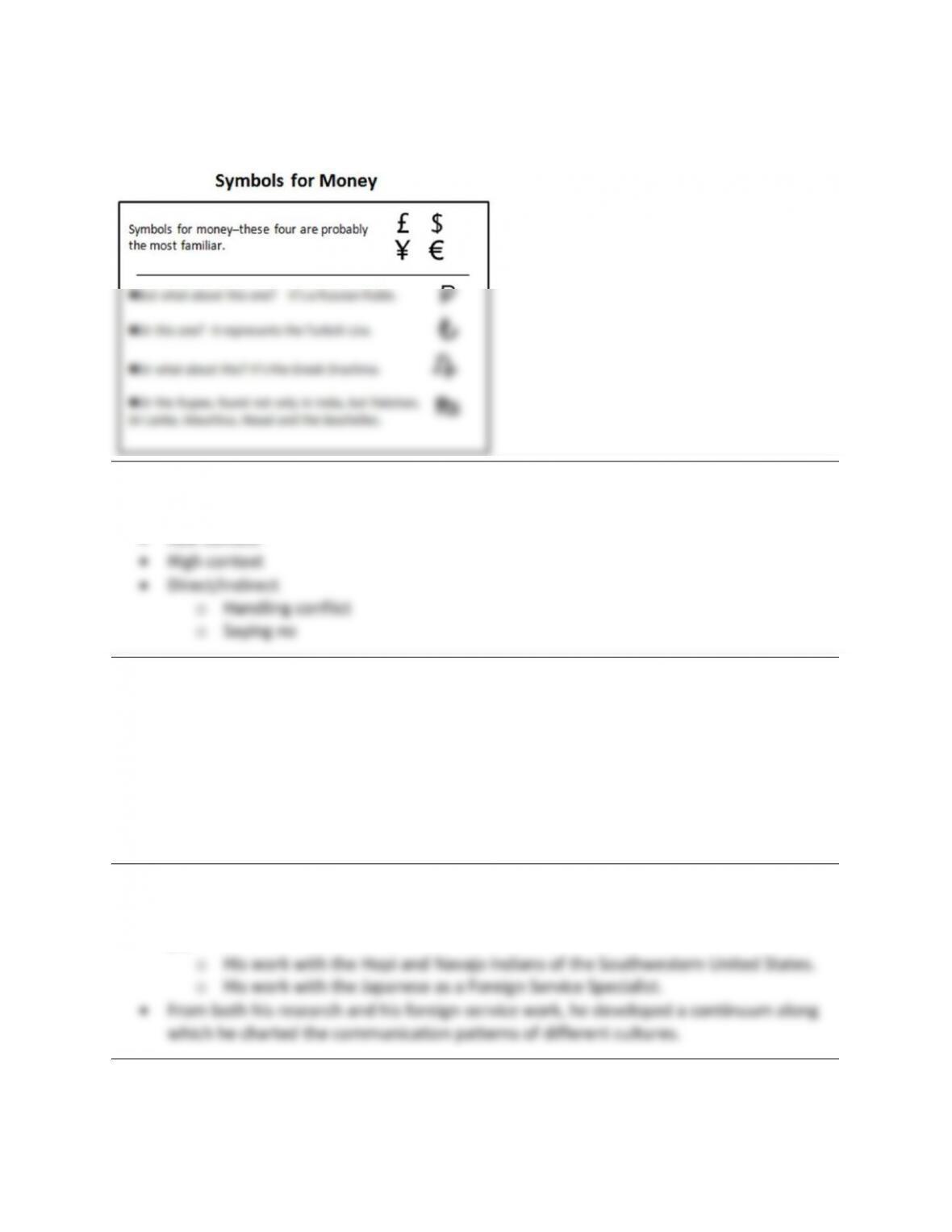
How Would the Triangle of Meaning Apply to Understanding Global Symbols of the Monetary
System?
Context and Communication
• Edward T. Hall
• Low context
Context and Communication
Edward T. Hall: The Silent Language (Book)
“One of the most effective ways to learn about oneself is by taking seriously the cultures of
others. It forces you to pay attention to those details of life which differentiate them from
you.”
• Hall is credited with founding the scholarly field of intercultural communication based
on:
Edward T. Hall
Communication follows a definite pattern, it is learned and it can be analyzed just as we do with
culture. This is the notion of high- and low-context cultures.
High Context
In high-context cultures, meaning is derived from the subtle, tacit actions and reactions of the
communicators and not necessarily the words they use. Communication will also be less direct.
• Relationships are especially important, so the manner in which something is said and
the attention paid to the audience for those remarks are carefully observed.
Low Context
A low-context culture relies more on the explicit or actual words that are spoken.
• Emphasis is placed on being direct, and receivers are meant to respond to the verbal
code in more literal ways.
High Context
In a high-context culture meaning is derived by what is not said with people grasping the
subtext within the context of what is being discussed.
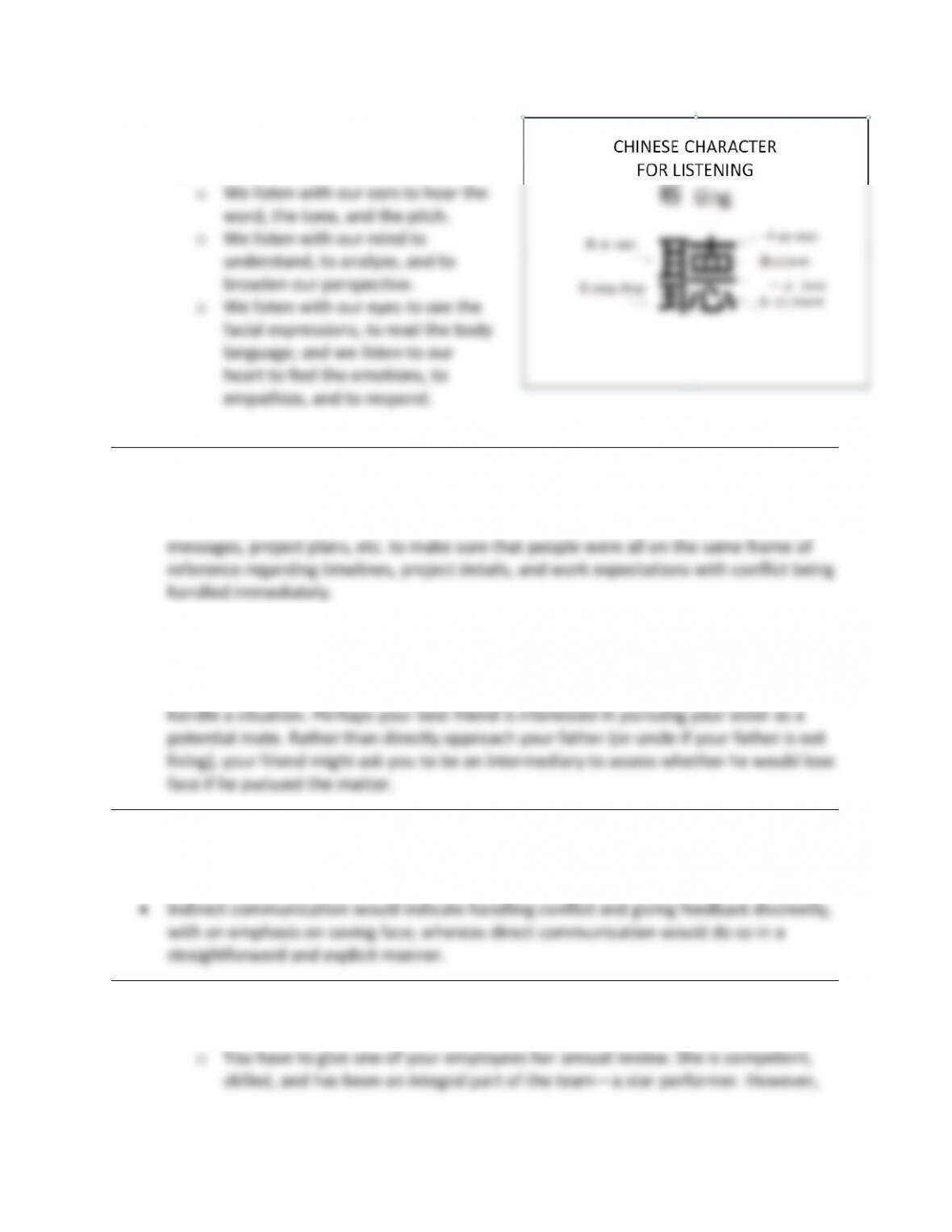
• The ancient Chinese symbol for listening
includes not only listening with the ears
but with the heart and eyes as well.
Direct Message: Straight forward with explicit expectations communicated to employees.
• In multi-national companies, there would be a need for over-communication of key
Indirect Message: An indirect form of communication would be more implicit and often an
intermediary would be used to deal with conflict with the emphasis of “saving face.”
• In an Arab culture, it would be rude to say what you think, so you might try to indirectly
Handling conflict
Another way of looking at direct and indirectness is how we handle conflict.
Example
• Handling feedback in the workplace:
o An indirect communicator does not discuss conflicts out in the open
▪ You would work around the conflict without directly stating that your
o A direct communicator would handle the feedback session by talking about it
explicitly.
Saying No
Not everyone says no in the same manner.
Not everyone uses the expression of thank you and please in the same way.
• For example, in India, you would only say thank you if you knew someone well—that
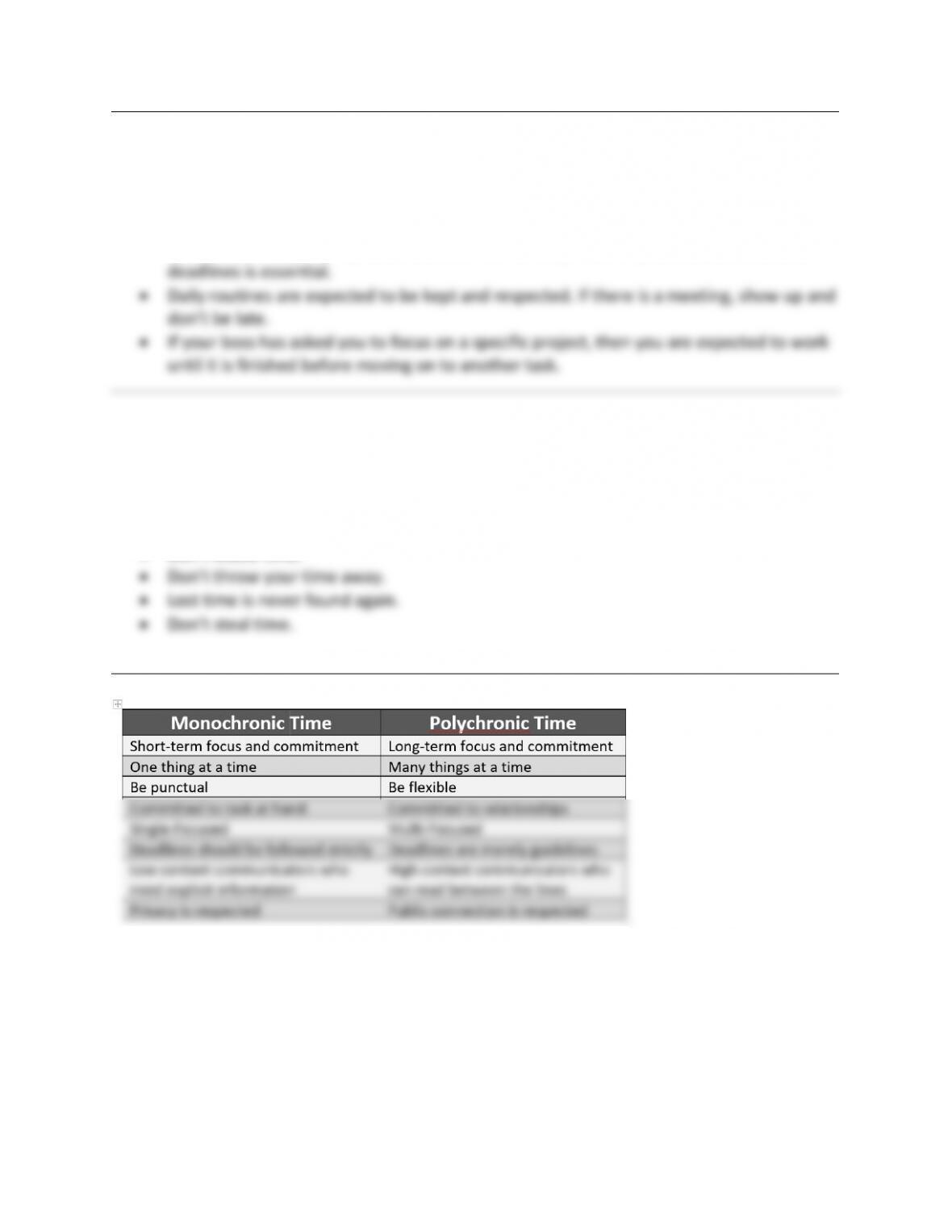
Monochronic and Polychronic Time
• Monochronic
• Polychronic
Monochronic
People are expected to do one thing at a time, and they have little patience for lateness or
interruptions.
• There is an emphasis on freedom and opportunity that comes to people who work hard.
Monochronic—Continued
People are expected to do one thing at a time, and they have little patience for lateness or
interruptions.
• Detailed planning with spreadsheets and lists to keep track of procedures, tasks, and
Time is Money
In the US, we have many sayings for time:
• Time is money.
• Don’t waste time.
Polychronic Time
In polychronic cultures, time is cyclical and there is a relaxed sense to when someone must be
someplace “on time.”
• Punctuality takes on a different meaning, and it would be more appropriate to show up
later than the time discussed.
Space
• The cultural anthropology of traffic patterns.
Space
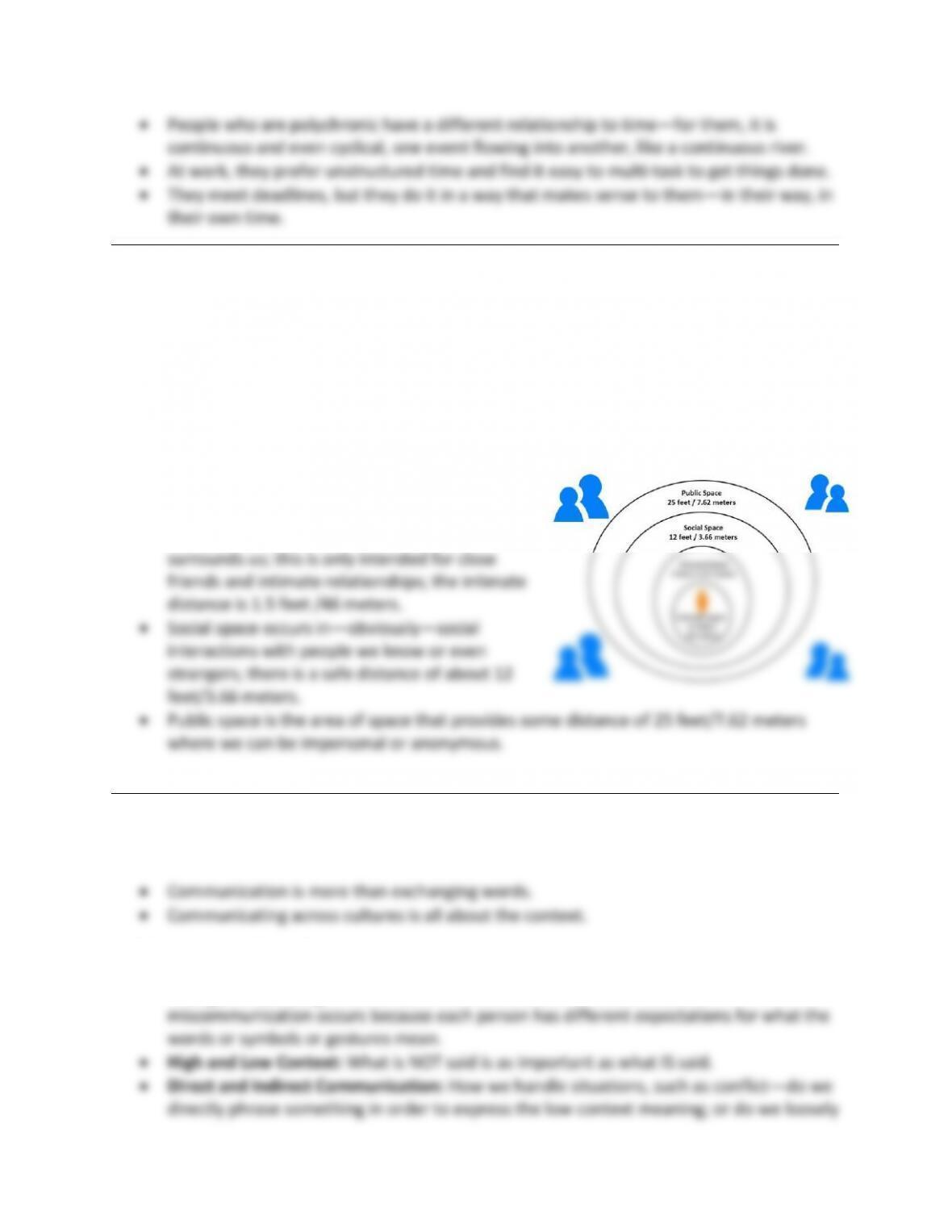
The way we use and organize space is internalized on an unconscious level and informed by our
cultural influences.
Edward T. Hall created the notion of personal space:
• The proverbial bubble that surrounds each of
us, which is 4 feet/1.22 meters.
• Intimate space is the closest space that
Summary
As business leaders, we need to remember that:
In this chapter, we have discussed:
• Triangle of Meaning: If we’re not on the same frame of reference, then
Final Thoughts
• As we’ve learned in this chapter, if we don’t understand the subtleties of a language and
***
CASES: Target Urina
ACTIVITY: Direct and Indirect exercise
Videos regarding space