Chapter 4: Cultural Frameworks and Foundations
Chapter Overview
Chapter 4: Cultural Frameworks and Foundations examines the questions: How do you measure
culture? What is the science behind it? Isn’t generalizing an entire culture sophisticated
stereotyping? These are the key questions we will address in Chapter 4.
LEARNING OBJECTIVE
All leaders need the proof that what they espouse is credible. This chapter investigates the
theory behind cultural dimensions and looks at how central tendencies of a nation can be used
as a starting point in order to understand difference. Dutch interculturalist Geert Hofstede is
KEY TAKEAWAYS
• Cultures can be measure based upon group tendencies.
LEADERSHIP APPLICATIONS
• Leaders who know that the principles they follow are backed by strong validity and
reliability can engage difference with confidence.
• It is important to see differences in order to understand how to react in different situations.
Introduction
• Why We Need Cultural Dimensions
Introduction
In this chapter, we will examine specific frameworks of culture known as cultural dimensions by
discussing their origins, current debates, and future extrapolations.
Understanding Human Values
Every society has values and value systems.
• A value is an enduring belief that one way of existence (thinking, believing, doing) is
better than another.
• A value system is the composite of principles and rules that people in a society learn in
order to help choose how to interact and navigate through life.
In the hierarchy of values and attitudes, values are the stable, enduring guides related to social
attitudes and beliefs, attitudes are oriented toward situational contexts.
• Within our value systems, we have value orientations which can be rank-ordered on a
Cultural Dimensions 101
Geert Hofstede, a prominent researcher and brilliant statistician, who is also a psychologist and
interculturalist, described culture as the collective programming of our mind.
• He explained that norms, the accepted and expected ways of living, are formed from
within the collective group’s interactions of people and subsequently influence us in
ways that we are not even aware.

• In his 1980 book Culture’s Consequences, Hofstede advanced the idea that “cultural
dimensions” are aspects of culture that can be measured against other cultures.
o He used continua to contrast differences in order to demonstrate how a
particular culture could be more or less of any particular dimension—for
example, some cultures like the US generally tend to be more individualist in
their social makeup.
▪ Individualist and collectivist are social dimensions (not political) that
mean the degree to which people will integrate into their primary groups
(family and extended family).
Hofstede’s Research
In the late 1960s and into the early 1970s, Hofstede performed what was the most
comprehensive study at that time regarding how culture influences values in the workplace.
Hofstede’s concept of analyzing survey data at the national (country) level that quantified
distinct cultural differences started with his landmark analysis of workplace values in
subsidiaries at IBM across the world.
Mental Models
• At the deepest level (the base of the pyramid) is human nature.
o Because of human nature, there are many behaviors and understandings that all
people share even though they come from different cultures.
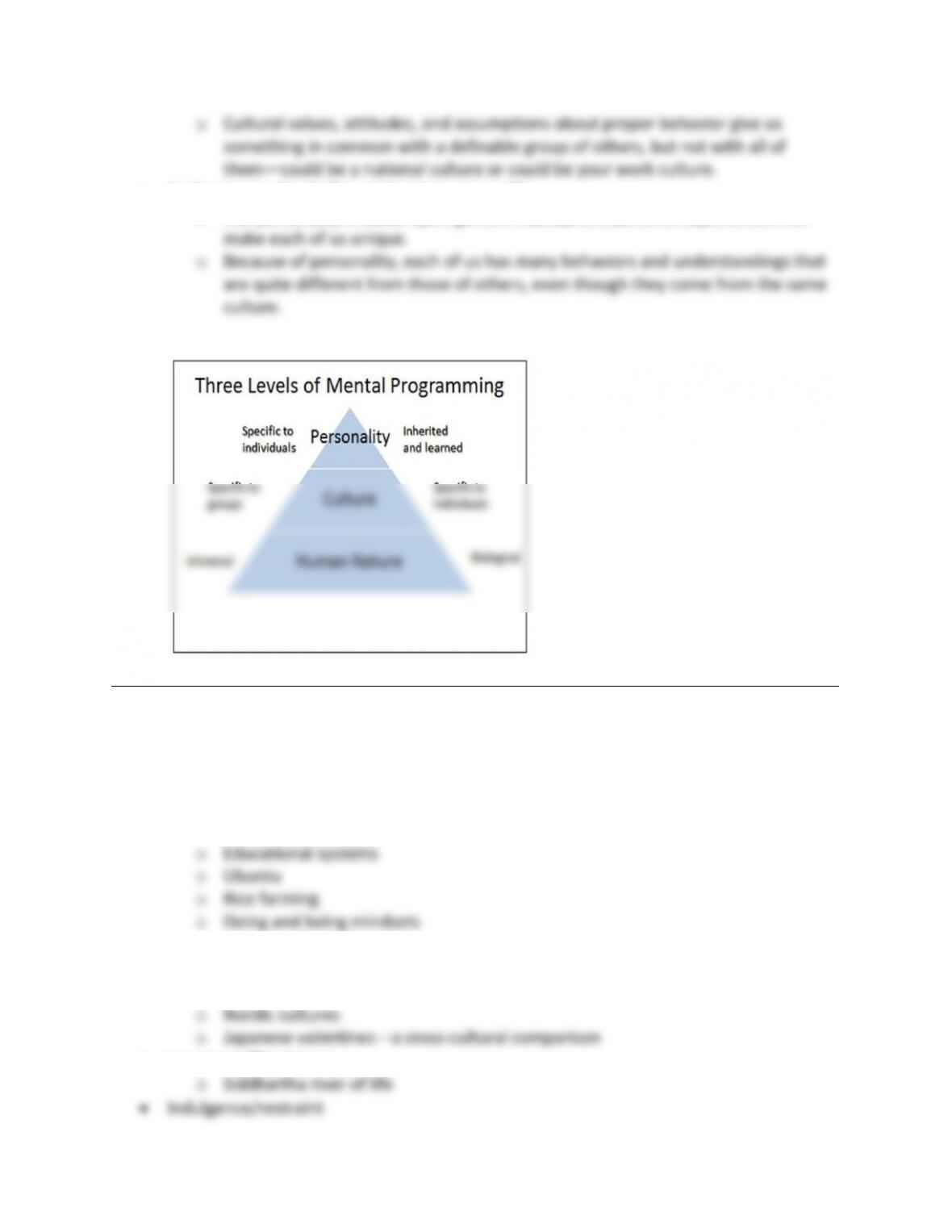
• At the top, or the shallowest level, is personality.
o Our personality is based upon genetic makeup and personal experiences that
Hofstede’s Six Cultural Dimensions
• Power distance
o Saudi women vote
• Individualism/collectivism
o Familismo
• Uncertainty avoidance
o Greek debt crisis
• Masculinity and femininity
• Long term/Short term
Power Distance
Power distance relates to how we measure inequality in our society—Who are the more
Individualism and Collectivism
Individualism and collectivism deals with how we tend to interact with others in individual or
collective ways—Do we think in terms of “me” or “we?” Do we have strong ties with our clan,
family, or in-group where there is cohesion, loyalty, and respect for members of the group? Or
are those ties looser and less defined by expectations that we act for the good of the group and
therefore can act in our own interest first, which means less responsibility for other’s well-being
and less interpersonal connection beyond family and close friends?
Uncertainty Avoidance
Uncertainty avoidance is about how a society tolerates ambiguity, or the degree to which
Masculinity and Femininity
A “masculine” culture refers to a society that leans toward competition, achievement, and
success, which are typically considered masculine roles within traditional society; whereas a
“feminine” culture values cooperation and caring.

Long-Term/Short-Term Orientation
Long-term/short-term orientation refers to how a society values traditions and values—
whether holding onto values that are steeped in a society’s history and tradition dating back
centuries and millennia, or whether they are more recently created.
Indulgence and Restraint
Indulgence and restraint refer to the new dimension that has grown out of this ongoing
research, namely by Bulgarian linguist Michael Minkov and his study of the World Values
Survey.
Challenges to Cultural Dimension Theory
• Debating theories
• Cultural generalizations
Debating Theories
It is important to understand the scientific debate about this type of research because it relates
to our ongoing discussion throughout the book regarding generalizations and sophisticated
stereotypes.
Cultural Generalizations
Are generalizations considered labels or stereotypes?
Milton Bennett, a prominent US scholar in the field of intercultural education:
Paradoxes of Culture
• Value trumping
• Nomunication
Hofstede’s rankings are to be used merely as a guide for initially understanding culture.
The emphasis is on the collective phenomenon, with attention to the aggregate results of any
given people.
While the results of the Hofstede dimensions are categorized by country, we know that with
any given country there are many cultural groups—such as ethnicity (China has over 54 ethnic
EXAMPLES
Value Trumping
On two levels this can be a paradox. Japanese cultures are highly relational—Doesn’t this
practice contradict the value of maintaining relationships?
• To bring up a problem during working hours would make people unhappy, create
disharmony for the day, and cause someone to lose face (you never criticize or openly
disagree with someone).
Nomunication
• Japanese act in a highly formal way (uncertainty avoiding behavior) when dealing with
others in a business setting; however, in the context of drinks after work they will be
informal and direct.
Summary
Culture is complex and in order to understand it we need ways to identify similarities and
differences.
• The cultural dimension method enables us to compare and contrast elements of
cultures based on careful research of human values surveys that are generalized across
cultures.

***
CASE: Best Buy
ACTIVITY: Hofstede’s Cultural Dimensions