Chapter 4: Cultural Frameworks
CASE: Best Buy
See Teacher Notes
ACTIVITY: Hofstede’s Cultural Dimensions
CULTURAL VALUE’S INVENTORY
Source: Stella Ting-Toomey and Leeva Chung, Summer Institute for Intercultural Communication.
Look at the continuums below (1 is low and 10 is high). Circle the number that indicates the predominant
values of your cultural/ethnic group, workplace, and your own personal orientation.
I. Identity Dimension—Individualism/Collectivism
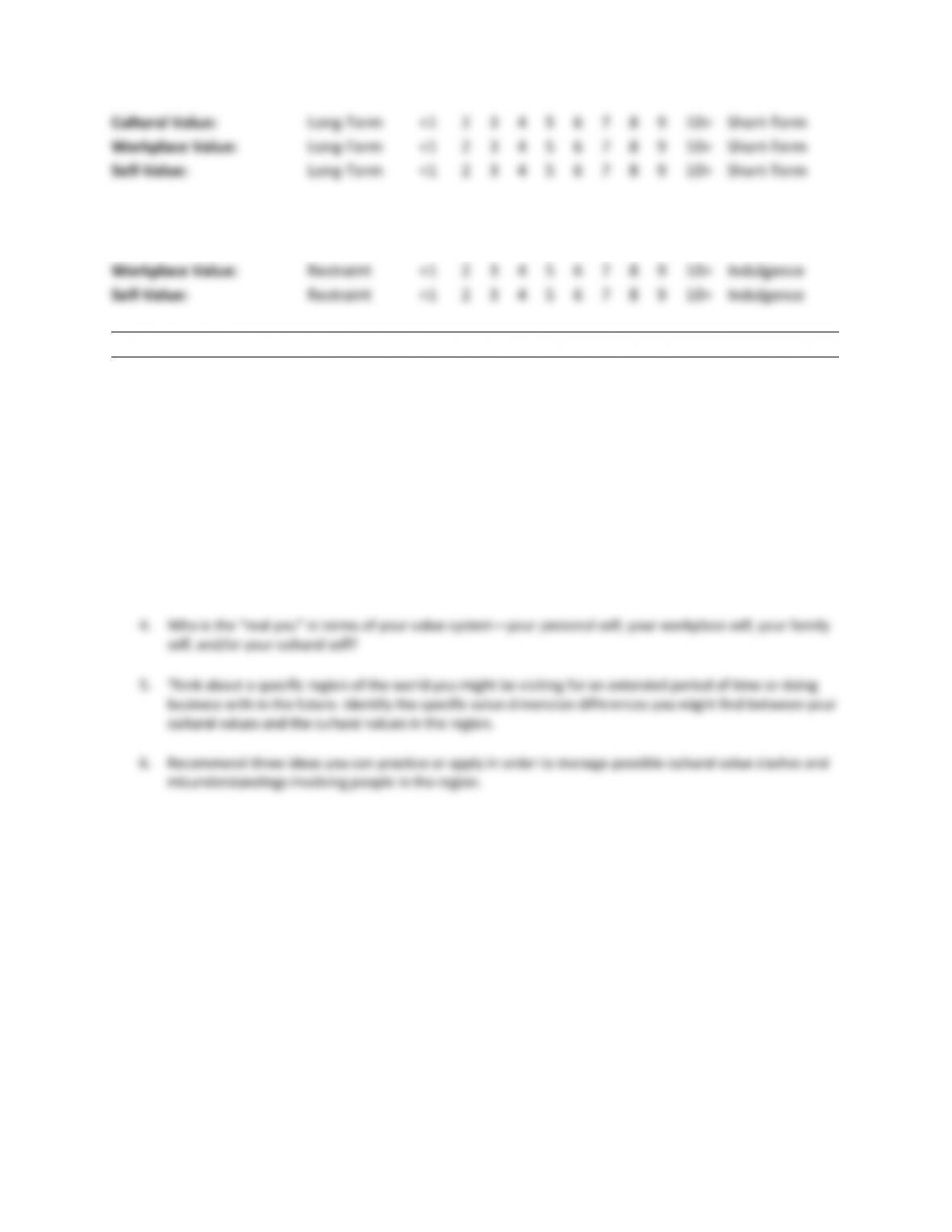
Cultural Value: Individualism <1 2 3 4 5 6 7 8 9 10> Collectivism
II. Power Distance—Small Power Distance (SPD)/Large Power Distance (LPD)
Cultural Value: Small P.D. <1 2 3 4 5 6 7 8 9 10> Large P.D.
III. Uncertainty Avoidance—Weak Uncertainty (WUA)/Strong Uncertainty Avoidance (SUA)
Cultural Value: Weak U.A. <1 2 3 4 5 6 7 8 9 10> Strong U.A.
IV. Gender Role Dimension—“Feminine” Orientation/“Masculine” Orientation
Cultural Value: Feminine <1 2 3 4 5 6 7 8 9 10> Masculine
V. Time Dimension—“Long–Term” Orientation/“Short–Term” Orientation
VI. Indulgence—“Restraint (strong control)/Indulgence (weak control) Over Impulses
Cultural Value: Restraint <1 2 3 4 5 6 7 8 9 10> Indulgence
Discussion Questions
Jot down some of your reflections and talk to someone right next to you. Compare the differences and similarities
between your value rankings and your classmate’s value rankings. Have a good conversation by asking some
interesting questions. Of course, pay attention to high-context issues and only ask what is appropriate.
1. How are your family value patterns different from or consistent with the larger cultural and/or ethnic
value patterns?
2. How are your personal value patterns different from or consistent with the larger cultural and/or ethnic
value patterns?
3. Which value dimension has the most influence on your everyday communication behavior? Explain.