Chapter 4
The Balance of Payments
QUESTIONS
1. What are the major accounts of the balance of payments, and what transactions are
recorded on each account?
Answer: The three major account of the balance of payments are the current account, the
capital account, and the official settlements account.
The current account records the following:
1. Imports, which are purchases of goods and services from foreign residents, and
exports, which are sales of goods and services to foreign residents.
2. Why is it important for an international manager to understand the balance of
payments?
Answer: The balance of payments provides information that is useful in understanding the
determination of exchange rates and the growth prospects of a country. For example,
Chapter 4: The Balance of Payments
2
3. What are the rules that determine the residency requirements on the balance of
payments?
Answer: The rules for residency are that the entity has a primary economic interest in the
4. Which items on the balance of payments are recorded as credits, and which items are
recorded as debits? Why?
Answer: The balance of payments uses a double-entry system. Each transaction gives rise to
two entries: One entry is a credit, and the other entry is a debit of equal value. Any
5. How are gifts and grants handled in the balance of payments?
6. What does it mean for a country to experience a capital inflow? Is this associated with a
surplus or a deficit on the country’s capital account?
7. If you add up all the current accounts of all countries in the world, the sum should be
zero. Yet this is not so. Why?
Chapter 4: The Balance of Payments 3
Answer: There used to be a large, consistently negative global deficit which suggests that the
discrepancy cannot simply be due to measurement errors because if it were, the balance
would be positive about as often as it is negative. Several IMF studies attributed the global
deficit to the underreporting of foreign investment income by rich countries (due to tax
8. What is the investment income account of the balance of payments?
9. What is the official settlements account of the balance of payments? How are official
settlements deficits and surpluses associated with movements in the international
reserves of the balance of payments?
10. What is the meaning of an account labeled “statistical discrepancy” or “errors and
omissions”? If this account is a credit, what does that imply about the measurement of
other items in the balance of payments?
Chapter 4: The Balance of Payments
4
11. Why must the national income of a closed economy equal the national expenditures of
that economy? What separates the two concepts in an open economy?
12. Explain why private national saving plus government saving equals the current
account of the balance of payments.
Answer: Saving is the difference between the income of an entity and what that entity
consumes. In a closed economy, the value of what is produced, the country’s gross domestic
product or GDP, must equal its expenditures and its income. Thus, investment expenditures
Chapter 4: The Balance of Payments
6
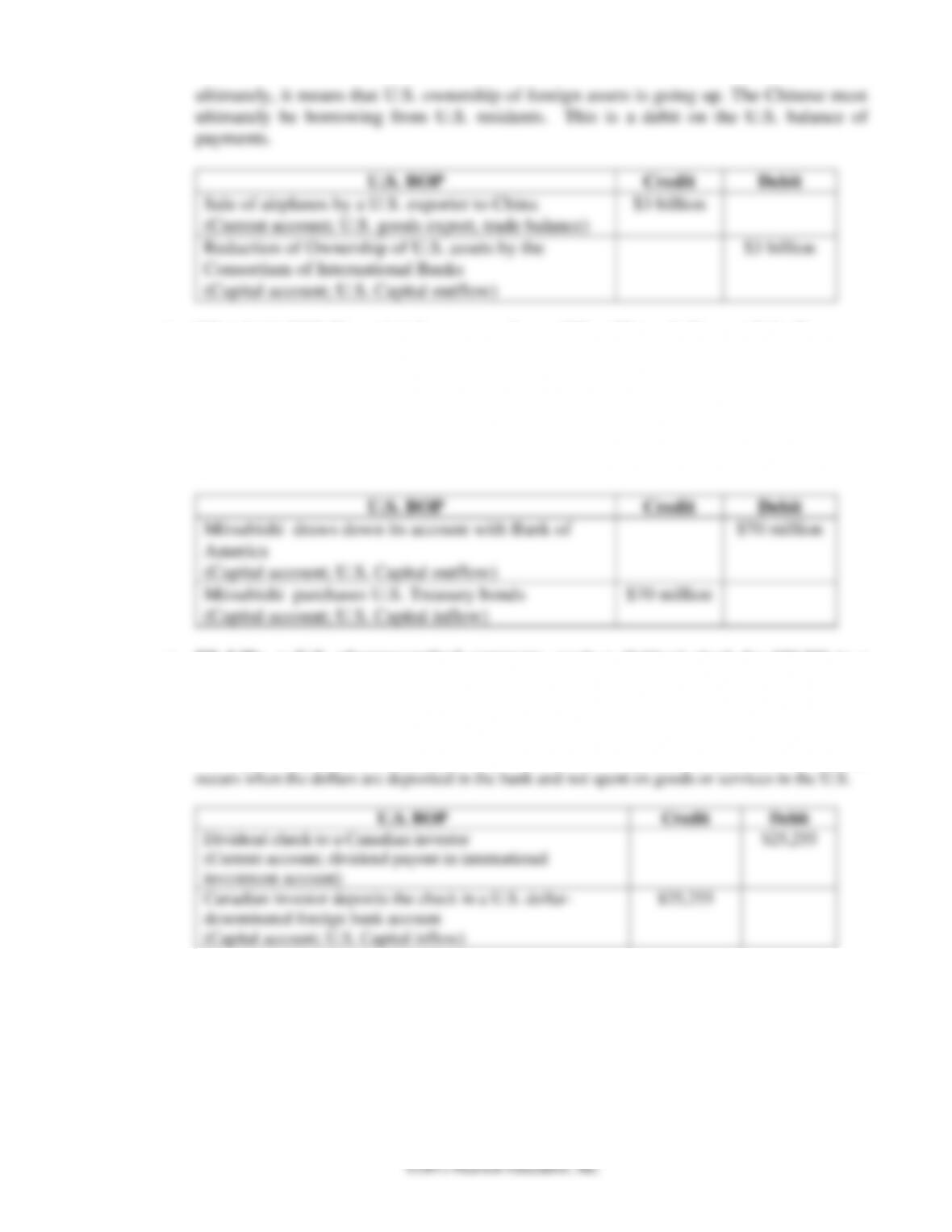
bonds for one of its Japanese clients. Mitsubishi draws down its dollar account with
Bank of America to pay for the bonds.
Answer: The purchase of Treasury bonds by a foreign company is a credit on the U.S.
balance of payments just like an export of goods is a credit. The reduction in Mitsubishi’s
bank account is a reduction in foreign ownership of U.S. assets and is a corresponding
debit.
Canadian investor in Toronto. The Canadian investor deposits the check in a U.S. dollar–
denominated bank account at the Bank of Montreal.
Answer: The dividend check is a debit on the U.S. balance of payments because it is a payment to
a foreigner. The corresponding credit is the increase in foreign ownership of U.S. assets that
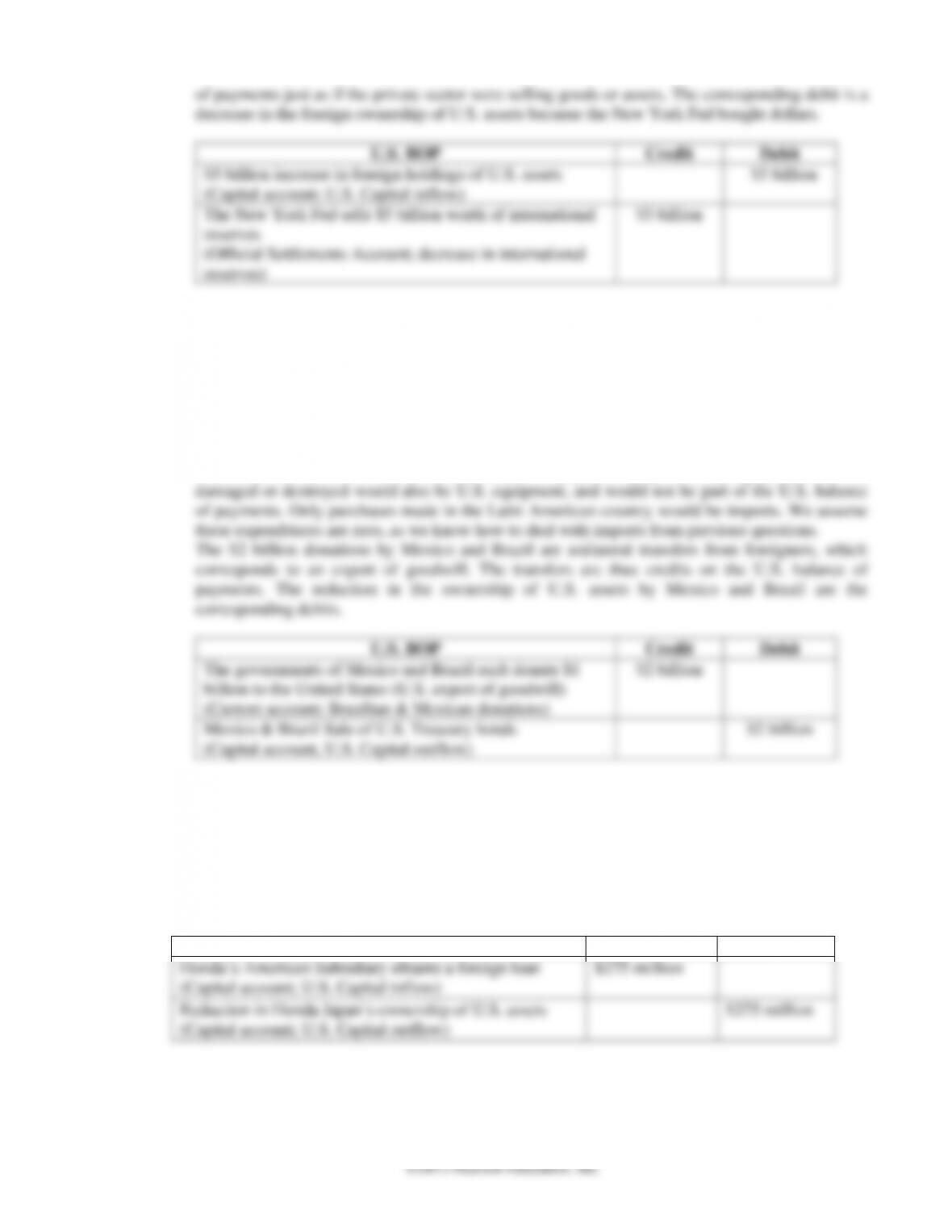
Chapter 4: The Balance of Payments 7
of payments just as if the private sector were selling goods or assets. The corresponding debit is a
decrease in the foreign ownership of U.S. assets because the New York Fed bought dollars.
U.S. BOP
Credit
Debit
$5 billion increase in foreign holdings of U.S. assets
(Capital account; U.S. Capital inflow)
$5 billion
The New York Fed sells $5 billion worth of international
reserves
(Official Settlements Account; decrease in international
reserves)
$5 billion
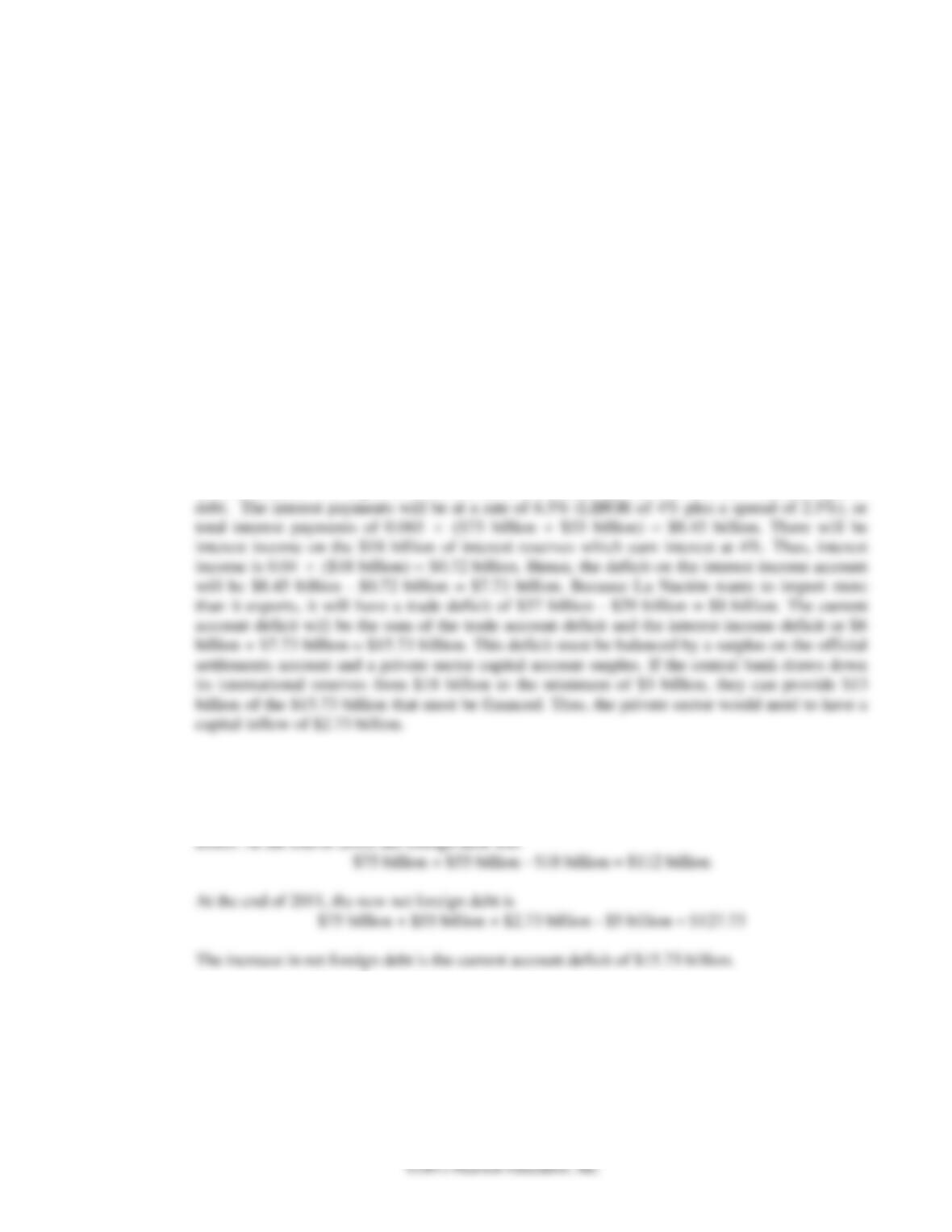
e. The president of the United States sends troops into a Latin American country to establish a
democratic government. The total operation costs U.S. taxpayers $8.5 billion. To show their
support for the operation, the governments of Mexico and Brazil each donate $1 billion to
the United States, which they raise by selling U.S. Treasury bonds that they were holding as
international reserves.
Answer: It is not entirely clear how much, if any, of the $8.5 billion of military expenditures
would be part of the balance of payments. Any expenditures on soldiers would not be, as the
soldiers are considered U.S. residents for balance of payments purposes. Any equipment that was
U.S. BOP
Credit
Debit
billion to the United States (U.S. export of goodwill)
Mexico & Brazil Sale of U.S. Treasury bonds
Chapter 4: The Balance of Payments
8
was dollar denominated, and at the end of 2010, its net private foreign debt was $75 billion and
the official foreign debt of La Nación’s treasury was $55 billion. Suppose that the interest rate
on these debts was 2.5% per annum (p.a.) over the London Interbank Offering Rate (LIBOR),
and no principal payments were due in 2011. International reserves of the Banco de Nación, La
Nación’s central bank, were equal to $18 billion at the end of 2010 and earn interest at LIBOR.
There were no other net foreign assets in the country. Because La Nación is growing very
rapidly, there is great demand for investment goods in La Nación. Suppose that residents of La
Nación would like to import $37 billion of goods during 2011. Economists indicate that the
value of La Nación’s exports is forecast to be $29 billion of goods during 2011. Suppose that the
Banco de Nación is prepared to see its international reserves fall to $5 billion during 2011. The
LIBOR rate for 2011 is 4% p.a.
a. What is the minimum net capital inflow during 2011 that La Nación must have if it wants to
see the desired imports and exports occur and wants to avoid having its international
reserves fall below the desired level?
Answer: We know that the balance of payments always sums to zero:
Current account + Regular capital account + Official settlements account = 0
The current account records exports minus imports plus interest inflows minus interest outflows.
Interest outflows are required to service the $75 billion of private debt and $55 billion of public
b. If this capital inflow occurs, what will La Nación’s total net foreign debt be at the end of
2011?
Answer: The total net foreign debt is the sum of private and public foreign debts minus public
3. True or false: A trade balance deficit can never have a capital account deficit as its
counterpart under truly flexible exchange rates (that is, the government does not intervene to
fix the price of foreign exchange). Explain your answer.
The statement is false. A capital account deficit must be balanced by a current account surplus which is
the sum of the trade account and the international investment income account. Thus, if the international
Chapter 4: The Balance of Payments 9
©2012 Pearson Education, Inc.
investment income account is sufficiently in surplus, the trade account can be in deficit, but the current
account can be in surplus. Therefore, deficits can simultaneously exist on the trade and capital accounts if
the investment income account is sufficiently such that a current account surplus exists to balance the
capital account deficit.
4. True or false: If a country is a net debtor to the rest of the world, its international investment
service account is in deficit. Explain your answer.
5. Choose a country and analyze its balance of payments for the past 10 years. Good sources of
data include official bulletins of the statistical authority of a country or its central banks;
International Financial Statistics, which is a publication of the IMF (www.imf.org), and the
Main Economic Indicators, which is a publication of the Organization for Economic Co-
operation and Development (www.oecd.org).
a. Examine how trade in goods and services has evolved over time. Is the country becoming
more or less competitive in world markets?
b. Consider the relationship between the country’s net foreign asset position and its
international investment income account.
c. If the country has run a current account deficit, what capital inflows have financed the
deficit? If the country has run a current account surplus, how have the capital outflows
been invested?
6. Pick a country and search the internet for newspaper or magazine articles that contain
information related to the balance of payments of the country and corresponding movements in
the foreign exchange value of the country’s currency. Does an unexpectedly large current
account deficit cause the country’s currency to strengthen or weaken on the foreign exchange
market?
7. What are the effects on the British balance of payments of the following set of transactions?
U.K. Videos imports £24 million of movies from the U.S. firm Twenty-First Century Wolf
(TFCW). The payment is denominated in pounds, is drawn on a British bank, and is deposited
in the London branch of a U.S. bank by TFCW because TFCW anticipates purchasing a film
studio in the United Kingdom in the near future.
8. What are the effects on the French balance of payments of the following set of transactions? Les
Fleurs de France, the French subsidiary of a British company, The Flowers of Britain, has just
received €4.4 million of additional investment from its British parent. Part of the investment is
Chapter 4: The Balance of Payments
10
a €0.9 million computer system that was shipped from Britain directly. The €3.5 million
remainder was financed by the parent by issuing euro denominated Eurobonds to investors
outside of France. Les Fleurs de France is holding these euros in its Paris bank account.
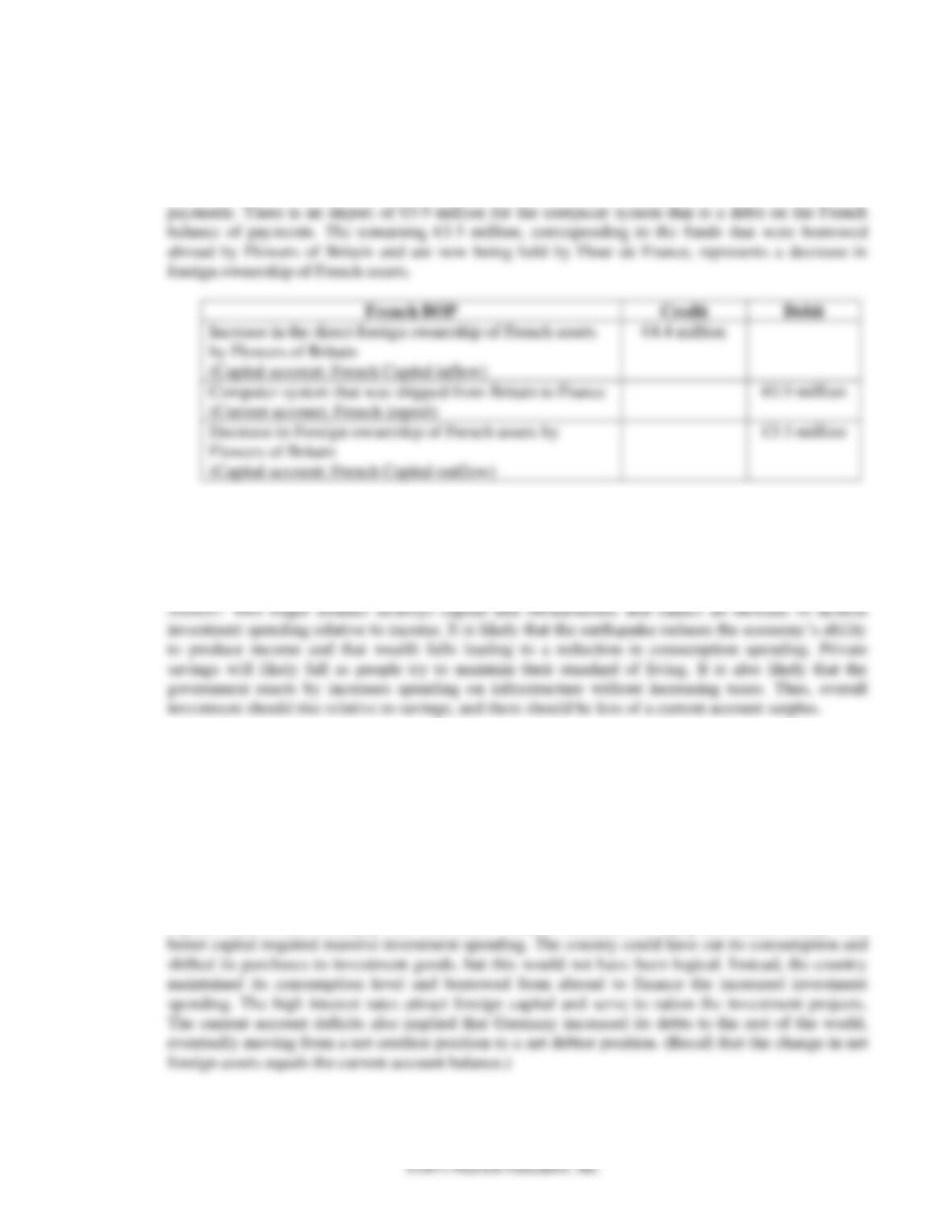
Answer: The €4.4 million of additional investment from the British parent to the French subsidiary is
an increase in the foreign ownership of French assets, which is a credit on the French balance of