Chapter 4
Exchange Rate Determination
Lecture Outline
Measuring Exchange Rate Movements
Exchange Rate Equilibrium
Demand for a Currency
Supply of a Currency for Sale
Equilibrium
Factors that Influence Exchange Rates
Relative Inflation Rates
Movements in Cross Exchange Rates
Explaining Movements in Cross Exchange Rates
Anticipation of Exchange Rate Movements
2Exchange Rate Determination
Chapter Theme
This chapter provides an overview of the foreign exchange market. It is designed to illustrate (1) why a
market exists, and (2) why exchange rates change over time.
Topics to Stimulate Class Discussion
1. Why did exchange rates change recently?
2. Show the class a current exchange rate table from a periodical—identify spot and forward quotations.
Then show the class an exchange rate table from a date a month ago, or three months ago. The
POINT/COUNTER-POINT:
How Can Persistently Weak Currencies Be Stabilized?
POINT: The currencies of some Latin American countries depreciate against the U.S. dollar on a
could impose capital restrictions on local investors to prevent capital outflows.
COUNTER-POINT: Some Latin American countries have had high inflation, which encourages local
WHO IS CORRECT? Use the Internet to learn more about this issue. Which argument do you support?
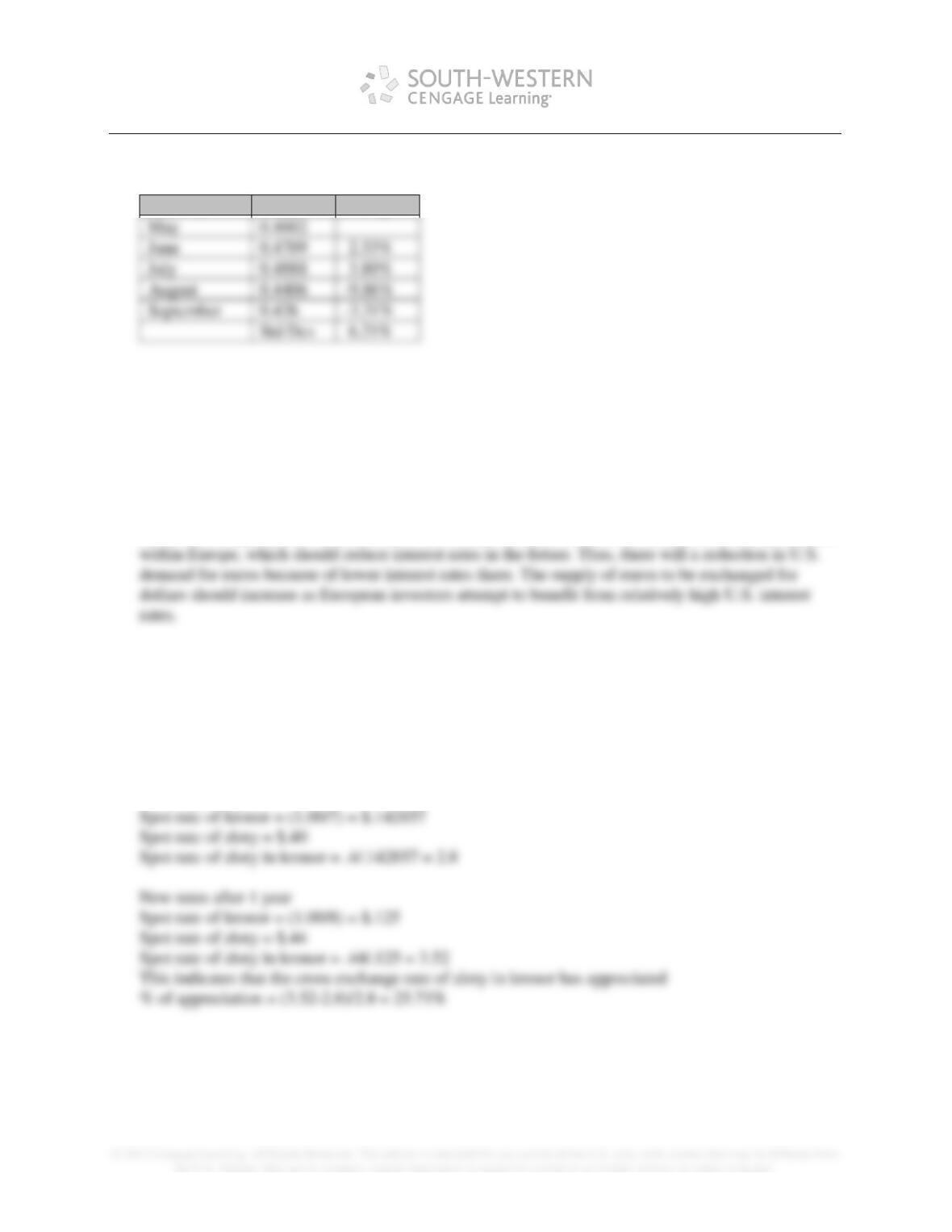
Offer your own opinion on this issue.
ANSWER: There is no perfect solution, but recognize the tradeoffs. The proposal to raise interest rates
Exchange Rate Determination 3
Answers to End of Chapter Questions
1. Percentage Depreciation. Assume the spot rate of the British pound is $1.73. The expected spot
rate one year from now is assumed to be $1.66. What percentage depreciation does this reflect?
2. Inflation Effects on Exchange Rates. Assume that the U.S. inflation rate becomes high relative to
Canadian inflation. Other things being equal, how should this affect the (a) U.S. demand for
Canadian dollars, (b) supply of Canadian dollars for sale, and (c) equilibrium value of the Canadian
dollar?
ANSWER: Demand for Canadian dollars should increase, supply of Canadian dollars for sale should
3. Interest Rate Effects on Exchange Rates. Assume U.S. interest rates fall relative to British interest
rates. Other things being equal, how should this affect the (a) U.S. demand for British pounds, (b)
supply of pounds for sale, and (c) equilibrium value of the pound?
4. Income Effects on Exchange Rates. Assume that the U.S. income level rises at a much higher rate
than does the Canadian income level. Other things being equal, how should this affect the (a) U.S.
demand for Canadian dollars, (b) supply of Canadian dollars for sale, and (c) equilibrium value of the
Canadian dollar?
ANSWER: Assuming no effect on U.S. interest rates, demand for dollars should increase, supply of
5. Trade Restriction Effects on Exchange Rates. Assume that the Japanese government relaxes its
controls on imports by Japanese companies. Other things being equal, how should this affect the (a)
U.S. demand for Japanese yen, (b) supply of yen for sale, and (c) equilibrium value of the yen?
6. Effects of Real Interest Rates. What is the expected relationship between the relative real interest
rates of two countries and the exchange rate of their currencies?
4Exchange Rate Determination
7. Speculative Effects on Exchange Rates. Explain why a public forecast by a respected economist
about future interest rates could affect the value of the dollar today. Why do some forecasts by
well-respected economists have no impact on today’s value of the dollar?
ANSWER: Interest rate movements affect exchange rates. Speculators can use anticipated interest
8. Factors Affecting Exchange Rates. What factors affect the future movements in the value of the
euro against the dollar?
ANSWER: The euro’s value could change because of the balance of trade, which reflects more U.S.
9. Interaction of Exchange Rates. Assume that there are substantial capital flows among Canada, the
U.S., and Japan. If interest rates in Canada decline to a level below the U.S. interest rate, and
inflationary expectations remain unchanged, how could this affect the value of the Canadian dollar
against the U.S. dollar? How might this decline in Canada’s interest rates possibly affect the value of
the Canadian dollar against the Japanese yen?
ANSWER: If interest rates in Canada decline, there may be an increase in capital flows from Canada
10. Trade Deficit Effects on Exchange Rates. Every month, the U.S. trade deficit figures are
announced. Foreign exchange traders often react to this announcement and even attempt to forecast
the figures before they are announced.
a. Why do you think the trade deficit announcement sometimes has such an impact on foreign
exchange trading?
ANSWER: The trade deficit announcement may provide a reasonable forecast of future trade
Exchange Rate Determination 5
b. In some periods, foreign exchange traders do not respond to a trade deficit announcement, even
when the announced deficit is very large. Offer an explanation for such a lack of response.
ANSWER: If the market correctly anticipated the trade deficit figure, then any news contained in the
11. Comovements of Exchange Rates. Explain why the value of the British pound against the dollar
will not always move in tandem with the value of the euro against the dollar.
ANSWER: The euro’s value changes in response to the flow of funds between the U.S. and the
12. Factors Affecting Exchange Rates. In the 1990s, Russia was attempting to import more goods but
had little to offer other countries in terms of potential exports. In addition, Russia’s inflation rate
was high. Explain the type of pressure that these factors placed on the Russian currency.
ANSWER: The large amount of Russian imports and lack of Russian exports placed downward
on the Russian currency.
13. National Income Effects. Analysts commonly attribute the appreciation of a currency to
expectations that economic conditions will strengthen. Yet, this chapter suggests that when other
factors are held constant, increased national income could increase imports and cause the local
currency to weaken. In reality, other factors are not constant. What other factor is likely to be
affected by increased economic growth and could place upward pressure on the value of the local
currency?
ANSWER: Interest rates tend to rise in response to a stronger economy, and higher interest rates can
14. Factors Affecting Exchange Rates. If Asian countries experience a decline in economic growth
(and experience a decline in inflation and interest rates as a result), how will their currency values
(relative to the U.S. dollar) be affected?
ANSWER: A relative decline in Asian economic growth will reduce Asian demand for U.S.
6Exchange Rate Determination
15. Impact of Crises. Why do you think most crises in countries (such as the Asian crisis) cause the
local currency to weaken abruptly? Is it because of trade or capital flows?
ANSWER: Capital flows have a larger influence. In general, crises tend to cause investors to expect
16. Impact of September 11. The terrorist attacks on the U.S. on September 11, 2001 were expected to
weaken U.S. economic conditions, and reduce U.S. interest rates. How do you think the weaker U.S.
economic conditions would affect trade flows? How would this have affected the value of the dollar
(holding other factors constant)? How do you think the lower U.S. interest rates would have affected
the value of the U.S. dollar (holding other factors constant)?
ANSWER: The weak U.S. economy would result in a reduced demand for foreign products, which
Advanced Questions
17. Measuring Effects on Exchange Rates. Tarheel Co. plans to determine how changes in U.S. and
Mexican real interest rates will affect the value of the U.S. dollar. (See Appendix B for the basics of
regression analysis.)
a. Describe a regression model that could be used to achieve this purpose. Also explain the
expected sign of the regression coefficient.
ANSWER: Various models are possible. One model would be:
Exchange Rate Determination 7
b. If Tarheel Co. thinks that the existence of a quota in particular historical periods may have
affected exchange rates, how might this be accounted for in the regression model?
ANSWER: A dummy variable could be included in the model, assigned a value of one for periods
18. Factors Affecting Exchange Rates. Mexico tends to have much higher inflation than the United
States and also much higher interest rates than the United States. Inflation and interest rates are
much more volatile in Mexico than in industrialized countries. The value of the Mexican peso is
typically more volatile than the currencies of industrialized countries from a U.S. perspective; it has
typically depreciated from one year to the next, but the degree of depreciation has varied
substantially. The bid/ask spread tends to be wider for the peso than for currencies of industrialized
countries.
a. Identify the most obvious economic reason for the persistent depreciation of the peso.
b. High interest rates are commonly expected to strengthen a country’s currency because they can
encourage foreign investment in securities in that country, which results in the exchange of other
currencies for that currency. Yet, the peso’s value has declined against the dollar over most
years even though Mexican interest rates are typically much higher than U.S. interest rates.
Thus, it appears that the high Mexican interest rates do not attract substantial U.S. investment in
Mexico’s securities. Why do you think U.S. investors do not try to capitalize on the high interest
rates in Mexico?
ANSWER: The high interest rates in Mexico result from expectations of high inflation. That is, the
8Exchange Rate Determination
c. Why do you think the bid/ask spread is higher for pesos than for currencies of industrialized
countries? How does this affect a U.S. firm that does substantial business in Mexico?
ANSWER: The bid/ask spread is wider because the banks that provide foreign exchange services are
19. Aggregate Effects on Exchange Rates. Assume that the United States invests heavily in
government and corporate securities of Country K. In addition, residents of Country K invest heavily
in the United States. Approximately $10 billion worth of investment transactions occur between
these two countries each year. The total dollar value of trade transactions per year is about $8
million. This information is expected to also hold in the future.
Because your firm exports goods to Country K, your job as international cash manager requires you
to forecast the value of Country K’s currency (the ―krank‖) with respect to the dollar. Explain how
each of the following conditions will affect the value of the krank, holding other things equal. Then,
aggregate all of these impacts to develop an overall forecast of the krank’s movement against the
dollar.
a. U.S. inflation has suddenly increased substantially, while Country K’s inflation remains low.
ANSWER: Increased U.S. demand for the krank. Decreased supply of kranks for sale. Upward
b. U.S. interest rates have increased substantially, while Country K’s interest rates remain low.
Investors of both countries are attracted to high interest rates.
c. The U.S. income level increased substantially, while Country K’s income level has remained
unchanged.
d. The U.S. is expected to impose a small tariff on goods imported from Country K.
ANSWER: The tariff will cause a decrease in the United States’ desire for Country K’s goods, and
e. Combine all expected impacts to develop an overall forecast.
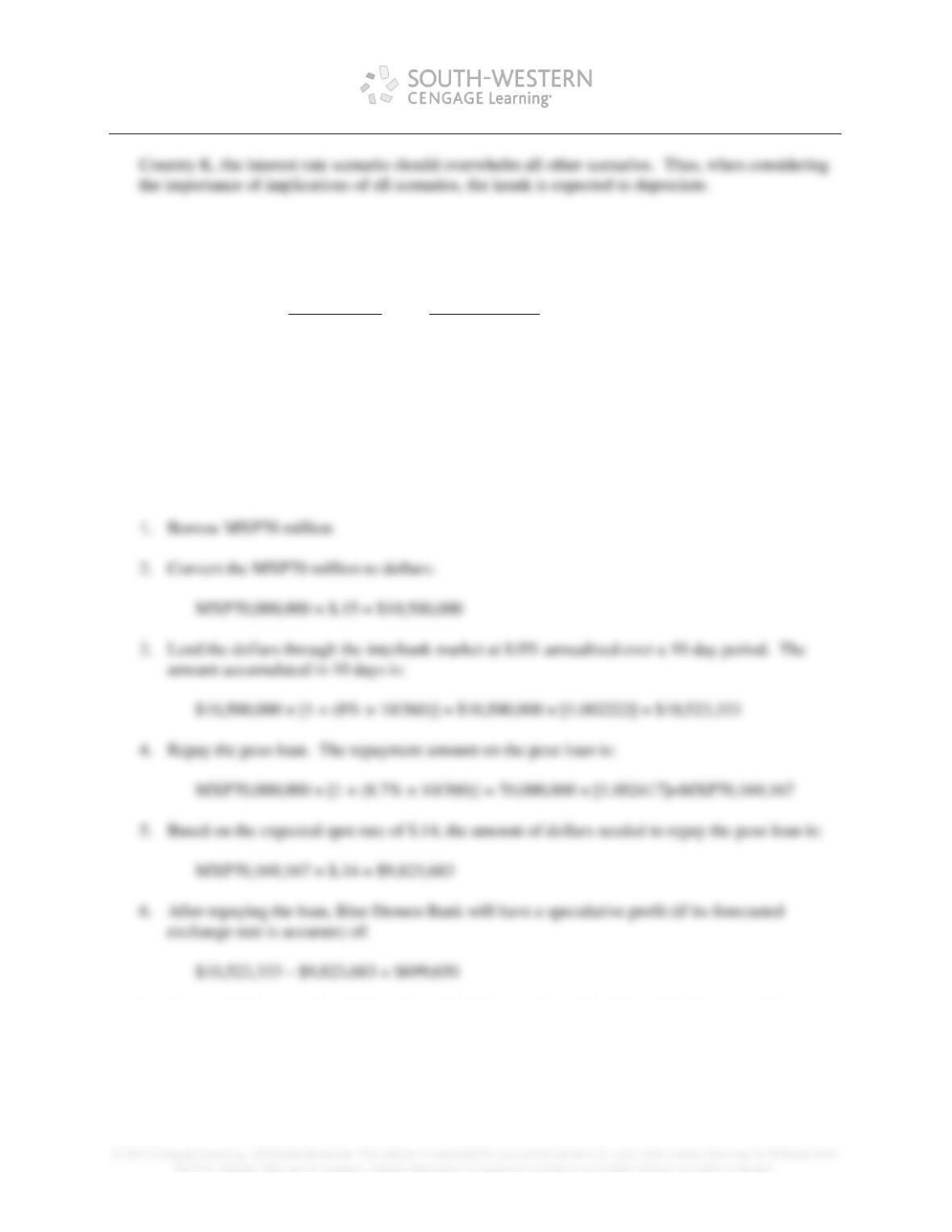
ANSWER: Two of the scenarios described above place upward pressure on the value of the krank.
Exchange Rate Determination 9
20. Speculation. Blue Demon Bank expects that the Mexican peso will depreciate against the dollar
from its spot rate of $.15 to $.14 in 10 days. The following interbank lending and borrowing rates
exist:
Lending Rate Borrowing Rate
U.S. dollar 8.0% 8.3%
Mexican peso 8.5% 8.7%
Assume that Blue Demon Bank has a borrowing capacity of either $10 million or 70 million peos in
the interbank market, depending on which currency it wants to borrow.
a. How could Blue Demon Bank attempt to capitalize on its expectations without using deposited
funds? Estimate the profits that could be generated from this strategy.
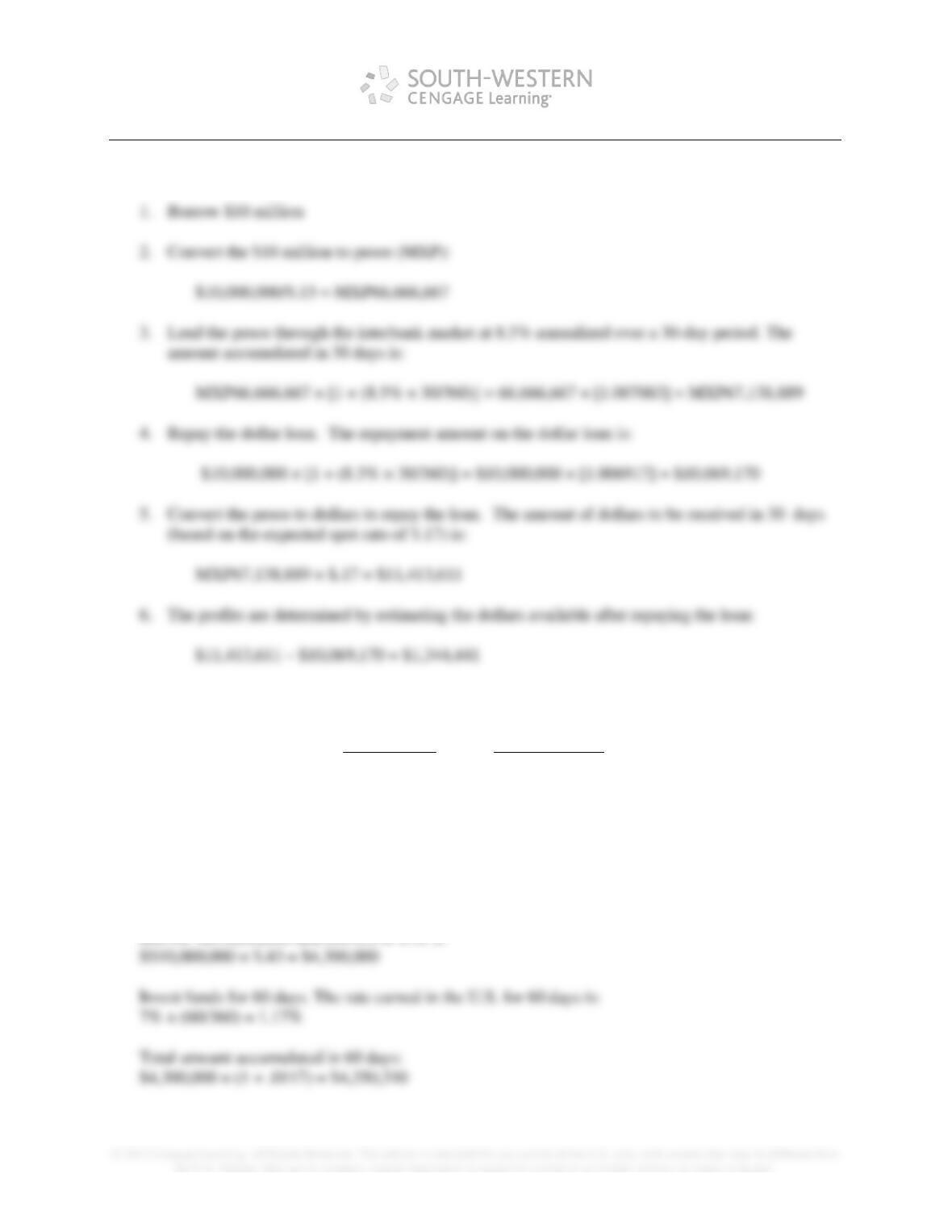
ANSWER: Blue Demon Bank can capitalize on its expectations about pesos (MXP) as follows:
b. Assume all the preceding information with this exception: Blue Demon Bank expects the peso to
appreciate from its present spot rate of $.15 to $.17 in 30 days. How could it attempt to capitalize
on its expectations without using deposited funds? Estimate the profits that could be generated
from this strategy.
10Exchange Rate Determination
ANSWER: Blue Demon Bank can capitalize on its expectations as follows:
21. Speculation. Diamond Bank expects that the Singapore dollar will depreciate against the dollar from
its spot rate of $.43 to $.42 in 60 days. The following interbank lending and borrowing rates exist:
Lending Rate Borrowing Rate
U.S. dollar 7.0% 7.2%
Singapore dollar 22.0% 24.0%
Diamond Bank considers borrowing 10 million Singapore dollars in the interbank market and
investing the funds in dollars for 60 days. Estimate the profits (or losses) that could be earned from
this strategy. Should Diamond Bank pursue this strategy?
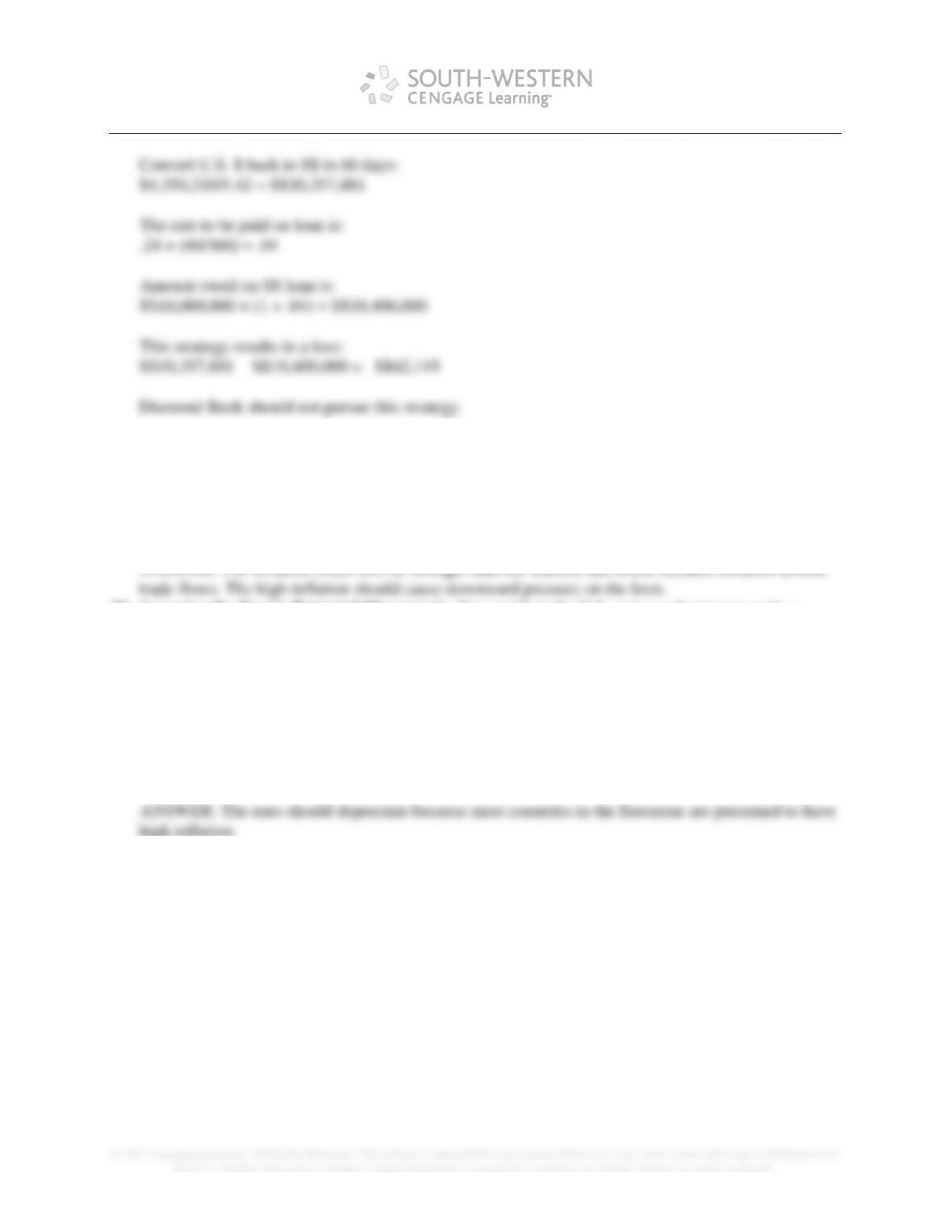
ANSWER:
Borrow S$10,000,000 and convert to U.S. $:
Exchange Rate Determination 11
22. Relative Importance of Factors Affecting Exchange Rate Risk. Assume that the level of
capital flows between the U.S. and the country of Krendo is negligible (close to zero) and will
continue to be negligible. There is a substantial amount of trade between the U.S. and the country of
Krendo and no capital flows. How will high inflation and high interest rates affect the value of the
kren (Krendo’s currency)? Explain.
23. Assessing the Euro’s Potential Movements. You reside in the U.S. and are planning to make a
one-year investment in Germany during the next year. Since the investment is denominated in euros,
you want to forecast how the euro’s value may change against the dollar over the one-year period.
You expect that Germany will experience an inflation rate of 1% during the next year, while all other
European countries will experience an inflation rate of 8% over the next year. You expect that the
U.S. will experience an annual inflation rate of 2% during the next year. You believe that the primary
factor that affects any exchange rate is the inflation rate. Based on the information provided in this
question, will the euro appreciate, depreciate, or stay at about the same level against the dollar over
the next year? Explain.
24. Weighing Factors That Affect Exchange Rates. Assume that the level of capital flows between
the U.S. and the country of Zeus is negligible (close to zero) and will continue to be negligible. There
is a substantial amount of trade between the U.S. and the country of Zeus. The main import by the
U.S. is basic clothing purchased by U.S. retail stores from Zeus, while the main import by Zeus is
special computer chips that are only made in the U.S. and are needed by many manufacturers in
Zeus. Suddenly, the U.S. government decides to impose a 20% tax on the clothing imports. The Zeus
government immediately retaliates by imposing a 20% tax on the computer chip imports. Second, the
Zeus government immediately imposes a 60% tax on any interest income that would be earned by
Zeus investors if they buy U.S. securities. Third, the Zeus central bank raises its local interest rates so
that they are now higher than interest rates in the U.S. Do you think the currency of Zeus (called the
zee) will appreciate or depreciate against the dollar as a result of all the government actions
described above? Explain.
12Exchange Rate Determination
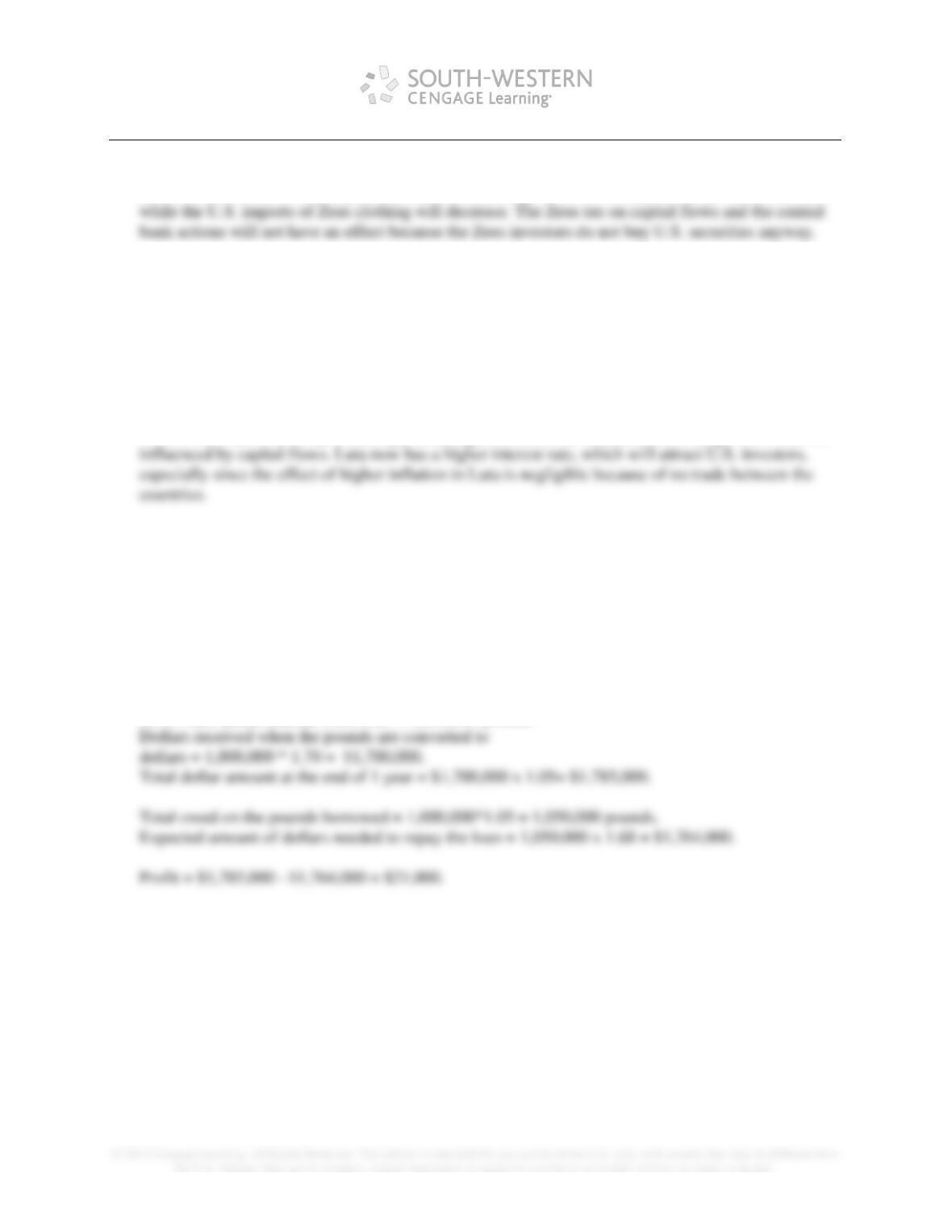
ANSWER: The zee should depreciate, because Zeus imports of U.S. computer chips will continue,
25. How Factors Affect Exchange Rates. The country of Luta has large capital flows with the U.S.
It has no trade with the U.S, and will not have trade with the U.S. in the future. Its interest rate is 6%,
the same as the U.S. interest rate. Its rate of inflation is 5%, the same as the U.S. inflation rate. You
expect that the inflation rate in Luta will rise to 8% this coming year, while the U.S. inflation rate
will remain at 5%. You expect that Luta’s interest rate will rise to 9% during the next year. You
expect that the U.S. interest rate will remain at 6% this year. Do you think Luta’s currency will
appreciate, depreciate, or remain unchanged against the dollar? Briefly explain.
ANSWER: Luta’s currency should appreciate against the dollar because the exchange rate should be
26. Speculation on Expected Exchange Rates. Kurnick Co. expects that the pound will
depreciate from $1.70 to $1.68 in one year. It has no money to invest, but it could borrow
money to invest. It has been approved by a bank to borrow either 1 million dollars or 1 million
pounds for one year. It can borrow dollars at 6% or Bitish pounds at 5% for one year. It can
invest in a risk-free dollar deposit at 5% for one year or a risk-free British deposit at 4% for
one year. Determine the expected profit or loss (in dollars) if Kurnick Co. pursues a strategy
to capitalize on the expected depreciation of the pound.
ANSWER: Initial amount borrowed = 1,000,000 pounds
27. Volatility of Exchange Rate Movements. Assume you want to determine whether the monthly
movements in the Polish zloty against the dollar are more volatile than monthly movements in some
other currencies against the dollar. The zloty was valued at $.4602 on May 1, $.4709 on June 1,
$.4888 on July 1, $.4406 on August 1, and $.4260 on September 1. Using Excel or another electronic
spreadsheet, compute the standard deviation (a measure of volatility) of the zloty’s monthly exchange
rate movements. Show your spreadsheet.
Exchange Rate Determination 13
ANSWER:
First day in:
Value
Change
0.4602
June
0.4709
2.33%
July
0.4888
3.80%
August
0.4406
-9.86%
September
0.426
-3.31%
Std Dev
6.21%
28. Impact of Economy on Exchange Rates. Assume that inflation is zero in the U.S. and in Europe
and will remain at zero. U.S. interest rates are presently the same as in Europe. Assume that the
economic growth for the U.S. is presently similar to Europe. Assume that international capital flows
are much larger than international trade flows. Today, there is news that clearly signals economic
conditions in Europe will be weakening in the future, while economic conditions in the U.S. will
remain the same. Explain why and how (which direction) the euro’s value would change today based
on this information.
ANSWER: Expectations of weak economic conditions result in a reduced demand for loanable funds
29. Movements in Cross Exchange Rates. Last year a dollar was equal to 7 Swedish kronor, and a
Polish zloty was equal to $.40. Today, the dollar is equal to 8 Swedish kronor and a Polish zloty is
equal to $.44. By what percentage did the cross exchange rate of the Polish zloty in Swedish kronor
(that is, the number of kronor that can be purchased with one zloty) change over the last year?
ANSWER:
Old rates last year
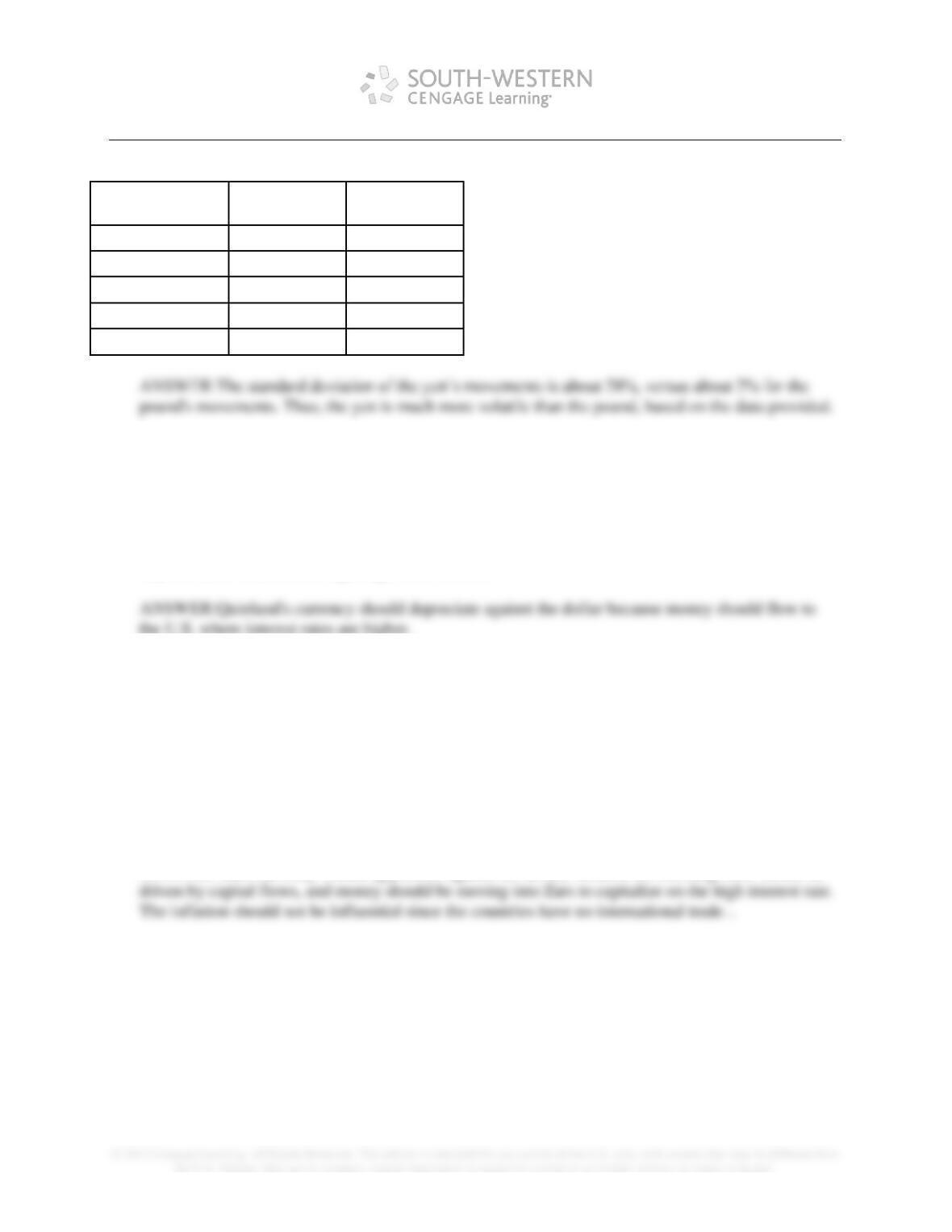
30. Measuring Exchange Rate Volatility. Here are exchange rates for the Japanese yen and British
pound at the beginning of each of the last 5 years. Your firm wants to determine which currency is
more volatile as it assesses its exposure to exchange rate risk. Estimate the volatility of each
currency’s movements.
14Exchange Rate Determination
Beginning of
Year
Yen
Pound
1
0.008
1.47
2
0.011
1.46
3
0.008
1.51
4
0.01
1.54
5
0.012
1.52
31. Impact of Economy on Exchange Rate. The country of Quinland has large capital flows with the
U.S. It has no trade with the U.S, and will not have trade with the U.S. in the future. Its interest rate
is 6%, the same as the U.S. interest rate. You expect that the inflation rate in Quinland will be 1%
this coming year, while the U.S. inflation rate will be 9%. You expect that Quinland’s interest rate
will be 2% during the next year, while the U.S. interest rate will rise to 10% during the next year.
Quinland’s currency adjusts in response to market forces. Will Quinland’s currency appreciate,
depreciate, or remain unchanged against the dollar?
32. Impact of Economy on Exchange Rate. The country of Zars has large capital flows with the U.S. It
has no trade with the U.S, and will not have trade with the U.S. in the future. Its interest rate is 6%,
the same as the U.S. interest rate. Its rate of inflation is 5%, the same as the U.S. inflation rate. You
expect that the inflation rate in Zars will rise to 8% this coming year, while the U.S. inflation rate
will remain at 5%. You expect that Zars’ interest rate will rise to 9% during the next year. You
expect that the U.S. interest rate will remain at 6% this year. Zars’ currency adjusts in response to
market forces and is not subject to direct central bank intervention. Will Zars currency appreciate,
depreciate, or remain unchanged against the dollar?
ANSWER: Zars’currency should appreciate against the dollar, because the exchange rate should be
Solution to Continuing Case Problem: Blades, Inc.
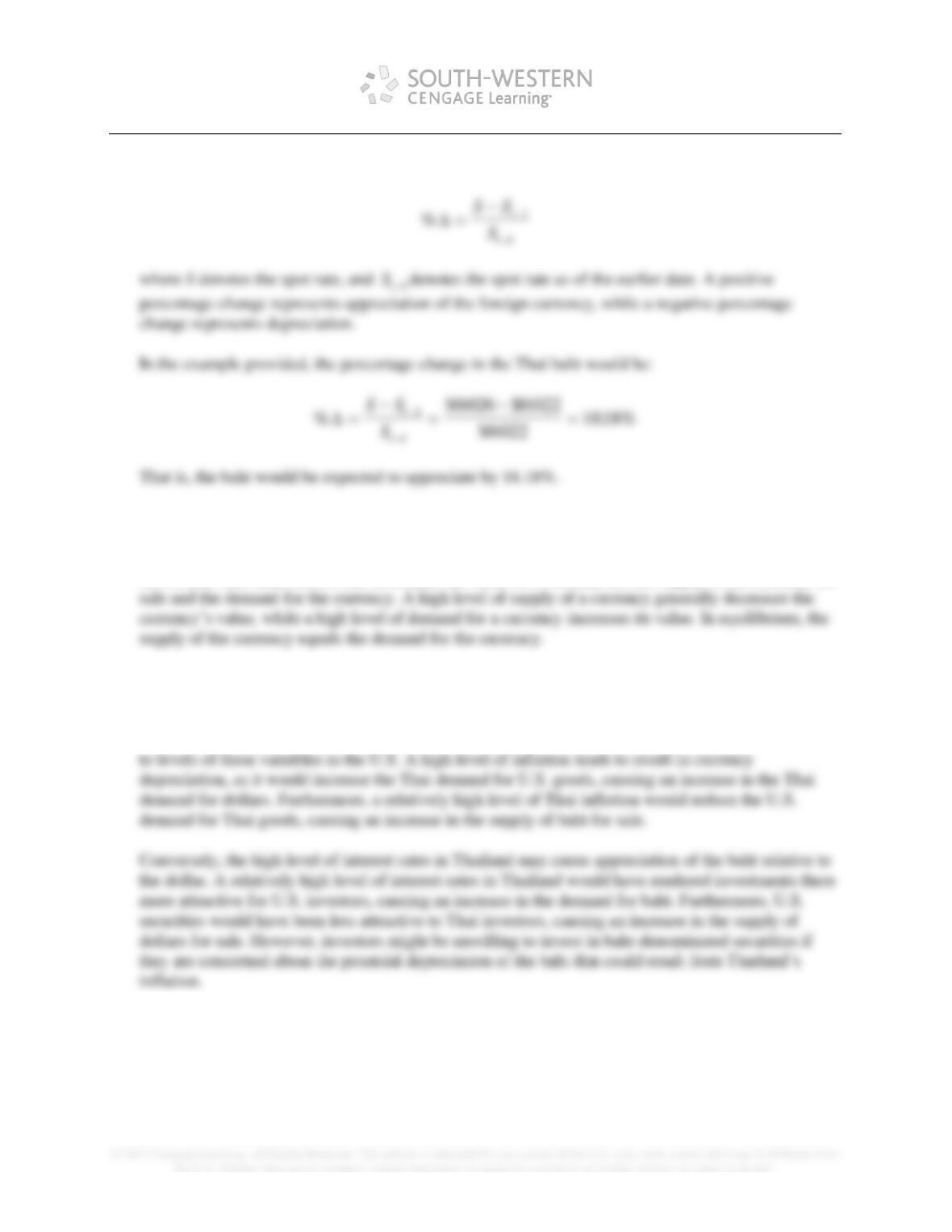
1. How are percentage changes in a currency’s value measured? Illustrate your answer numerically by
assuming a change in the Thai baht’s value from a value of $0.022 to $0.026.
Exchange Rate Determination 15
ANSWER: The percentage change in a currency’s value is measured as follows:
2. What are the basic factors that determine the value of a currency? In equilibrium, what is the
relationship between these factors?
ANSWER: The basic factors that determine the value of a currency are the supply of the currency for
3. How might the relatively high levels of inflation and interest rates affect the baht’s value? (Assume a
constant level of U.S. inflation and interest rates.)
ANSWER: The baht would be affected both by inflation levels and interest rates in Thailand relative
4. How do you think the loss of confidence in the Thai baht, evidenced by the withdrawal of funds from
Thailand, will affect the baht’s value? Would Blades be affected by the change in value, given the
primary Thai customer’s commitment?
16Exchange Rate Determination
ANSWER: In general, depreciation in the foreign currency results when investors liquidate their
5. Assume that Thailand’s central bank wishes to prevent a withdrawal of funds from its country in
order to prevent further changes in the currency’s value. How could it accomplish this objective
using interest rates?
ANSWER: If Thailand’s central bank wishes to prevent further depreciation in the baht’s value, it
6. Construct a spreadsheet illustrating the steps Blades’ treasurer would need to follow in order to
speculate on expected movements in the baht’s value over the next 30 days. Also show the
speculative profit (in dollars) resulting from each scenario. Use both of Ben Holt’s examples to
illustrate possible speculation. Assume that Blades can borrow either $10 million or the baht
equivalent of this amount. Furthermore, assume that the following short-term interest rates
(annualized) are available to Blades:
Currency
Lending Rate
Borrowing Rate
Dollars
8.10%
8.20%
Thai baht
14.80%
15.40%
ANSWER: (See spreadsheet attached.)
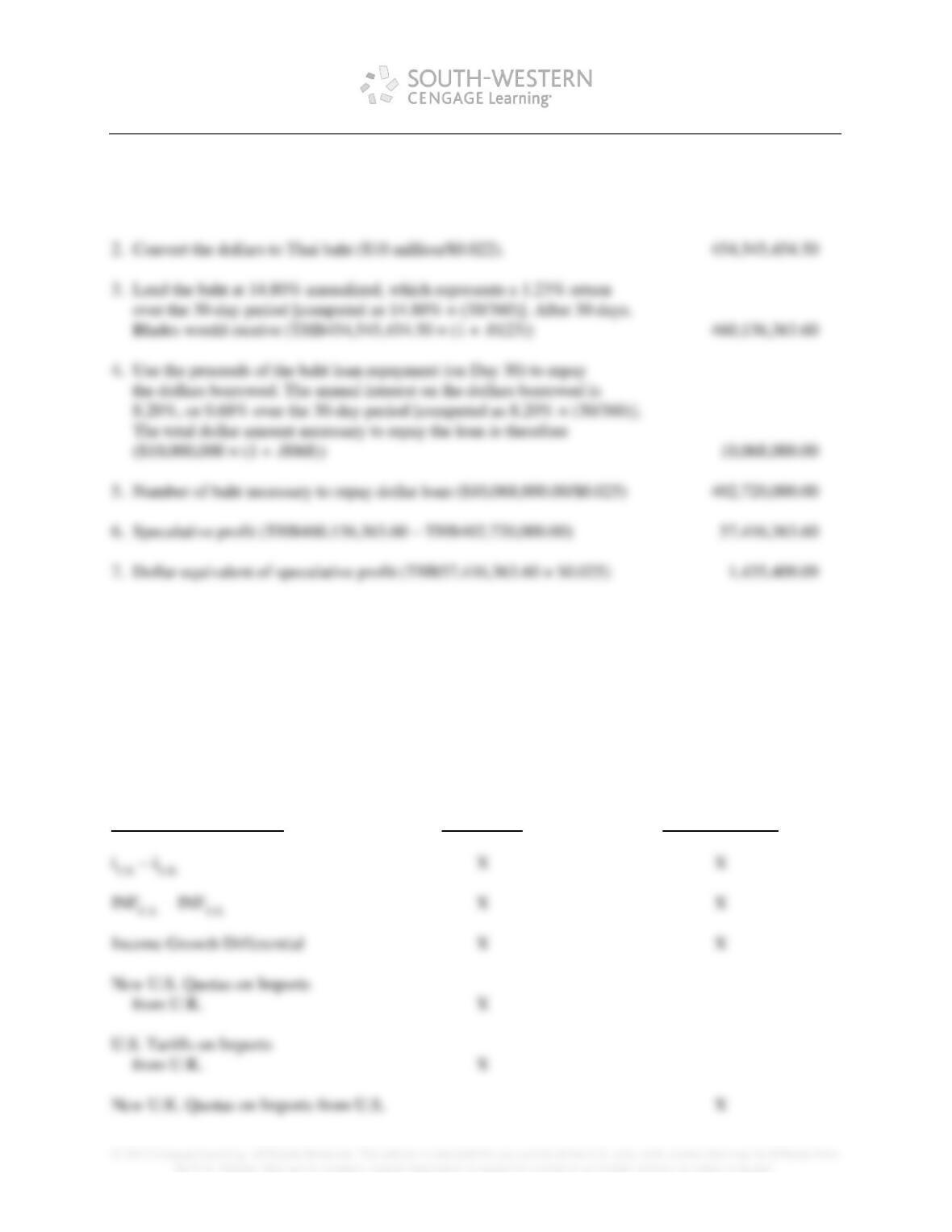
Exchange Rate Determination 17
Appreciation of the Baht from $0.022 to $0.025
1. Borrow dollars.
10,000,000.00
2. Convert the dollars to Thai baht ($10 million/$0.022).
3. Lend the baht at 14.80% annualized, which represents a 1.23% return
over the 30-day period [computed as 14.80% × (30/360)]. After 30 days,
Blades would receive (THB454,545,454.50 × (1 + .0123))
4. Use the proceeds of the baht loan repayment (on Day 30) to repay
the dollars borrowed. The annual interest on the dollars borrowed is
8.20%, or 0.68% over the 30-day period [computed as 8.20% × (30/360)].
The total dollar amount necessary to repay the loan is therefore
($10,000,000 × (1 + .0068))
10,068,000.00
5. Number of baht necessary to repay dollar loan ($10,068,000.00/$0.025)
6. Speculative profit (THB460,136,363.60 – THB402,720,000.00)
57,416,363.60
7. Dollar equivalent of speculative profit (THB57,416,363.60 × $0.025)
Solution to Supplemental Case: Bruin Aircraft, Inc.
Some of the more commonly cited factors are listed as follows. This exercise forces students to
recognize how factors influence the value of each currency.
Check (X) Here if the Factor Check (X) Here if the Factor
Factors that Can Affect Influences the U.S. Demand Influences the Supply of
the Value of the Pound for Pounds Pounds for Sale
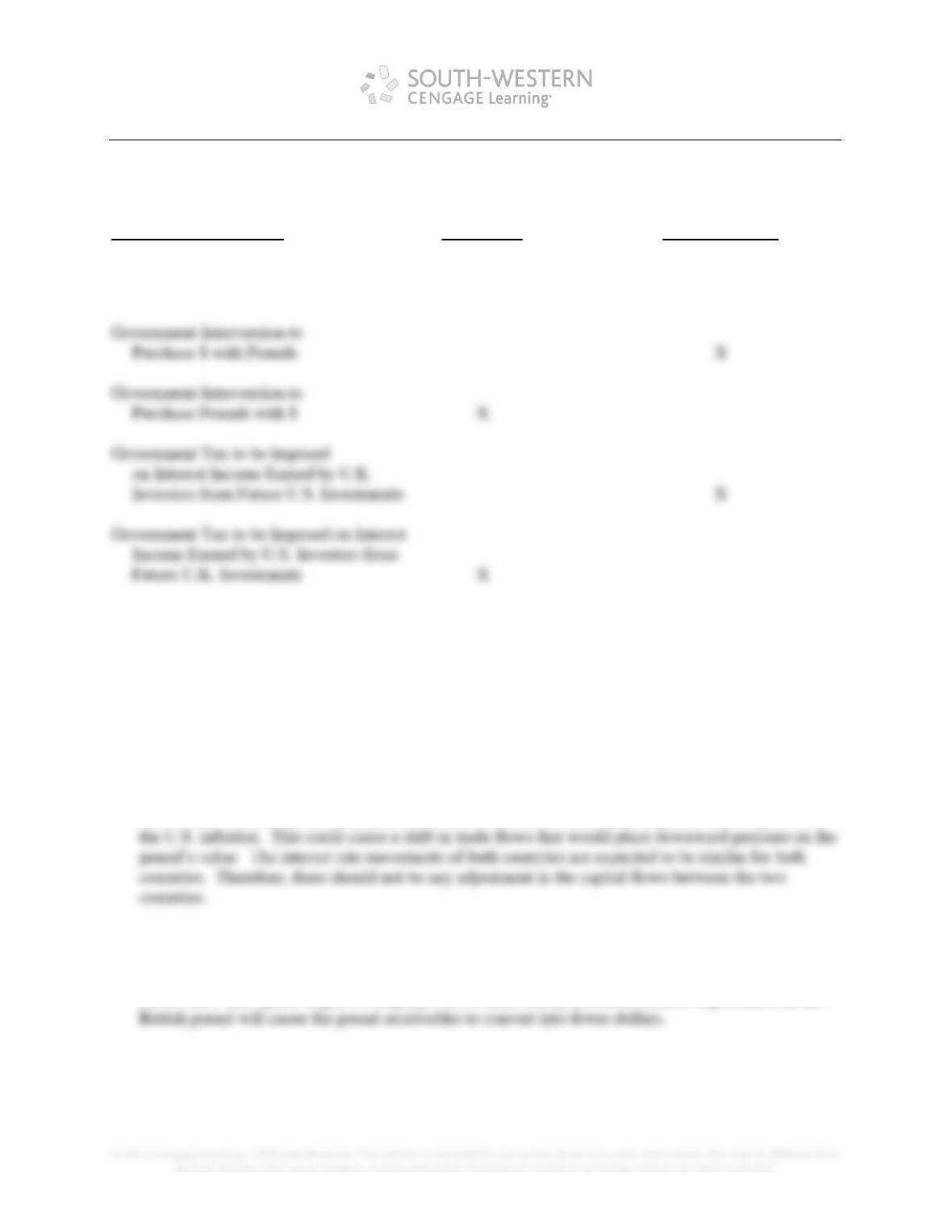
18Exchange Rate Determination
Check (X) Here if the Factor Check (X) Here if the Factor
Factors that Can Affect Influences the U.S. Demand Influences the Supply of
the Value of the Pound for Pounds Pounds for Sale
New U.K. Tariffs on Imports from U.S. X
Small Business Dilemma
Assessment by the Sports Exports Company of Factors That Affect the British Pound’s
Value
1. Given Jim’s expectations, forecast whether the pound will appreciate or depreciate against the dollar
over time.
ANSWER: The pound should depreciate because the British inflation is expected to be higher than
2. Given Jim’s expectations, will the Sports Exports Company be favorably or unfavorably affected by
the future changes in the value of the pound?
ANSWER: The Sports Exports Company will be unfavorably affected, because depreciation in the