CHAPTER 4
FINANCIAL GOALS AND CORPORATE GOVERNANCE
1. Business Ownership. What are the predominant ownership forms in global business?
Business ownership can first be divided between state ownership and private
ownership. State ownership, public ownership, is probably the largest globally.
2. Business Control. How does ownership alter the control of a business organization?
Is the control of a private firm that different from a publicly traded company?
Privately controlled companies – a single individual or family – is often characterized
by top-down control, where the owner is active in more of the daily strategic and
3. Separation of Ownership and Management. Why is this separation so critical to
the understanding of how businesses are structured and led?
The field of agency theory is the study of how shareholders can motivate
management to accept the prescriptions of the Shareholder Wealth Maximization
(SWM) model. For example, liberal use of stock options should encourage
management to think like shareholders. Whether these inducements succeed is open
4. Corporate Goals: Shareholder Wealth Maximization. Explain the assumptions
and objectives of the shareholder wealth maximization model.
The Anglo-American markets are characterized by a philosophy that a firm’s
objective should be to maximize shareholder wealth. Anglo-American is defined to
mean the United States, United Kingdom, Canada, Australia, and New Zealand. This
5. Corporate Goals: Stakeholder Capitalism Maximization (SCM). Explain the
assumptions and objectives of the stakeholder capitalization model.
Continental European and Japanese markets are characterized by a philosophy that all
of a corporation’s stakeholders should be considered, and the objective should be to
maximize corporate wealth. Thus a firm should treat shareholders on a par with other
6. Management’s Time Horizon. Do shareholder wealth maximization and
stakeholder capitalism have the same time-horizon for the strategic, managerial, and
financial objectives of the firm? How do they differ?
Companies pursuing shareholder returns, particularly publicly traded firms, have a
very short time horizon for financial results. The 90-day time interval, the quarterly
result, is a very short period of time for companies to continually demonstrate the
7. Operational Goals. What should be the primary operational goal of an MNE?
Financial goals differ from strategic goals in that the former focus on money and
wealth (such as the present value of expected future cash flows). Strategic goals are
more qualitative – operating objectives such as growth rates and/or share-of-market
goals.
Trident’s strategic goals are the setting of such objectives as degree of global scope
and depth of operations. In what countries should the firm operate? What products
should be made in each country? Should the firm integrate its international operations
or have each foreign subsidiary operate more or less on its own? Should it
8. Financial Returns. How do shareholders in a publicly traded firm actually reap cash
flow returns from their ownership? Who has control over which of these returns?
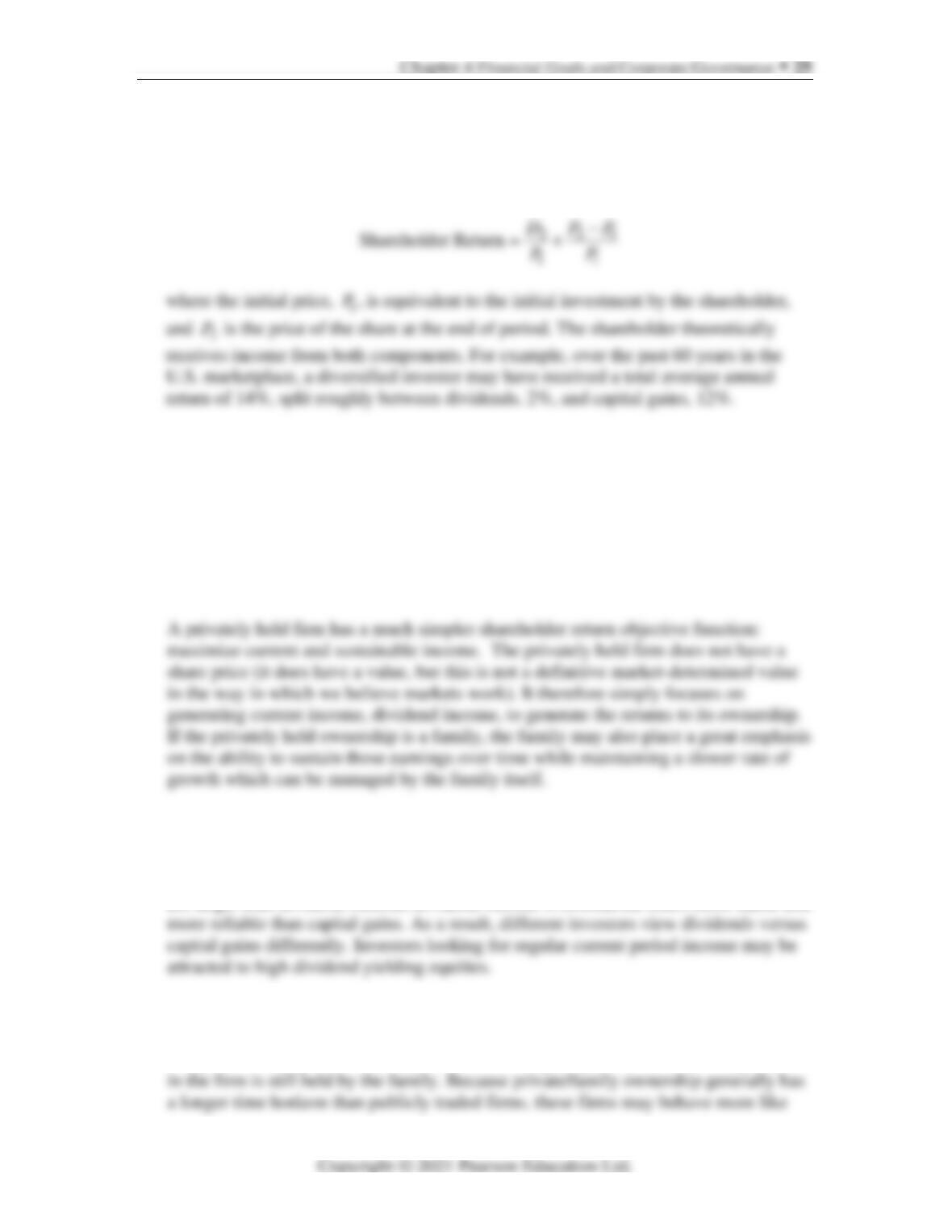
The return to a shareholder in a publicly traded firm combines current income in the
form of dividends and capital gains from the appreciation of share price:
Management generally believes it has the most direct influence over the first
component – the dividend yield. Management makes strategic and operational
decisions which grow sales, generate profits, and then distributes those profits to
ownership in the form of dividends. Capital gains – the change in the share price as
traded in the equity markets – is much more complex, and reflects many forces which
are not in the direct control of management. Despite growing market share, profits, or
any other traditional measure of business success, the market may not reward these
actions directly with share price appreciation.
9. Dividend Returns. Are dividends really all that important to investors in publicly
traded companies? Aren’t capital gains really the point or objective of the investor?
Although on average over the past century in the U.S. capital markets capital gains
10. Ownership Hybrids. What is a hybrid? How may it be managed differently?
Many firms around the world are both publicly traded, but privately controlled. This
is typical of family owned businesses which have gone public, but controlling interest
26
▪ Eiteman/Stonehill/Moffett | Multinational Business Finance, 15th Edition, GE
private firms, being more ‘patient’ in terms of seeing the financial and operational
results of corporate investment and strategy.
11. Corporate Governance. Who is responsible for the implementation of corporate
governance within a firm? What are the main functions of corporate governance?
What does it entail?
Corporate governance is the set of rules, practices, and processes by which a firm is
directed and controlled. The function of corporate governance is to balance the
interests of the firm’s stakeholders, and thus it covers all spheres of management.
12. Governance Regimes. What are the four major types of governance regimes and
how do they differ?
The four major corporate governance regimes are 1) market-based, characterized by
dispersed ownership and a separation of ownership from management; 2) family-
based, where ownership and management are often combined; 3) bank-based, where
government frequently controls bank lending practices, restricting the growth rate of
13. Governance Development Drivers. What are the primary drivers of corporate
governance across the globe? Is the relative weight or importance of some drivers
increasing over others?
There are four major drivers in the evolution of corporate governance principles and
practices globally: 1) the financial market development; 2) the degree of separation
14. Good Governance Value. Does good governance have a ‘value’ in the marketplace?
Do investors really reward good governance, or does good governance just attract a
specific segment of investors?
This is basically a rhetorical question for student discussion. There have been a
number of studies, for example by McKinsey, as to what premium – if any – that
market may be willing to pay a small premium, but in general, the results to date have
been unconvincing.
15. Shareholder Dissatisfaction. What alternative actions can shareholders take if they
are dissatisfied with their company?
Disgruntled shareholders may:
a. Remain quietly disgruntled. This puts no pressure on management to change its
ways under both the Shareholder Wealth Maximization (SWM) model and the
Corporate Wealth Maximization (CWM) model.
c. Change management. Under the one-share, one-vote procedures of the SWM
model, a concerted group of shareholders can vote out existing board members if
they fail to change management practices. This usually takes the form of the board
firing the firm’s president or chief operating officer. Cumulative voting, which is
a common attribute of SWM firms, facilitates the placing of minority stockholder
representation on the board. If, under the CWM model, different groups of
shareholders have voting power greater than their proportionate ownership of the
company, ousting of directors and managers is more difficult.
16. Emerging Markets Corporate Governance Failures. It has been claimed that
failures in corporate governance have hampered the growth and profitability of some
prominent firms located in emerging markets. What are some typical causes of these
failures in corporate governance?
17. Corporate Governance in Emerging Markets. Investors usually pay more attention
to corporate governance during the processes of mergers and acquisitions. Assume
you are a management consultant who is advising a MNE on whether to make an
offer to acquire a firm in an emerging market. How can you evaluate the corporate
governance performance of this firm?