11
CHAPTER 3
THE CLASSICAL WORLD OF DAVID RICARDO
AND COMPARATIVE ADVANTAGE
Learning Objectives:
■ Identify the basic assumptions of the Ricardian model.
■ Explain comparative advantage as a basis for trade between nations.
I. Outline
Introduction
– Some Common Myths
Assumptions of the Basic Ricardian Model
Ricardian Comparative Advantage
Comparative Advantage and the Total Gains from Trade
II. Special Chapter Features
Titans of International Economics: David Ricardo (1772-1823)
In the Real World: Export Concentration of Selected Countries
III. Purpose of Chapter
The purpose of this chapter is to introduce students to the basic idea of Classical
IV. Teaching Tips
A. This chapter begins with a look at some common myths about international trade. An
12
This is perhaps best accomplished by giving the class several different examples of two-country
by two-commodity examples similar to those in the text, pointing out when there is a basis for
trade.
E. It is important to demonstrate comparative advantage using the PPF because it not only
allows one to generalize beyond the labor theory of value (to opportunity cost in general), but
also demonstrates that trade allows a country to consume beyond its PPF. Using the PPF thus
provides a good transition between the Classical model and the upcoming neoclassical
presentation.
V. Answers to End-of-Chapter Questions and Problems
1. (a) The autarky price ratios:
France: 1 computer:25 wheat, or 1 wheat:1/25 computer
Germany: 1 computer:20 wheat, or 1 wheat:1/20 computer
(b) France has a comparative advantage in wheat and Germany in computers. France’s
(d) France saves 4 days of labor/computer; Germany saves 0.5 days of labor/wheat.
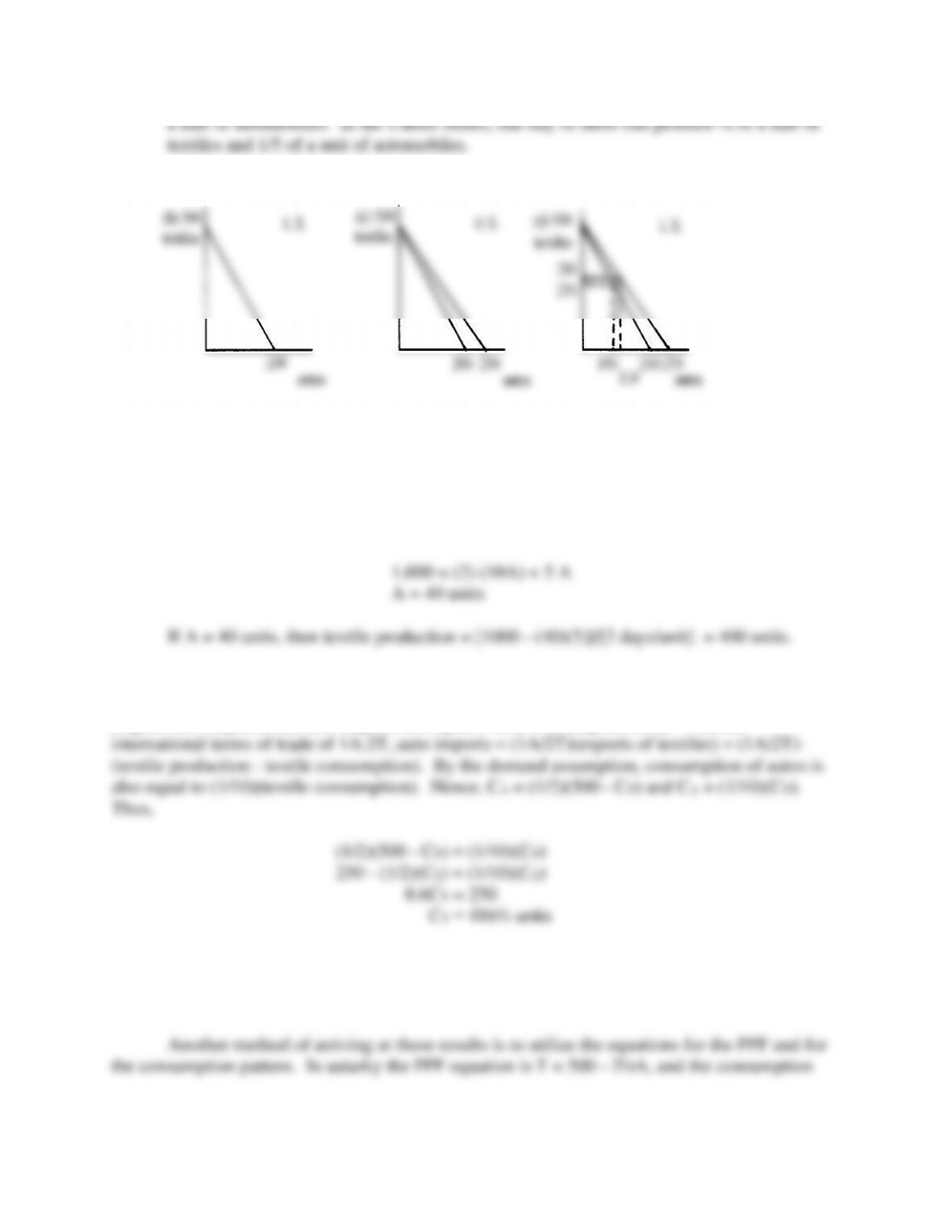
2. (a) In the United Kingdom one day of labor can produce ⅓ of a unit of textiles and 1/6 of
13
3. In autarky, the production (and consumption) of textiles and autos will utilize all the
available 1,000 days of labor. Thus, with T = number of units of textiles produced and A =
number of autos produced, 1,000 = (2 days/unit)T + (5 days/unit)A. The consumption
requirement is that 10 units of textiles be consumed for every unit of automobiles. Hence, total
textile production is equal to (10) (total auto production), i.e., 10A. Thus, given the available
labor, and substituting 10A for T,
With specialization in textile production and trade, textile production equals 500 units.
Consumption of textiles (CT) is equal to textile production minus the textile exports used to
acquire auto imports, and auto imports are equal to auto consumption (CA). With the
With CT = 416⅔ units, CA therefore equals 41⅔ units. Because of specialization and trade, the
United States has gained 16⅔ units of textiles (416⅔ – 400) and 1⅔ autos (41⅔ – 40) in
comparison with the autarky situation.
equation is CT = 10CA. Solving the two equations for the two unknowns (there are only two
4. Classical comparative advantage indicates that when a small price-taking country trades
with a large country, the benefits of trade go to the small country. Developing countries may not
5. Portugal has an absolute advantage in the production of both goods because the absolute
labor requirements for both wine and cloth are less than in Spain. However, since the relative
6. Because the price of the import good falls and the price of the export good rises with
trade, the slope of the consumption-possibilities frontier originating at the production point is
7. This could follow from the conclusions reached regarding the distribution of benefits
from trade between countries of different economic size. If the impact of the difference in size
between the two countries leads to the international terms of trade changing relatively more for
8. This statement could be true if trade was based on absolute advantage. However, since
trade can take place on the basis of comparative advantage, what counts is relative cost
15
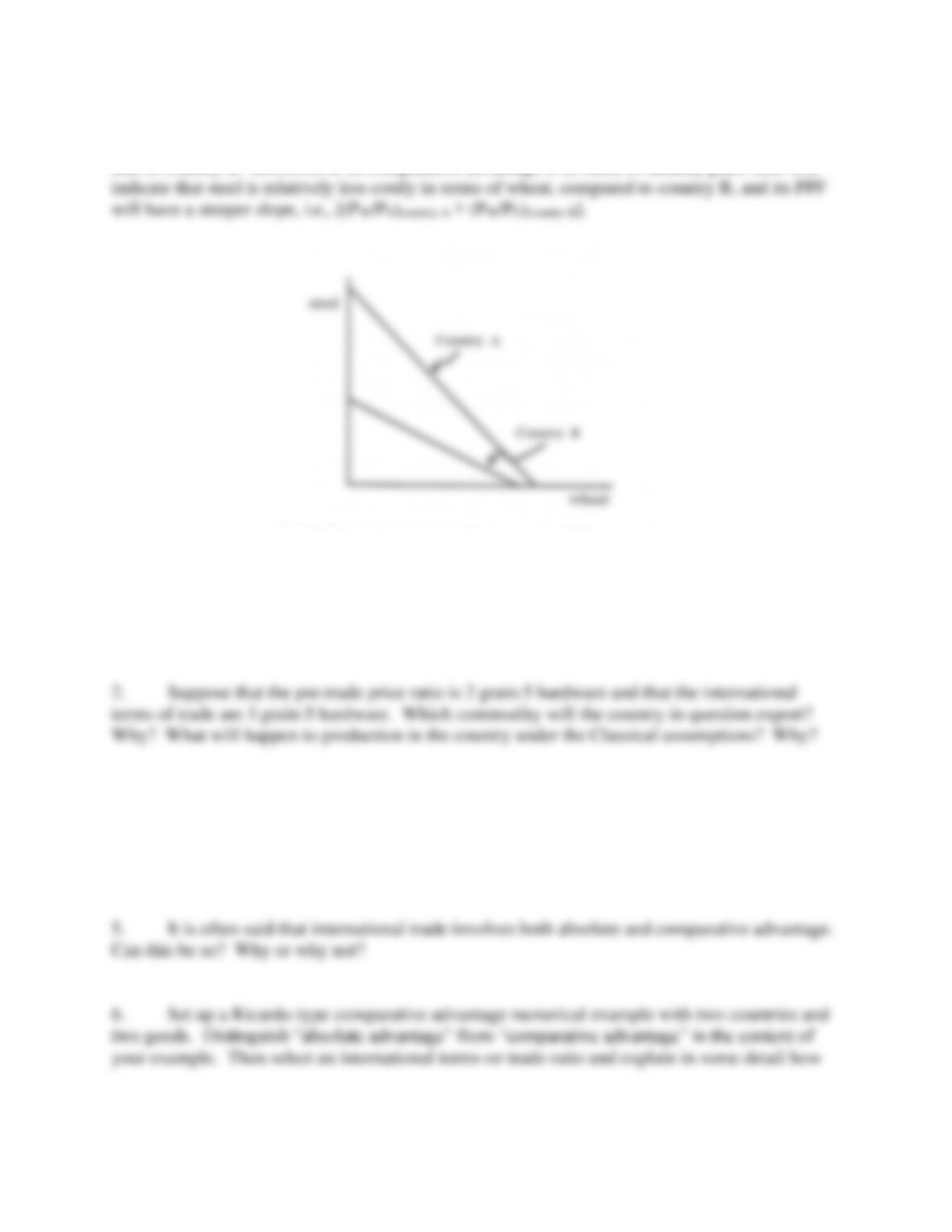
9. Because country A is more efficient in the production of both goods, its PPF lies outside
that of country B. However, if its comparative advantage is in steel, its autarky price ratio will
VI. Sample Exam Questions
A.
E
Es
ss
sa
ay
y
Q
Qu
ue
es
st
ti
io
on
ns
s
1. Why did Ricardo think that international trade was based on comparative advantage
while internal (domestic) trade was based on absolute advantage?
3. Did the concept of comparative advantage strengthen or worsen the case against
Mercantilist trade doctrine? Why?
4. Is it possible for trade to take place in the Classical world of David Ricardo without
complete specialization of production in both countries? If so, when? Who will receive the
gains from trade in this instance? Why?

16
trade between the two countries benefits each of them in comparison with autarky. When would
either of your countries NOT benefit from engaging in trade? Explain.