260
CHAPTER 24
NATIONAL INCOME AND THE CURRENT ACCOUNT
Learning Objectives:
■ Show how the incorporation of a foreign trade sector into a Keynesian income model
alters the determination of income equilibrium compared to a closed-economy model.
■ Explain the autonomous spending multiplier process in an open economy.
■ Discuss the concepts of internal balance and external balance.
I. Outline
Introduction
– Does GDP Growth Cause Trade Deficits?
The Current Account and National Income
II. Special Chapter Features
Titans of International Economics: John Maynard Keynes (1883-1946)
In the Real World: Average Propensities to Import, Selected Countries
III. Purpose of Chapter
The purpose of this chapter is to introduce the students to the manner in which changes in
the current account influence the macroeconomy and the mechanism by which these changes
influence the current account. The material forms a necessary foundation for the remaining
chapters in the text.
261
IV. Teaching Tips.
A. The opening vignette can be used to make sure that the students realize that the foreign
trade sector of the economy is not something separate from the rest of the economy – rather, it is
intricately interdependent with developments in the “internal” sector.
D. Some international economics texts call the open-economy multiplier the “foreign trade
multiplier.” We recommend that you not use that term, however, since we think that it is
misleading – the multiplier does not apply only to autonomous changes in the foreign trade
sector of the economy.
V. Answers to End-of-Chapter Questions and Problems
1. An autonomous increase in saving at each income level is equivalent to an autonomous
decrease in consumption at each income level. The autonomous decrease in consumption will
decrease equilibrium national income by the autonomous consumption change times the open-
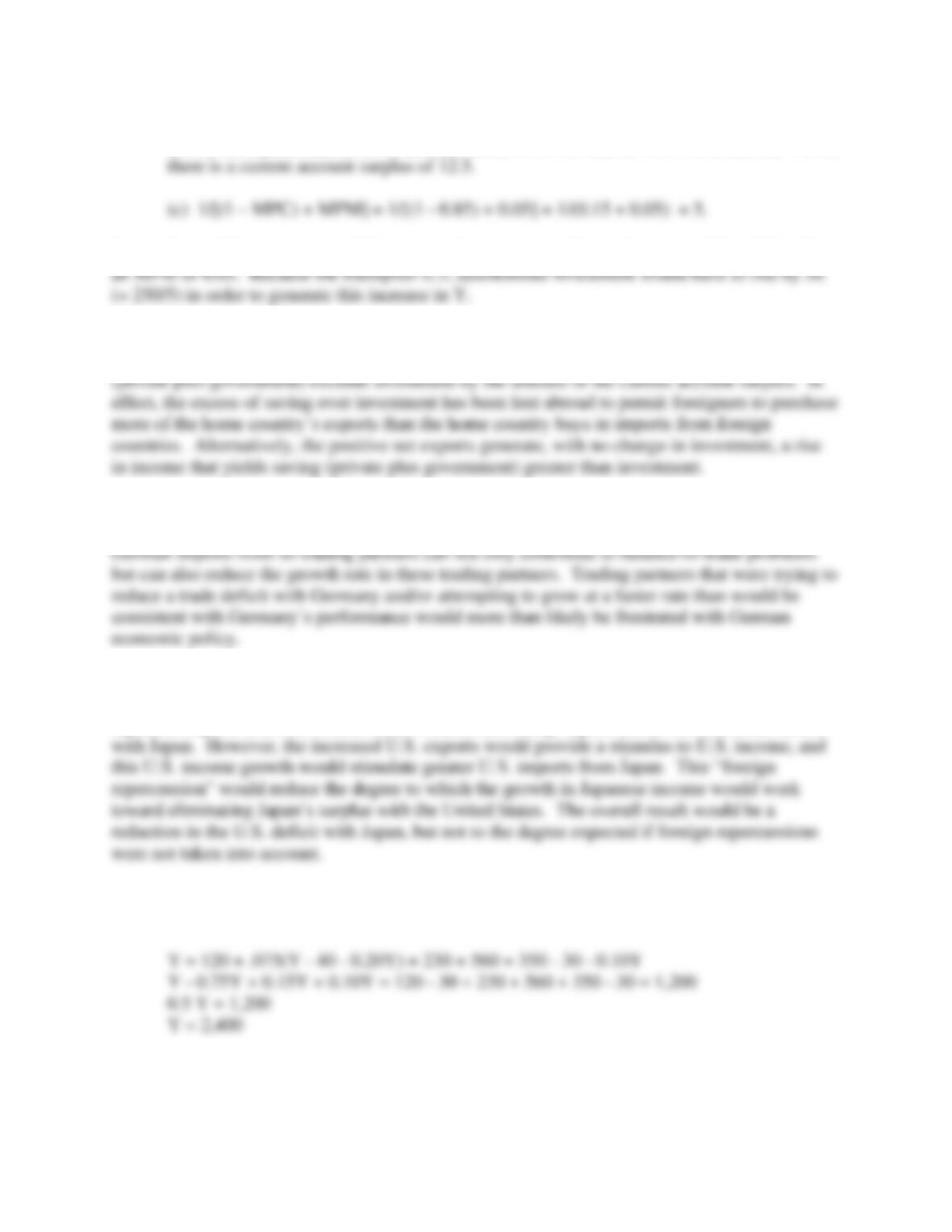
2. (a) Y = C + I + G + (X – M)
Y = 50 + 0.85Yd + 150 + 300 + 80 – (10 + 0.05Y)
262
(b) At the equilibrium level of income, because X = 80 and M = 10 + 0.05(1,150) = 67.5,
3. Y would have to rise by 250, because this increase in Y would increase M by 12.5 with
4. If a country has a current account surplus (X > M), then a reworking of the national
income expression S + M + T = I + X + G to S + (T – G) – I = (X – M) indicates that saving
5. If Germany pursues a policy that results in a lower rate of growth, then its growth in
demand for goods from its trading partners will also slow down. A slower rate of growth of
6. Expansionary fiscal policy in Japan would lead to an expansion of Japanese income and
thus increased imports, some of which would come from the United States. This expansion of
Japanese imports from the United States would, other things equal, reduce the U.S. trade deficit
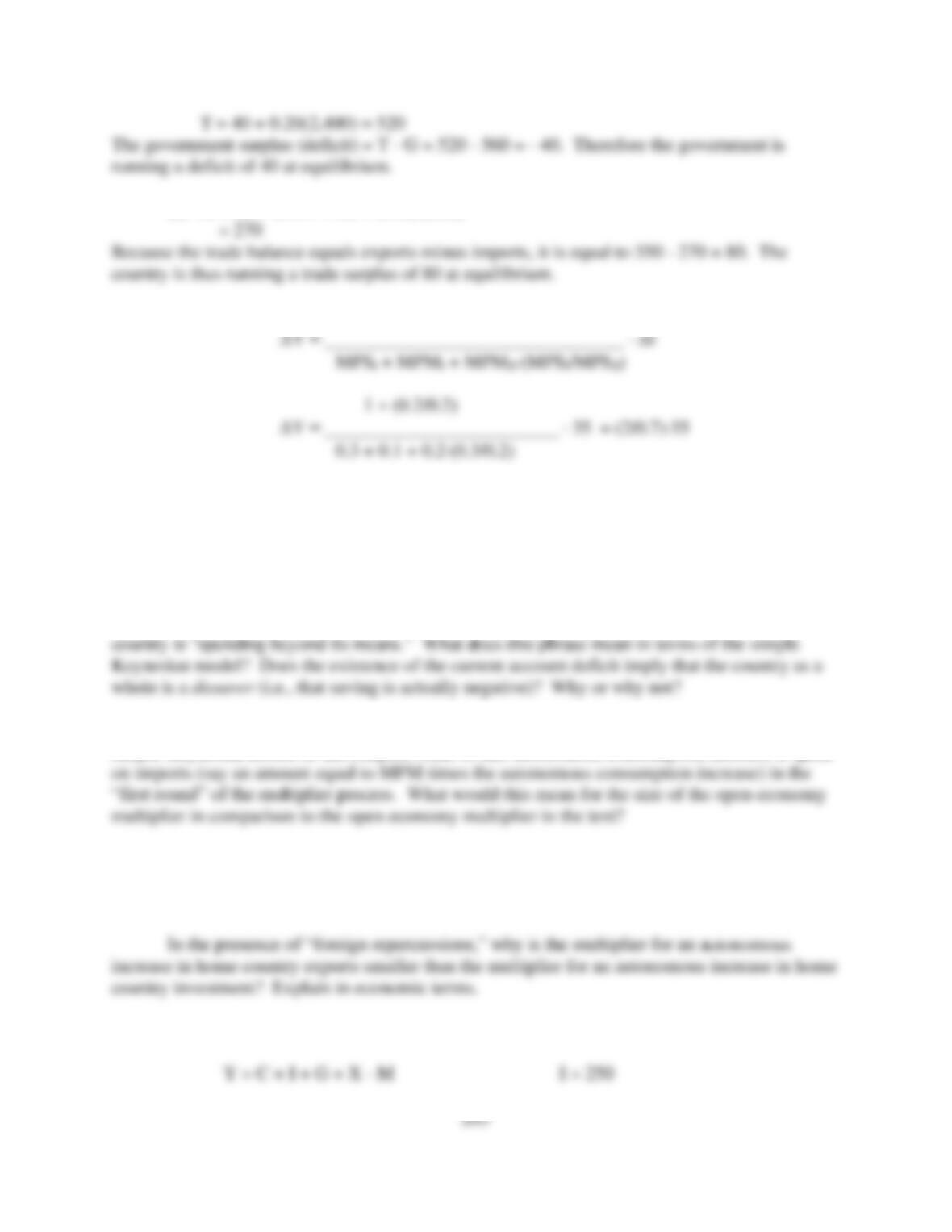
7. (a) Since E = Y in equilibrium, then Y = C + I + G + X – M. Substituting the equations
and/or exogenous values for the various expenditure items into the income identity produces
(b) T = 40 + 0.20Y
263
T = 40 + 0.20(2,400) = 520
The government surplus (deficit) = T – G = 520 – 560 = – 40. Therefore the government is
running a deficit of 40 at equilibrium.
(c) M = 30 + 0.10Y = 30 + 0.10(2,400)
8. 1 + (MPMII/MPSII)
Therefore country I’s income will rise by $100 billion.
VI. Sample Exam Questions
A.
E
Es
ss
sa
ay
y
Q
Qu
ue
es
st
ti
io
on
ns
s
1. If a country has a current account deficit, this is often referred to as a situation where the
2. Suppose that autonomous consumption increases but that, unlike the situation in the
simple Keynesian model of this chapter, some of this autonomous consumption increase is spent
3. (This question pertains to Appendix B material.)
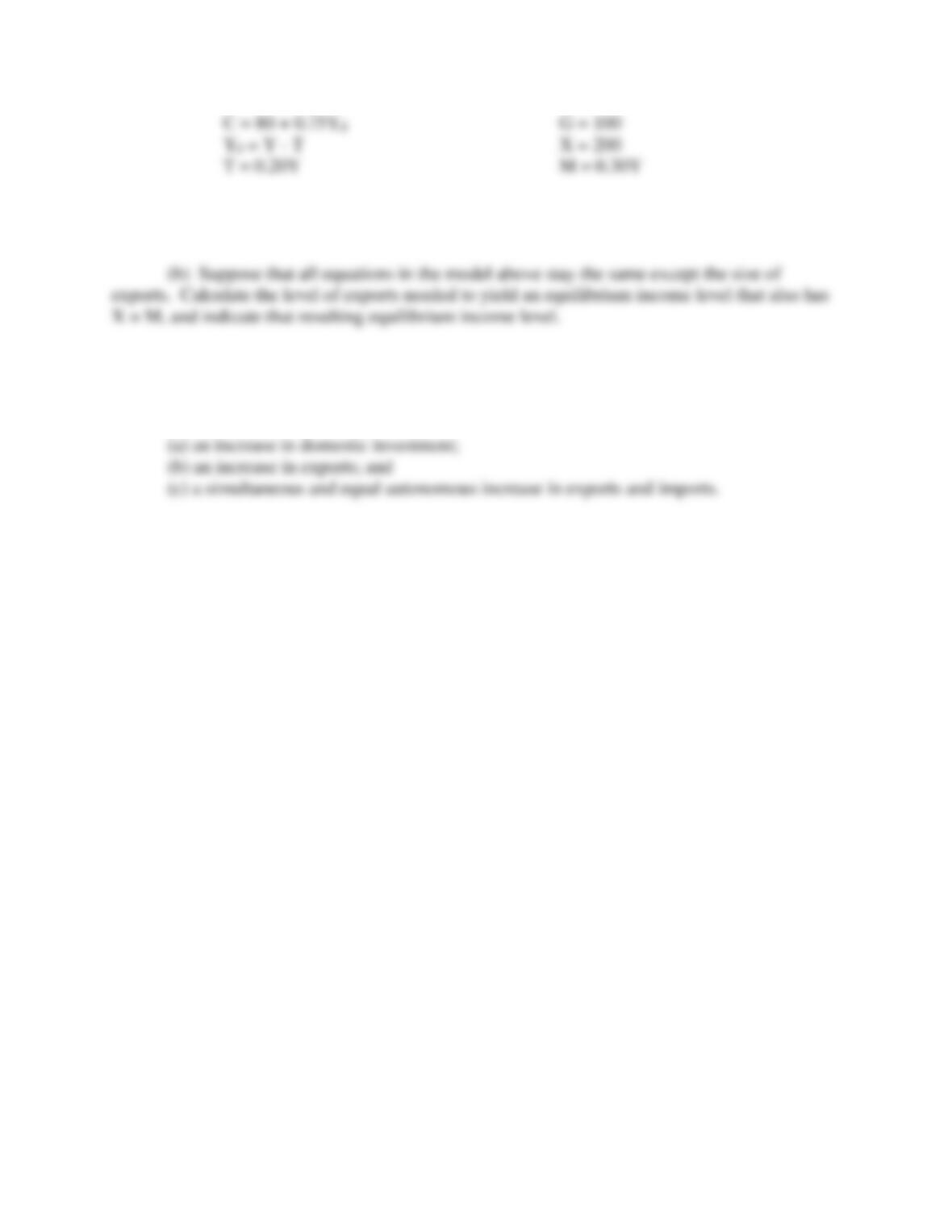
4. Given the following Keynesian model:
264
(a) Calculate the equilibrium level of income and indicate the value of the current
account balance when the economy is at its equilibrium income level.
5. In the context of a Keynesian open-economy income model for a country, carefully
explain the impact of each of the following autonomous events upon equilibrium income in the
country and upon the country’s current account balance: