250
CHAPTER 23
PRICE ADJUSTMENTS AND BALANCE-OF-PAYMENTS
DISEQUILIBRIUM
Learning Objectives:
■ Explain how changes in exchange rates affect the movement of goods and services and
I. Outline
Introduction
– Price Adjustment: The Exchange Rate Question
The Price Adjustment Process and the Current Account under a Flexible-Rate System
Summary
Appendix: Derivation of the Marshall-Lerner Condition
II. Special Chapter Features
Concept Box 1: Elasticity of Import Demand and the Supply Curve of Foreign Exchange
when Demand Is Linear
III. Purpose of Chapter
The purpose of this chapter is to introduce the students to the manner in which changes in
the exchange rate affect the current account. The material forms a necessary foundation for the
later macro policy chapters in the text.
IV. Teaching Tips
A. It often appears that the prices of foreign goods do not change as expected with respect to
B. The characteristics of the foreign exchange market are critical to understanding the nature
of the adjustment process. We have found that linking the foreign demand schedule for home
C. We do not feel that it is useful to expend too much effort on the Marshall-Lerner
D. Given the continually-voiced interest in returning to a fixed exchange rate system, this is
a good time to make the student aware of the different manner in which price adjustments take
place under fixed rates as opposed to flexible rates.
E. Make certain that students understand the link between gold flows or obligatory central
V. Answers to End-of-Chapter Questions and Problems
1. This is not valid. The existence of a downward-sloping supply curve of foreign exchange
is not a sufficient condition for producing an unstable equilibrium. If the downward-sloping
2. In the analysis of this chapter, it is necessary that the supply curve be downward-sloping
in order for the equilibrium position to be unstable. However, if one were to get more exotic and
3. According to the Marshall-Lerner condition, the current account balance will improve
because of currency depreciation if the sum of the absolute values of the elasticities of demand
252
is equal to {(790 – 810)/[(790 + 810)/2]}/0.10 = – 0.25. The elasticity of demand for exports is
equal to {(1,025 – 975)/[(1,025 + 975)/2]}/(-0.10) = – 0.50. The sum of the absolute values of
these two elasticities is thus 0.75, which is strictly less than 1.0. One would therefore conclude
that a depreciation of the home currency would cause the current account balance to worsen.
4. This could be explained in terms of a J-curve phenomenon. If the short-run elasticities of
supply and demand for traded goods are sufficiently inelastic (producing a backward-bending
5. This question calls for the students to examine their own behavior. If the short-run
response is different than the long-run response (e.g., more inelastic), and if enough people
6. If the Chinese are keeping their currency undervalued (below the market equilibrium
price), it would decrease their own demand for foreign goods and services and hence their import
$1.95/£1.
3.075 pesos/£1, and the gold import point is 58.5 pesos/£20 = 2.925 pesos/£1.
8. The term “pass–through” refers to the degree to which changes in the exchange rate are
realized in changes in the prices of goods. If the dollar depreciates by 10 percent against the
Japanese yen, then the prices of Japanese goods to U.S. consumers should rise by 10 percent if
253
offset the impact of the appreciating yen (depreciating dollar) by reducing their domestic prices,
thus leading to an increase in the price of Japanese goods in the United States that is less than the
depreciation of the dollar, i.e., reducing the degree of “pass–through.”
VI. Sample Exam Questions
A.
E
Es
ss
sa
ay
y
Q
Qu
ue
es
st
ti
io
on
ns
s
1.
2. Suppose that there is an increase in the supply of foreign exchange due to an inflow of
3. “The J curve occurs because of differences of short-run elasticities from long-run
254
4. Briefly compare and contrast the price adjustment mechanism under fixed exchange rates
to that under flexible exchange rates. Why is a price adjustment necessary under a fixed-rate
system?
6. Is the Marshall-Lerner condition of any relevance for the successful operation of the gold
standard adjustment mechanism? Explain.
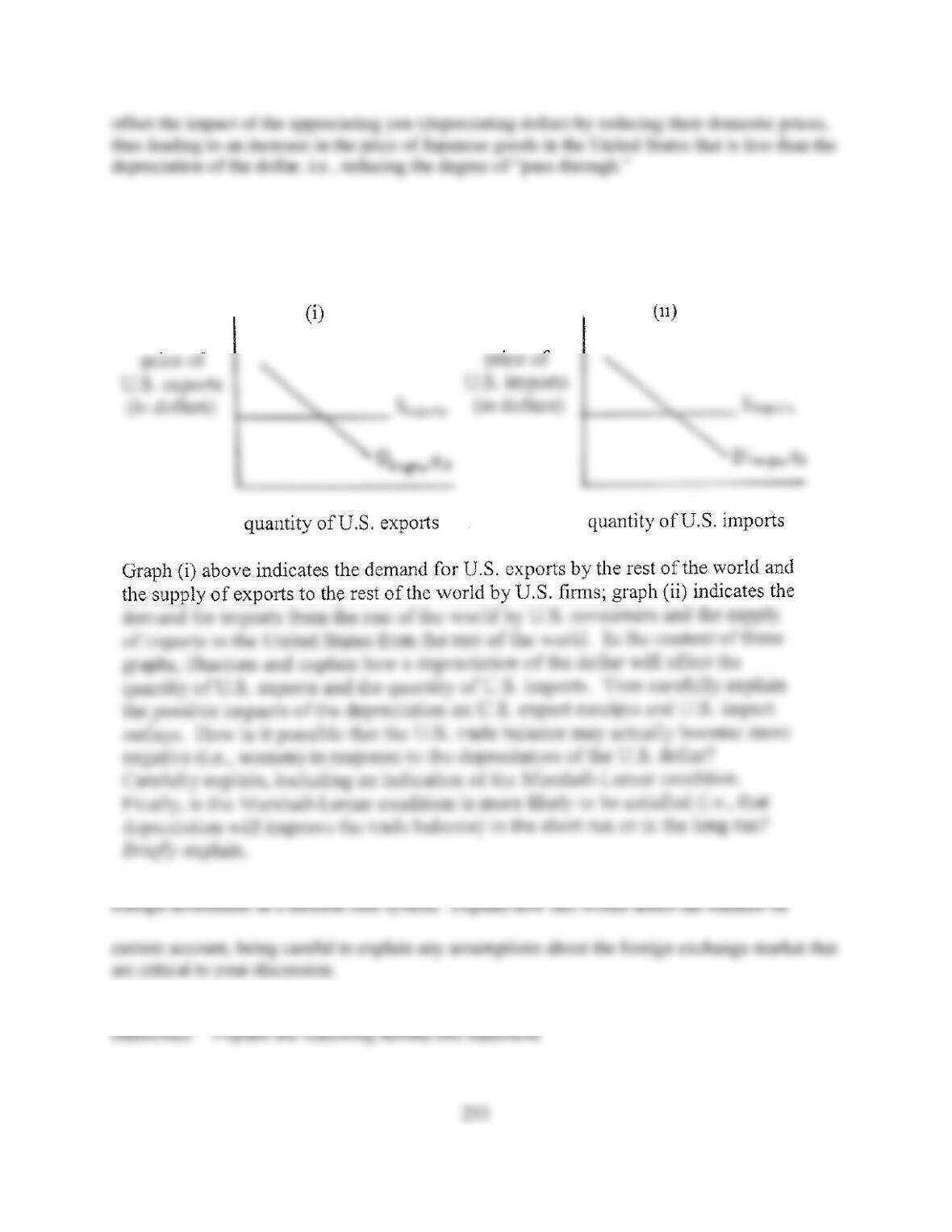
7. Assume a two-country world containing country A (whose currency is the dollar) and
country B (whose currency is the peso). In this context, and using relevant graphs, explain how a
depreciation of the dollar against the peso (for example, a 10% depreciation) conceptually affects