Chapter 20
Foreign Currency Futures and Options
QUESTIONS
1. How does a futures contract differ from a forward contract?
Answer: Foreign currency futures contracts, or futures contracts for short, allow individuals
and firms to buy and sell specific amounts of foreign currency at an agreed-upon price
determined on a given future day. Although this sounds very similar to forward contracts,
there are a number of important differences between forward contracts and futures contracts.
The first major difference between foreign currency futures contracts and forward
©2017 Cambridge University Press
2. What effects does “marking to market” have on futures contracts?
3. What are the differences between foreign currency option contracts and forward
contracts for foreign currency?
4. What are you buying if you purchase a U.S. dollar European put option against the
Mexican peso with a strike price of MXN10.0/$ and a maturity of July? (Assume that it
is May and the spot rate is MXN10.5/$.)
©2017 Cambridge University Press
5. What are you buying if you purchase a Swiss franc American call option against the
U.S. dollar with a strike price of CHF1.30/$ and a maturity of January? (Assume that it
is November and the spot rate is CHF1.35/$.)
6. What is the intrinsic value of a foreign currency call option? What is the intrinsic value
of a foreign currency put option?
7. What does it mean for an American option to be “in the money”?
8. Why do American option values typically exceed their intrinsic values?
©2017 Cambridge University Press
12. Why do options provide insurance against foreign exchange risks in bidding situations?
Why can’t you hedge with a forward contract in a bidding situation?
Answer: Let’s assume the bidding situation involves the company determining a particular
amount of foreign currency for providing a service or selling some goods. By bidding a fixed
amount of foreign exchange, a company incurs a contingent transaction foreign exchange
13. Suppose that you have a foreign currency receivable (payable). What option strategy
places a floor (ceiling) on your domestic currency revenue (cost)?
14. Describe qualitatively how changing the strike price of the option provides either more
or less expensive insurance.
©2017 Cambridge University Press
15. Why does an increase in the strike price of an option decrease the value of a call option
and increase the value of a put option?
16. Why does an increase in the volatility of foreign exchange rates increase the value of
foreign currency options?
17. How does increasing time to maturity affect foreign currency option value?
©2017 Cambridge University Press
18. What is the payoff on an average-rate pound call option against the dollar?
19. Suppose the current spot rate is $1.29/€. What is your payoff if you purchase a down–
and-in put option on the euro with a strike price of $1.31/€, a barrier of $1.25/€, and a
maturity of 2 months? When would someone want to do this?
Answer: For a down-and-in option, the exchange rate must first cross the barrier to activate
the contract. Then, the buyer of the option has the right to exercise at maturity. So, the payoff
PROBLEMS
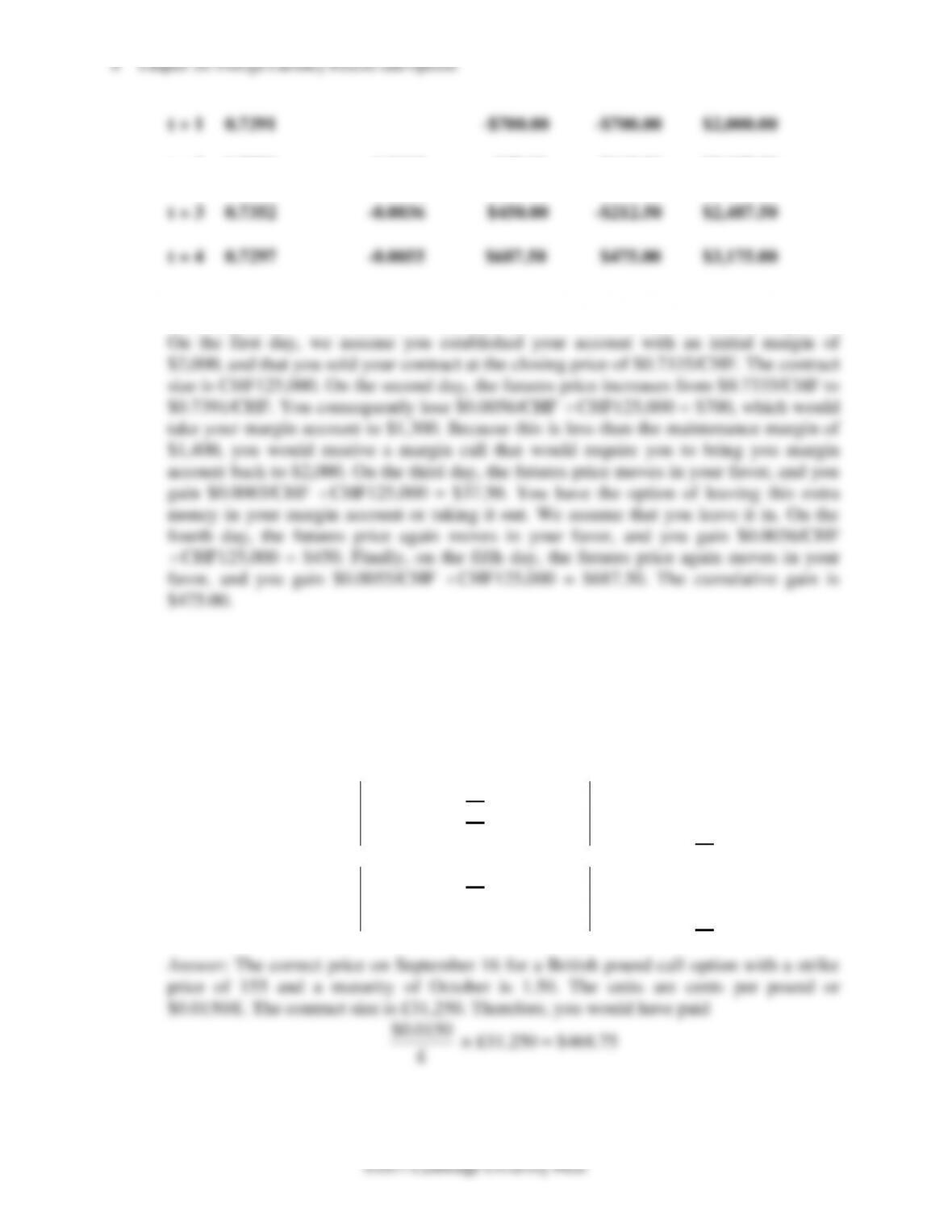
1. If you sold a Swiss franc futures contract at time t and the exchange rate has evolved as
shown here, what would your cash flows have been?
Day
Futures
Price
$/CHF
Change in
Futures
Price
Gain or
Loss
Cumulative
Gain or
Loss
Margin
Account
t
0.7335
$2,000.00
0.0056
Chapter 20: Foreign Currency Futures and Options
9
3. Using the data in problem 2, how much would you have paid to purchase a Australian
dollar put option contract with a strike price of 65 and an October maturity?
Answer: The correct price on September 16 for an Australian dollar put option with a strike
4. Suppose that you buy a €1,000,000 call option against dollars with a strike price of
$1.2750/€. Describe this option as the right to sell a specific amount of dollars for euros
at a particular exchange rate of euros per dollar. Explain why this latter option is a
dollar put option against the euro.
5. Assume that today is March 7, and, as the newest hire for Goldman Sachs, you must
advise a client on the costs and benefits of hedging a transaction with options. Your
client (a small U.S. exporting firm) is scheduled to receive a payment of €6,250,000 on
April 20, 44 days in the future. Assume that your client can borrow and lend at a 6%
p.a. U.S. interest rate.
a. Describe the nature of your client’s transaction exchange risk.
Answer: Your client is scheduled to receive €6,250,000 in 44 days. If no hedging is done,
b. Use the appropriate American option with an April maturity and a strike price of
129¢/€ to determine the dollar cost today of hedging the transaction with an option
strategy. The cost of the call option is 3.93¢/€, and the cost of the put option is
1.58¢/€.
Answer: To hedge foreign currency revenue with an option, you must purchase a put
€
c. What is the minimum dollar revenue your client will receive in April? Remember to
take account of the opportunity cost of doing the option hedge.
Chapter 20: Foreign Currency Futures and Options
10
Answer: If the exchange rate is less than $1.29/€ in April, your client will be able to sell
€
d. Determine the value of the spot rate ($/€) in April that would make your client
indifferent ex post to having done the option transaction or a forward hedge. The
forward rate for delivery on April 20 is $1.30/€.
Answer: If the client does the forward hedge, their revenue will be
$1.30 × €6,250,000 = $8,125,000
€
If the client does the option hedge and does not have to exercise the option, they will sell
the euros in 42 days, and their revenue will
( )
S(t+42,$/€) × €6,250,000 – $99,474.17
If this option revenue is to equal the forward revenue, we know
( )
S(t+42,$/€) × €6,250,000 – $99,474.17 = $8,125,000
Solving this equation gives
$1.3159
S(t+42,$/€) = €
.
6. Assume that today is September 12. You have been asked to help a British client who is
scheduled to pay €1,500,000 on December 12, 91 days in the future. Assume that your
client can borrow and lend pounds at 5% p.a.
a. Describe the nature of your client’s transaction exchange risk.
Answer: Your client is scheduled to pay €1,500,000 in 91 days. If no hedging is done, and
b. What is the option cost for a December maturity and a strike price of £0.72/€ to
hedge the transaction? The option premiums per 100 euros are £1.70 for calls and
£2.40 for puts.
©2017 Cambridge University Press
€100
c. What is the maximum pound cost your client will experience in December?
Answer: If the exchange rate is greater than £0.72/€ in December, your client will be able
to buy euros at that value. If the future spot exchange rate is lower than £0.72/€, the client
€
d. Determine the value of the spot rate (£/€) in December that makes your client
indifferent ex post to having done the option transaction or a forward hedge if the
forward rate for delivery on December 11 is £0.70/€.
Answer: If the client does the forward hedge, their cost will be
£0.70 × €1,500,000 = £1, 050,000
€
If the client does the option hedge and does not have to exercise the option, they will buy
the euros in 91 days, and their cost will be
( )
S(t+89,£/€) × €1,500,000 + £25,817.88
If this option cost is to equal the forward cost, we know
( )
S(t+89,£/€) × €1,500,000 + £25,817.88 = £1,050,000
Solving this equation gives
£0.6828
S(t+89,£/€) = €
.
7. Assume that today is June 11. Your firm is scheduled to pay £500,000 on August 15, 65
days in the future. The current spot is $1.75/£, and the 65-day forward rate is $1.73/£.
You can borrow and lend dollars at 7% p.a. Suppose you think options are overpriced
because you think the dollar will be in a tight trading range in the near future. You
have been thinking about selling an option as a way to reduce the dollar cost of your
pound payable.
a. If an August pound option with a strike price of 175¢/£ costs 4.5¢/£ per pound for
the call and 4¢/£ for the put, what is the minimum that you will have to pay in
August to eliminate your pound payable? Over what range of future exchange rates
will this price be achieved?
Chapter 20: Foreign Currency Futures and Options
12
strategy of selling someone an option that allows them to sell pounds to you. This is a
pound put option. You would take in 4¢/£ for the put, or
$0.04 × £500,000 = $20,000
£
The future value of this amount would be available to offset your costs in 65 days. This
future value is
7 65
$20,000 × 1 + = $20,252.78
100 360
As long as the exchange rate is less than or equal to the strike price of $1.75/£, your costs
will be
$1.75 × £500,000 – $20,252.78 = $854,747.22
£
This is
$1.7095
£
, much less than the forward rate.
b. How much must the pound appreciate before your speculative option strategy ends
up costing you more than the forward rate?
Answer: At the forward rate of $1.73/£, you can lock in a dollar cost of
$1.73 × £500,000 = $865,000
£
The future spot rate that sets the speculative cost to the forward cost is found by equating
the two costs
( )
S(t+63,$/£) × £500,000 – $20,252.78 = $865,000
Solving this equation for the spot rate gives
$1.7705
S(t+63,$/£) = £
8. Upon arriving for work Monday, you observe a violation of put–call parity. In
particular, the synthetic forward price of dollars per yen is above the current forward
rate. How would you capitalize on this information?
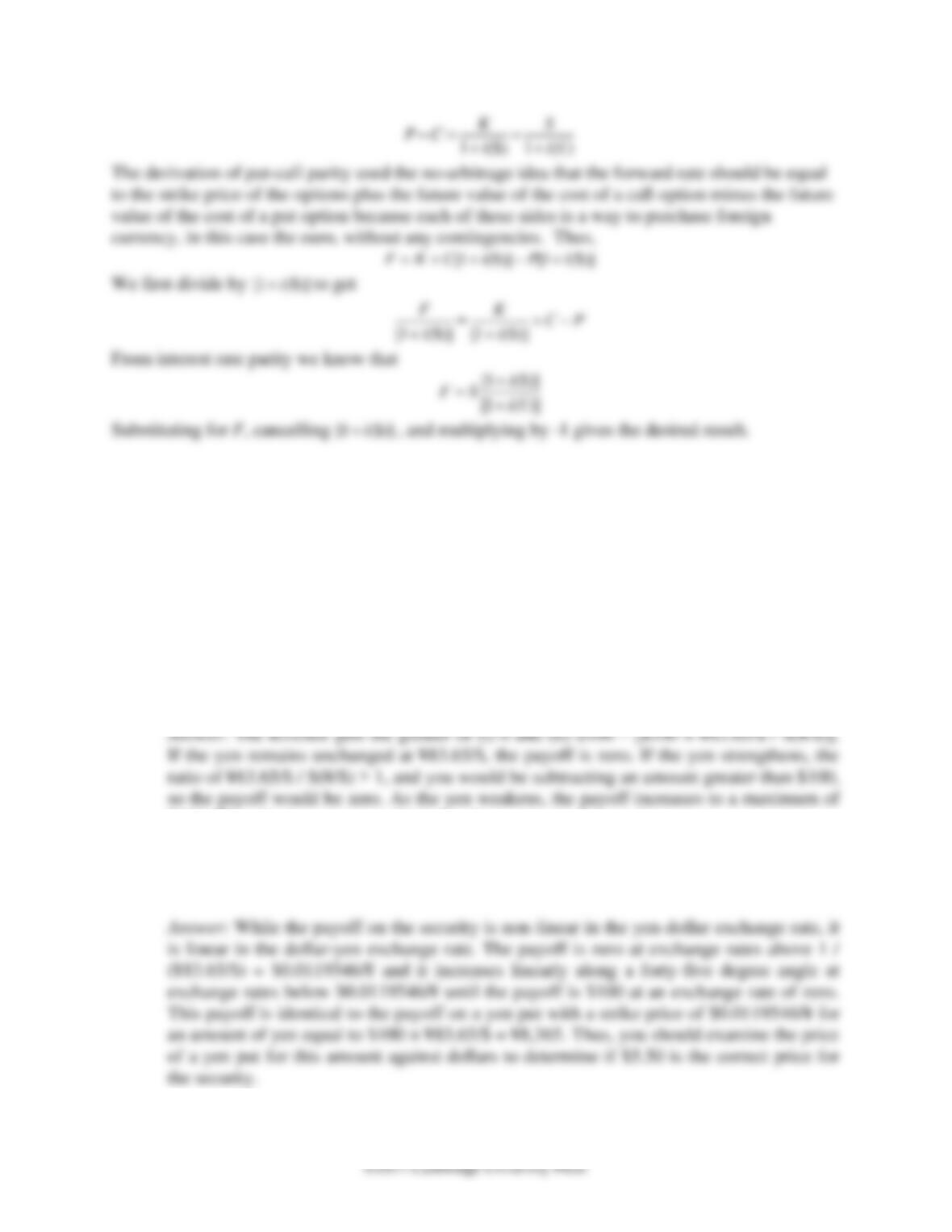
9. Use interest rate parity to demonstrate that you can represent put-call parity as
Chapter 20: Foreign Currency Futures and Options
13
KS
10. On April 28, 1995, the Paine Webber Group introduced a new type of security on the
NYSE: U.S. dollar increase warrants on the yen. At exercise, each warrant entitled the
holder to an amount of U.S. dollars calculated as
Greater of (i) 0 and (ii) $100 – [$100 × ¥83.65/$ / Spot rate)]
The “spot rate” in the formula refers to the yen/dollar rate on any day during the
exercise period, which extended until April 28, 1996. The 1-year forward rate on April
28 was ¥79.72/$, and the spot rate was ¥83.65/$.
a. What view on the future yen/dollar rate do investors in this security hold?
$100. Thus, the investor must think that the yen is going to weaken.
b. This security was issued at a price of $5.50. To see whether the security is fairly
priced, which option prices would you want to examine?