Chapter 20
Financing in the Short-Term
Lecture Outline
Sources of Foreign Financing
Internal Short-term Financing
Financing with a Foreign Currency
Comparison of Interest Rates Among Currencies
Determining the Effective Financing Rate
2 Financing in the Short-Term
Chapter Theme
This chapter explains short-term liability management of MNCs. From this chapter, students should
Topics to Stimulate Class Discussion
1. If a firm consistently exports to a country with low interest rates and needs to consistently borrow
funds, explain how it could coordinate its invoicing and financing to reduce its financing costs.
POINT/COUNTER-POINT:
Do MNCs Increase Their Risk When Borrowing Foreign Currencies?
POINT: Yes. MNCs should borrow the currency that matches their cash inflows. If they borrow a foreign
COUNTER-POINT: No. If MNCs expect that they can reduce the effective financing rate by borrowing a
WHO IS CORRECT? Use the Internet to learn more about this issue. Which argument do you support?
Offer your own opinion on this issue.
ANSWER: If MNCs borrow in a low interest rate currency that is not matched with their inflow
Financing in the Short-Term 3
Answers to End of Chapter Questions
1. Financing From Subsidiaries. Explain why an MNC parent would consider financing from its
subsidiaries.
2. Foreign Financing.
a. Explain how a firm’s degree of risk aversion enters into its decision of whether to finance in a
foreign currency or a local currency.
b. Discuss the use of specifying a break-even point when financing in a foreign currency.
ANSWER: A very risk-averse firm may prefer to borrow domestically since it knows with certainty
3. Probability Distribution.
a. Discuss the development of a probability distribution of effective financing rates when financing
in a foreign currency. How is this distribution developed?
b. Once the probability distribution of effective financing rates from financing in a foreign currency
is developed, how can this distribution be used in deciding whether to finance in the foreign
currency or the home currency?
ANSWER: First, a probability distribution of exchange rate changes is created. Using this along
4. Financing and Exchange Rate Risk. How can a U.S. firm finance in euros and not necessarily be
exposed to exchange rate risk?
5. Short-term Financing Analysis. Assume that Tulsa Inc. needs $3 million for a one-year period.
Within one year, it will generate enough U.S. dollars to pay off the loan. It is considering three
options: (1) borrowing U.S. dollars at an interest rate of 6%, (2) borrowing Japanese yen at an
4 Financing in the Short-Term
interest rate of 3%, or (3) borrowing Canadian dollars at an interest rate of 4%. Tulsa Inc. expects
that the Japanese yen will appreciate by 1% over the next year and that the Canadian dollar will
appreciate by 3%. What is the expected ―effective‖ financing rate for each of the three options?
Which option appears to be most feasible? Why might Tulsa Inc. not necessarily choose the option
reflecting the lowest effective financing rate?
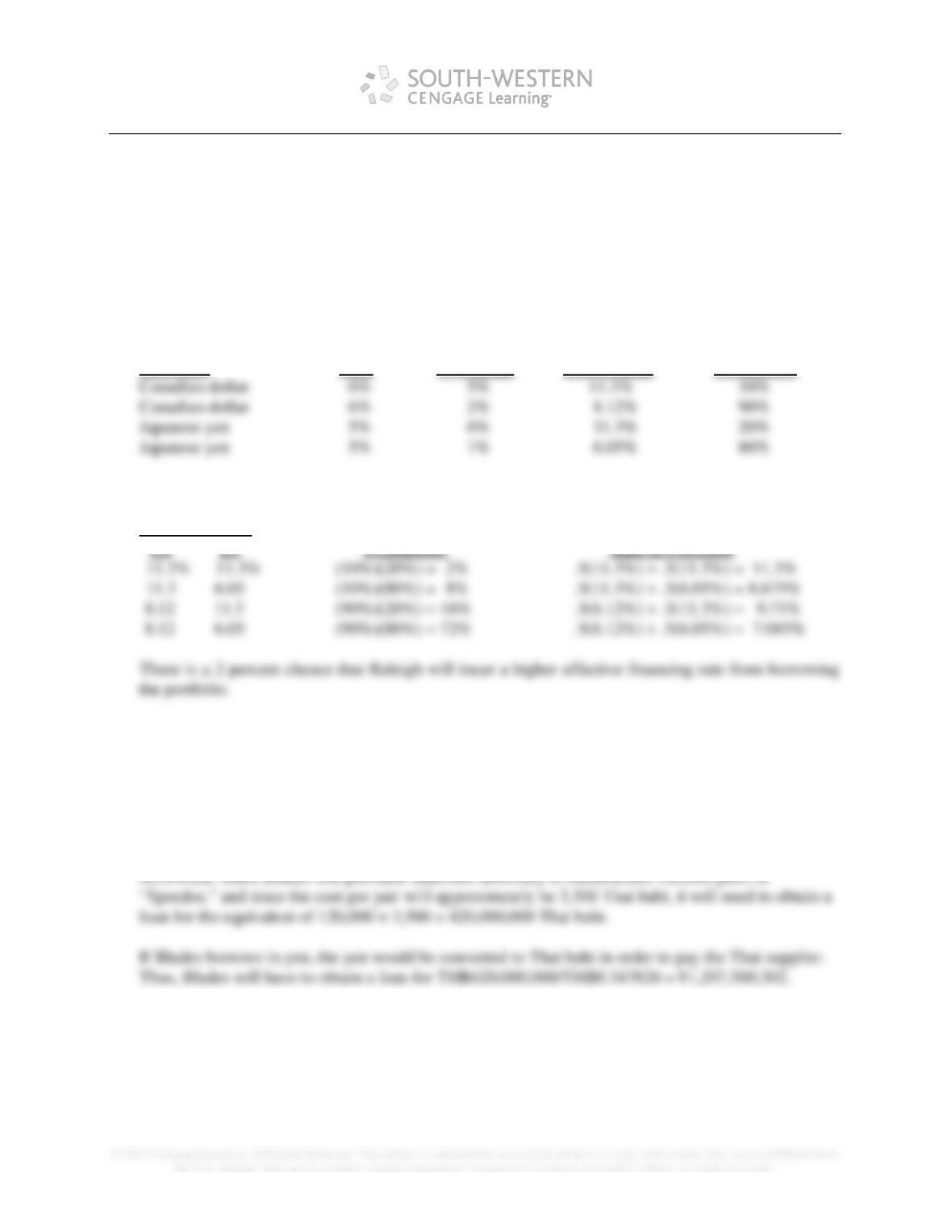
ANSWER:
Expected
Interest Expected Percentage Effective
Currency Rate Change in Currency Financing Rate
6. Effective Financing Rate. How is it possible for a firm to incur a negative effective financing rate?
ANSWER: If the currency borrowed substantially depreciates against the firm’s home currency (by
negative.
7. IRP Application to Short-term Financing. If interest rate parity does not hold, what strategy
should Connecticut Co. consider when it needs short-term financing?
a. Assume that Connecticut Co.needs dollars. It borrows euros at a lower interest rate than that for
dollars. If interest rate parity exists and if the forward rate of the euro is a reliable predictor of
the future spot rate, what does this suggest about the feasibility of such a strategy?
b. If Connecticut Co. expects the spot rate to be a more reliable predictor of the future spot rate,
what does this suggest about the feasibility of such a strategy?
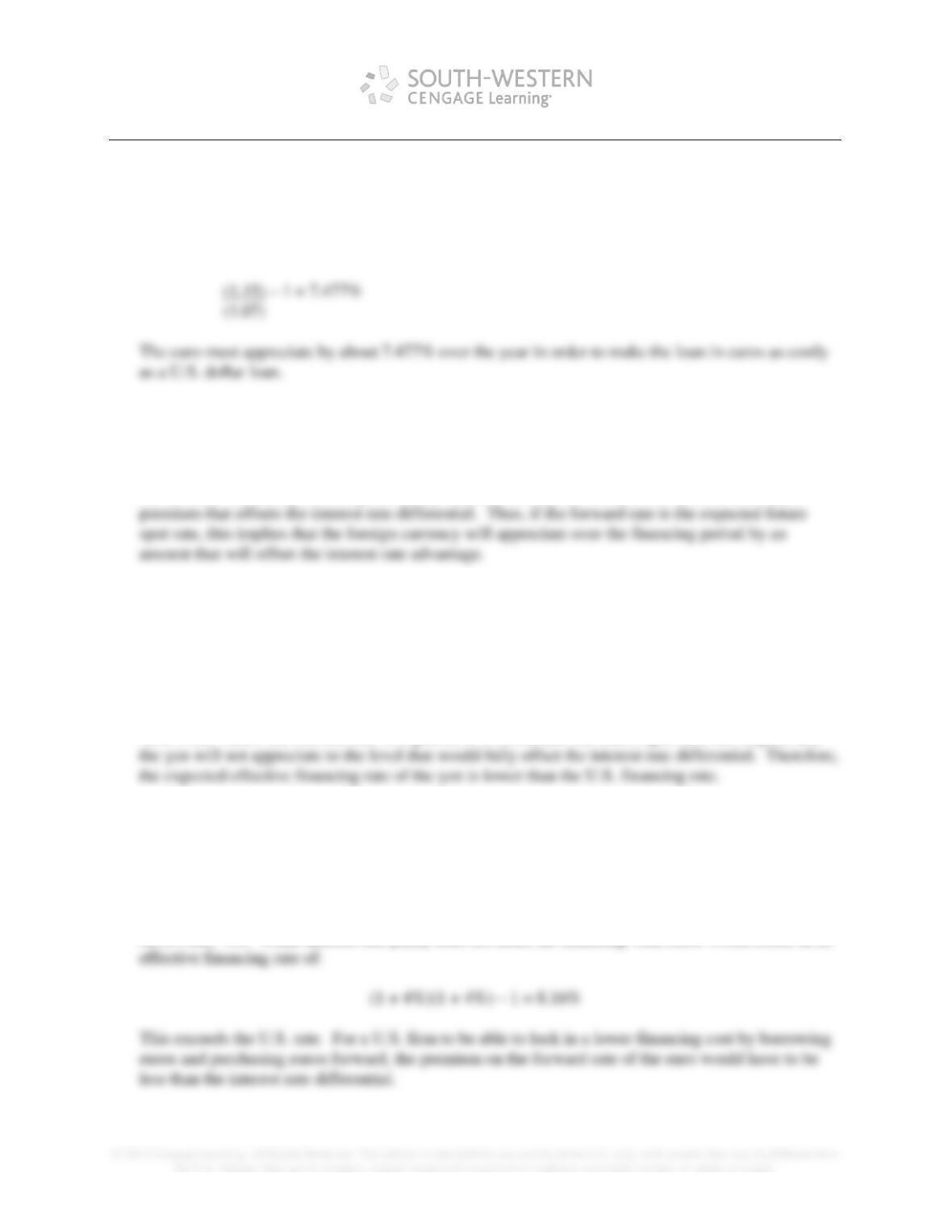
ANSWER: The firm could consider borrowing a foreign currency and purchasing the currency
forward to lock in its financing cost.
Financing in the Short-Term 5
8. Break-even Financing. Akron Co. needs dollars. Assume that the local one-year loan rate is 15%,
while a one-year loan rate on euros is 7%. By how much must the euro appreciate to cause the loan
in euros to be more costly than a U.S.-dollar loan?
ANSWER:
9. IRP Application to Short-term Financing. Assume that interest rate parity exists. If a firm believes
that the forward rate is an unbiased predictor of the future spot rate, will it expect to achieve lower
financing costs by consistently borrowing a foreign currency with a low interest rate?
ANSWER: No, because a foreign currency with a relatively low interest rate exhibits a forward
10. Effective Financing Rate. Boca, Inc., needs $4 million for one year. It currently has no business in
Japan but plans to borrow Japanese yen from a Japanese bank, because the Japanese interest rate is
three percentage points lower than the U.S. rate. Assume that interest rate parity exists; also assume
that Boca believes that the one-year forward rate of the Japanese yen will exceed the future spot rate
one year from now. Will the expected effective financing rate be higher, lower, or the same as
financing with dollars? Explain.
ANSWER: Since the forward rate is expected to overestimate the future spot rate, this implies that
11. IRP Application to Short-term Financing. Assume that the U.S. interest rate is 7 percent and the
euro’s interest rate is 4 percent. Assume that the euro’s forward rate has a premium of 4 percent.
Determine whether the following statement is true: ―Interest rate parity does not hold; therefore,
U.S. firms could lock in a lower financing cost by borrowing euros and purchasing euros forward for
one year.‖ Explain your answer.
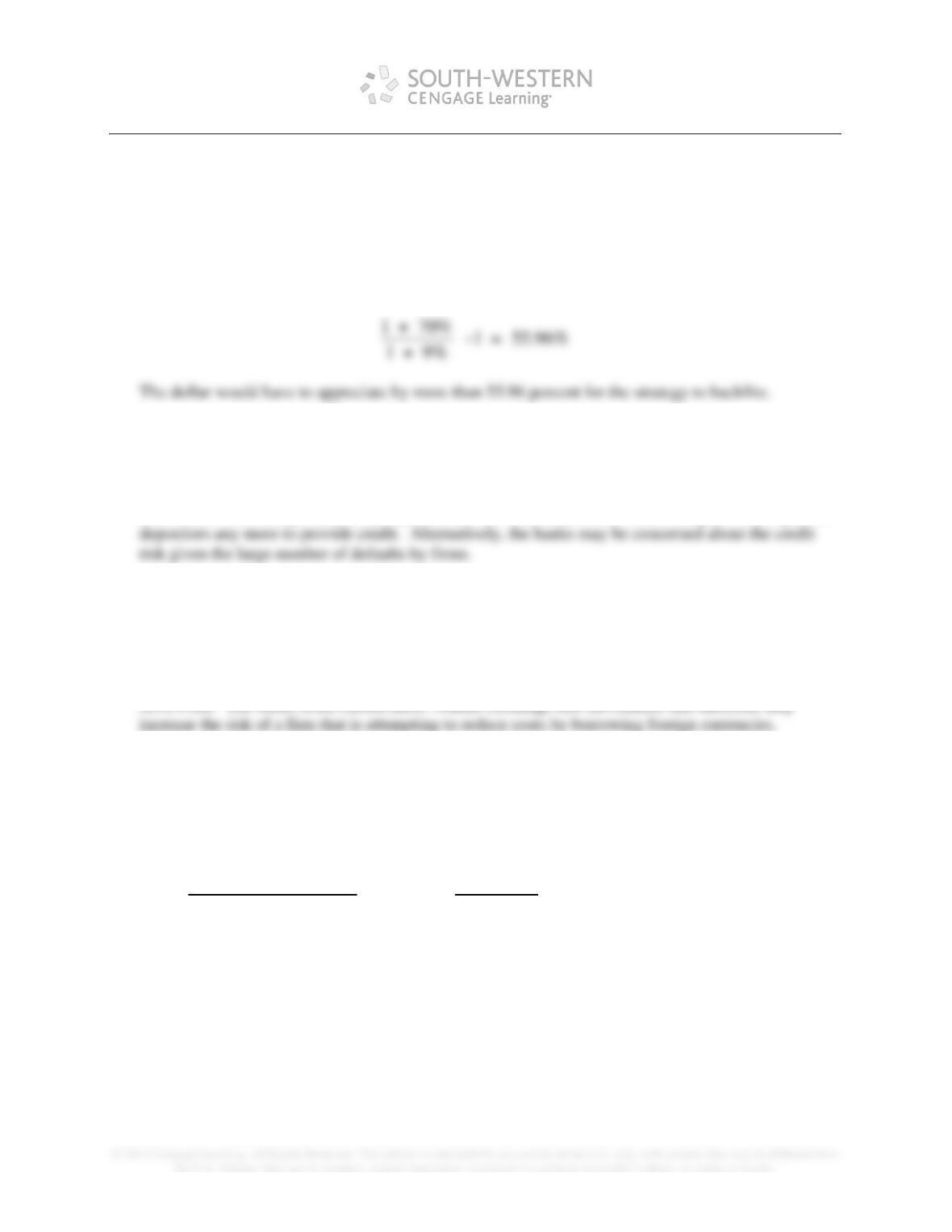
ANSWER: No. While interest rate parity does not hold, the financing with euros would result in an
6 Financing in the Short-Term
12. Break-even Financing. Orlando, Inc., is a U.S.-based MNC with a subsidiary in Mexico. Its
Mexican subsidiary needs a one-year loan of 10 million pesos for operating expenses. Since the
Mexican interest rate is 70 percent, Orlando is considering borrowing dollars, which it would convert
to pesos to cover the operating expenses. By how much would the dollar have to appreciate against
the peso to cause such a strategy to backfire? (The one-year U.S. interest rate is 9%.)
ANSWER:
13. Financing During a Crisis. Bradenton, Inc., has a foreign subsidiary in Asia that commonly obtains
short-term financing from local banks. If Asian suddenly experiences a crisis, explain why Bradenton
may not be able to easily obtain funds from the local banks.
ANSWER: The foreign subsidiary may find that the local banks do not have adequate funding from
14. Impact of Credit Crisis on Risk of Financing. Homewood Co. commonly finances some of its
U.S. expansion by borrowing foreign currencies (such as Japanese yen) that have low interest rates.
Describe how the potential return and risk of this strategy may have changed as a result of the credit
crisis in 2009.
ANSWER: The credit crisis caused more volatile exchange rate movements and therefore may
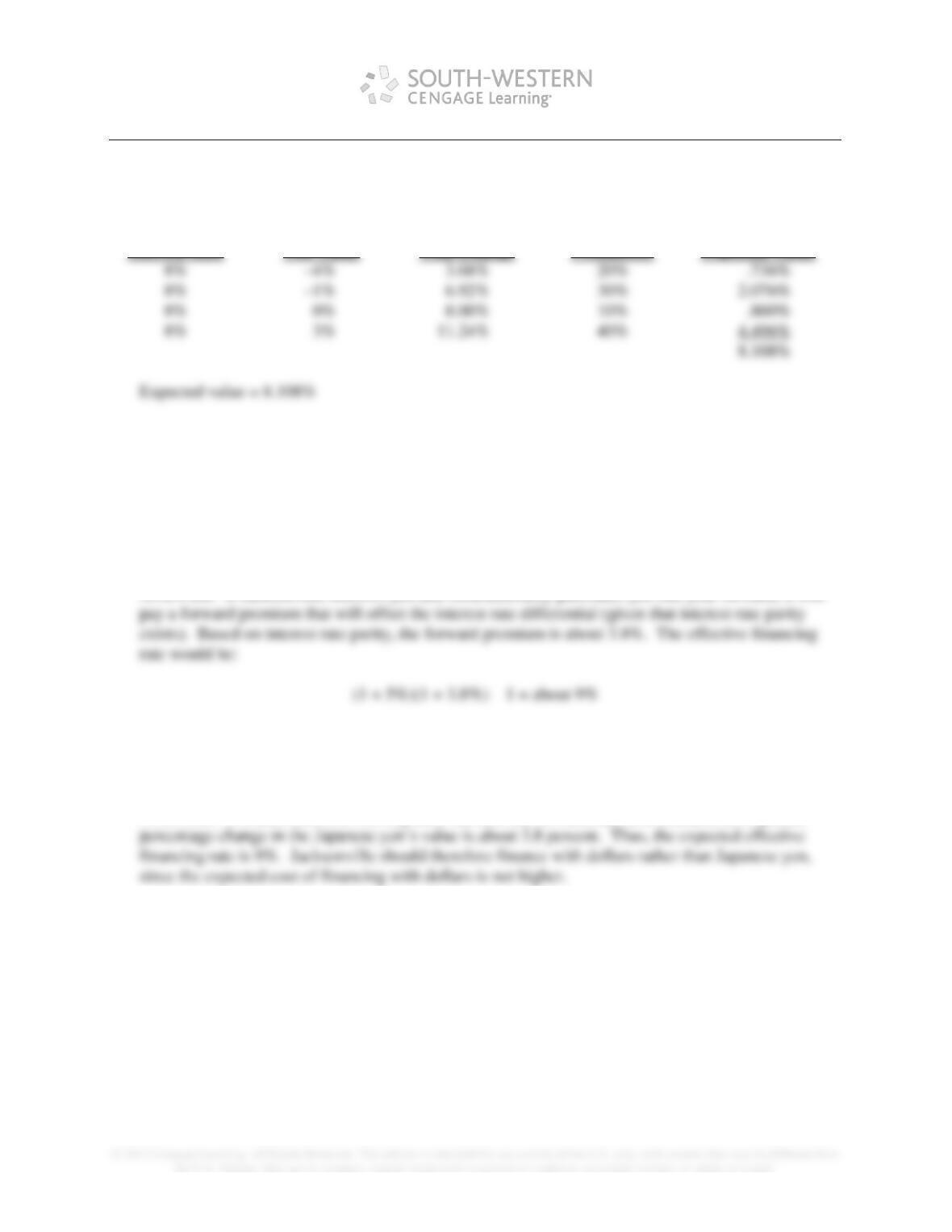
15. Probability Distribution of Financing Costs. Missoula, Inc., decides to borrow Japanese yen for
one year. The interest rate on the borrowed yen is 8 percent. Missoula has developed the following
probability distribution for the yen’s degree of fluctuation against the dollar:
Possible Degree of
Fluctuation of Percentage
Yen Against the Dollar Probability
–4% 20%
–1% 30%
0% 10%
3% 40%
Given this information, what is the expected value of the effective financing rate of the Japanese yen
from the U.S. corporation’s perspective?
Financing in the Short-Term 7
ANSWER:
Japanese
Interest Rate
Possible %
Change in
Yen Value
Effective
Financing Rate
Based on
That Change
Probability
Computation of
Expected Value
16. Analysis of Short-term Financing. Jacksonville Corp. is a U.S.-based firm that needs $600,000.
It has no business in Japan but is considering one-year financing with Japanese yen, because the
annual interest rate would be 5 percent versus 9 percent in the United States. Assume that interest
rate parity exists.
a. Can Jacksonville benefit from borrowing Japanese yen and simultaneously purchasing yen one
year forward to avoid exchange rate risk? Explain.
ANSWER: If Jacksonville borrows yen and simultaneously purchases yen one year forward, it will
b. Assume that Jacksonville does not cover its exposure and uses the forward rate to forecast the
future spot rate. Determine the expected effective financing rate. Should Jacksonville finance
with Japanese yen? Explain.
ANSWER: If it does not cover the exposure but uses the forward rate as a forecast, the expected
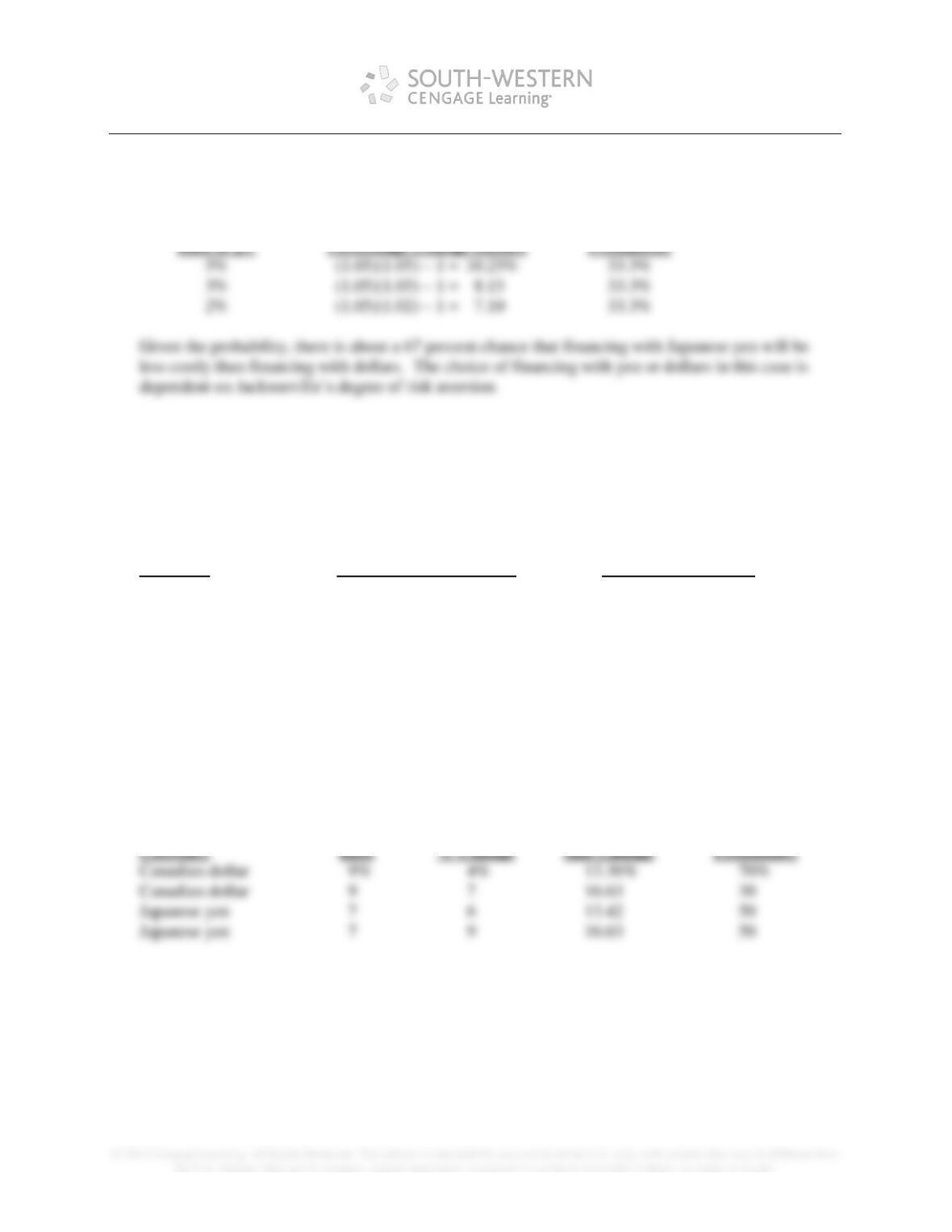
c. Assume that Jacksonville does not cover its exposure and expects that the Japanese yen will
appreciate by either 5 percent, 3 percent, or 2 percent, and with equal probability of each
occurrence. Use this information to determine the probability distribution of the effective
financing rate. Should Jacksonville finance with Japanese yen? Explain.
8 Financing in the Short-Term
ANSWER:
Possible % Effective Financing
Change in Spot Rate of JY if that
17. Financing With a Portfolio. Pepperdine, Inc., considers obtaining 40 percent of its one-year
financing in Canadian dollars and 60 percent in Japanese yen. The forecasts of appreciation in the
Canadian dollar and Japanese yen for the next year are as follows:
Probability
Possible Percentage of that Percentage
Change in the Spot Change in the
Currency Rate Over the Loan Life Spot Rate Occurring
Canadian dollar 4% 70%
Canadian dollar 7 30
Japanese yen 6 50
Japanese yen 9 50
The interest rate on the Canadian dollar is 9 percent, and the interest rate on the Japanese yen is 7
percent. Develop the possible effective financing rates of the overall portfolio and the probability of
each possibility based on the use of joint probabilities.
ANSWER:
Effective
Financing
Interest Possible Rate Based on

Financing in the Short-Term 9
Possible Joint
Effective
Financing Rate Joint Effective Financing
18. Financing With a Portfolio.
a. Does borrowing a portfolio of currencies offer any possible advantages over the borrowing of a
single foreign currency?
ANSWER: If a firm borrows a single foreign currency, it is especially vulnerable to that currency’s
b. If a firm borrows a portfolio of currencies, what characteristics of the currencies will affect the
potential variability of the portfolio’s effective financing rate? What characteristics would be
desirable from a borrowing firm’s perspective?
ANSWER: Currencies which are volatile and highly correlated with each other could cause the
19. Financing With a Portfolio. Raleigh Corp. needs to borrow funds for one year to finance an
expenditure in the United States. The following interest rates are available:
Borrowing Rate
U.S. 10%
Canada 6%
Japan 5%
The percentage change in the spot rates of the Canadian dollar and Japanese yen over the next year
are as follows:
Canadian Dollar Japanese Yen
Percentage Change Percentage Change
Probability in Spot Rate Probability in Spot Rate
10% 5% 20% 6%
90% 2% 80% 1%
10 Financing in the Short-Term
If Raleigh Corporation borrows a portfolio, 50 percent of funds from Canadian dollars and 50 percent
of funds from yen, determine the probability distribution of the effective financing rate of the
portfolio. What is the probability that Raleigh will incur a higher effective financing rate from
borrowing this portfolio than from borrowing U.S. dollars?
ANSWER:
Effective
Financing
Interest Possible Rate Based on
Currency Rate % Change that Change Probability
Possible Joint
Effective
Financing Rate Joint Effective Financing
Solution to Continuing Case Problem: Blades, Inc.
1. What is the amount, in baht, that Blades needs to borrow to cover the payments due to the Thai
suppliers? What is the amount, in yen, that Blades needs to borrow to cover the payments due to the
Thai suppliers?
ANSWER: Since Blades will purchase materials necessary to manufacture 120,000 pairs of
2. Given that Blades will use the receipts from the receivables in Thailand to repay the loan and that
Blades plans to remit all baht-denominated cash flows back to the U.S. parent whether it borrows in
baht or yen, does the future value of the yen with respect to the baht affect the cost of the loan if
Blades borrows in yen?
Financing in the Short-Term 11
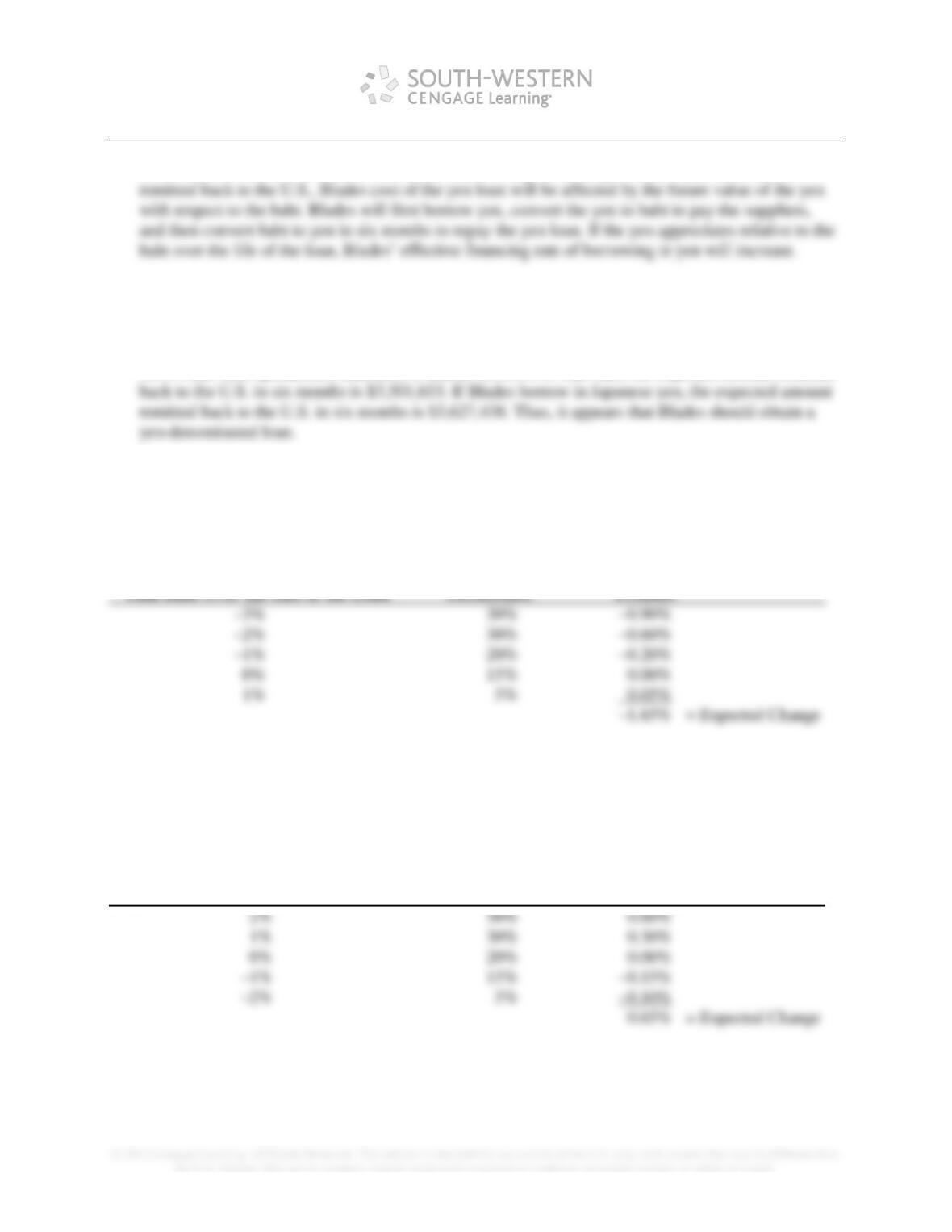
ANSWER: Given that all baht–denominated cash flows generated by Blades’ Thai subsidiary are
3. Using a spreadsheet, compute the expected amount (in U.S. dollars) that will be remitted back to the
U.S. in six months if Blades finances its working capital requirements by borrowing baht versus
borrowing yen. Based on your analysis, should Blades obtain a yen- or baht-denominated loan?
ANSWER: (See spreadsheet attached.) If Blades borrows in Thai baht, the expected amount remitted
Computation of Expected Change in Value of Thai Baht
(Relative to the Dollar)
(1)
(2)
(3) = (1) × (2)
Possible Rate of Change in the
Probability of
Thai Baht Over the Life of the Loan
Occurrence
Product
Computation of Expected Change in Value of Japanese Yen
(Relative to the Baht)
(1)
(2)
(3) = (1) × (2)
Possible Rate of Change in the
Probability of
Japanese Yen Over the Life of the Loan
Occurrence
Product
12 Financing in the Short-Term
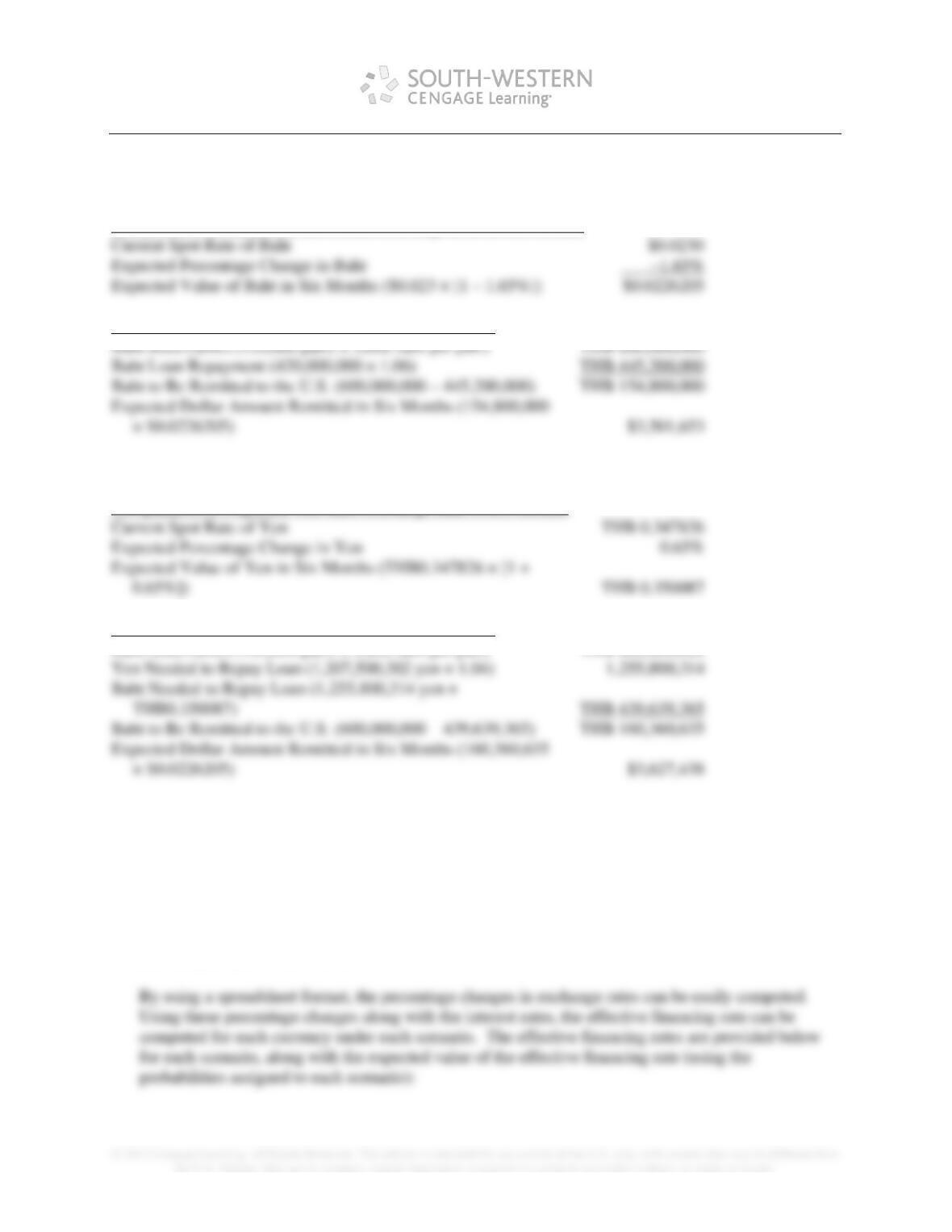
(1) Blades Borrows in Thai Baht
Computation of Expected Baht-Dollar Exchange Rate in Six Months
Current Spot Rate of Baht
$0.0230
Expected Percentage Change in Baht
Expected Value of Baht in Six Months ($0.023 × [1 – 1.65%])
Computation of Baht to Be Remitted to the U.S. Parent:
Baht Receivables (120,000 pairs × 5,000 baht per pair)
THB 600,000,000
Baht Loan Repayment (420,000,000 × 1.06)
THB 445,200,000
Baht to Be Remitted to the U.S. (600,000,000 – 445,200,000)
THB 154,800,000
Expected Dollar Amount Remitted in Six Months (154,800,000
× $0.0226205)
(2) Blades Borrows in Japanese Yen
Computation of Expected Yen-Baht Exchange Rate in Six Months
Current Spot Rate of Yen
Expected Percentage Change in Yen
Expected Value of Yen in Six Months (THB0.347826 × [1 +
0.65%])
Computation of Baht to Be Remitted to the U.S. Parent:
Baht Receivables (120,000 pairs × 5,000 baht per pair)
THB 600,000,000
Yen Needed to Repay Loan (1,207,500,302 yen × 1.04)
Baht Needed to Repay Loan (1,255,800,314 yen ×
THB0.350087)
THB 439,639,365
Baht to Be Remitted to the U.S. (600,000,000 – 439,639,365)
THB 160,360,635
Expected Dollar Amount Remitted in Six Months (160,360,635
× $0.0226205)
Solution to Supplemental Case: Flyer Company
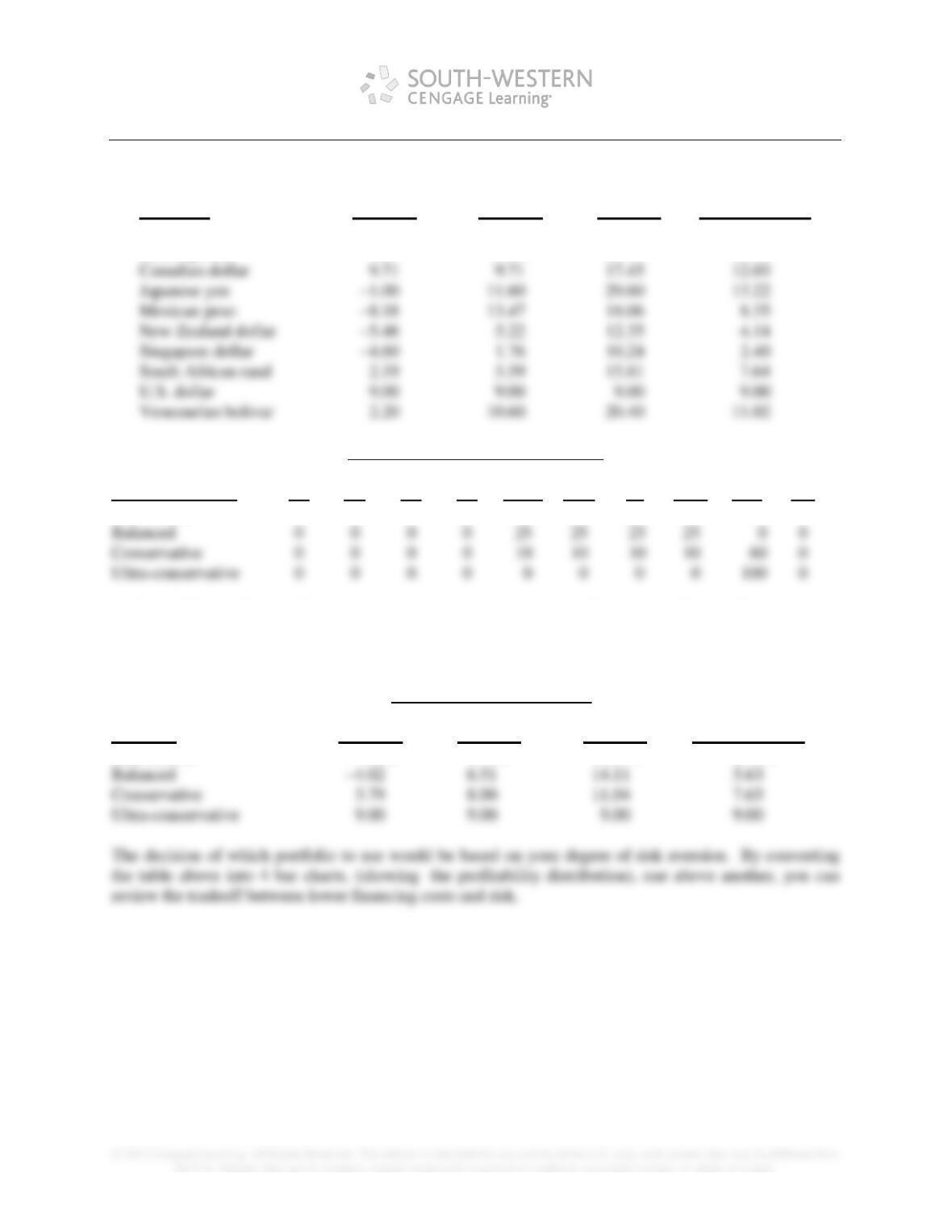
a. The optimal portfolio is dependent on your degree of risk aversion. By converting the information in
the table above into 4 bar charts (showing the probability distribution), one above another, you can
review the risk-return tradeoff.
Financing in the Short-Term 13
Somewhat Expected Value
Strong $ Stable $ Weak $ of Effective
Currency Scenario Scenario Scenario Financing Rate
Australian dollar –0.56% 14.51% 28.07% 14.05%
British pound 4.56 14.48 21.10 13.49
Percentage of Funds Borrowed from:
Type of Portfolio
A$
BP
C$
JY
MXP
NZ$
S$
SAR
US$
VB
Risk neutral
0
0
0
0
0
0
100
0
0
0
Balanced
0
0
0
0
25
25
25
0
0
Conservative
0
0
0
0
10
10
10
0
Ultra-conservative
0
0
0
0
0
0
0
0
0
Each portfolio’s effective financing rates are determined as a sum of weighted effective financing rates
under each scenario.
Portfolio’s Effective
Financing Rate Based on a Expected Value
Strong $ Stable $ Weak $ of Effective
Portfolio Scenario Scenario Scenario Financing Rate
Risk neutral –4.60% 1.76% 10.24% 2.40%

14 Financing in the Short-Term
Small Business Dilemma
Short-Term Financing by the Sports Exports Company
1. Should Logan borrow dollars or pounds to finance his joint venture business? Why?
ANSWER: Jim should borrow pounds. Although the British interest rate is slightly higher, Jim
2. Logan could also borrow euros at an interest rate that is lower than the U.S. or British rate. The
values of the euro and pound tend to move in the same direction against the dollar but not always by
the same degree. Would borrowing euros to support the British joint venture result in more exposure
to exchange rate risk than borrowing pounds? Would it result in more exposure to exchange rate risk
than borrowing dollars?
ANSWER: Borrowing euros would result in more exchange rate risk than borrowing pounds,
dollars.