Chapter 2
The Foreign Exchange Market
QUESTIONS
1. What is an exchange rate?
2. What is the structure of the foreign exchange market? Is it like the New York Stock
Exchange?
3. What is a spot exchange rate contract? When does delivery occur on a spot contract?
Answer: When currencies in the interbank spot market are traded, certain business
conventions are followed. For example, when the trade involves the U.S. dollar, business
©2017 Cambridge University Press
9. What is an appreciation of the dollar relative to the pound? What happens to the dollar
price of the pound in this situation?
10. What is a depreciation of the Thai baht relative to the Malaysian ringgit? What
happens to the baht price of the ringgit in this situation?
PROBLEMS
1. Mississippi Mud Pies, Inc. needs to buy 1,000,000 Swiss francs (CHF) to pay its Swiss
chocolate supplier. Its banker quotes bid–ask rates of CHF1.3990–1.4000/USD. What
will be the dollar cost of the CHF1,000,000?
2. If the Japanese yen–U.S. dollar exchange rate is ¥104.30/$, and it takes 25.15 Thai bahts
to purchase 1 dollar, what is the yen price of the baht?
4 Chapter 2 The Foreign Exchange Market
©2017 Cambridge University Press
Answer: To prevent triangular arbitrage, the direct quote of the yen price of the baht (¥/THB)
must equal the yen price of the dollar times the dollar price of the baht (which is the
reciprocal of the baht price of the dollar):
¥104.30/$
1/(THB25.15/$) = ¥104.30/$
$0.03976/THB = ¥ 4.1471/THB
3. As a foreign exchange trader, you see the following quotes for Canadian dollars (CAD),
U.S. dollars (USD), and Mexican pesos (MXN):
USD0.7047/CAD MXN6.4390/CAD MXN8.7535/USD
Is there an arbitrage opportunity, and if so, how would you exploit it?
Answer: The direct quote for the cross-rate of MXN6.4390/CAD should equal the implied
4. The Mexican peso has weakened considerably relative to the dollar, and you are trying
to decide whether this is a good time to invest in Mexico. Suppose the current exchange
rate of the Mexican peso relative to the U.S. dollar is MXN9.5/USD. Your investment
advisor at Goldman Sachs argues that the peso will lose 15% of its value relative to the
dollar over the next year. What is Goldman Sachs’s forecast of the exchange rate in 1
year?
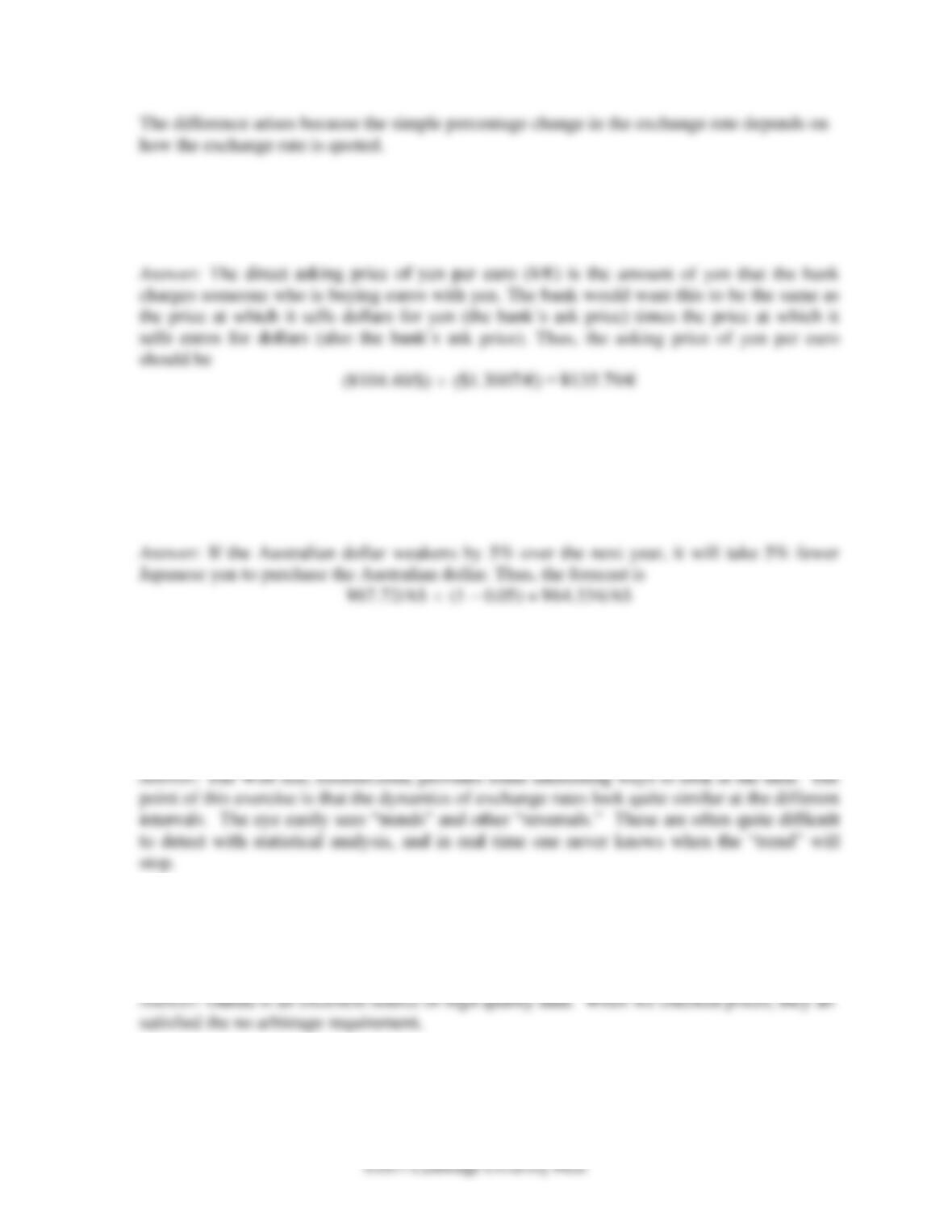
Answer: One way to think of this is to say that the investment advisor is referring to the fact
that the Mexican peso price of the dollar will be 15% higher next year. In this case, the
forecast of the MXN/USD exchange rate in year 1
Chapter 2: The Foreign Exchange Market 5
©2017 Cambridge University Press
The difference arises because the simple percentage change in the exchange rate depends on
how the exchange rate is quoted.
5. Deutsche Bank quotes bid–ask rates of $1.3005/€ – $1.3007/€ and ¥104.30 – 104.40/$.
What would be Deutsche Bank’s direct asking price of yen per euro?
Answer: The direct asking price of yen per euro (¥/€) is the amount of yen that the bank
6. Alumina Limited of Australia has called Mitsubishi UFJ Financial Group to get its
opinion about the Japanese yen–Australian dollar exchange rate. The current rate is
¥67.72/A$, and Mitsubishi thinks the Australian dollar will weaken by 5% over the next
year. What is Mitsubishi UFJ’s forecast of the future exchange rate?
7. Go to www.fxstreet.com, find the “Live Charts Window,” and plot the exchange rate of
the dollar vs. the euro with a “candle stick” high-low chart at 5 minute intervals for one
day, daily intervals for one month, and weekly intervals for one year. Now, cover the
units and ask a classmate to identify the different graphs. Are you surprised?
8. Pick 3 currencies, and go to www.oanda.com to get their current bilateral exchange
rates. Is there an arbitrage opportunity?
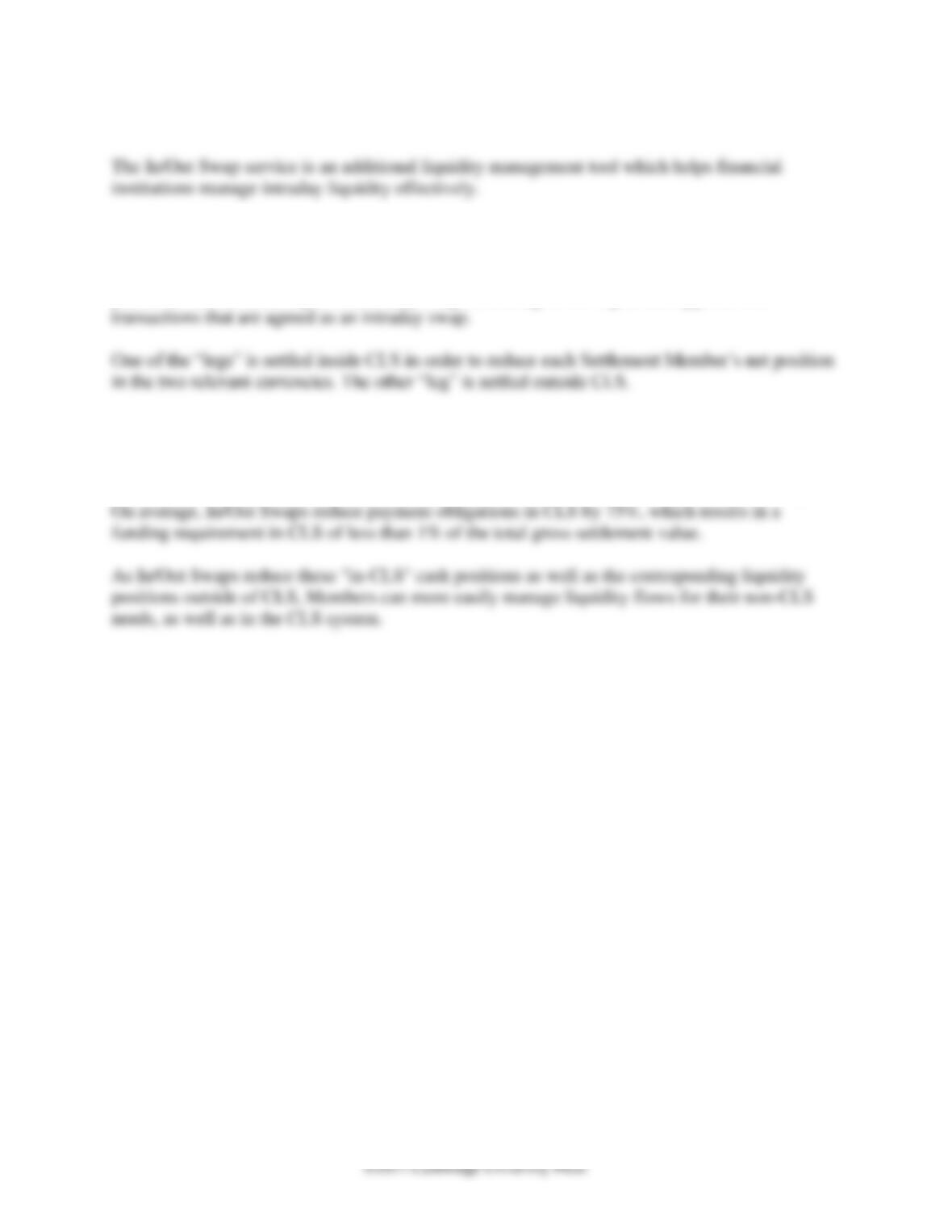
9. Go to the CLS Bank web site, www.cls-group.com, and read about In/Out Swaps. How
do they help participants manage their risks?
6 Chapter 2 The Foreign Exchange Market
Answer: Here is the quote from the Web site:
How It Works
The In/Out Swap is designed to reduce the payment obligations to CLS and to mitigate liquidity
pressures. An In/Out Swap is an intraday swap consisting of two equal and opposite FX
Benefits
The combined effect of these two transactions is a reduction in the intraday funding requirements
of the two Settlement Members, while leaving the institutions’ overall FX positions unchanged.