
Assumptions Values
Buy back pounds for (£/CAD) £0.5900
Which is equivalent, the reciprocal (CAD/£) 1.6949
Problem 2.1 Albert’s Trip to Canada
Albert visits Toronto and buys 1.74 Canadian dollars (CAD) for one British
pound (GBP). When he returns home to the United Kingdom, he converts
CAD1 into GBP0.59. Is the new exchange rate favorable or unfavorable?

Assumptions Values
Cross rate (euros/AUD) 0.5988
Prize amount in euros 150.00
Problem 2.2 Lottery Winner
Aisha lives in Melbourne, Australia. She wins €150 in an online lottery on
Thursday and wishes to convert the amount into Australian dollars (AUD). If the
exchange rate is 0.5988 euros per AUD, how many AUDs does she get, and what
is the value date of the AUD payment?
Problem 2.3 Gilded Question
Assumptions Values
Price of an ounce of gold in French frans (FRF/oz) FRF 380.00
Price of an ounce of gold in Sterling Pounds (GBP/oz) 4.50
In 1923, one ounce of gold costs 380 French francs (FRF). If at the same time one
ounce of gold could be purchased in Britain for GBP4.50, what was the exchange rate
between the French franc and the British pound?
Brent Oil
What is the implied ₤/ZAR exchange rate? £0.0538 £0.0633
(GBP price of an ounce / ZAR price of an ounce)
Problem 2.4 Brent Oil
In 2015, one barrel of Brent oil traded for GBP42.5 and South Africa rands (ZAR) 790. What is
Assumptions Values
Original spot rate, Japanese yen/Ukrainian hryvnia 4.47
New spot rate, Japanese yen/Ukrainian hryvnia 4.40
Export price of Mitsubishi Triton truck, Japanese yen 1,350,000
New Import Price in Ukrainian hryvnia 306,818.18
Export price in yen / New spot rate in yen/Ukrainian hryvnia
Problem 2.5 Ukraine Imports
Because the price of the truck itself did not change, the percentage change in the
import price as expressed in Ukrainian hryvnia is the same percentage change in the
value of the Japanese yen against the Ukrainian hryvnia itself.
Mitsubishi manufactures in Japan most of the pick-up trucks it sells in Ukraine. The
base platform for the Mitsubishi Triton truck line is ¥1,350,000. The spot rate of the
Implied exchange rate (EGP/£) 12.1982
Problem 2.6 Online Shopping
Tamara lives in Egypt and has placed a bundle of items in her Amazon.co.uk
Many emerging markets that suffer from foreign exchange shortages have more than
one exchange rate . The official exchange rate is the one officially transacted by the
Problem 2.7 Israeli Shekel Changes Value
Calculation of Percentage Change in Value Values
Initial exchange rate (ILS/£) 5.82
New exchange rate (ILS/£) 6.78
As the exchange rate rises, the British pound is able to
buy more shekels. Thus, the shekel has depreciated by
16.49%.
Assumptions Values
Original Chinese yuan peg to the dollar, yuan/$ 8.28
Revalued Chinese yuan to the dollar, yuan/$ 8.11
Hong Kong dollar peg to the US dollar, HK$/$ 7.80
Original HK$/Yuan cross rate 0.9420
HK$/Yuan = (HK$/$) x ($/Yuan)
Problem 2.8 Dollar Peg for Hong Kong
The Hong Kong dollar has long been pegged to the U.S. dollar at HK$7.80/$. When
Calculation of Percentage Change in Value Values
Initial exchange rate, post official revaluation (Yuan/$) 8.11
Percentage revaluation against the US dollar 20.00%
Revalued exchange rate (Yuan/$) 6.76
Problem 2.9 Renminbi Revaluation
As painfully obvious, it is clear why so many critics of the Chinese yuan
policy were not particularly happy with the revaluation of only 2.1%.
Many experts believe that the Chinese currency should not only be revalued
Assumptions Values
Original (2014) unit price, rupees (PKR) 11,000.00
Original (2014) British pound price for sale and distribution 95.00
Average spot rate for 2015, rupees per pound 120.00
Implied original spot rate, PKR/GBP 115.79
Recalcualted Pakistani rupee price of product 11,400.00
(Original GBP price x Avg spot rate for 2015)
Problem 2.10 TEXPAK in the United Kingdom
Assuming that TEXPAK wishes to preserve the British price for competitiveness, the
same Britsh pound price must be converted back into Pakistani rupees with the new spot
exchange rate in rupees per GBP:
TEXPAK is a Pakistani-based textile firm that is facing increasing competition from other
manufacturers in emerging markets selling in Europe. All garments are produced in
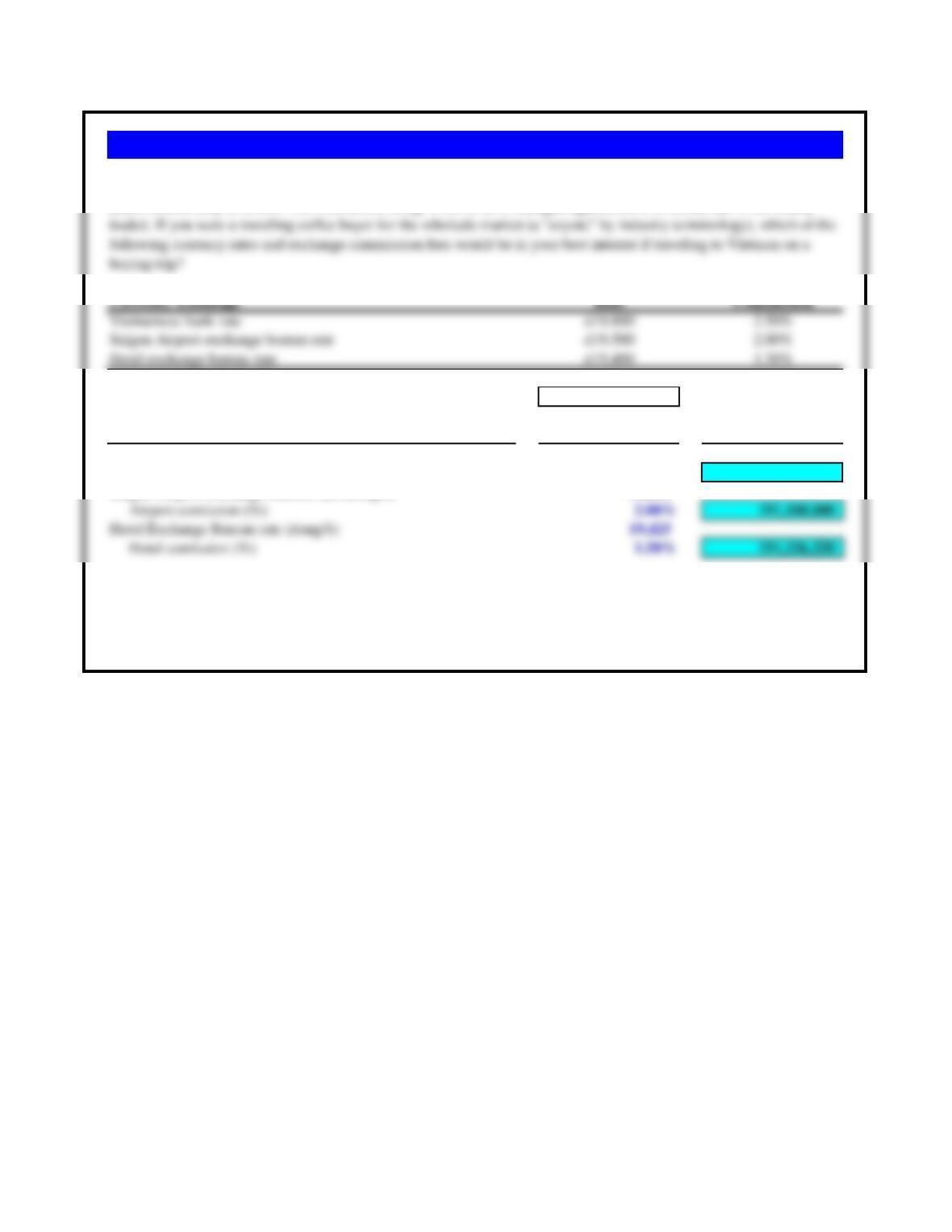
Assuming an intial cash amount for exchange to dong of: $10,000.00
Vietnamese
Assumptions Values dong proceeds
Vietnamese bank rate (dong/$)
19,800
Bank commission (%)
2.50% 193,050,000
19,500
2.00% 191,100,000
19,425
1.50% 191,336,250
The combined exchange rate and commission offered in the commercial banks in Vietnam is the better rate. In the case
of the Hotel Exchange Bureau rate, although its exchange rate is slightly weaker than the airport, its lower comission
makes it preferable over the combined airport rate.
Many people were surprised when Vietnam became the second largest coffee producing country in the world in recent
Problem 2.11 Vietnamese Coffee Coyote
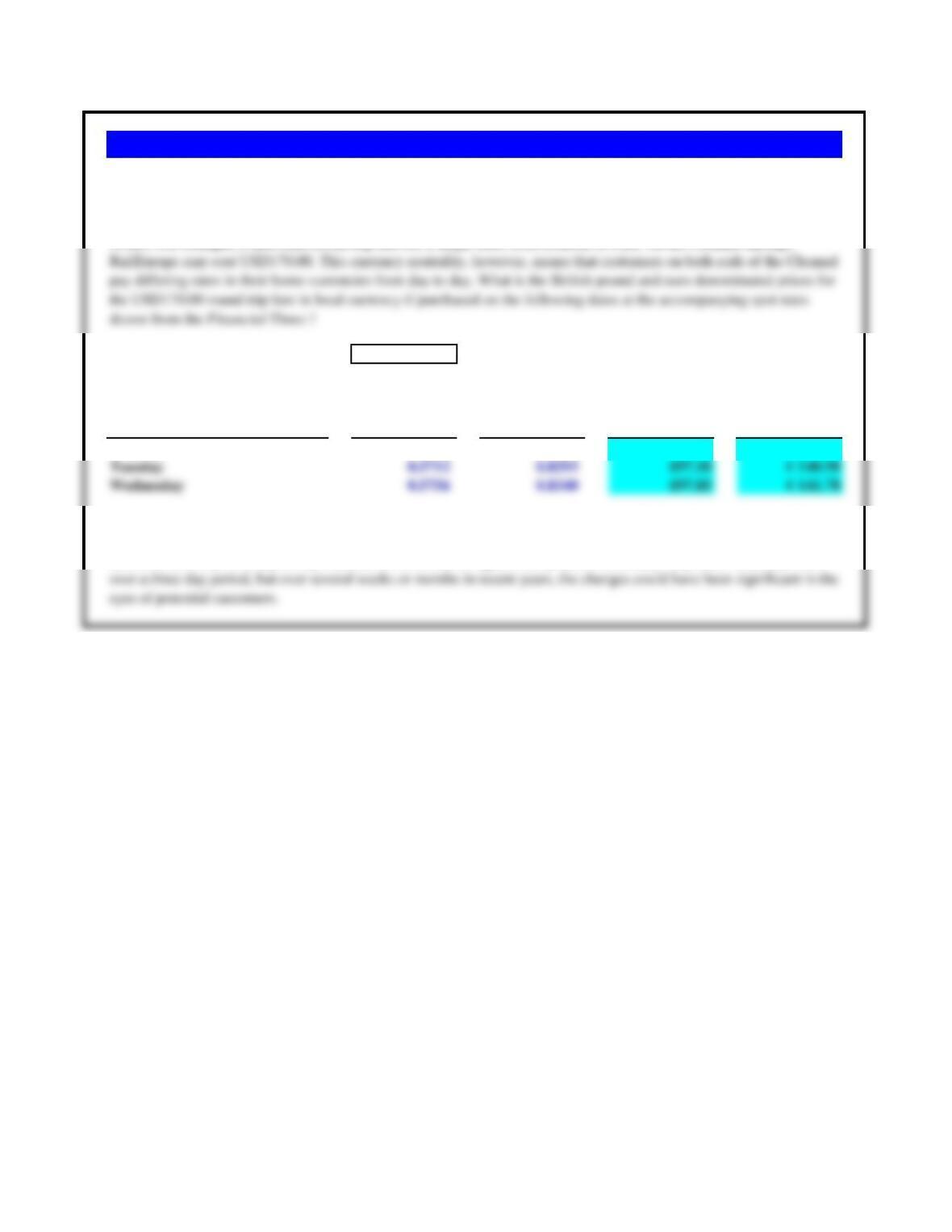
Round trip RailEurope train fare $170.00
British pound Euro British pound Continental
Spot Rate Spot Rate train fare train fare
Date of Spot Rate (£/$) (€/$) (£) (€)
Monday 0.5702 0.8304 £96.93 € 141.17
Problem 2.12 Chunnel Choices
In an attempt to be neutral or impartial in its currency of pricing, the Chunnel has actually introduced a degree of
currency risk to all customers either British or Continental, as neither group counts the U.S. dollar as its home or
domestic currency. The day-to-day fluctuations in the dollar against the pound and the euro may seem relatively small
The Channel Tunnel or “Chunnel” passes underneath the English Channel between Great Britain and France, a land-
link between the Continent and the British Isles. One side is therefore an economy of British pounds, the other euros. If
you were to check the Chunnel’s rail ricket Internet rates you would find that they would be denominated in U.S. dollars
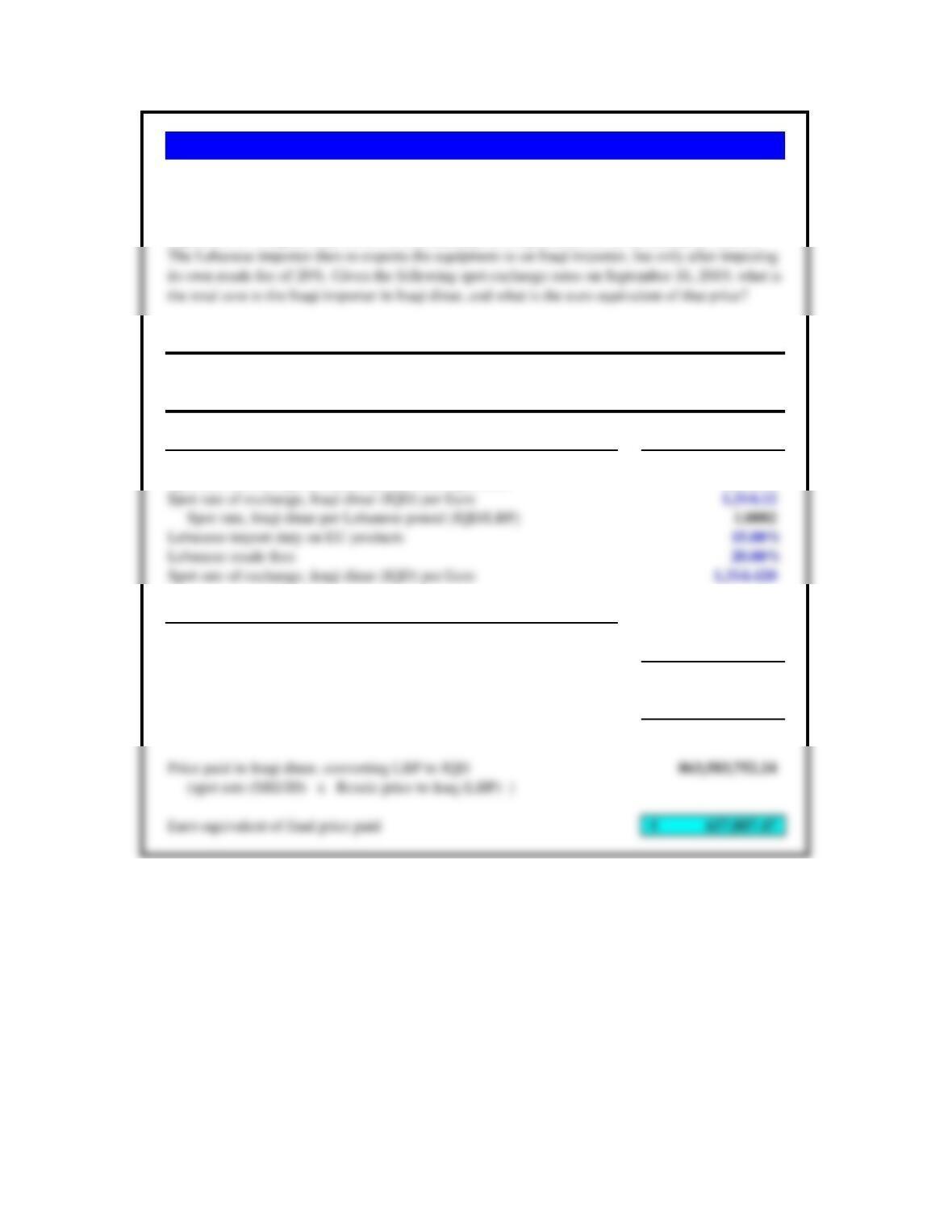
Currency Crossrate Spot Rate
Lebanese pound (LBP) per krona (kr) LBP154.13/kr
Lebanese pound (LBP) per euro (€) LBP1,668.38/€
Iraqi dinar (IQD) per euro (€) IQD1,314.42/€
Assumptions Values
Purchase price, in Swedish krona (kr) 375,000 kr
Spot rate of exchange, Lebanese pound (LBP) per Euro 1,668.38
What is the dollar price after all exchanges and fees?
Purchase price, converted to Lebanese pound (LBP) 625,642,500.00
Additional fees due on importation 93,846,375.00
Total cost, Lebanese pound (LBP) 719,488,875.00
Resale fee in Lebanese pounds 143,897,775.00
Resale price to Iraq, in Lebanese pounds 863,386,650.00
Problem 2.13 Scania Heavy Machinery AB
Scania Heavy Machinery AB, a manufacturer of heavy-duty machinery and vehicles near
Stockholm, ships an order to a buyer in Lebanon. The purchase price is kr375,000. Lebanon
imposes a 15% import duty on heavy machinery products purchased from the European Union.
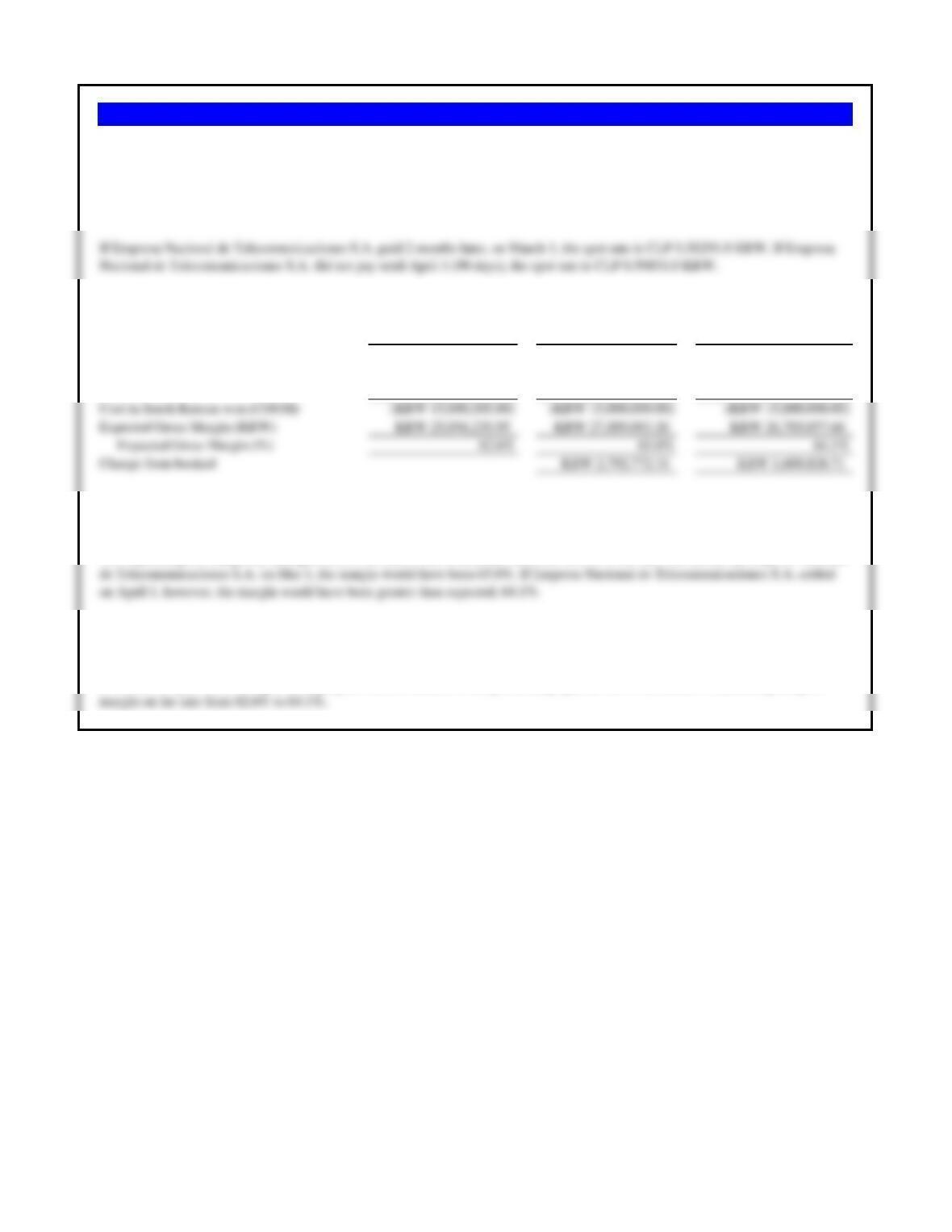
a. Complete the sale and settlement worksheet below
Booked If settled on …. If settled on ….
01 Jan 2019 1 Mar 2019 01 Apr 2019
Sale, in Chilean pesos CLP 25,000,000 CLP 25,000,000 CLP 25,000,000
Chilean pesos per South Korean won 0.6235 0.5829 0.5983
Sales in South Korean won KPW 40,096,230.95 KPW 42,889,003.26 KPW 41,785,057.66
b. How would the gross margin on the sale change over the three different settlement dates?
If settled on April 1, the foreign exchange gain or loss would be a foreign exchange gain of KRW1,688,826.71, increasing the gross
margin on the sale from 62.6% to 64.1%.
Samsung Electronics of Korea sells 25 million Chilean pesos worth of semiconductors to Empresa Nacional de Telecomunicaciones
S.A., Chile, on January 1, 2019. The sale is invoiced in Chilean pesos (contract for settlement). The spot exchange rate on January 1,
2019 was CLP 0.62351.0 KRW, so a sale of 25 million Chilean pesos is recorded on Samsung’s financial statements as KRW
40,096,230.95.
2.14 Samsung of South Korea
If Empresa Nacional de Telecomunicaciones S.A. paid 2 months later, on March 1, the spot rate is CLP 0.58291.0 KRW. If Empresa
Nacional de Telecomunicaciones S.A. did not pay until April 1 (90 days), the spot rate is CLP 0.59831.0 KRW.
The expected gross margin by management, on the date of the contractual sale, was 62.6%. If the sale was settled by Empresa Nacional
de Telecomunicaciones S.A. on Mar 1, the margin would have been 65.0%. If Empresa Nacional de Telecomunicaciones S.A. settled
on April 1, however, the margin would have been greater than expected, 64.1%.
c. If the total sale was settled on April 1 2019, what would be the foreign exchange gain (loss) recorded on the sale?
a. What is the value of the total bond as originally issued in French francs, German marks, British pounds, Dutch florins, and U.S. dollars?
b. Create a chart which shows the fixed rate of exchange implied by the coupon for the six different currencies.
Annual Quarterly
Annual Coupon Coupon
Currency Par Value Coupon Rate (4% of Par) (coupon/4) As described on the coupon
Russian gold roubles 125.00 4.000% 5.0000 1.2500 In St. Petersburg 1.25 Roubles.
French francs
500.00 4.000% 20.0000 5.0000 In Paris 5 Francs.
19.775 4.000% 0.7910 0.1978 In London 3 Schill. 11 and 1/2 P.
404.00 4.000% 16.1600 4.0400 In Berlin 4 Mark 4 Pf.
239.00 4.000% 9.5600 2.3900 In Amsterdam 2 Flor. 39 C.
Of all the currencies, the British pound sterling is the most difficult for calculation. At this time 12 pence = 1 schilling, 20 schiling = 1 pound sterling.
Russian French Pounds German Dutch US gold
roubles francs sterling marks florins dollars
Currency units (per rouble) (per franc) (per pound) (per mark) (per florin) (per dollar)
Russian gold roubles ———– 0.2500 6.3211 0.3094 0.5230 1.2987
French francs 4.0000 ———– 25.2845 1.2376 2.0921 5.1948
These exchange rates can then be used to calculate the total issuance value in each of the respective currencies.
Total Bond
Currency Issuance
Total issue value per rouble By Currency
Russian gold roubles ———– 113,600,000
French francs 4.0000 454,400,000
British pounds sterling 0.1582 17,971,520
These total issuance values are found by multiplying the exchange rate (Currency
c. Create a second chart which compares these exchange rates with these same exchange rates today (use either the Wall Street Journal or
Financial Times to find current exchange rates).
This is a student project, in principle, but one that is difficult to fulfill given that the French franc, German mark, and Dutch florin have all been replaced
Problem 2.15 Tsar Alexander III’s Russian Gold Loan
b. The chart or matrix of implied exchange rates is found by dividing the par values by currency. For example, French francs/Russian roubles is
found by dividing Rbl 125 by FF 500, giving an implied exchange rate of Rbl 0.2500/FF.
c. Create a second chart which compares these exchange rates with these same exchange rates today (use either the Wall Street Journal or Financial Times to
a. The value of the bond is its Par Value, as stated on the bond, assuming that the rates of interest by currency were current at the time of its
issuance. From that we can also calculate the value of each coupon (interest) payment by currency on both an annual and quarterly basis.