273
CHAPTER 18
International Financial Management
Chapter Objectives
After studying this chapter, students should be able to:
2. Identify the primary types of foreign-exchange risk faced by
international businesses.
4. Evaluate the various capital budgeting techniques used for international
investments.
5. Discuss the primary sources of investment capital available to
international businesses.
LECTURE OUTLINE
OPENING CASE: Singapore Airlines’ Worldwide Financial Management
The opening case details Singapore Airlines’ international operations. The company is
• To pay local expenses, the airline must maintain local currency cash balances in
each country where it operates and must carefully manage these currencies to
protect the company from risks associated with exchange rate fluctuations.
274
CHAPTER SUMMARY
Chapter 18 explores international financial management. The chapter begins by
considering the different issues that international financial managers must face, and then
FINANCIAL ISSUES IN INTERNATIONAL TRADE
International business transactions not only require the buyer and seller to reach
agreement on price, quantity, and delivery date, they also require buyers and sellers to
negotiate and agree on which currency to use for the transaction, when and how to
check credit, which form of payment to use, and how to arrange for financing.
Choice of Currency
• Exporters typically prefer to be paid in their home currency so that they know exactly
how much they will be receiving from the importer. Importers, however, typically
prefer to pay in their home currency so that they know exactly how much they will be
paying the exporter. In some cases, a third country currency will be selected. For
example, the text notes that the U.S. dollar is used for transactions in the oil industry.
Credit Checking
• It is important for firms to check the credit of their customers prior to completing a
business transaction. In situations where the importer is financially healthy,
Method of Payment
• There are several methods of payment for international business transactions,
including payment in advance, open account, documentary collection, letters of
credit, credit cards, and countertrade. Each form involves a different degree of cost
and risk.
• Payment in Advance. The safest method of payment from the exporter’s
perspective is payment in advance; however, this method of payment is very

275
importer refuses to pay, and working capital must be tied up to finance foreign
accounts receivable.
• Firms may engage in specialized international lending called factoring whereby they
buy foreign accounts receivable at a discount from face value.
• Documentary Collection. Documentary collection is a method to finance
transactions in which commercial banks serve as agents to facilitate the payment
importer by requiring payment at some specified time after the importer receives the
goods. A date draft specifies a particular date on which payment must be made.
• To obtain title to the goods, the importer must accept the time draft (and incur a legal
obligation to pay it). An accepted time draft is called a trade acceptance. The
importer’s bank may also accept a time draft, adding its own obligation to pay the
collection process. Finally, financing for foreign accounts receivable is easier and
less expensive when documentary collection is used rather than open accounts
since acceptances are legally enforceable.
• Importers may still refuse a shipment and decline to accept the draft, or may default
on the time draft when it comes due. Either situation could be costly for exporters.
Teaching Note:
Students frequently become confused when discussing the process of
documentary collection and letters of credit (see next section). When
discussing these concepts, instructors may wish to develop a chart showing each
step of the process so that students can follow the process more clearly.
• Letters of Credit. International businesses may use letters of credit to arrange for
payment. A letter of credit is a document that is issued by a bank and contains its
276
• An irrevocable letter of credit cannot be altered without the written consent of both
the importer and the exporter, while a revocable letter of credit may be altered at
any time for any reason.
• Since banks charge a fee for these services, companies must determine which are
necessary forms of insurance and which are not. See Figure 18.2 here.
• Credit Cards. Firms may use credit cards for small international transactions,
particularly those between international merchants and foreign retail customers.
• Countertrade. Countertrade occurs when a firm accepts something other than
money as payment for its goods and services. There are various forms of
countertrade, including barter (each party simultaneously swaps its products for the
countertrade.
• Countertrade is widely used in international business, and may account for as much
as 40 percent of world trade. The text provides an example of Marc Rich & Co.’s use
of countertrade. Discuss Map 18.1 here.
• Each method of payment has various costs and risks associated with it. In the end,
the exporter must decide how much risk and cost to bear. Discuss Table 18.1 here.
Financing Trade
• International firms must be ready to offer financing arrangements to foreign
MANAGING FOREIGN-EXCHANGE RISK
277
Transaction Exposure
• A firm faces transaction exposure when the financial benefits and costs of an
international transaction can be affected by exchange-rate movements that occur
after the firm is legally obligated to complete the transaction.
• Various transactions, including the purchase of goods, services, or assets, the sale
of goods, services, or assets, the extension of credit, and borrowing money can lead
movements.
• Buy Swiss Francs Forward. A company (the text continues to use the example of
Saks) could buy the required foreign currency in the forward market and lock in the
price it will pay for the currency. Like going naked, this strategy allows a company to
keep its capital free for other uses; however, it also provides a company with a
guaranteed price it will pay for the foreign currency. The company will miss any
opportunity to capitalize on exchange-rate movements, though.
• A similar strategy to buying in the forward market is buying in the futures market.
The choice between the two markets will be affected by the price of the required
currency and relative transaction costs.
• Buy Swiss Franc Currency Options. A company could acquire a currency options
contract, allowing it to buy the required currency (see Chapter Eight). This would
give the company the opportunity, but not the obligation, to buy the required currency
Translation Exposure
• Translation exposure (also known as accounting exposure) is the impact on the
firm’s consolidated financial statements of fluctuations in exchange rates that change
the value of foreign subsidiaries as measured in the parent’s currency. The text
does provide a simple example of translation exposure involving GM, however.
278
• Economic exposure is the impact on the value of a firm’s operations of
unanticipated exchange-rate changes. This type of exposure affects virtually every
area of operations. The text provides an example of how Sony has tried to limit its
economic exposure using an operational hedge.
MANAGEMENT OF WORKING CAPITAL
• The management of working capital is more complicated for international firms than
purely domestic ones because the working capital position for each subsidiary (in
each currency) must be considered in addition to the firm’s position as a whole.
• Three corporate financial goals must be balanced: minimizing working capital
balances; minimizing currency conversion costs; and minimizing foreign-exchange
risks.
Minimizing Working Capital Balances
• Working capital is held to facilitate day-to-day transactions and to cover the firm
against unexpected demands for cash. However, since the return on working capital
Minimizing Currency Conversion Costs
• Because there is a lot of internal trade among the various units of some MNCs, firms
279
• Bilateral netting is done between two business units, and multilateral netting is
done among three or more business units. The text provides an example of a
multilateral netting operation. See Figure 18.3 and Table 18.3 here.
VENTURING ABROAD
Colefax and Fowler’s Cash Flow Solution
This box examines how Colefax and Fowler, a wallpaper and fabric store, manages
its working capital and currency conversion costs. In the past, the company had
simply passed the costs along to customers, but now Colefax and Fowler has
established bank accounts in each country where it has customers, and allows
Minimizing Foreign-Exchange Risk
• Firms may use a leads and lags strategy to try to increase their net holdings of
currencies that are expected to rise in value and decrease their net holdings of
currencies that are expected to fall in value. The text provides an example of Avon
using the strategy.
INTERNATIONAL CAPITAL BUDGETING
The more common approaches to evaluate investment projects are net present value,
internal rate of return, and payback period.
Net Present Value
• Firms calculate the net present value of a project by estimating the cash flows the
project will generate in each time period, and discounting them back to present.
When evaluating international projects, firms must also consider risk adjustment,
Internal Rate of Return
280
• A project can also be evaluated using the internal rate of return. This method
requires that managers first estimate the cash flows generated by each project under
Payback Period
• A firm can also calculate a project’s payback period, the number of years it will take
SOURCES OF INTERNATIONAL INVESTMENT CAPITAL
Firms must secure sufficient capital to fund promising projects. Whether funds come
from internal sources or external ones, firms want to minimize the worldwide cost of
capital, foreign-exchange risk, political risk, and their global tax burden.
External Sources of Investment Capital
• Various debt and equity alternatives exist for firms that want to raise external capital.
Internal Sources of Investment Capital
• One source of investment capital is the cash that a firm generates internally. A firm
can use the cash flow generated by any subsidiary to fund the investment projects of
Strategic Use of Transfer Pricing
• International businesses can reduce their overall tax burdens by using transfer
pricing and tax havens. Transfer pricing refers to the prices one branch or
subsidiary of a parent charges a second branch or subsidiary for goods or services.
281
Transfer prices can be calculated using a market-based approach, or a nonmarket
method.
• Market-Based Transfer Prices. The market-based method utilizes prices
determined in the open market to transfer goods between units of the same
company. The text illustrates this concept with an example of how Hyundai uses the
approach.
Tax Havens
• MNCs also reduce their tax burdens by locating their activities in tax havens,
countries that impose little or no corporate income taxes. MNCs using tax havens
divert income from subsidiaries in high-tax countries to the subsidiary operating in
the tax haven country. The text provides an example of how a company might use
the Cayman Islands as a tax haven location.
VENTURING ABROAD
Taxation of Foreign Subsidiary Income by the U.S. Government
This box discusses the tax liabilities for U.S.-owned foreign subsidiaries. It explains
the deferral rule in the U.S. tax code which allows earnings from foreign subsidiaries
to be taxed only when they are remitted to the parent company in the form of
dividends. The company has no tax liability as long as those earnings stay overseas
282
EMERGING OPPORTUNITIES
Sun, Sand and Shells
CHAPTER REVIEW
1. What special problems arise in financing and arranging payment for international
transactions?
2. What are the major methods of payment used for international transactions?
3. What are the different types of letters of credit?
4. How do a time draft and a sight draft differ? How do a trade acceptance and a banker’s
acceptance differ?
5. How do the various types of countertrade arrangements differ from each other?
Countertrade occurs when a firm accepts something other than money as payment for its
goods and services. There are four types of countertrade: barter, counterpurchase, buy-
6. What techniques are available to reduce transaction exposure? Discuss each.
A firm has several options for reducing transaction exposure. First, a company could buy
the required foreign currency in the forward market and thereby lock in the price it will pay
7. What is translation exposure? What effect does a balance sheet hedge have on translation
exposure?
8. Why do MNCs engage in currency netting operations?
9. What capital budgeting techniques are available to international businesses?
The most common capital budgeting techniques used in international business are net
present value, internal rate of return, and payback period. The net present value approach
10. What is a transfer price? How do firms determine them?
A transfer price refers to the prices one branch or subsidiary of a parent charges a second
QUESTIONS FOR DISCUSSION
1. What are the advantages and disadvantages of each method of payment for international
transactions from the exporter’s perspective?
2. Which type of letter of credit is most preferable from the exporter’s point of view?
285
3. Why do firms use countertrade? What problems do they face when they do?
Countertrade occurs when a firm accepts something other than money as payment for its
4. How does capital budgeting for international projects differ from that for domestic projects?
5. How can firms use transfer prices and tax havens to reduce their corporate income tax bills?
What do governments do in response?
6. Are firms that create shell corporations in tax havens being socially responsible?
286
Students can discuss this topic. Both positions have points that can be made. The argument
7. Why would a firm want to negotiate an Advance Pricing Arrangement with the Internal
Revenue Service? Why would the Internal Revenue Service want to negotiate an Advance
Pricing Arrangement?
The APA program is designed to resolve actual or potential transfer pricing disputes, in a
BUILDING GLOBAL SKILLS
Essence of the exercise
This exercise provides typical monthly transactions for the operating units of Belgian Lace
Products (BLP). The exercise asks students to examine BLP’s profit picture, develop a
currency conversion strategy, and evaluate the impact of a single European currency on BLP.
Answers to the follow-up questions:
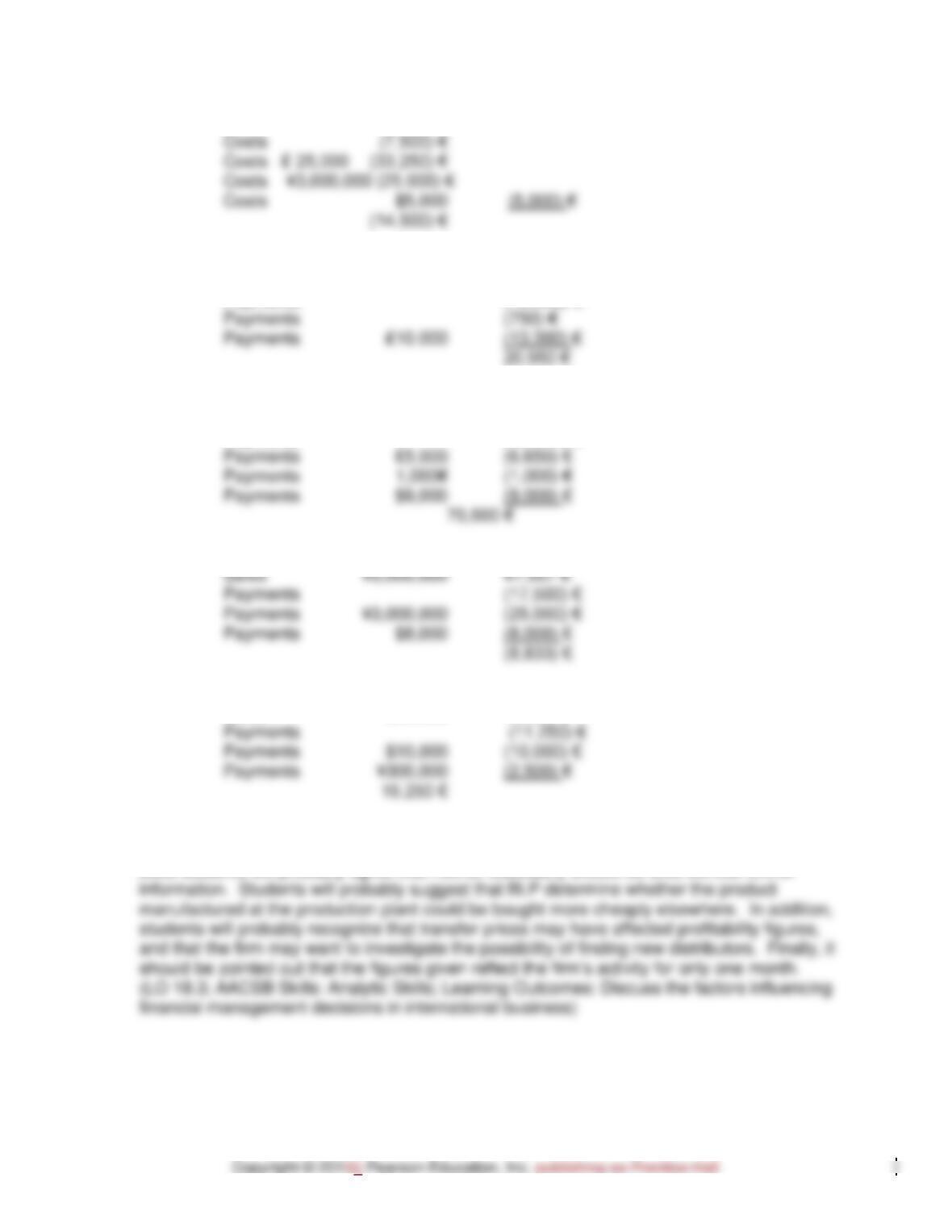
1. Calculate the profitability of each of BLP’s five subsidiaries. (Because BLP is Belgian,
perform the calculations in terms of euros, which Belgium began using as its national
currency in 2002.) Are any of the subsidiaries unprofitable? On the basis of the information
provided, would you recommend shutting down an unprofitable subsidiary? Why or why
not?
Manufacturing Subsidiary:
Sales 15,000 €
287
Sales 11,250 €
Belgian Distribution Subsidiary:
Sales 50,000 €
Payments (15,000) €
British Distribution Subsidiary:
Sales ₤75,000 99,750 €
Payments (12,500) €
Japanese Distribution Subsidiary:
U.S. Distribution Subsidiary:
Sales $40,000 40,000 €
The above calculations indicate that both the BLP production facility and the Japanese
distribution subsidiary were unprofitable in the time period for which figures were given.
Most students will probably agree that neither subsidiary should be shut without further
2. Suppose it costs each subsidiary 1 percent of the transaction each time it converts its home
currency into another currency in order to pay its suppliers. Develop a strategy by which
288
BLP as a corporation can reduce its total currency conversion costs. Suppose your strategy
costs BLP 400 euros per month to implement? Should the firm still adopt your approach?
3. If the United Kingdom decided to join the EU’s single currency bloc and use the euro, what
effect would this have on BLP? What effect would it have on the benefits and costs of the
strategy you developed to reduce BLP’s currency conversion costs?
Most students will probably recognize that the UK’s joining the single European currency will
be beneficial to BLP. With England as part of the single European currency, conversion
CLOSING CASE
Everything’s Green in Ireland
The closing case describes how Ireland, largely through its tax laws, has become an important
player in and profited from intellectual property development and licensing. Microsoft, Google,
and other firms have licensed their software through their Irish subsidiary and significantly
reduced the amount of taxes they have had to pay on their profits.
Key Points:
• Ireland has become the new focal point for structuring transactions to reduce tax
bills, and they are aggressively using the tax code, to promote economic
development.
289
• Google Ireland Holdings in turn owns Google Ireland Limited, which employs almost
2,000 people in Dublin.
• That unit sells billions of dollars of ads every year but passes on most of those
royalties through Google Ireland Holdings, the Bermuda unit.
• This arrangement is fairly common and it is called the “Double Irish.”
• Irish law exempts some royalty payments to other European Union countries, so
those European profits make a brief stopover in the Netherlands (Google Netherland
Holdings).
• When this money passes through the Dutch unit (which has no employees), it in turn
pays out 99.9% of what it collects to the unit in Bermuda.
Case Questions
1. Why do tax rates and tax treatment of corporate income vary so dramatically among
countries?
2. Explain the use of the Double Irish and Dutch Sandwich by Google.
Google reached an agreement with the Internal Revenue Service in 2006, allowing it
to license to a subsidiary the offshore rights to its intellectual property for undisclosed
fees. U.S. companies have an incentive to set such prices low, reducing their taxable
income at home.
Google Ireland Ltd. employs about 2,000 people at this office in central Dublin. The
subsidiary gets credit for about 88 percent of the company’s overseas sales, yet
3. How important is the Advance Pricing Arrangement that Google negotiated with the
IRS to the success of its tax minimization strategy?
4. Google’s corporate model is “Don’t be evil.” Is Google’s use of the Double Irish and
Dutch Sandwich honoring that model?
5. Explain how Microsoft uses its Irish subsidiary to cut its U.S. taxes. How does it get
around U.S. regulations regarding passive income?
6. What is the impact of Microsoft’s Irish subsidiary on the Irish economy?
7. Are Google and Microsoft acting ethically? Are they being socially responsible?
This is a great discussion question. Microsoft and Google are certainly acting
legally. The structure Microsoft and Google have adopted appears to be carefully