Chapter 17
Multinational Cost of Capital and Capital Structure
Lecture Outline
Components of Capital
External Sources of Debt
External Sources of Equity
The MNC‘s Capital Structure Decision
Subsidiary Versus Parent Capital Structure Decisions
Impact of Increased Subsidiary Debt Financing
Impact of Reduced Subsidiary Debt Financing
Limitations in Offsetting a Subsidiary‘s Leverage
Multinational Cost of Capital
MNC’s Cost of Debt
2 Multinational Cost of Capital and Capital Structure
Chapter Theme
This chapter explains why the capital structure and the cost of capital of MNCs may vary with those of
domestic firms. It also explains why the cost of capital varies across countries. The disparity in the cost
of capital across countries is important because it can influence the MNC’s decisions on where to
establish subsidiaries and where to obtain funds.
Topics to Stimulate Class Discussion
1. Why don’t all MNCs attempt to obtain funds in countries where the cost of capital is very low?
POINT/COUNTER-POINT:
Should the Reduced Tax Rate on Dividends Affect an MNC’s Capital
Structure?
COUNTER-POINT: A dividend income tax reduction may encourage a U.S.-based MNC to offer
associated with debt).
WHO IS CORRECT? Use the Internet to learn more about this issue. Which argument do you support?
Offer your own opinion on this issue.
ANSWER: The MNC may consider shifting its capital structure, but would have to consider how the
Answers to End of Chapter Questions
1. Capital Structure of MNCs. Present an argument in support of an MNC’s favoring a debt-intensive
capital structure.
Multinational Cost of Capital and Capital Structure 3
Present an argument in support of an MNC’s favoring an equity-intensive capital structure.
ANSWER: MNCs that are well-diversified across countries would have somewhat stable cash flows
2. Optimal Financing. Wizard, Inc. has a subsidiary in a country where the government allows only a
small amount of earnings to be remitted to the U.S. each year. Should Wizard finance the subsidiary
with debt financing by the parent, equity financing by the parent, or financing by local banks in the
foreign country?
ANSWER: Wizard should use financing by local banks in the foreign country, so that the subsidiary
3. Country Differences. Describe general differences between the capital structures of firms based in
the United States and those of firms based in Japan. Offer an explanation for these differences.
ANSWER: Japanese firms tend to have a higher degree of financial leverage. This may be because
4. Local Versus Global Capital Structure. Why might a firm use a “local” capital structure at a
particular subsidiary that differs substantially from its “global” capital structure?
ANSWER: A particular country’s characteristics can cause the MNC’s subsidiary to use mostly debt
5. Cost of Capital. Explain how characteristics of MNCs can affect the cost of capital.
ANSWER: The following characteristics of MNCs can influence the cost of capital:
4 Multinational Cost of Capital and Capital Structure
6. Capital Structure and Agency Issues. Explain why managers of a wholly-owned subsidiary may
be more likely to satisfy the shareholders of the MNC.
ANSWER: Managers of a wholly-owned subsidiary can more easily focus on the objective of
7. Target Capital Structure. LaSalle Corp. is a U.S.-based MNC with subsidiaries in various less
developed countries where stock markets are not well established. How can LaSalle still achieve its
“global” target capital structure of 50 percent debt and 50 percent equity, if it plans to use only debt
financing for the subsidiaries in these countries?
ANSWER: LaSalle Corporation can use mostly equity financing for its U.S. operations. When
8. Financing Decision. Drexel Co. is a U.S.-based company that is establishing a project in a politically
unstable country. It is considering two possible sources of financing. Either the parent could provide
most of the financing, or the subsidiary could be supported by local loans from banks in that
country. Which financing alternative is more appropriate to protect the subsidiary?
ANSWER: Drexel should let local banks support the subsidiary since it would be in the interest of
9. Financing Decision. Veer Co. is a U.S.-based MNC that has most of its operations in Japan. Since
the Japanese companies with which it competes use more financial leverage, it has decided to adjust
its financial leverage to be in line with theirs. With this heavy emphasis on debt, Veer should reap
more tax advantages. It believes that the market’s perception of its risk will remain unchanged, since
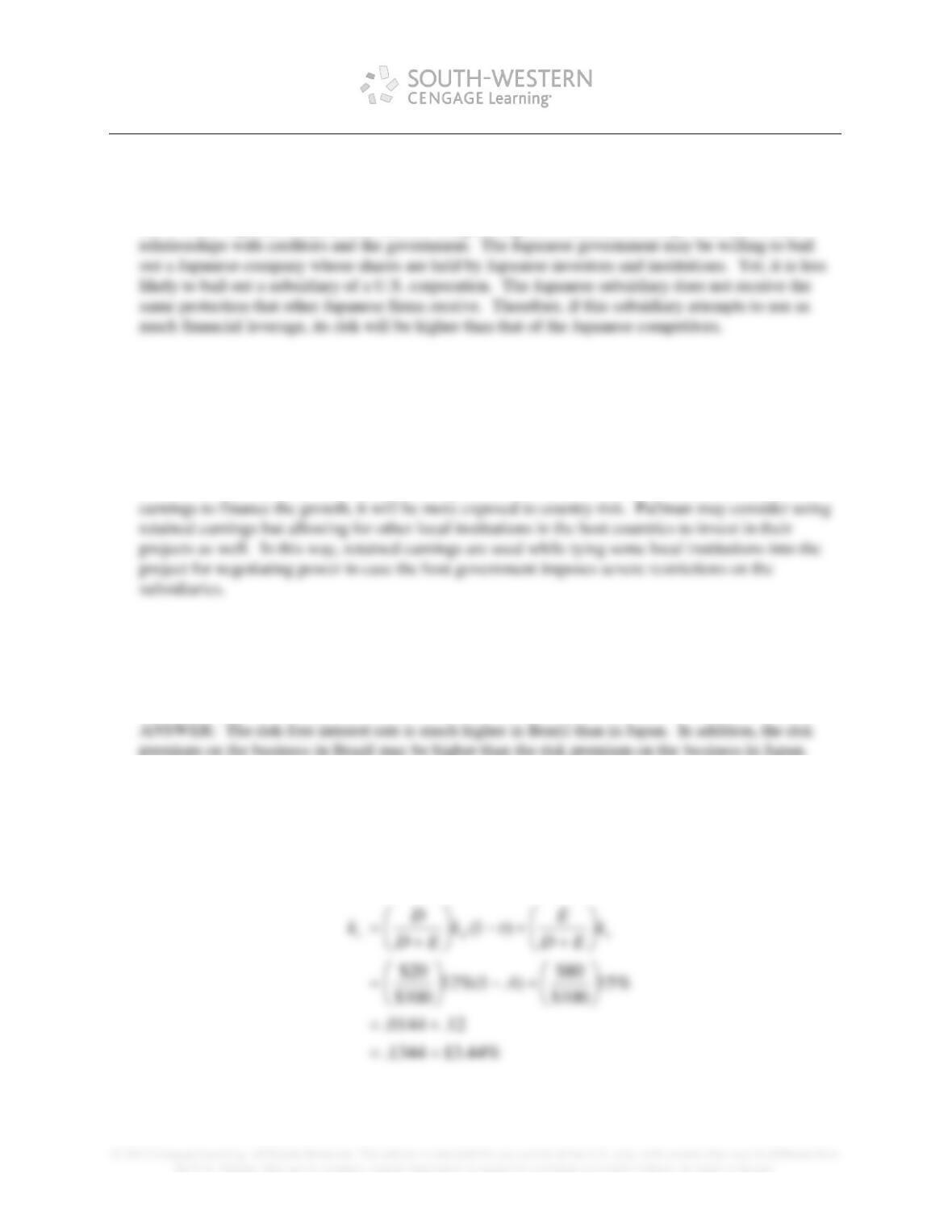
Multinational Cost of Capital and Capital Structure 5
its financial leverage will still be no higher than that of its Japanese competitors. Comment on this
strategy.
ANSWER: Japanese corporations can use a higher degree of financial leverage because of their
10. Financing Tradeoffs. Pullman, Inc., a U.S. firm, has been highly profitable, but prefers not to pay
out higher dividends because its shareholders want the funds to be reinvested. It plans for large
growth in several less developed countries. Pullman would like to finance the growth with local debt
in the host countries of concern to reduce its exposure to country risk. Explain the dilemma faced by
Pullman, and offer possible solutions.
ANSWER: Pullman Inc. has retained earnings that it must reinvest. Yet, if it uses the retained
11. Costs of Capital Across Countries. Explain why the cost of capital for a U.S.-based MNC with a
large subsidiary in Brazil is higher than for a U.S.-based MNC in the same industry with a large
subsidiary in Japan. Assume that the subsidiary operations for each MNC are financed with local
debt in the host country.
12. WACC. An MNC has total assets of $100 million and debt of $20 million. The firm’s before-tax cost
of debt is 12 percent, and its cost of financing with equity is 15 percent. The MNC has a corporate
tax rate of 40 percent. What is this firm’s weighted average cost of capital?
ANSWER:

6 Multinational Cost of Capital and Capital Structure
13. Cost of Equity. Wiley, Inc., an MNC, has a beta of 1.3. The U.S. stock market is expected to
generate an annual return of 11 percent. Currently, Treasury bills yield 2 percent. Based on this
information, what is Wiley’s estimated cost of equity?
ANSWER:
14. WACC. Blues, Inc. is an MNC located in the U.S. Blues would like to estimate its weighted average
cost of capital. On average, bonds issued by Blues yield 9 percent. Currently, T-bond rates are 3
percent. Furthermore, Blues’ stock has a beta of 1.5, and the return on the Wilshire 5000 stock index
is expected to be 10 percent. Blues’ target capital structure is 30 percent debt and 70 percent equity.
If Blues is in the 35 percent tax bracket, what is its weighted average cost of capital?
ANSWER: First, estimate the cost of equity using the CAPM:
Next, estimate the weighted average cost of capital:
%21.111121.
15. Effects of September 11. Rose, Inc., of Dallas, Texas needed to infuse capital into its foreign
subsidiaries to support their expansion. As of August 2001, it planned to issue stock in the U.S.
However, after the September 11, 2001 terrorist attack on the U.S., it decided that long-term debt was
a cheaper source of capital. Explain how the terrorist attack could have altered the two forms of
capital.
ANSWER: The attack had an adverse effect on stock market conditions, and Rose’s stock price
Multinational Cost of Capital and Capital Structure 7
16. Nike’s Cost of Capital. If Nike decides to expand further in South America, why might its capital
structure be affected? Why will its overall cost of capital be affected?
ANSWER: If Nike expands further in South America, it must decide how to finance those
Advanced Questions
17. Interaction Between Financing and Investment. Charleston Corp. is considering establishing a
subsidiary in either Germany or the United Kingdom. The subsidiary will be mostly financed with
loans from the local banks in the host country chosen. Charleston has determined that the revenue
generated from the British subsidiary will be slightly more favorable than the revenue generated by
the German subsidiary, even after considering tax and exchange rate effects. The initial outlay will
be the same, and both countries appear to be politically stable. Charleston decides to establish the
subsidiary in the United Kingdom because of the revenue advantage. Do you agree with its
decision? Explain.
ANSWER: Charleston neglected the cost of financing the subsidiary. It may be more costly to
18. Financing Decision. In recent years, several U.S. firms have penetrated Mexico’s market. One of the
biggest challenges is the cost of capital to finance businesses in Mexico. Mexican interest rates tend
to be much higher than U.S. interest rates. In some periods, the Mexican government does not
attempt to lower the interest rates because higher rates may attract foreign investment in Mexican
securities.
a. How might U.S.-based MNCs expand in Mexico without incurring the high Mexican interest
expenses when financing the expansion? Are any disadvantages associated with this strategy?
ANSWER: The parents of the MNCs could provide funding for the subsidiaries by investing their
8 Multinational Cost of Capital and Capital Structure
b. Are there any additional alternatives for the Mexican subsidiary to finance its business itself after
it has been well established? How might this strategy affect the subsidiary’s capital structure?
ANSWER: Once the subsidiary has generated earnings, it can retain the earnings and reinvest them
19. Financing Decision. Forest Company produces goods in the U.S., Germany, and Australia, and sells
the goods in the areas where they are produced. Foreign earnings are periodically remitted to the
U.S. parent. As the euro’s interest rates have declined to a very low level, Forest Company has
decided to finance its German operations with borrowed funds in place of the parent’s equity
investment. Forest will transfer the U.S. parent’s equity investment in the German subsidiary over to
its Australian subsidiary. These funds will be used to pay off a floating-rate loan, as Australian
interest rates have been high and are rising. Explain the expected effects of these actions on the
consolidated capital structure and cost of capital of Forest Company.
Given the strategy to be used by Forest, explain how its exposure to exchange rate risk may have
changed.
ANSWER: While the capital structure is now more equity-intensive in Australia and more debt-
20. Financing in a High Interest Rate Country. Fairfield Corp., a U.S. firm, recently established a
subsidiary in a less developed country that consistently experiences an annual inflation rate of 80
percent or more. The country does not have an established stock market, but loans by local banks are
available with a 90 percent interest rate. Fairfield has decided to use a strategy in which the subsid–
iary is financed entirely with funds from the parent. It believes that in this way it can avoid the
excessive interest rate in the host country. What is a key disadvantage of using this strategy that may
cause Fairfield to be no better off than if it paid the 90 percent interest rate?
ANSWER: The local currency of the host company will likely depreciate consistently and
Multinational Cost of Capital and Capital Structure 9
21. Cost of Foreign Debt Versus Equity. Carazona Inc. is a U.S. firm that has a large subsidiary in
Indonesia. It wants to finance the subsidiary’s operations in Indonesia. However, the cost of debt is
presently about 30 percent there for firms like Carazona or government agencies that have a very
strong credit rating. A consultant suggests to Carazona that it should use equity financing there to
avoid the high interest expense. He suggests that since Carazona’s cost of equity in the U.S. is about
14 percent, so the Indonesian investors should be satisfied with a return of about 14 percent as well.
Clearly explain why the consultant’s advice is not logical. That is, explain why Carazona’s cost of
equity in Indonesia would not be less than Carazona’s cost of debt in Indonesia.
22. Integrating Cost of Capital and Capital Budgeting. Zylon Co. is a U.S. firm that provides
technology software for the government of Singapore. It will be paid S$7,000,000 at the end of each
of the next five years. The entire amount of the payment represents earnings since Zylon created the
technology software years ago. Zylon is subject to a 30 percent corporate income tax rate in the
United States. Its other cash inflows (such as revenue) are expected to be offset by its other cash
outflows (due to operating expenses) each year, so its profits on the Singapore contract represent its
expected annual net cash flows. Its financing costs are not considered within its estimate of cash
flows. The Singapore dollar (S$) is presently worth $.60, and Zylon uses that spot exchange rate as a
forecast of future exchange rates.
The risk-free interest rate in the United States is 6 percent while the risk-free interest rate in
Singapore is 14 percent. Zylon’s capital structure is 60 percent debt and 40 percent equity. Zylon is
charged an interest rate of 12 percent on its debt. Zylon’s cost of equity is based on the CAPM. It
expects that the U.S. annual market return will be 12 percent per year. Its beta is 1.5.
Quiso Co., a U.S. firm, wants to acquire Zylon and offers Zylon a price of $10,000,000.
Zylon’s owner must decide whether to sell the business at this price and hires you to make a
recommendation. Estimate the NPV to Zylon as a result of selling the business, and make a
recommendation about whether Zylon’s owner should sell the business at the price offered.
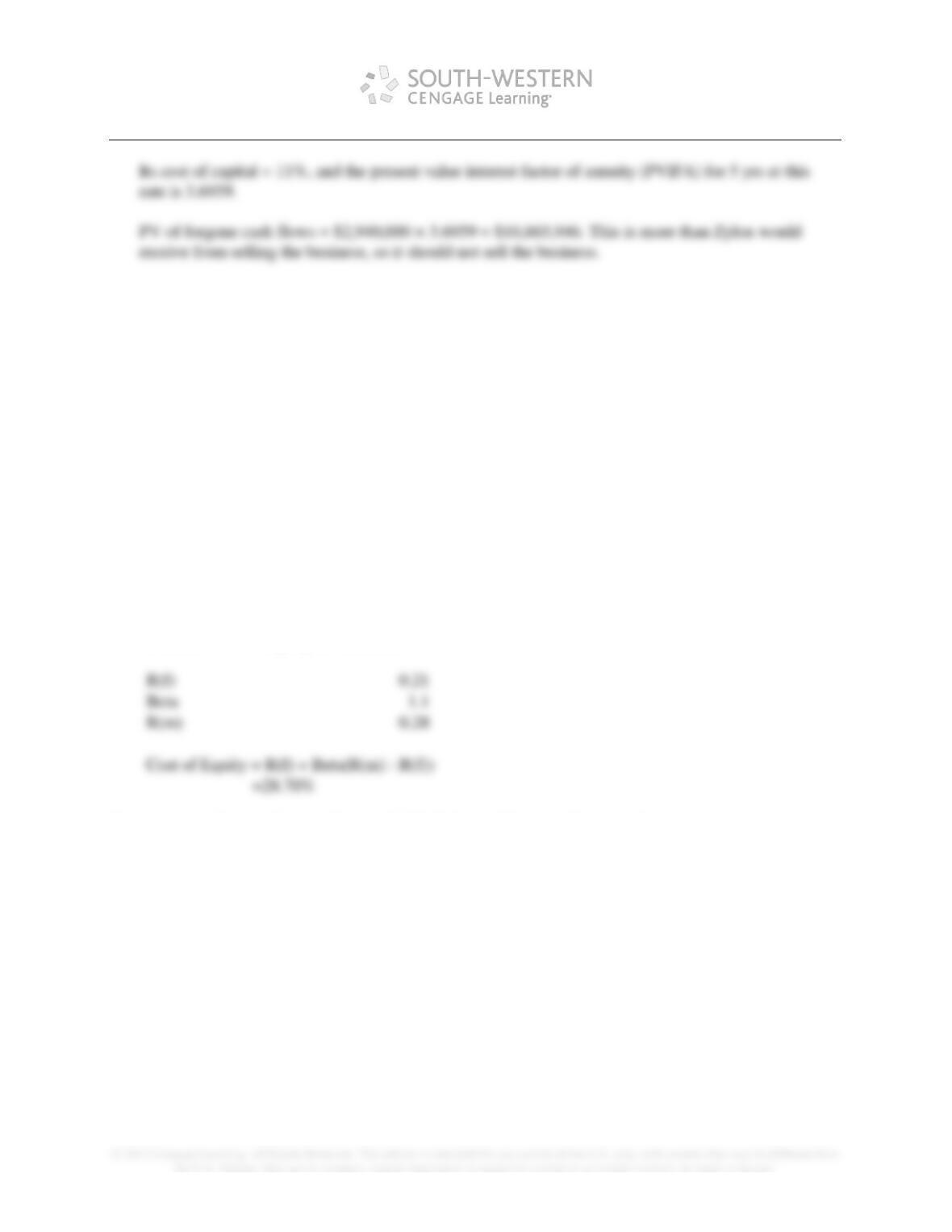
ANSWER:
Zylon’s cost of debt = 12% (1 – .3) = 8.4%
10 Multinational Cost of Capital and Capital Structure
23. Financing with Foreign Equity. Orlando Co. has its U.S. business funded with dollars with a capital
structure of 60% debt and 40% equity. It has its Thailand business funded with Thai baht with a
capital structure of 50% debt and 50% equity. The corporate tax rate on U.S. earnings and on
Thailand earnings is 30%. The annualized 10-year risk-free interest rate is 6% in the U.S. and 21% in
Thailand. The annual real rate of interest is about 2% in the U.S. and in Thailand. Interest rate parity
exists. Orlando pays 3 percentage points above the risk-free rates when it borrows, so its before-tax
cost of debt is 9% in the U.S. and 24% in Thailand. Orlando expects that the U.S. annual stock
market return will be 10% per year, and the Thailand annual stock market return will be 28% per
year. Its business in the U.S. has a beta of .8 relative to the U.S. market, while its business in
Thailand has a beta of 1.1 relative to the Thai market. The equity used to support Orlando’s Thai
business was created from retained earnings by the Thailand subsidiary in previous years. However,
Orlando Co. is considering a stock offering in Thailand that is denominated in Thai baht and targeted
at Thai investors. Estimate Orlando’s cost of equity in Thailand that would result from issuing stock
in Thailand.
ANSWER:
Estimate cost of equity in Thailand
R(f)
Beta
R(m)
Cost of Equity = R(f) + Beta(R(m) – R(f))
=28.70%
24. Assessing Foreign Project Funded With Debt and Equity. Nebraska Co. plans to pursue a
project in Argentina that will generate revenue of 10 million Argentine pesos (AP) at the end of each
of the next 4 years. It will have to pay operating expenses of AP3 million per year. The Argentine
government will charge a 30% tax rate on profits. All after-tax profits each year will be remitted to
the U.S. parent and no additional taxes are owed. The spot rate of the AP is presently $.20. The AP is
expected to depreciate by 10% each year for the next 4 years. The salvage value of the assets will be
worth AP40 million in 4 years after capital gains taxes are paid. The initial investment will require
$12 million, half of which will be in the form of equity from the U.S. parent, and half of which will
come from borrowed funds. Nebraska will borrow the funds in Argentine pesos. The annual interest
rate on the funds borrowed is 14%. Annual interest (and zero principal) is paid on the debt at the end
of each year, and the interest payments can be deducted before determining the tax owed to the
Argentine government. The entire principal of the loan will be paid at the end of year 4. Nebraska
requires a rate of return of at least 20% on its invested equity for this project to be worthwhile.
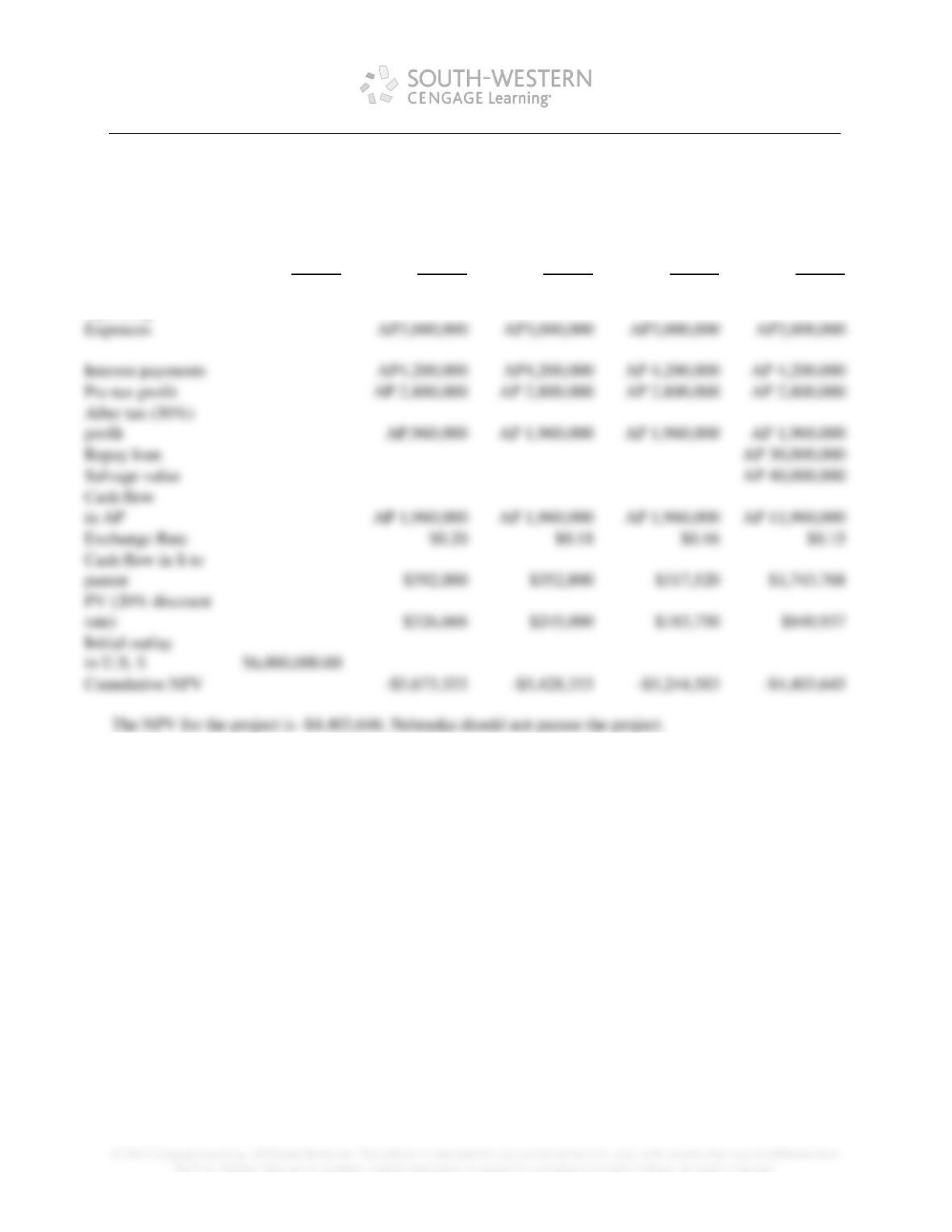
Determine the NPV of this project. Should Nebraska pursue the project?
Multinational Cost of Capital and Capital Structure 11
ANSWER:
Initial investment of $12 million is supported by one-half debt, or $6 million. Debt financing requires
AP30 million. The annual interest payment is 14% of AP30 million = AP4,000,000.
Year 0
Year 1
Year 2
Year 3
Year 4
Revenue
AP10,000,000
AP10,000,000
AP10,000,000
AP10,000,000
Expences
Interest payments
Pre-tax profit
After tax (30%)
profit
Repay loan
Salvage value
Cash flow
in AP
Exchange Rate
parent
PV (20% discount
rate)
Initial outlay
in U.S. $
$6,000,000.00
Cumulative NPV
Operating
25. Sensitivity of Foreign Project Risk to Capital Structure. Texas Co. produces drugs and plans to
acquire a subsidiary in Poland. This subsidiary is a lab that would perform biotech research. Texas Co. is
attracted to the lab because of the cheap wages of scientists in Poland. The parent of Texas Co. would
review the lab research findings of the subsidiary in Poland when deciding which drugs to produce, and
would then produce the drugs in the U.S. The expenses incurred in Poland will represent about half of the
total expenses incurred by Texas Co. All drugs produced by Texas Co. are sold in the U.S. and this
situation would not change in the future. Texas Co. has considered 3 ways to finance the acquisition of
the Polish subsidiary if it buys it. First, it could use 50% equity funding (in dollars) from the parent and
50% borrowed funds in dollars. Second, it could use 50% equity funding (in dollars) from the parent and
50% borrowed funds in Polish zloty. Third, it could use 50% equity funding by selling new stock to
Polish investors denominated in Polish zloty and 50% borrowed funds denominated in Polish zloty.
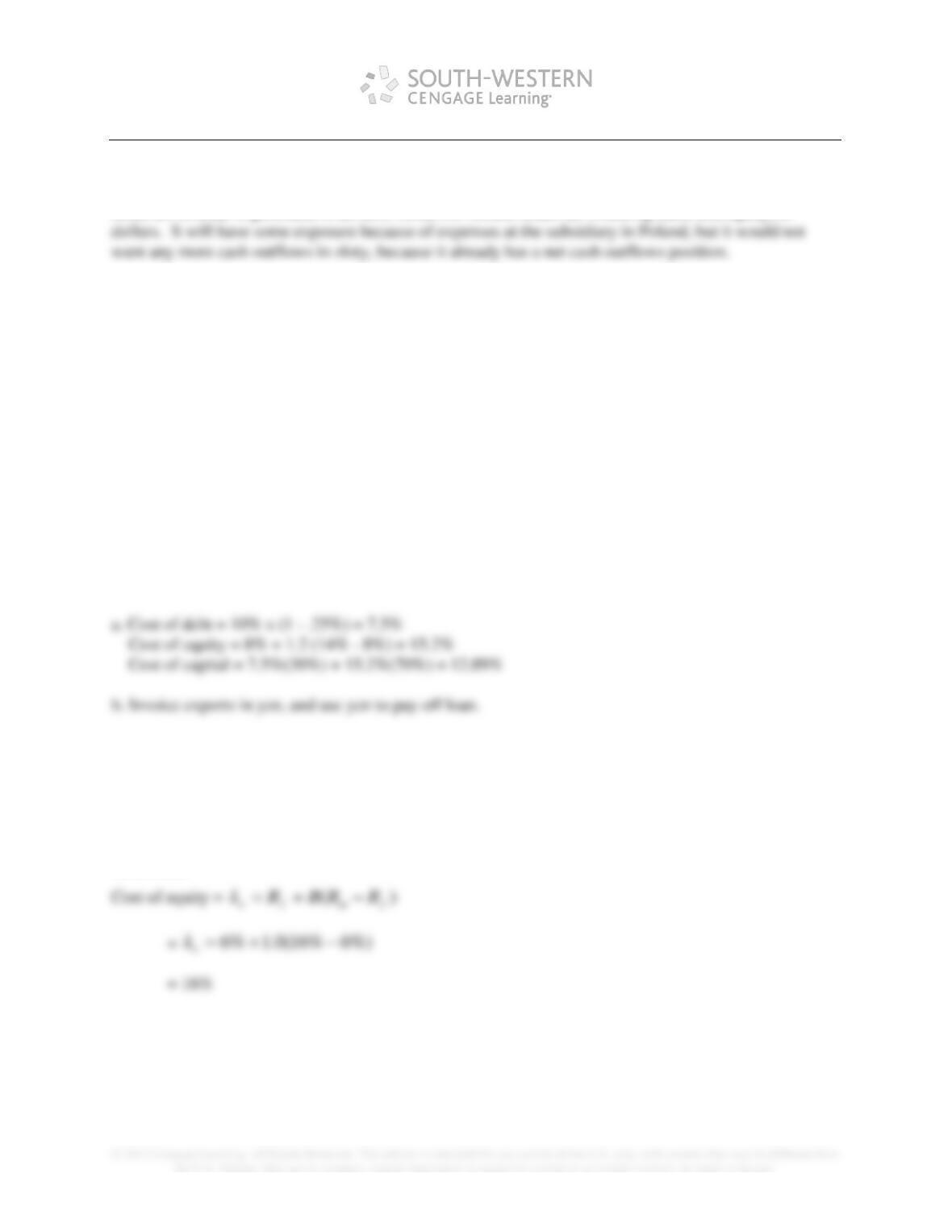
Assuming that Texas Co. decides to acquire the Polish subsidiary, which financing method for the Polish
subsidiary would minimize the exposure of Texas to exchange rate risk? Explain.
12 Multinational Cost of Capital and Capital Structure
ANSWER:
Since all revenue is generated in dollars, Texas Co. should obtain all financing (debt and equity) in
26. Cost of Capital and Risk of Foreign Financing. Vogl Co. is a U.S. firm that conducts major
importing and exporting business in Japan, whereby all transactions are invoiced in dollars. It obtained
debt in the U.S. at an interest rate of 10 percent per year. The long-term risk-free rate in the U.S. is 8
percent. The stock market return in the U.S. is expected to be 14 percent annually. Vogl’s beta is 1.2. Its
target capital structure is 30 percent debt and 70 percent equity. Vogl Co. is subject to a 25% corporate
tax rate.
a. Estimate the cost of capital to Vogl Co.
b. Vogl has no subsidiaries in foreign countries but plans to replace some of its dollar-denominated debt
with Japanese yen-denominated debt, since Japanese interest rates are low. It will obtain yen-
denominated debt at an interest rate of 5 percent. It can not effectively hedge the exchange rate risk
resulting from this debt because of parity conditions that makes the price of derivatives contracts
reflect the interest rate differential. How could Vogl Co. reduce its exposure to the exchange rate risk
resulting from the yen-denominated debt without moving its operations?
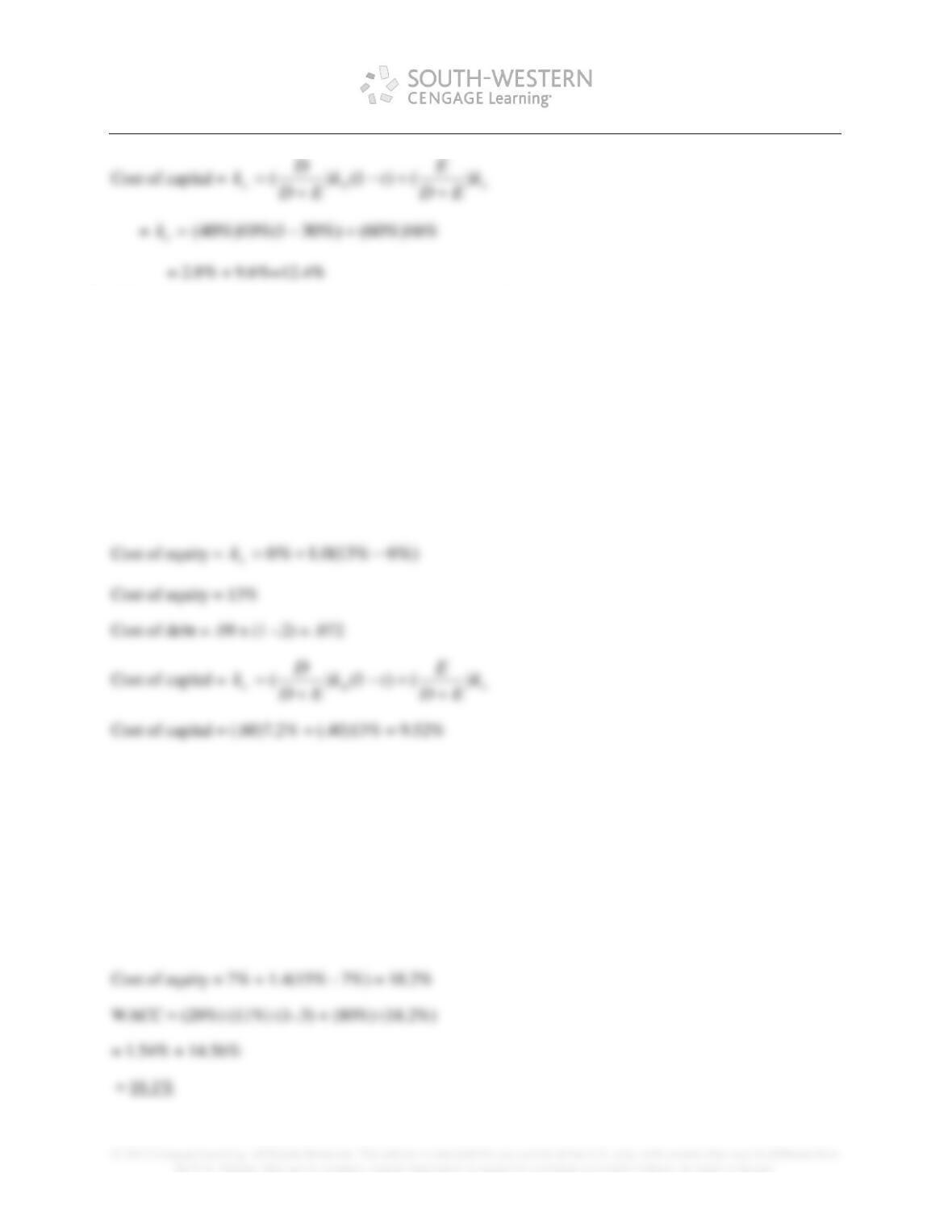
ANSWER:
27. Measuring the Cost of Capital. Messan Co. (a U.S. firm) borrows U.S. funds at an interest rate of 10
percent per year. Its beta is 1.0. The long-term annualized risk-free rate in the U.S. is 6 percent. The stock
market return in the U.S. is expected to be 16 percent annually. Messan’s target capital structure is 40
percent debt and 60 percent equity. Messan Co. is subject to a 30% corporate tax rate. Estimate the cost
of capital to Messan Co.
ANSWER:
Multinational Cost of Capital and Capital Structure 13
28. MNC’s Cost of Capital. Sandusky Co. is based in the U.S. About 30% of its sales are from exports to
Portugal. Sandusky Co. has no other international business. It finances its operations with 40% equity
and the remainder of funds with dollar-denominated debt. It borrows its funds from a U.S. bank at an
interest rate of 9 percent per year. The long-term risk-free rate in the U.S. is 6 percent. The long-term
risk-free rate in Portugal is 11 percent. The stock market return in the U.S. is expected to be 13 percent
annually. Sandusky’s stock price typically moves in the same direction and by the same degree as the
U.S. stock market. Its earnings are subject to a 20% corporate tax rate.
Estimate the cost of capital to Sandusky Co.
ANSWER:
Cost of equity =
)( fmfe RRBRk
29. MNC’s Cost of Capital. Slater Co. is a U.S.-based MNC that finances all operations with debt and
equity. It borrows U.S. funds at an interest rate of 11 percent per year. The long-term risk-free rate in the
U.S. is 7 percent. The stock market return in the U.S. is expected to be 15 percent annually. Slater’s beta
is 1.4. Its target capital structure is 20 percent debt and 80 percent equity. Slater Co. is subject to a 30%
corporate tax rate. Estimate the cost of capital to Slater Co.
ANSWER:
Cost of debt = 11%
14 Multinational Cost of Capital and Capital Structure
30. Change in Cost of Capital. Assume that the parent of Naperville Co. will use equity to finance a
project in Switzerland, while the parent of Lombard Co. will rely on a dollar-denominated loan finance a
project in Switzerland, and Addison Co. will rely on a Swiss franc-denominated loan to finance a project
in Switzerland. The firms will arrange their financing in one month. This week, the U.S. risk-free long-
term interest rate declined, but interest rates in Switzerland did not change. Do you think the estimated
cost of capital for the projects by each of these 3 U.S. firms increased, decreased, or remained unchanged
? Explain.
31. Cost of Equity. Illinois Co. is a U.S. firm that plans to expand its business overseas. It plans to use
all equity to be obtained in the U.S. to finance a new project. The project’s cash flows are not affected by
U.S. interest rates. Just before Illinois Co. obtains new equity, the risk-free interest rate in the U.S. rises.
Will the change in interest rates increase, decrease, or have no effect on the required rate of return on the
project. Briefly explain.
ANSWER: An all-equity capital structure will allow the parent to have a higher cost of capital and a
Solution to Continuing Case Problem: Blades, Inc.
1. If Blades expands into Thailand, do you think its cost of capital will be higher or lower than the cost
of capital of roller blade manufacturers operating solely in the United States? Substantiate your
answer by outlining how Blades’ characteristics distinguish it from domestic roller blade
manufacturers.
ANSWER: Blades’ cost of capital will probably be higher than the cost of capital of roller blade
Multinational Cost of Capital and Capital Structure 15
2. According to the CAPM, how would Blades’ required rate of return be affected by an expansion into
Thailand? How do you reconcile this result with your answer to question 1? Do you think Blades
should use the required rate or return resulting from the CAPM to discount the cash flows of the Thai
subsidiary to determine its NPV?
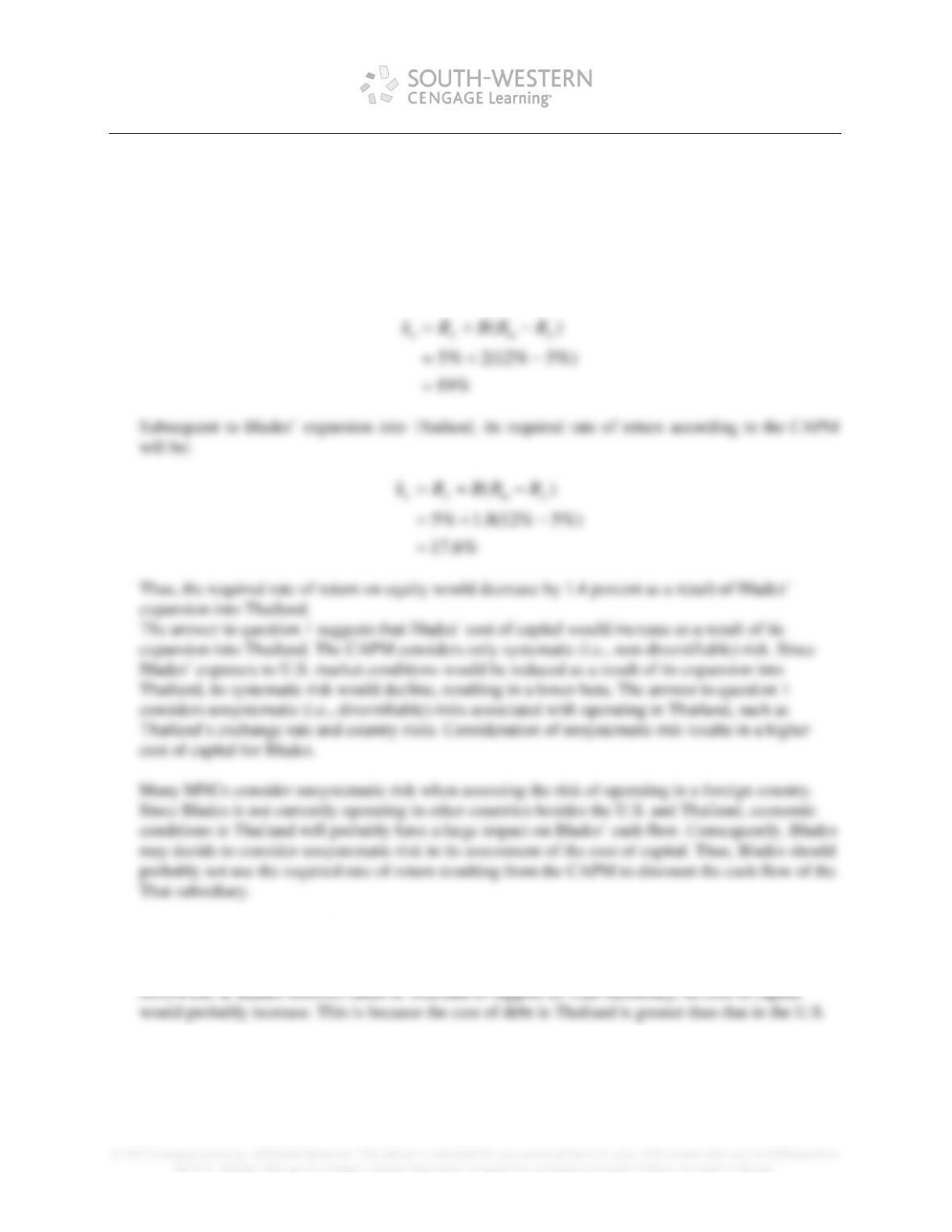
ANSWER: Before Blades’ expansion into Thailand, its required rate of return according to the
CAPM was:
3. If Blades borrows funds in Thailand to support its Thai subsidiary, how would this affect its cost of
capital? Why?
4. Given the high level of interest rates in Thailand, the high level of exchange rate risk, and the high
(perceived) level of country risk, do you think Blades will be more or less likely to use debt in its
capital structure as a result of its expansion into Thailand? Why?
16 Multinational Cost of Capital and Capital Structure
ANSWER: Given the high levels of interest rates, exchange rate risk, and (perceived) country risk in
Solution to Supplemental Case: Sabre Computer Corporation
a. The cost of financing is composed of a risk-free rate and a risk premium. The Mexican joint venture
would likely have a higher risk-free rate since its inflation rate is usually much higher than
Hungary’s. The risk premium should probably be higher on the Hungarian venture because there is
more uncertainty about the revenue to be generated from that venture. However, the advantage on
the risk premium for the Mexican venture will be overwhelmed by the disadvantage on the risk-free
rate. Overall, the cost of financing the Mexican project will be higher.
c. If the debt is backed by the parent, the creditors may be less inclined to charge a high risk premium.
Multinational Cost of Capital and Capital Structure 17
Small Business Dilemma
Multinational Capital Structure Decision at the Sports Exports Company
1. What is an advantage of using equity to support the subsidiary? What is a disadvantage?
ANSWER: An advantage is that retained earnings may be a relatively low-cost method of financing.
2. If Jim decided to use long-term debt as its primary form of capital to support this subsidiary, should
he use dollar-denominated debt or pound-denominated debt?
ANSWER: Jim should use pound-denominated debt, because this creates a cash outflow on interest
3. How can the equity proportion of this firm’s capital structure increase over time after it is more
established?
ANSWER: It will generate earnings that can be retained and reinvested as an equity investment in
the firm.