Assumptions Values
Face amount of sale € 700,000
Maturity, days 90
Problem 16.1 Nikken Microsystems (A)
Assume Nikken Microsystems has sold Internet servers to Telecom España for €700,000. Payment
is due in 3 months and will be made with a trade acceptance from Telecom España Acceptance. The
acceptance fee is 1.0% per annum of the face amount of the note. This acceptance will be sold at a
4% per annum discount. What is the annualized percentage all-in-cost in euros of this method of
trade financing?
Assumptions Values
Face amount of sale € 700,000
a. What are the US dollar proceeds received at once?
Face amount of the receivable € 700,000
Less trade acceptance fee (1,750)
b. What are the dollar proceeds received in 3 months under alternative 2?
Face amount of the receivable € 700,000
Less trade acceptance fee (1,750)
c. Breakeven reinvestment rate
US dollars received now, part a) 698,250$
d. Which alternative should Nikken Microsystems choose?
If Nikken Microsystems’ opportunity cost of capital is 8%, it should be indifferent financially
Problem 16.2 Nikken Microsystems (B)
Assume that Nikken Microsystems prefers to receive U.S. dollars rather than euros for the trade
transaction described in problem 1. It is considering two alternatives:1) It can sell the acceptance for
euros at once and convert the euros immediately to U.S. dollars at the spot rate of exchange of $1.00/€;
or 2) It can hold the euro acceptance until maturity but at the start sell the expected euro proceeds
forward for dollars at the 3-month forward rate of $1.02/€.
d. Which alternative should Nikken Microsystems choose?
a. What are the U.S. dollar net proceeds received at once from the discounted trade acceptance in
alternative 1?
b. What are the U.S. dollar net proceeds received in 3 months in alternative 2?
c. What is the breakeven investment rate that would equalize the net U.S. dollar proceeds from both
alternatives?
Assumptions Values
Value of shipment 3,000,000$
All-in-cost of Bankers’ Acceptance
Face amount of bankers’ acceptance 3,000,000.00$
Less acceptance fee for 6-month maturity (26,250.00)
Problem 16.3 Motoguzzie (A)
Motoguzzie exports large-engine motorcycles (greater than 700cc) to Australia and invoices its
customers in U.S. dollars. Sydney Wholesale Imports has purchased $3,000,000 of merchandise
from Motoguzzie, with payment due in 6 months. The payment will be made with a bankers’
acceptance issued by Charter Bank of Sydney at a fee of 1.75% per annum. Motoguzzie has a
weighted average cost of capital of 10%. If Motoguzzie holds this acceptance to maturity, what is its
annualized percentage all-in cost?
Assumptions Values
Value of shipment 3,000,000$
All-in-Cost of Bankers’ Acceptance
Face amount of bankers’ acceptance 3,000,000.00$
Less acceptance fee for 6-month maturity (26,250.00)
Problem 16.4 Motoguzzie (B)
Assuming the facts in problem 3, Bank of America is now willing to buy Motoguzzie’s bankers’
acceptance for a discount of 6% per annum. What would be Motoguzzie’s annualized percentage all-
in-cost of financing its $3,000,000 Australian receivable?
Assumptions Values
Face amount of sale (first payment of 5) 200,000$
All-in-Cost of Trade Acceptance
Face amount of sale 200,000.00$
Less cash down-payment (40,000.00)
a. Annualized percentage all-in-cost (AIC) 5.128%
(acceptance fee + discount) / (amount received) x (360/180)
a. What is the annualized percentage all-in-cost to Nakatomi Toyota?
b. What are Nakatomi’s net cash proceeds, including the cash down payment?
Problem 16.5 Nakatomi Toyota
NakatomiToyota buys its cars from Toyota Motors-USA, and sells them to U.S. customers. One of
its customers is EcoHire, a car rental firm which buys cars from Nakatomi Toyota at a wholesale
price. Final payment is due to Nakatomi Toyota in 6 months. EcoHire has bought $200,000 worth of
cars from Nakatomi, with a cash down payment of $40,000 and the balance due in 6 months without
any interest charged as a sales incentive. Nakatomi Toyota will have the EcoHire receivable
accepted by Alliance Acceptance for a 2% fee, and then sell it at a 3% per annum discount to Wells
Fargo Bank.
Assumptions Values
Face amount of the note due March 1, 2011 issued by Kaduna 200,000$
What is the all-in-cost of forfaiting?
Face amount of note 200,000$
Annualized all-in-cost of factoring 11.000%
( total interest and fee costs / face amount of note )
b. What might motivate Umaru Oil to use this relatively expensive alternative for financing?
The promissory notes issued by Umaru Oil will be endorsed by their bank, Lagos City Bank, for
a 1% fee and delivered to Gunslinger Drilling. At this point Gunslinger Drilling will endorse the
notes without recourse and discount them with the forfaiter, Bank of Zurich, receiving the full
$200,000 principal amount. Bank of Zurich will sell the notes by re-discounting them to investors in
the international money market without recourse. At maturity the investors holding the notes will
present them for collection at Lagos City Bank. If Lagos City Bank defaults on payment, the
investors will collect on the notes from Bank of Zurich.
a. What is the annualized percentage all-in-cost to Umaru Oil of financing the first $200,000 note
due March 1, 2011?
Problem 16.6 Forfaiting at Umaru Oil (Nigeria)
Umaru Oil of Nigeria has purchased $1,000,000 of oil drilling equipment from Gunslinger Drilling
of Houston, Texas. Umaru Oil must pay for this purchase over the next 5 years at a rate of $200,000
per year due on March 1st of each year.
Bank of Zurich, a Swiss forfaiter, has agreed to buy the 5 notes of $200,000 each at a discount.
The discount rate would be approximately 8% per annum based on the expected 3-year LIBOR rate
plus 200 basis points, paid by Umaru Oil. Bank of Zurich also would charge Umaru Oil an
additional commitment fee of 2% per annum from the date of its commitment to finance until receipt
of the actual discounted notes issued in accordance with the financing contract. The $200,000
promissory notes will come due on March 1st in successive years.
Problem 16.7 Sunny Coast Enterprises (A)
a. What are the annualized percentage all-in-costs of each alternative?
b. What are the advantages and disadvantages of each alternative?
c. Which alternative would you recommend?
Assumptions Values
Face amount of receivable 100,000$
Alternative 1: Bank Credit Line
Face amount of receivable 100,000$
Less bank interest expense on receivable (3,250)
Alternative 2: Bank Credit Line + Export Credit Insurance
Face amount of receivable 100,000$
Sunny Coast Enterprises has sold a combination of films and DVDs to Hong Kong Media
Incorporated for US$100,000, with payment due in 6 months. Sunny Coast Enterprises has the
following alternatives for financing this receivable: 1) Use its bank credit line. Interest would be at
the prime rate of 5% plus 150 basis points per annum. Sunny Coast Enterprises would need to
maintain a compensating balance of 20% of the loan’s face amount. No interest will be paid on the
compensating balance by the bank; or 2) Use its bank credit line but purchase export credit
insurance for a 1% fee. Because of the reduced risk, the bank interest rate would be reduced to 5%
per annum without any points.
Assumptions Values
Face amount of receivable 100,000$
a. What is the annualized all-in-cost of factoring?
Face amount of receivable 100,000$
b. What are the advantages and disadvantages of the factoring alternative compared to the
alternatives in Sunny Coast Enterprises (A)?
Problem 16.8 Sunny Coast Enterprises (B)
Sunny Coast Enterprises has been approached by a factor that offers to purchase the Hong Kong
Media Imports receivable at a 16% per annum discount plus a 2% charge for a non-recourse clause.
a. What is the annualized percentage all-in-cost of this factoring alternative?
Assumptions Values
Principal of note 100,000$
All-in-cost to Whatchamacallit:
Face amount of note 100,000$
Less acceptance fee (500)
Problem 16.9 Whatchamacallit Sports (A)
Phang’s bank issues a letter of credit on behalf of Phang and agrees to accept Whatchamacallit’s
Whatchamacallit Sports (Whatchamacallit) is considering bidding to sell $100,000 of ski equipment
to Phang Family Enterprises of Seoul, Korea. Payment would be due in 6 months. Since
Whatchamacallit cannot find good credit information on Phang, Whatchamacallit wants to protect
its credit risk. It is considering the following financing solution.
Problem 16.10 Whatchamacallit Sports (B)
a. What is Whatchamacallit’s annualized percentage all-in-cost of financing?
b. What are Phang’s costs?
Assumptions Values
Principal of note 100,000$
a. All-in-cost to Whatchamacallit: Values
Face amount 100,000$
Annualized all-in-cost of factoring 9.424%
( total interest and fee costs / net proceeds ) x (360/term of note)
b. What is the cost ot Phang?
c. What are the advanatges and disadvantages of this alternative?
Whatchamacallit could also buy export credit insurance from FCIA for a 1.5% premium. It finances the
$100,000 receivable from Phang from its credit line at 6% per annum interest. No compensating bank
balance would be required.
The cost of using its credit line would cost Whatchamacallit 9.42% compared to only 3.05% with the
c. What are the advantages and disadvantages of this alternative compared to the bankers’ acceptance
financing in Whatchamacallit (A)? Which alternative would you recommend?
Breweries will receive the face amount of $720,000. The present value of
$720,000 received 90 days hence, discounted at Inca’s WACC of 20% per
Problem 16.11 Inca Breweries of Peru
Assumptions Values
Invoice 720,000$
Alternative 1 Values
Alternative 2 Values
Inca Breweries can sell the banker’s acceptance in today’s money market at an 8% per annum discount:
Difference between alternatives (11,245.71)$
Analysis
If Inca Breweries holds the draft for 90 days after the bank accepts it, Inca
The current discount rate on three-month banker’s acceptances is 8% per annum, and Inca Breweries
estimates its weighted average cost of capital to be 20% per annum. The commission for selling a
banker’s acceptance in the discount market is 1.2% of the face amount.
(i.e., $685,714.29) discounted at Inca’s WACC. Inca should sell the acceptance in today’s banker’s
acceptance market and take the cash at once.
The amount of cash received today (i.e., $696,960) is greater than the present value of the full $720,000
Inca Breweries of Lima, Peru, has received an order for 10,000 cartons of beer from Alicante Importers
of Alicante, Spain. The beer will be exported to Spain under the terms of a letter of credit issued by a
Madrid bank on behalf of Alicante Importers. The letter of credit specifies that the face value of the
shipment, $720,000, will be paid 90 days later after the Madrid bank accepts a draft drawn by Inca
Breweries in accordance with the terms of the letter of credit.
How much cash will Inca Breweries receive from the sale if it holds the acceptance until maturity? Do
you recommend that Inca Breweries hold the acceptance until maturity or discount it at once in the U.S.
banker’s acceptance market?
Problem 16.12 Swishing Shoe Company
b. Does Swishing Shoe Company incur any other risks in this transaction?
accepted it, Swishing Footware will received the face amount of £400,000. The
present value of £400,000 received 120 days hence, discounted at Swishing’s
WACC of 18% per annum (6% for 120 days) is £377,358.49.
Assumptions Values
Face value of the shipment £400,000.00
Alternative 1 Values
Alternative 2 Values
Difference between alternatives £1,358.49
Analysis
Point 1. Swishing‘s gain should be calculated in present value terms. Swishing will receive £376,000
Point 2. In this transaction Swishing has assumed the foreign exchange transaction risk; that is, the risk
that the pounds sterling to be received from the export will be worth fewer dollars when received. In part
Swishing Shoe Company of Durham, North Carolina, has received an order for 50,000 cartons of athletic
shoes from Southampton Footware, Ltd., of England, payment to be in British pounds sterling. The shoes
will be shipped to Southampton Footware under the terms of a letter of credit issued by a London bank
on behalf of Southampton Footware. The letter of credit specifies that the face value of the shipment,
£400,000, will be paid 120 days after the London bank accepts a draft drawn by Southampton Footware
in accordance with the term of the letter of credit.
The current discount rate in London on 120-day bankers’ acceptances is 12% per annum, and
Southampton Footware estimates its weighted average cost of capital to be 18% per annum. The
commission for selling a banker’s acceptance in the discount market is 2.0% of the face amount.
If Southampton Footware holds the draft for 120 days after the bank has
Swishing Shoes can sell the banker’s acceptance in today‘s London money
market at a 12% per annum discount:
a. Would Swishing Shoe Company gain by holding the acceptance to maturity, as compared to
discounting the bankers’ acceptance at once?
Problem 16.13 Going Abroad
If Swishing decides to open a plant and manufacture in Ireland, the following factors must be considered:
1. Corporate income tax rates in Ireland and the United States.
Assume that Great Britain charges a duty of 10% on shoes imported into the United Kingdom. Swishing Shoe
Company, in Problem 12, discovers that it can manufacture shoes in Ireland and import them into Britain free of
any import duty. What factors should Swishing consider in deciding to continue to export shoes from North
Carolina versus manufacture them in Ireland?
7. The possibility that valuable technology of a proprietary nature would be stolen. (This might seem unlikely in
the Irish British context, but for other countries it could be a significant factor.)
Such a list as above cannot possibly identify all the subjective factors that might go into a decision to invest
rather than export, but it provides a starting point for consideration of the global strategy of a firm.
terrorist attack on the Twin Towers in New York and the Pentagon, it might encounter a sharp rise in air freight
rates afterward. Terrorists attacks and their aftermath can not be easily predicted, but success of a foreign
manufacturing venture versus exporting must consider the possibility of any kind of unpredictable structural
2. Present and possible future changes in shipping costs. (If Swishing had been using air freight before the
there. The cost of manufacturing shoes in Ireland will depend both on the volume for which that plant is designed
and the percent of capacity expected to be used in the near future.
3. Expected production volume in Ireland relative to the designed manufacturing capacity of the new factory
potential workers.
5. The existence, or nonexistence, of excess capacity in the North Carolina factory, both at present and in terms
of expected future growth.
6. The political risk of investing in Ireland for the British market, should the type of political terrorism and anti-
British feelings currently in Northern Ireland spread to the Republic of Ireland itself.
on such banker’s acceptances as it now might be incurring. Alternatively, Swishing would avoid waiting 120 days
for its cash and undertaking the associated translation risk. Note that the solution to problem 2, above, in which
Swishing found it advantageous to wait 120 days for the cash is unique to that moment in time. A week or a
month later discount rates might change and the alternative would then be preferable.
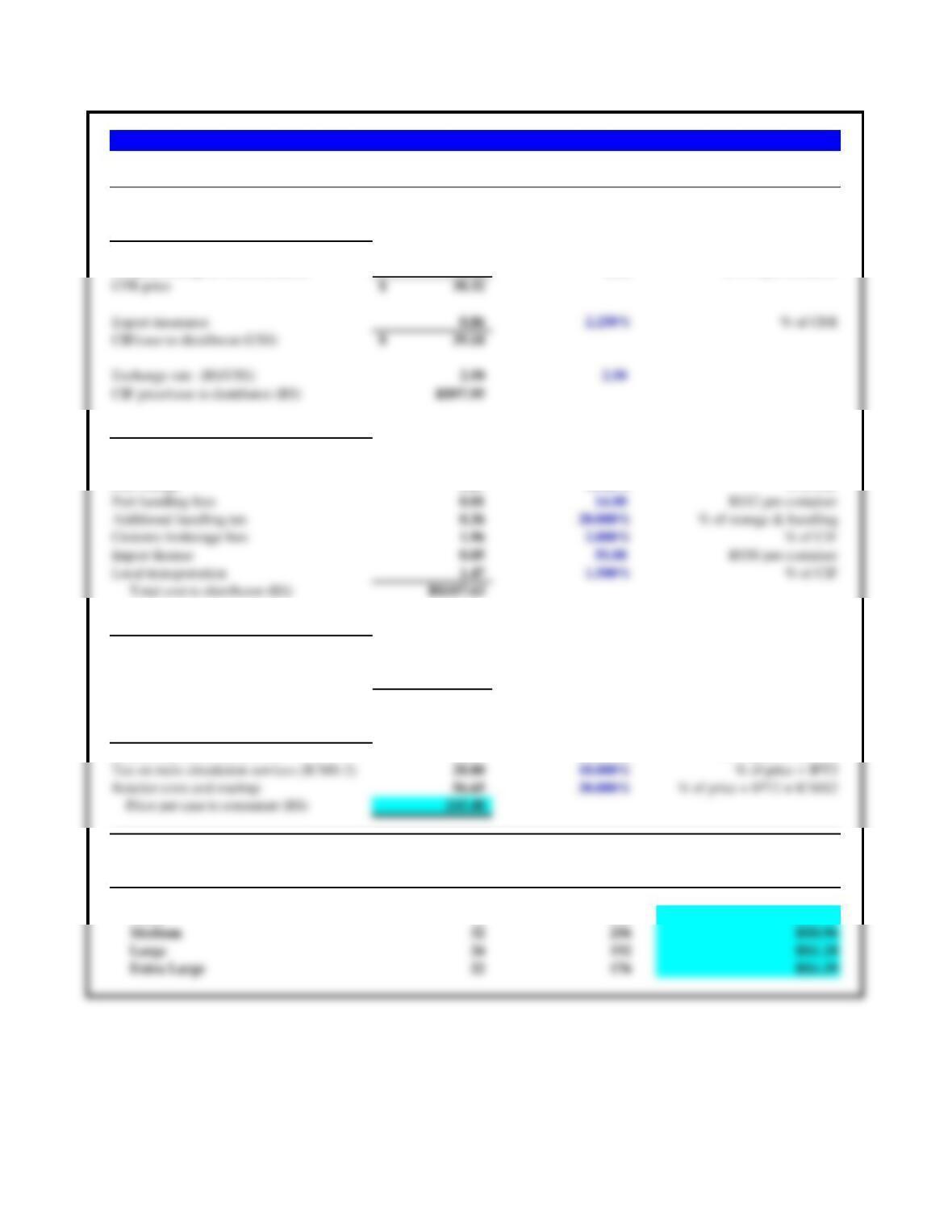
Price / case Rate Calculation
Cases per container 968
Export to Brazil Costs & Pricing
FOB price per case (US$) 34.00$
Freight, loading, & documentation 4.32 4180 $4180 per container
Brazilian Importation Costs
Import duties (ID) 1.96 2.000% % of CIF
Merchant marine renovation fee (MMRF) 2.70 25.00% % of freight
Port storage 1.27 1.300% % of CIF
Distributor’s Costs & Pricing
Storage cost 1.47 1.500% % of CIF * months
Cost of financing diaper inventory 6.86 7.000% % of CIF * months
Distributor’s margin 23.19 20.000% % of Price + storage + cc
Price to retailer (R$) 139.15
Brazilian Retailer Costs & Pricing
Industrial product tax (IPT-2) 20.87 15.000% % of price to retailer
DIAPER PRICES Bags of 8 Diapers per Price to Consumer
per case case (R$/diaper)
Small 44 352 R$0.70
Mini-Case: Crosswell International’s Precious Ultra-Thin Diapers