
Chapter 15
International Corporate Governance and Control
Lecture Outline
International Corporate Governance
Governance by Board Members
Governance by Institutional Investors
Governance by Shareholder Activists
International Corporate Control
Motives for International Acquisitions
International Acquisition Process
Barriers to International Corporate Control
Model for Valuing a Foreign Target
Factors Affecting a Target Valuation
Target-Specific Factors
Country-Specific Factors
Case Study of Valuing a Foreign Target
International Screening Process
Disparity in Foreign Target Valuations
Expected Cash Flows of the Foreign Target
Exchange Rate Effects on Remitted Earnings
Required Return of Acquirer
Other Corporate Control Decisions
International Partial Acquisitions
International Acquisitions of Privatized Businesses
International Divestitures
Control Decisions as Real Options
Call Option on Real Assets
Put Option on Real Assets
International Corporate Governance and Control ❖ 2
Chapter Theme
This chapter emphasizes how an MNC can be subject to governance. The potential for corporate control
can encourage MNC managers to maximize value for their shareholders and may allow for opportunities
to expand internationally or to reduce international operations.
Topics to Stimulate Class Discussion
1. Why are MNCs subject to corporate control?
2. How should MNCs determine whether multinational restructuring is worthwhile?
POINT/COUNTER-POINT:
Can a Foreign Target Be Assessed Like Any Other Asset?
POINT: Yes. The value of a foreign target to an MNC is the present value of the future cash flows to the
MNC. The process of estimating a foreign target’s value is the same as the process of estimating a
machine’s value. A target has expected cash flows, which can be derived from information about previous
cash flows.
COUNTER-POINT: No. A target’s behavior will change after it is acquired by an MNC. Its efficiency
may change depending on the ability of the MNC to integrate the target with its own operations. The
morale of the target employees could either improve or worsen after the acquisition, depending on the
treatment by the acquirer. Thus, a proper estimate of cash flows generated by the target must consider the
changes in the target due to the acquisition.
WHO IS CORRECT? Use the Internet to learn more about this issue. Which argument do you support?
Offer your own opinion on this issue.
Answers to End of Chapter Questions
1. Motives for Restructuring. Why do you think MNCs continuously assess possible forms of
multinational restructuring, such as foreign acquisitions or downsizing of a foreign subsidiary?
2. Exposure to Country Regulations. Maude Inc., a U.S.-based MNC, has recently acquired a firm in
Singapore. To eliminate inefficiencies, Maude downsized the target substantially, eliminating two-
thirds of the workforce. Why might this action affect the regulations imposed on the subsidiary’s
business by the Singapore government?
International Corporate Governance and Control ❖ 3
© 2021 Cengage Learning. All Rights Reserved. May not be copied, scanned, or duplicated, in whole or in part, except for use as
permitted in a license distributed with a certain product or service or otherwise on a password-protected website for classroom use.
ANSWER: One of the benefits of direct foreign investment from a host government’s viewpoint is the
potential reduction of unemployment. If a U.S.-based MNC such as Maude contributes to growing
unemployment in the host country, the government may impose special taxes or requirements that
would render further expansion in Singapore undesirable.
3. Global Expansion Strategy. Poki Inc., a U.S.-based MNC, is considering expanding into Thailand
because of decreasing profit margins in the U.S. The demand for Poki’s product in Thailand is very
strong. However, forecasts indicate that the baht is expected to depreciate substantially over the next
three years. Should Poki expand into Thailand? What factors may affect its decision?
ANSWER: Poki faces a tradeoff. Demand for its product in Thailand is very strong, while it is
deteriorating in the U.S. However, the baht is expected to depreciate substantially, which would
4. Valuation of a Private Target. Rastell, Inc., a U.S.-based MNC, is considering the acquisition of
a Russian target to produce tablet computers and market them throughout Russia, where demand for
tablets has increased substantially in recent years. Assume that the stock prices of most Russian
companies rose substantially just prior to Rastell’s assessment of the target. If Rastell Inc. acquires a
private target in Russia, will it be able to avoid the impact of the high stock prices on business
valuations in Russia?
5. Comparing International Projects. Savannah, Inc., a manufacturer of clothing, wants to increase its
market share by acquiring a target producing a popular clothing line in Europe. This clothing line is
well established. Forecasts indicate that the euro will remain relatively stable over the life of the
project. Marquette, Inc., wants to increase its market share in the tablet computer market by acquiring
a target in Thailand that currently produces radios and converting the operations to produce tablests.
Forecasts indicate that the baht will depreciate over the life of the project. Funds resulting from both
Savannah’s and Marquette’s projects will be remitted to the respective U.S. parent on a regular basis.
Which target do you think will result in a higher net present value? Why?
International Corporate Governance and Control ❖ 5
(numbers are in millions)
Year 1 Year 2 Year 3
Revenue MYR200 MYR216 MYR233.3
Tax (35%) MYR17.5 MYR20.3 MYR23.3
Earnings After Taxes MYR32.5 MYR37.7 MYR43.4
Sale of Firm MYR300
Cash Flows in MYR MYR45.5 MYR50.7 MYR356.4
b. Will Blore Inc. be able to acquire the Malaysian target for a price lower than its valuation of the
target?
ANSWER: The Malaysian target’s shares are presently valued at MYR30 per share. Thus, the 9
8. Uncertainty Surrounding a Foreign Target. Refer to question 7. What are some of the key sources of
uncertainty in Blore’s valuation of the target? Identify two reasons why the expected cash flows from an
Asian subsidiary of a U.S.-based MNC would be lower as if Asia experienced a new economic crisis.
ANSWER: There is much uncertainty regarding the assumptions employed. For example, the growth
International Corporate Governance and Control ❖ 7
depreciate from its current level of $.033 to $.028 next year and to $.025 in the following year. Senser
could sell the subsidiary today for 5 million rubles to a potential acquirer. If Senser continues to
operate the subsidiary, it will generate cash flows of 3 million rubles next year and 4 million rubles in
the following year. These cash flows would be remitted back to the parent in the U.S. The required
rate of return of the project is 16 percent. Should Senser continue operating the Russian subsidiary?
ANSWER:
End of Year 2 End of Year 3 End of Year 4
Rubles remitted 3,000,000 4,000,000
13. Divestiture Decision. Colorado Springs Co. plans to divest either its Singapore subsidiary or its
Canadian subsidiary. Assume that if exchange rates remain constant, the dollar cash flows that each
of these subsidiaries would provide to the parent over time would be somewhat similar. However, the
company expects the Singapore dollar to depreciate against the U.S. dollar, and the Canadian dollar to
appreciate against the U.S. dollar. The firm can sell either subsidiary for about the same price today.
Which one should it sell?
14. Divestiture Decision. San Gabriel Corp. recently considered divesting its Italian subsidiary but
determined that the divestiture was not feasible. The required rate of return on this subsidiary was 17
percent. In the last week, San Gabriel’s required return on that subsidiary increased to 21 percent. If
the sales price of the subsidiary has not changed, explain why the divestiture may now be feasible.
15. Divestiture Decision. Ethridge Co. of Atlanta, Georgia has a subsidiary in India that produces
products and sells them throughout Asia. In response to the September 11, 2001 terrorist attacks on
the U.S., Ethridge Co. decided to conduct a capital budgeting analysis to determine whether it should
divest the subsidiary. Why might this decision be different after the attack as opposed to before the
attacks? Describe the general method for determining whether the divestiture is financially feasible.
© 2021 Cengage Learning. All Rights Reserved. May not be copied, scanned, or duplicated, in whole or in part, except for use as
permitted in a license distributed with a certain product or service or otherwise on a password-protected website for classroom use.
16. Feasibility of a Divestiture. Merton Inc. has a subsidiary in Bulgaria that it fully finances with its
own equity. Last week, a firm offered to buy the subsidiary from Merton Inc. for $60 million in cash
and the offer is still available this week as well. The annualized long-term risk-free rate in the U.S.
increased from 7% to 8% this week. The monthly cash flows expected to be generated by the
subsidiary have not changed since last week. The risk premium that Merton Inc. applies to its projects
in Bulgaria was reduced from 11.3% to 10.9% this week. The annualized long-term risk-free rate in
Bulgaria declined from 23% to 21% this week. Would the NPV to Merton Inc. from divesting this
unit be more or less than the NPV determined last week? Why? [No analysis is necessary, but make
sure that your explanation is very clear.]
17. Accounting for Government Restrictions. Sunbelt Inc. plans to purchase a firm in Indonesia. It
believes that it can install its operating procedure in this firm, which would significantly reduce the
firm’s operating expenses. However, the Indonesian government may approve the acquisition only if
Sunbelt does not lay off any workers. How can Sunbelt possibly increase efficiency without laying
off workers? How can Sunbelt account for the Indonesian government’s position as it assesses the
NPV of this possible acquisition?
18. Foreign Acquisition Decision. Florida Co. produces software. Its primary business in Boca
Raton is expected to generate cash flows of $4,000,000 at the end of each of the next 3 years, and
expects that it could sell this business for $10 million (after accounting for capital gains taxes) at the
end of 3 years. Florida Co. also has a side business in Pompano Beach that takes the software created
in Boca Raton and exports it to Europe. As long as the side business distributes this software to
Europe, it is expected to generate $2 million in cash flows at the end of each of the next three years.
This side business in Pompano Beach is separate from Florida’s main business.
Recently, Florida was contacted by a Ryne Co. in Europe which specializes in distributing software
throughout Europe. If Florida acquires Ryne Co., it would rely on Ryne instead of its side business to
sell its software in Europe, because Ryne could easily reach all of Florida Company’s existing
European customers as well as even more potential European customers. By acquiring Ryne, Florida
would be able to sell much more software in Europe than it can sell with its side business, but it has to
determine whether the acquisition would be feasible. The initial investment to acquire Ryne Co.
International Corporate Governance and Control ❖ 9
would be $7 million. Ryne would generate 6 million euros per year in profits and would be subject to
a European tax rate of 40%. All after-tax profits would be remitted to Florida Co. at the end of each
year and the profits would not be subject to any U.S taxes since they were already taxed in Europe.
The spot rate of the euro is $1.10 and Florida Co. believes the spot rate is a reasonable forecast of
future exchange rates. Florida Co. expects that it could sell Ryne Co. at the end of 3 years for 3
million euros (after accounting for any capital gains taxes). Florida Company’s required rate of return
on the acquisition is 20%. Determine the net present value of this acquisition. Should Florida Co.
acquire Ryne Co.?
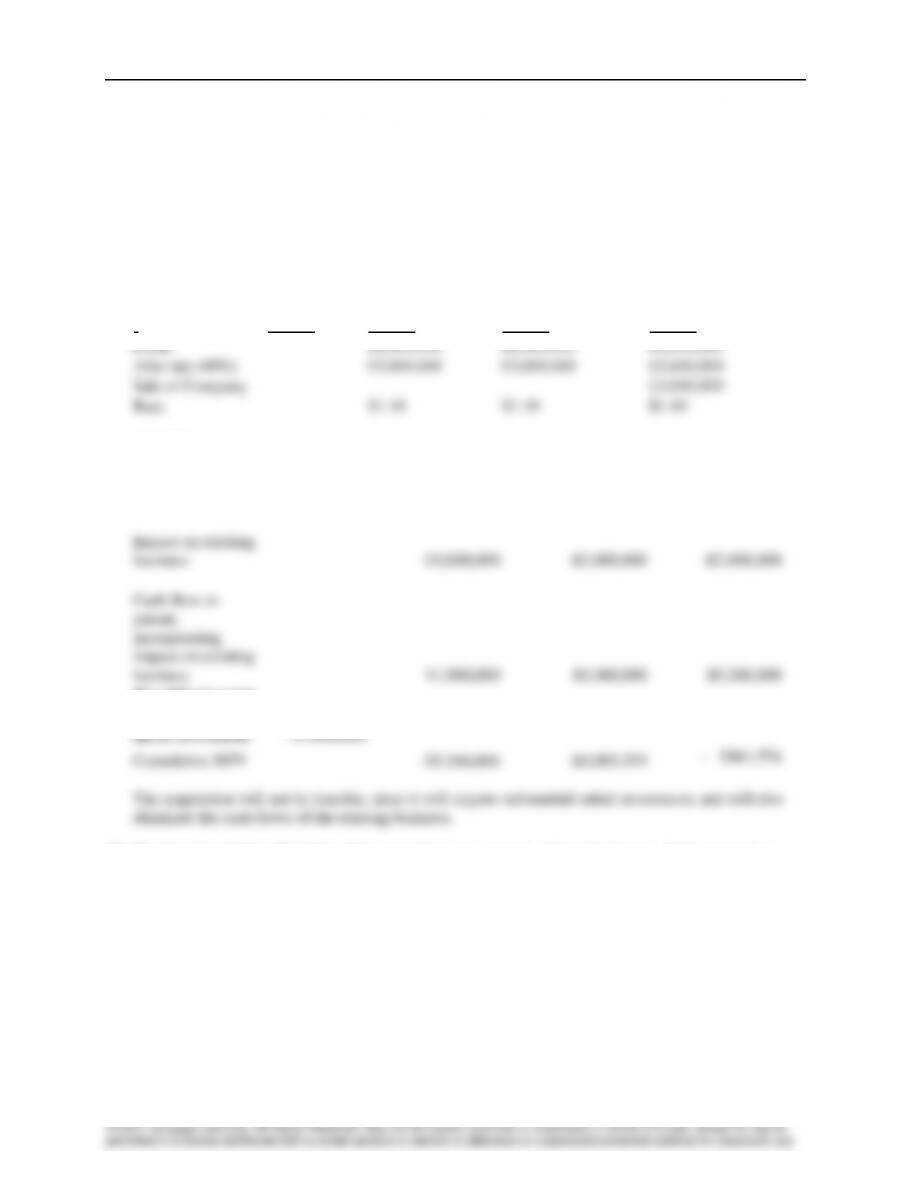
ANSWER:
Year 0
Year 1
Year 2
Year 3
Profit
€6,000,000
€6,000,000
€6,000,000
After tax (40%)
€3,600,000
€3,600,000
€3,600,000
Sale of Company
€3,000,000
Rate
$1.10
$1.10
$1.10
Cash flow to
parent, ignoring
impact on existing
business
$3,960,000
$3,960,000
$7,260,000
Impact on existing
business
-$2,000,000
-$2,000,000
-$2,000,000
Cash flow to
parent,
incorporating
impact on existing
business
$1,960,000
$1,960,000
$5,260,000
PV (20% discount
rate)
$1,633,333
$1,361,111
$3,043,981
Initial Investment
-$7,000,000
Cumulative NPV
-$5,366,666
-$4,005,555
– $961,574
The acquisition will not be feasible, since it will require substantial initial investment, and will also
eliminate the cash flows of the existing business.
19. Foreign Acquisition Decision. Minnesota Company consists of two businesses. Its local business
is expected to generate cash flows of $1,000,000 at the end of each of the next 3 years. It also owns a
foreign subsidiary based in Mexico, whose business is selling technology in Mexico. This business is
expected to generate $2,000,000 in cash flows at the end of each of the next three years. The main
competitor of the Mexican subsidiary is Perez Co., a privately-held firm that is based in Mexico.
Minnesota Company just contacted Perez Co., and wants to acquire it. If it acquires Perez, Minnesota
would merge Perez’s operations with its Mexican subsidiary’s business. The merged operations in
Mexico would be expected to generate a total of $3,000,000 in cash flows at the end of each of the
next 3 years. Perez Co. is willing to be acquired for a price of 40 million pesos. The spot rate of the
Mexican peso is $.10. The required rate of return on this project is 24%. Determine the net present
value of this acquisition by Minnesota Company. Should the company pursue this acquisition?
International Corporate Governance and Control ❖ 10
© 2021 Cengage Learning. All Rights Reserved. May not be copied, scanned, or duplicated, in whole or in part, except for use as
permitted in a license distributed with a certain product or service or otherwise on a password-protected website for classroom use.
ANSWER:
Year 1
Year 2
Year 3
Additional Cashflows from
Acquiring Perez
$1,000,000
$1,000,000
$1,000,000
Required Rate of Return
0.24
0.24
0.24
Present Value of CF
$806,451
$650,364
$524,487
The present value = $806,451 + $650,364 + $534,487 = $1,981,303
NPV = $1,981,303 – $4,000,000 = -$2,018,697
Minnesota should not pursue the acquisition.
20. Decision to Sell a Business. Kentucky Co. has an existing business in Italy that it is trying to sell.
It receives one offer today from Rome Co. for $20 million (after capital gains taxes are paid). Another
Italian company, Venice Co., also wants to buy the business, but will not have the funds to make the
acquisition until 2 years from now. Venice Co. is meeting with Kentucky Co. today to negotiate the
acquisition price that it will pay for Kentucky’s subsidieary in two years. If Kentucky Co. retains the
business for the next two years, it expects that the business would generate 6 million euros per year in
cash flows (after taxes are paid) at the end of each of the next two years, which would be remitted to
the U.S. The euro is presently valued at $1.20 and that rate can be used as a forecast of future spot
rates. Kentucky would only retain the business if it could earn a rate of return of at least 18% by
keeping the firm for the next two years rather than selling it to Rome Co. now. Determine the
minimum price in dollars for which Kentucky should be willing to sell its business (after accounting
for capital gains taxes paid) to Venice Co. in order to satisfy its required rate of return.
ANSWER:
To determine the minimum price in dollars at which Kentucky Co should be willing to sell the
business two years from now, determine the NPV of its operation for the next two years. The
calculations below show the NPV of the future cash flows is $11,272,623.
Year 1
Year 2
Cash flow in euro
€ 6,000,000
€6,000,000
Rate
$1.20
$1.20
Cash flow to the parent
company
$7,200,000
$7,200,000
PV of parent cash flows
(18% discount rate)
$6,101,695
$5,170,928
Cumulative NPV
$11,272,623
Kentucky Co should be willing to sell its business in two years for no less than the difference between
the $20,000,000 offer today and the NPV, with an adjustment for the time value of money:

© 2021 Cengage Learning. All Rights Reserved. May not be copied, scanned, or duplicated, in whole or in part, except for use as
permitted in a license distributed with a certain product or service or otherwise on a password-protected website for classroom use.
21. Foreign Divestiture Decision. Baltimore Co. considers divesting its 6 foreign projects as of
today. Each project will last one year. The company’s required rate of return on each project is the
same. The cost of operations for each project is denominated in dollars and is the same for all six
projects. Baltimore believes that each project will generate the equivalent of $10 million in one year
based on today’s exchange rate. However, each project generates its cash flow in a different currency.
Baltimore believes that interest rate parity (IRP) exists. Baltimore forecasts exchange rates as
explained in the following table.
a. Based on this information, which project will Baltimore be most likely to divest? Why?
b. Based on this information, which project will Baltimore be least likely to divest? Why?
Project
Comparison of one-year U.S.
and foreign Interest rates
Method used to forecast the
spot rate one year from now
Country A
The U.S. interest rate is higher
than country A’s interest rate
Spot rate
Country B
The U.S interest rate is higher
than counntry B’s interest rate
Forward rate
Country C
The U.S. interest rate is the
same as country C’s interest
rate
Forward rate
Country D
The U.S. interest rate is the
same as country D’s interest
rate
Spot rate
Country E
The U.S. interest rate is lower
than country E’s interest rate
Forward rate
Country F
The U.S. interest rate is lower
than country F’s interest rate
Spot rate
ANSWER:
22. Factors that Affect the NPV of a Divestiture. Clemson Co. (a U.S. firm) has a subsidiary in
Germany that generates substantial earnings in euros each year. One week ago, Clemson received an
offer from a company to purchase the German subsidiary, and it has not yet responded to this offer.

International Corporate Governance and Control ❖ 12
a. Since last week, the expected stream of euro cash flows has not changed, but the forecasts of the
euro’s value in future periods have been revised downward. Will the NPV of the divestiture be
larger or smaller or the same as it was last week? Briefly explain.
b. Since last week, the expected stream of euro cash flows has not changed, but the long-term
interest rate in the U.S. has declined. Will the NPV of the divestiture be larger or smaller or the
same as it was last week? Briefly explain.
ANSWER:
23. Impact of Country Perspective on Target Valuation. Targ Co. of the U.S. has been targeted by
3 firms that consider acquiring it: (1) Americo (from the U.S.), Japino (of Japan), and Canzo (of
Canada). These 3 firms do not have any other international business, have similar risk levels, and have
a similar capital structure. Each of the 3 potential acquirers has derived similar expected dollar cash
flow estimates for Targ Co. The long-term risk-free interest rate is 6% in the U.S., 9% in Canada, and
3% in Japan. The stock market conditions are similar in each of the countries. There are no potential
country risk problems that would result from acquiring Targ Co. All potential acquirers expect that the
Canadian dollar will appreciate by 1 percent per year against the U.S. dollar and will be stable against
the Japanese yen. Which firm will likely have the highest valuation of Targ Co.? Explain.
24. Valuation of a Foreign Target. Gaston Co. (a U.S. firm) is considering the purchase of a target
company based in Mexico. The net cash flows to be generated by this target firm are expected to be
300 million pesos at the end of one year. The existing spot rate of the peso is $.14, and the expected
spot rate in one year is $.12. All cash flows will be remitted to the parent at the end of one year. In
addition, Gaston hopes to sell the company for 800 million pesos (after taxes) at the end of one year.
The target has 10 million shares outstanding. If Gaston purchases this target, it would require a 25
percent return. What is the maximum value in pesos per share that Gaston should pay for this target
company today? Show your work.
25. Divestiture of a Foreign Subsidiary. Rudecki Co. (a U.S. firm) has a Polish subsidiary that is
considering divesting. This subsidiary is completely focused on research and development for
Rudecki’s other business. Rudecki has cash outflows (paid in zloty, the Polish currency) for the
laboratories and scientists in Poland. Although the subsidiary does not generate any sales, its research
and development lead to new products and higher sales of products that are solely in the U.S. and are
denominated in dollars. There is no foreign competition. Last week, a firm offered to purchase the
subsidiary for $10 million, and the offer is still available. Today Rudecki has revised its forecasts of
the zloty upward for all future periods. Will today’s adjustment of the exchange rate forecasts
increase, decrease, or have no effect on the net present value of a divestiture of this subsidiary from

International Corporate Governance and Control ❖ 13
Rudecki’s perspective? Briefly explain. [Keep in mind that the NPV of the divestiture is not the same
as the NPV that results from acquiring a project.]
26. Poison Pills and Takeovers. Explain how a foreign target could use poison pills to prevent a
takeover or change the terms of a takeover.
ANSWER: A poison pill does not require the approval of other shareholders so it can be easily
27. Governance of MNCs by Shareholders. Explain the various ways in which large shareholders can
attempt to govern an MNC and improve its management.
28. Divestiture of a Foreign Subsidiary. Ved Co. (a U.S. firm) has a subsidiary in Germany that
generates substantial earnings in euros each year. It will soon decide whether to divest the subsidiary.
One week ago, a company offered to purchase the subsidiary from Ved Co., and Ved has not yet
responded to this offer.
a. Since last week, the expected stream of euro cash flows has not changed, but the forecasts of the
euro’s value in future periods have been revised downward. When deciding whether a divestiture
is feasible, Ved Co. estimates the NPV of the divestiture. Will Ved’s estimated NPV of the
divestiture be larger than, smaller than, or the same as it was last week? Briefly explain.
b. If the long-term interest rate in the U.S. suddenly declines, and all other factors are unchanged, will
the NPV of the divestiture be larger or smaller or the same as it was last week? Briefly explain.
ANSWER:
a. Since the euro is depreciating, then the PVs for the divesture will lower, because the values of the
29. Valuation of a Planned Divestiture. Dallen Co. has a subsidiary in Mexico that does research and
development and produces prescription pills that are transported to and sold in the U.S. The parent
used its own funds to build the subsidiary. Dallen Co. pays for the operations in Mexico in Mexican
pesos, but all of its revenue from selling the pills in the U.S. is in dollars. It has no other international
International Corporate Governance and Control ❖ 14
business. Dallen’s competitors are local firms in the U.S. that have no international operations. Two
days ago, Dallen received an offer from a firm to buy Dallen’s subsidiary, and the offer is in effect for
a few days.
a. Yesterday, an event occurred that makes the parent of Dallen Co. believe that the Mexican peso
will weaken substantially in the future. Do you think the event that occurred yesterday will
increase, decrease, or have no impact on the likelihood that Dallen will accept the offer and sell
its subsidiary at the existing offer price? Briefly explain.
b. Today, an event occurred that caused the risk-free interest rate in the U.S. to increase. Do you
think the event that just occurred today will increase, decrease, or have no impact on the
likelihood that Dallen will accept the offer and sell its subsidiary at the existing offer price?
Briefly explain.
30. Divestiture Decision. Kylee Co. (a U.S. firm) has a British subsidiary that will generate cash flows of
3 million pounds at the end of each of the next two years. It uses the prevailing spot rate of the British
pound of $1.80 as a forecast of the future value of the pound. Its required rate of return on this
business is 16 percent. Kylee just received an offer from a British company that wants to buy the
subsidiary for $8,000,000. Assume that Kylee would not be subject to any tax on the sale.
a. Should Kylee Co. sell the business? Show your work.
ANSWER:
Year 1 Year 2
Expected CF in Pounds 3,000,000 3,000,000
b. Assume that news reports today that causes Kylee to think that the British pound will strengthen
substantially the next two years. Assume the offer price remains unchanged. If Kylee reassesses
whether to divest based on this information, do you think the potential news will increase the net
present value of the divestiture (make the divestiture more beneficial for Kylee), reduce the net

International Corporate Governance and Control ❖ 15
present value of the divestiture, or have no impact on the estimated net present value of the
divestiture? Briefly explain.
c. Assume that today the prevailing long-term U.S. risk-free interest rate decreased, and that this has
no effect on Kylee’s cash flows from operations. Assume the offer price remains unchanged. Do
you think this information about the decline in the U.S. risk-free interest rate will increase the net
present value of the divestiture, reduce the net present value of the divestiture, or have no impact
on the estimated net present value of the divestiture? Briefly explain.
CRITICAL THINKING
Valuation of Foreign Target Companies In 2011, Microsoft acquired Skype (based in Luxembourg)
for approximately $8.5 billion. Write a short essay that describes the general process that Microsoft would
have used to determine how much it was willing to pay for Skype. Some analysts claim that Skype as an
independent company was not worth $8.5 billion, but that it is worth more than $8.5 billion to Microsoft.
Explain this point in your essay.
ANSWER
Solution to Continuing Case Problem: Blades, Inc.
1. Using a spreadsheet, determine the NPV of the acquisition of Skates’n’Stuff. Based on your
numerical analysis, should Blades establish a subsidiary in Thailand or acquire Skates’n’Stuff?
ANSWER: (See spreadsheet attached.) The analysis indicates that the acquisition will result in a net
2. If Blades negotiates with Skates’n’Stuff, what is the maximum amount (in Thai baht) that Blades
should be willing to pay?
ANSWER: If Blades, Inc. were to negotiate with Skates’n’Stuff, it should attempt to pay a price that

International Corporate Governance and Control ❖ 17
Year 0
Year 1
Year 2
Year 3
Year 4
Year 5
Year 6
Year 7
Year 8
Year 9
Year 10
1. Units Sold to Retailers in Thailand
280,000
280,000
280,000
280,000
280,000
280,000
280,000
280,000
280,000
280,000
280,000
2. Price per Unit (in Thai baht)
4,500
5,040
5,645
6,322
7,081
7,931
8,882
9,948
11,142
12,479
13,976
3. Revenue from Sales to Retailers
in Thailand = (1) × (2) (in 000s)
1,260,000
1,411,200
1,580,544
1,770,209
1,982,634
2,220,551
2,487,017
2,785,459
3,119,714
3,494,079
3,913,369
4. Variable Cost per Unit (in Thai baht)
3,500
3,920
4,390
4,917
5,507
6,168
6,908
7,737
8,666
9,706
10,870
5. Total Variable Cost = (1) × (4) (in 000s)
980,000
1,097,600
1,229,312
1,376,829
1,542,049
1,727,095
1,934,346
2,166,468
2,426,444
2,717,617
3,043,731
6. Less Cost Savings from Production
of 108,000 Pairs in Thailand (000s)
32,400
32,400
—
—
—
—
—
—
—
—
—
7. Fixed Operating Expenses (in Thai
baht 000s)
20,000
22,400
25,088
28,099
31,470
35,247
39,476
44,214
49,519
55,462
62,117
8. Noncash Expense (Depreciation in
baht 000s)
60,000
60,000
60,000
60,000
60,000
60,000
60,000
60,000
60,000
60,000
60,000
9. Total Expenses = (5) – (6) + (7) +
(8) (in baht 000s)
1,027,600
1,147,600
1,314,400
1,464,928
1,633,519
1,822,342
2,033,823
2,270,681
2,535,963
2,833,079
3,165,848
10. Before-Tax Earnings of Subsidiary
= (3) – (9) (in baht 000s)
232,400
263,600
266,144
305,281
349,115
398,209
453,194
514,777
583,750
661,000
747,521
11. Host Government Tax (25%) (in 000s)
58,100
65,900
66,536
76,320
87,279
99,552
113,298
128,694
145,938
165,250
186,880
12. After-Tax Earnings of Subsidiary
174,300
197,700
199,608
228,961
261,836
298,657
339,895
386,083
437,813
495,750
560,640
13. Net Cash Flow to Subsidiary =
(12) + (8) (in baht 000s)
234,300
257,700
259,608
288,961
321,836
358,657
399,895
446,083
497,813
555,750
620,640
14. Thai Baht Remitted by Subsidiary
(100% of CF) (in baht 000s)
234,300
257,700
259,608
288,961
321,836
358,657
399,895
446,083
497,813
555,750
620,640
15. Withholding Tax on Remitted
Funds (10%) (in baht 000s)
23,430
25,770
25,961
28,896
32,184
35,866
39,990
44,608
49,781
55,575
62,064
16. Thai Baht Remitted After
Withholding Taxes (in 000s)
210,870
231,930
233,647
260,065
289,653
322,791
359,906
401,475
448,032
500,175
558,576
17. Salvage Value (000s)
1,100,000
18. Exchange Rate of Thai Baht ($)
0.02300
0.02254
0.02209
0.02165
0.02121
0.02079
0.02037
0.01997
0.01957
0.01918
0.01879
19. $ Cash Flow to Parent = (16) × (18)
4,850,010
5,227,702
5,161,080
5,629,732
6,144,827
6,710,882
7,332,857
8,016,198
8,766,879
9,591,461
31,169,086
20. PV of Parent Cash Flows (25%
Discount Rate)
4,850,010
4,182,162
3,303,091
2,882,423
2,516,921
2,199,022
1,922,265
1,681,119
1,470,838
1,287,344
3,346,755
21. Initial $ Investment by Blades
23,000,000
22. Cumulative PV ($ 000s)
(18,150)
(13,968)
(10,665)
(7,782)
(5,265)
(3,066)
(1,144)
537
2,008
3,295
6,642

International Corporate Governance and Control ❖ 18
Solution to Supplemental Case: Redwing Technology Company
a. The earnings performance translated in dollars is misleading because they are distorted by varying
exchange rates. The actual earnings in each local currency in each subsidiary should be assessed,
since the subsidiary has no control over the exchange rate used for translation. The translation causes
earnings to be overstated when the local currency is strong (against the dollar) and understated when
the local currency is weak. The following table shows the earnings of each subsidiary when
measured in the local currency. Based on this table, the Canadian subsidiary experienced a consistent
growth in earnings over time, averaging about a 14 percent increase per year. Conversely, the South
African subsidiary experienced consistent declines in earnings over time, with an average annual
earnings growth rate of –4.38%. The Japanese subsidiary experienced a decline in earnings in all but
one year, and its average annual earnings growth rate was –1.03%. When measured in this way, the
executive in charge of the Canadian subsidiary appears to have achieved the best performance. The
Annual Annual Annual
Years Percentage South Percentage Percentage
Ago Canada Increase Africa Increase Japan Increase
5 C$16.80 — R210.00 — Y7,500.00 —
4 19.92 18.57% 200.00 –4.76% 7,441.86 –.77%
2 25.92 14.28 180.00 –3.74 7,454.54 –2.03
1 28.44 9.72 175.00 –2.78 7,187.50 –3.58
b. Based on its high annual growth rate of earnings, the Canadian subsidiary would likely deserve a cash
infusion from the parent to push for additional growth. The parent would probably feel that its funds
are more likely to generate decent returns there than in other countries.
International Corporate Governance and Control ❖ 19
Small Business Dilemma
Multinational Restructuring by the Sports Exports Company
1. Are there any reasons why the business that has been so successful in the United Kingdom might not
be successful in other European countries?
2. If the business is diversified throughout Europe, will this substantially reduce the Sports Exports
Company’s exposure to exchange rate risk?
3. Now that several countries in Europe participate in a single currency system, will this affect the
performance of new expansion throughout Europe?