Multinational Capital Budgeting ❖ 21
14. NZ$ remitted by sub.
15. Withholding tax imposed on
16. NZ$ remitted after withholding
20. PV of parent cash flows
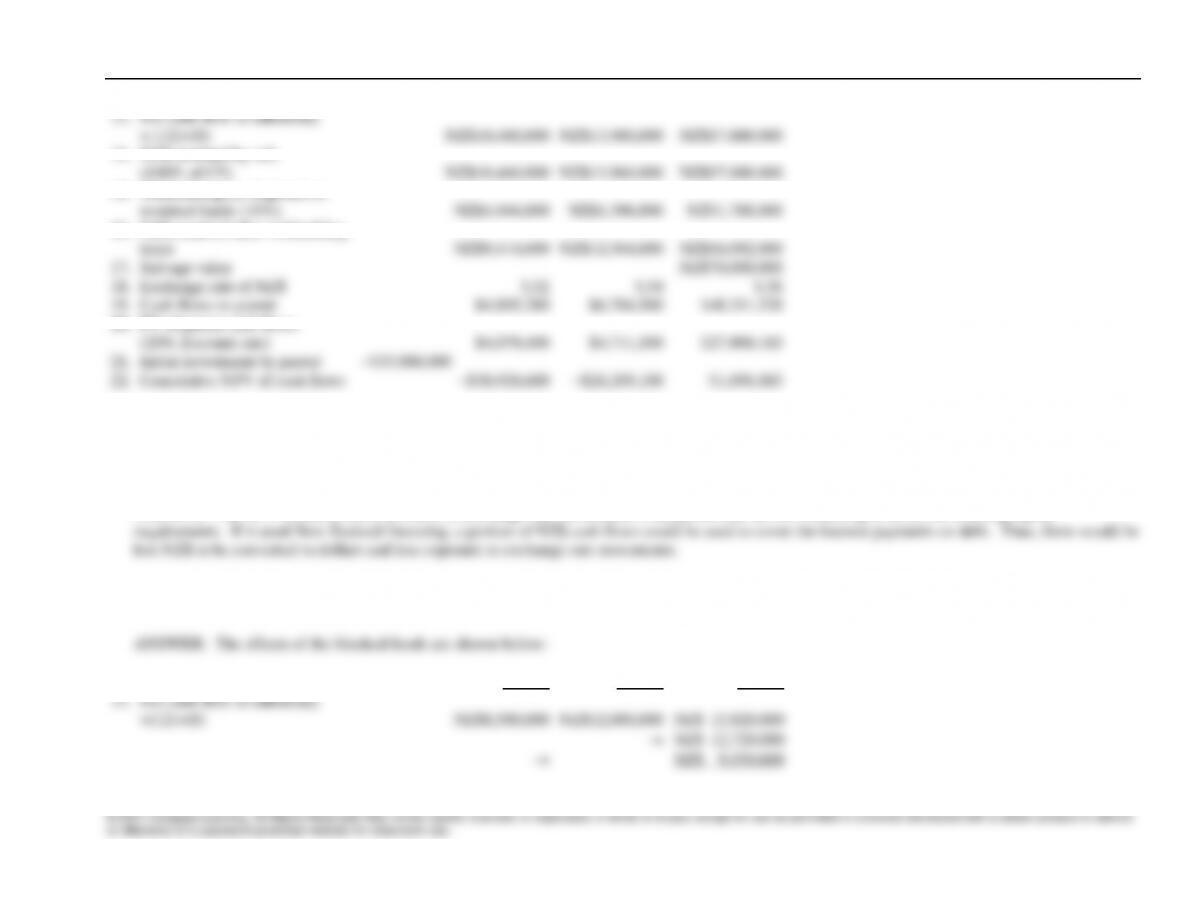
The analysis shows that this alternative financing arrangement is expected to generate a lower net present value than the original financing arrangement.
c. From the parent’s perspective, would the NPV of this project be more sensitive to exchange rate movements if the subsidiary uses New Zealand
financing to cover the working capital or if the parent invests more of its own funds to cover the working capital? Explain.
ANSWER: The NPV would be more sensitive to exchange rate movements if the parent uses its own financing to cover the working capital
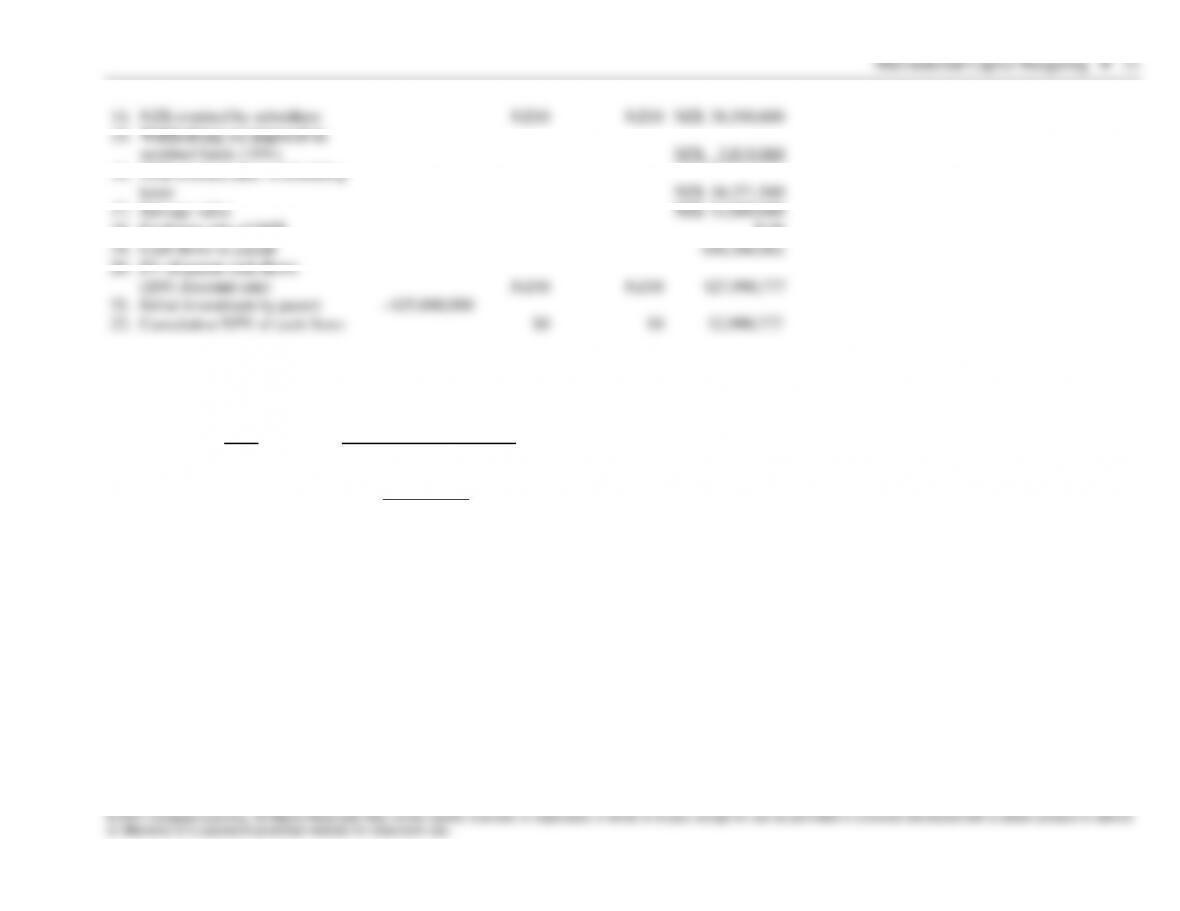
d. Assume that Wolverine used the original financing proposal and that funds are blocked until the subsidiary is sold. The funds to be remitted are
reinvested at a rate of 6 percent (after taxes) until the end of Year 3. How is the project’s NPV affected?
Year 1 Year 2 Year 3
Multinational Capital Budgeting ❖ 23
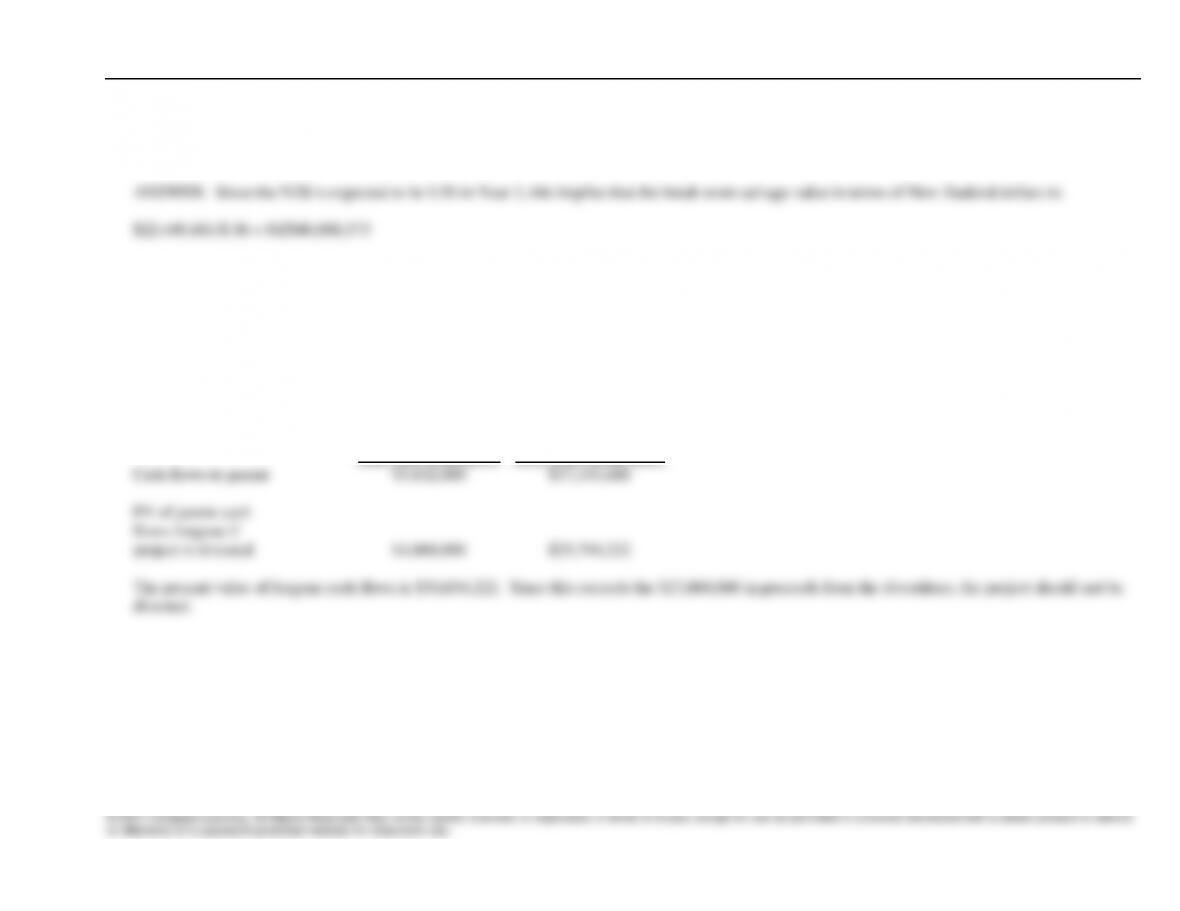
= [$25,000,000 – $12,008,333](1+.20)3
= $22,449,601
f. Assume that Wolverine decides to implement the project, using the original financing proposal. Also assume that after one year, a New Zealand
firm offers Wolverine a price of $27 million after taxes for the subsidiary and that Wolverine’s original forecasts for Years 2 and 3 have not
changed. Compare the present value of the expected cash flows if Wolverine keeps the subsidiary to the selling price. Should Wolverine divest the
subsidiary? Explain.
ANSWER:
Divestiture Analysis One Year After
the Project Began
End of Year 2 End of Year 3
(one year from now) (two years from now)
28. Capital Budgeting with Hedging. Baxter Co. is considering a project with Thailand’s government. If it accepts the project, it will definitely receive one
lump sum cash flow of 10 million Thai baht in five years. The spot rate of the Thai baht is presently $0.03. The annualized interest rate for a 5-year
period is 4% in the U.S. and 17% in Thailand. Interest rate parity exists. Baxter plans to hedge its cash flows with a forward contract. What is the dollar
amount of cash flows that Baxter will receive in five years if it accepts this project?
ANSWER: The forward rate premium is:

Multinational Capital Budgeting ❖ 24
29. Capital Budgeting and Financing. Cantoon Co. is considering the acquisition of a unit from the French government. Its initial outlay would be $4
million. Cantoon will reinvest all the earnings in the unit. It expects that at the end of 8 years, it will sell the unit for 12 million euros after capital gains
taxes are paid. The spot rate of the euro is $1.20 and is used as the forecast of the euro in the future years. Cantoon has no plans to hedge its exposure to
exchange rate risk. The annualized U.S. risk-free interest rate is 5% regardless of the maturity of the debt, and the annualized risk-free interest rate on
euros is 7%, regardless of the maturity of debt. Assume that interest rate parity exists. Cantoon’s cost of capital is 20%. It plans to use cash to make the
acquisition.
a. Determine the NPV under these conditions.
b. Rather than use all cash, Cantoon could partially finance the acquisition. Specifically, it could obtain a loan of 3 million euros today that would be
used to cover a portion of the acquisition. In this case, it would have to pay back a lump sum total of 7 million euros at the end of 8 years to repay
the loan. There are no interest payments on this debt. This financing deal is structured such that none of the payment is tax-deductible. Determine the
NPV if Cantoon uses the forward rate instead of the spot rate to forecast the future spot rate of the euro, and elects to partially finance the
acquisition. [You need to derive the 8-year forward rate for this question.]
ANSWER:
a. Discount factor based on a required return of 20% for 8 years = .232

Multinational Capital Budgeting ❖ 25
b. The forward rate premium is:
p = (1 + .05)8 – 1 = (1.48)/1.718) – 1 = –13.85%
(1 + .07)8
30. Sensitivity of NPV to Conditions. Burton Co., based in the U.S., considers a project in which it
has an initial outlay of $3 million and expects to receive 10 million Swiss francs (SF) in one year. The spot rate of the Swiss franc is $.80. Burton Co.
decides to purchase put options on Swiss francs with an exercise price of $.78 and a premium of $.02 per unit to hedge its receivables. It has a required
rate of return of 20 percent.
a. Determine the net present value of this project for Burton Co. based on the forecast that the Swiss franc will be valued at $.70 at the end of one year.
b. Assume the same information in part (a), but with the following adjustment. Although Burton expected to receive 10 million Swiss francs,
Switzerland unexpectedly experienced weak economic conditions after Burton initiated the project. Consequently, Burton received only
Multinational Capital Budgeting ❖ 26
6 million Swiss francs at the end of the year. Also assume that the spot rate of the Swiss franc at the end of the year was $.79. Determine the net
present value of this project for Burton Co. if these conditions occur.
ANSWER:
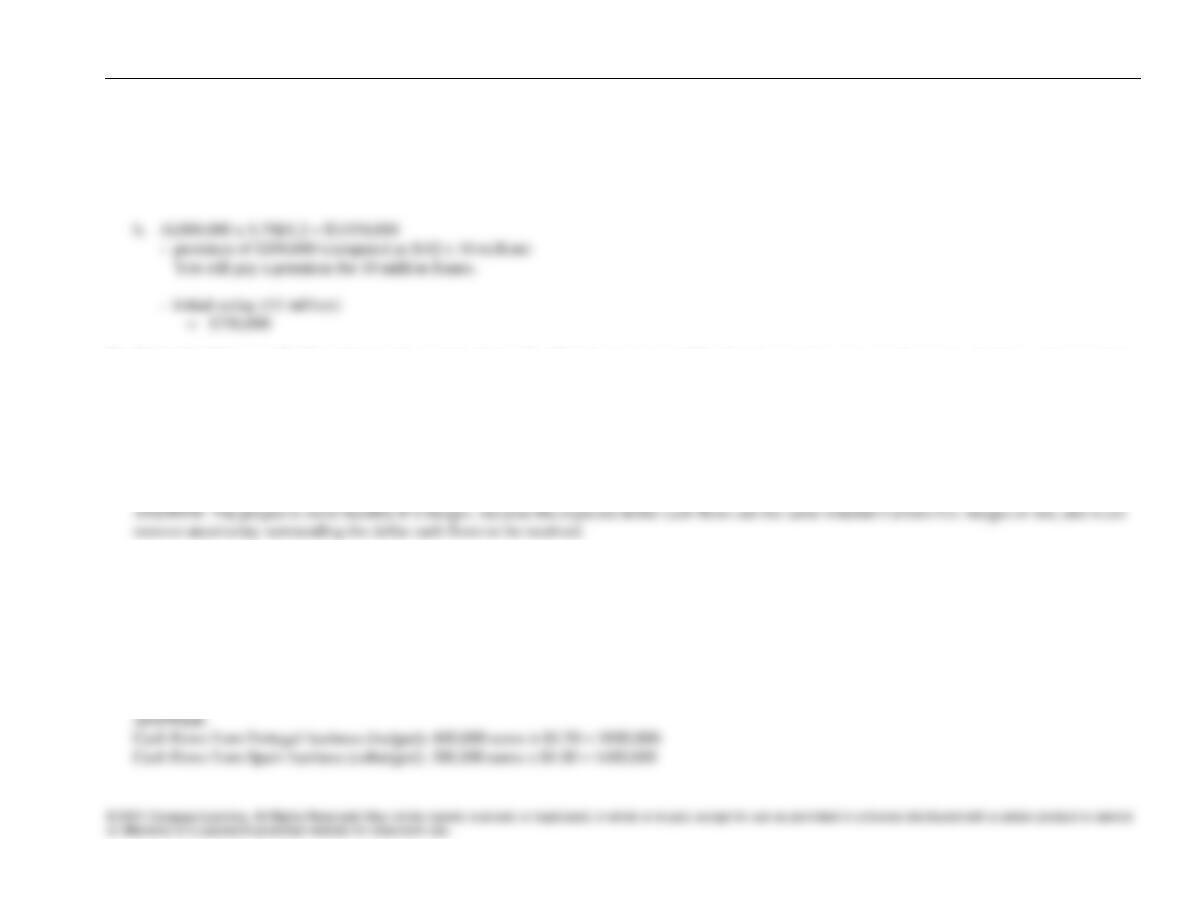
a. [SF10,000,000 x ($.78)]/1.2=$6,500,000 – premium of $200,000 (computed as $.02 x 10 million) – initial outlay ($3 million) = $3,300,000.
31. Hedge Decision on a Project. Carlotto Co. (a U.S. firm) will definitely receive 1 million British pounds in one year based on a business contract it has
with the British government. Like most firms, Carlotto Co. is risk averse and only takes on risk only when the potential benefits outweigh the risk. It has
no other international business and is considering various methods to hedge its exchange rate risk. Assume that interest rate parity exists. Carlotto Co.
recognizes that exchange rates are very difficult to forecast with accuracy, but it believes that the one-year forward rate of the pound yields the best
forecast of the pound’s spot rate in one year. Today the pound’s spot rate is $2.00, and the one-year forward rate of the pound is $1.90. Carlotto Co. has
determined that a forward hedge is better than alternative forms of hedging. Should Carlotto Co. hedge with a forward contract or should it remain
unhedged? Briefly explain.
32. NPV of Partially Hedged Project. Sazer Co. (a U.S. firm) is considering a project in which it
produces special safety equipment. It will incur an initial outlay of $1 million for the research and development of this equipment. It expects to receive
600,000 euros in one year from selling the products in Portugal where it already does much business. In addition, it also expects to receive 300,000 euros
in one year from sales to Spain, but these cash flows are very uncertain because Sazer has no existing business in Spain. Today’s spot rate of the euro is
$1.50 and the one-year forward rate is $1.50. It expects that the euro’s spot rate will be $1.60 in one year. It will pursue the project only if it can satisfy
its required rate of return of 24 percent. It decides to hedge all the expected receivables due to business in Portugal, and none of the expected receivables
due to business in Spain. Estimate the net present value (NPV) of the project.

Multinational Capital Budgeting ❖ 28
b. Revise the previous answer in part (a) by reducing the CF in euros by 1,600,000 and reducing the initial outlay from $7 million to $5 million.
Cash flows (hedged): 2,000,000 euros × $1.34 = $2,680,000.
35. Influence of Tax Laws on Cash Flow to MNC Parents The appendix to this chapter explains how tax laws can affect how much earnings the
subsidiaries remit to parents. Explain why the U.S. tax rules prior to 2017 encouraged foreign subsidiaries of U.S.-based MNCs to reinvest their earnings
in their location rather than remit the earnings to the MNC parent. How did the Tax Cuts and Jobs Act of 2017 cause a higher proportion of subsidiary
earnings to be remitted to the U.S. parents?
36. Influence of Tax Laws on MNC’s Choice of Home Base Explain why a territorial tax law could encourage U.S.-based MNCs to consider moving
their headquarters to another country.
ANSWER: The Tax Cuts and Jobs Act implemented a territorial tax system as of 2018, in which the taxes imposed are based solely on the country
where the corporate income is earned. Under this system, subsidiaries of U.S.-based MNCs pay corporate income taxes where they are based (as they
Multinational Capital Budgeting ❖ 29
CRITICAL THINKING
Influence of Tax Laws on MNC’s Choice of Home Base Before the Tax Cuts and Jobs Act of 2017 lowered U.S. corporate income tax rates, some
U.S.-based MNCs moved their parent to another country with lower corporate tax rates in an attempt to reduce their taxes. Write a short essay that
presents your opinion on this issue. Should U.S.-based MNCs have been allowed to move their parent without consequences? If other countries lower
their corporate income tax rates in the future, should the U.S. government also lower its corporate tax rate? For whatever solution you propose, explain
the possible adverse effects as well.
ANSWER
There is no perfect answer here, but students are challenged to consider the tradeoffs. One possible answer is that parents of U.S.-based MNCs should be
Solution to Continuing Case Problem: Blades, Inc.
1. Should the sales and the associated costs of 180,000 pairs of roller blades to be sold in Thailand under the existing agreement be included in the capital
budgeting analysis to decide whether Blades should establish a subsidiary in Thailand? Should the sales resulting from a renewed agreement be
included? Why or why not?
Multinational Capital Budgeting ❖ 31
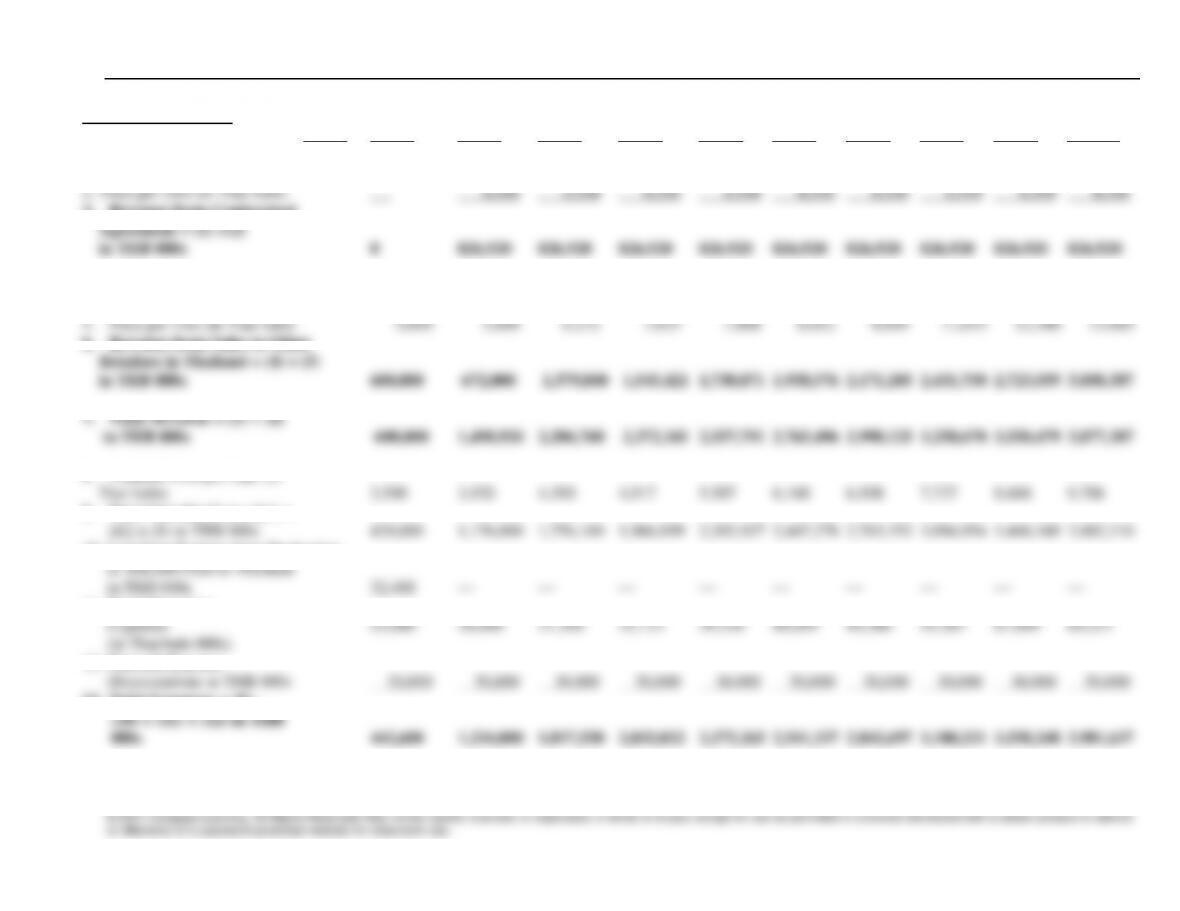
Answer to Question b:
Year 0
Year 1
Year 2
Year 3
Year 4
Year 5
Year 6
Year 7
Year 8
Year 9
Year 10
1. Units Sold to
Entertainment Products
—
180,000
180,000
180,000
180,000
180,000
180,000
180,000
180,000
180,000
2. Price per Unit (in Thai baht)
—
4,594
4,594
4,594
4,594
4,594
4,594
4,594
4,594
4,594
3. Revenue from Contractual
Agreement = (1) ×(2)
in THB 000s
0
826,920
826,920
826,920
826,920
826,920
826,920
826,920
826,920
826,920
4. Units Sold to Other
Retailers in Thailand
120,000
120,000
220,000
220,000
220,000
220,000
220,000
220,000
220,000
220,000
5. Price per Unit (in Thai baht)
5,000
5,600
6,272
7,025
7,868
8,812
9,869
11,053
12,380
13,865
6. Revenue from Sales to Other
Retailers in Thailand = (4) × (5)
in THB 000s
600,000
672,000
1,379,840
1,545,421
1,730,871
1,938,576
2,171,205
2,431,750
2,723,559
3,050,387
7. Total Revenue = (3) + (6)
in THB 000s
600,000
1,498,920
2,206,760
2,372,341
2,557,791
2,765,496
2,998,125
3,258,670
3,550,479
3,877,307
8. Variable Cost per Unit (in
Thai baht)
3,500
3,920
4,390
4,917
5,507
6,168
6,908
7,737
8,666
9,706
9. Total Variable Cost = [(1) +
(4)] × (8) in THB 000s
420,000
1,176,000
1,756,160
1,966,899
2,202,927
2,467,278
2,763,352
3,094,954
3,466,348
3,882,310
10. Less Cost Savings from Production
of 108,000 Pairs in Thailand
in THB 000s
32,400
—
—
—
—
—
—
—
—
—
11. Fixed Operating
Expenses
(in Thai baht 000s)
25,000
28,000
31,360
35,123
39,338
44,059
49,346
55,267
61,899
69,327
12. Noncash Expense
(Depreciation) in THB 000s
30,000
30,000
30,000
30,000
30,000
30,000
30,000
30,000
30,000
30,000
13. Total Expenses = (9) –
(10) + (11) + (12) in THB
000s
442,600
1,234,000
1,817,520
2,032,022
2,272,265
2,541,337
2,842,697
3,180,221
3,558,248
3,981,637