Chapter 14
Political and Country Risk
QUESTIONS
1. Describe the differences between country risk and political risk. What is sovereign risk?
Answer: Political risk is the risk that a government action will negatively affect a company’s cash
flows. In the most extreme form of political risk, governments seize property without compensating
the owners in a total expropriation (or nationalization).
Country risk is a broader concept that encompasses both the potentially adverse effects of a
2. What economic variables would give some indication of the country risk present in a particular
country?
3. Suppose an MNC is considering investing in Bolivia. Will an overall assessment of Bolivia’s
country risk suffice to understand the political risk present in the investment?
Answer: First, an analysis of country risk may definitely be informative about political risk in a
narrow sense. The better a country’s economic situation, the less likely it is to face political and social
Chapter 14: Political and Country Risk
102
4. What are three political risk factors?
5. When, where, and why did the Debt Crisis start?
Answer: The Debt Crisis started in Mexico on August 12, 1982 when Mexico announced that it could
no longer make the scheduled payments on its foreign debt. Mexico requested loans from foreign
governments and the IMF, and it started negotiating with its commercial bank creditors. This
constituted the start of the Debt Crisis. By the end of the year, 24 other countries had requested
restructuring on their commercial bank debts.
©2017 Cambridge University Press
6. What is debt overhang?
7. What is a debt buyback? Why was a program of debt buybacks not sufficient to resolve the
Debt Crisis?
8. What were the main characteristics of the Brady Plan?
Answer: The 1989 Brady Plan, developed by then U.S. Treasury Secretary Nicholas Brady, had the
following important characteristics: 1) It put pressure on banks to offer some form of debt relief to
developing countries. 2) It called for an expansion in secondary market transactions aimed at debt
©2017 Cambridge University Press
9. Why should the discount rate not be adjusted for political risk?
Answer: Consider a multinational corporation with a shareholder base that is globally diversified. In
this case, the discount rate should reflect only international, systematic risks. Chapter 13 showed that
systematic risks are typically related to how an MNC’s return in a particular country covaries with the
10. What are some examples of organizations that provide country risk ratings?
11. How can we use current quantitative information to predict future political events, such as
expropriation?
©2017 Cambridge University Press
12. Suppose a multinational corporation is particularly worried about ethnic warfare in a few
countries in which it is considering investing. Do country risk ratings have information on this
particular risk?
13. Can Panama issue a bond denominated in dollars at the same terms (that is, at the same yield)
as the U.S. government? Why or why not?
14. What stops governments from defaulting on loans or bonds held by foreigners?
©2017 Cambridge University Press
15. What is a Brady bond?
Answer: Brady bonds were created as a consequence of the Brady plan which aimed at resolving the
Debt Crisis for many countries. In February 1990, Mexico became the first country to issue Brady
bonds, and Brady deals were subsequently done by Argentina, Brazil, Bulgaria, Costa Rica, the
16. How is a political risk probability related to a country spread?
Answer: First, recall that the country spread is an indication of the default risk of a bond. However,
although a government might default on its bonds as a result of a political event, this does not
necessarily mean that it will also expropriate the assets of the MNCs that lie within its borders.
Chapter 14: Political and Country Risk 107
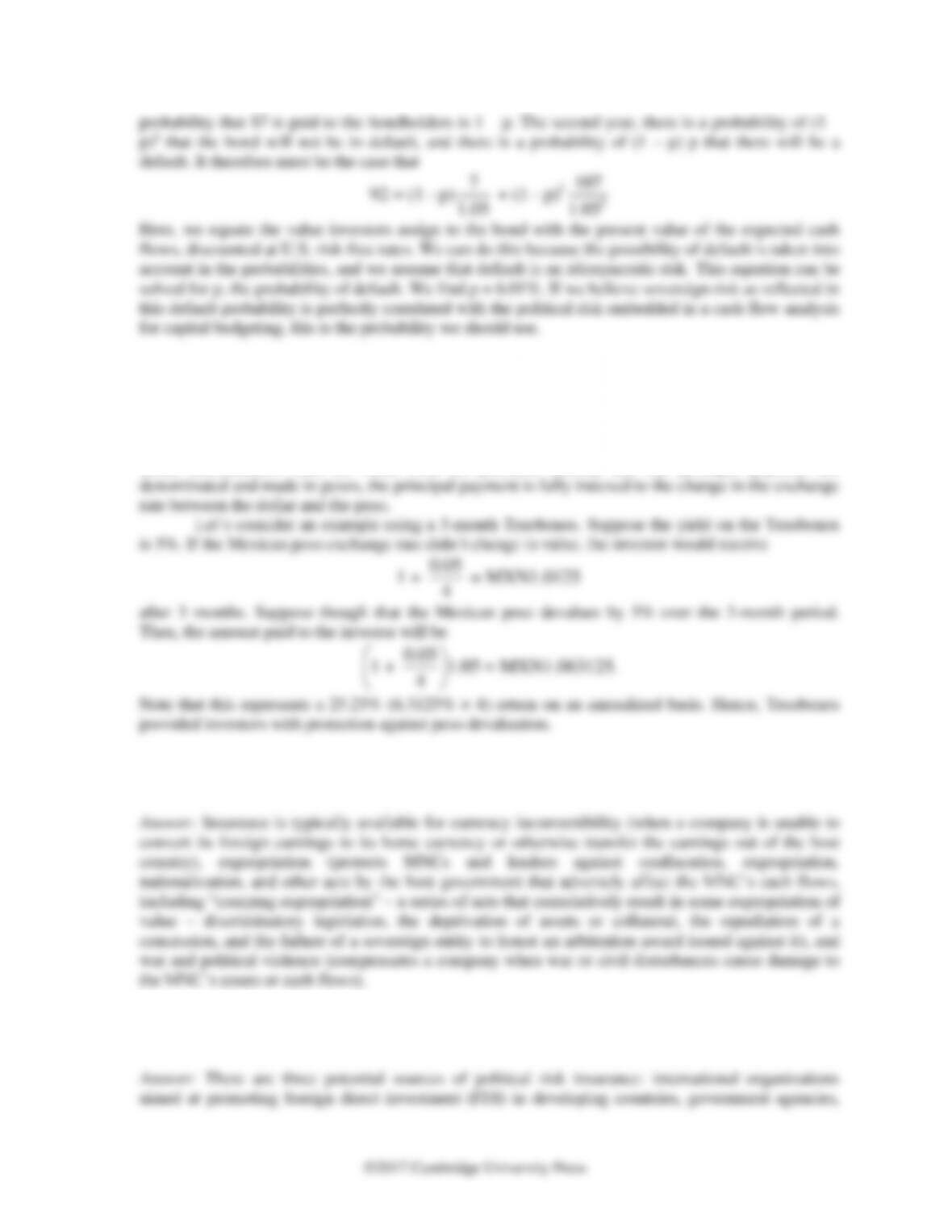
probability that $7 is paid to the bondholders is 1 – p. The second year, there is a probability of (1 –
p)2 that the bond will not be in default, and there is a probability of (1 – p) p that there will be a
default. It therefore must be the case that
2
2
7 107
92 = (1 – p) + (1 – p)
1.05 1.05
Here, we equate the value investors assign to the bond with the present value of the expected cash
flows, discounted at U.S. risk-free rates. We can do this because the possibility of default is taken into
account in the probabilities, and we assume that default is an idiosyncratic risk. This equation can be
solved for p, the probability of default. We find p = 6.01%. If we believe sovereign risk as reflected in
this default probability is perfectly correlated with the political risk embedded in a cash flow analysis
for capital budgeting, this is the probability we should use.
17. What are Cetes? What are Tesobonos?
Answer: Cetes are treasury bills issued by the Mexican government, denominated in Mexican peso.
Tesobonos are also treasury bills issued by the Mexican government, but they are effectively U.S.
dollar denominated. That is, while both the purchase amount and the principal payment are
18. What are the three main types of political risk covered by political risk insurance?
19. What are some organizations or firms that provide political risk insurance?
©2017 Cambridge University Press
20.
21. How is it possible to embed political risk insurance in a capital budgeting analysis?
22. What is project finance?
Answer: Project finance is a method of financing that is specific to a particular project, typically
PROBLEMS
1. In February 1994, Argentina’s currency board was in place, and 1 peso was exchangeable into 1
dollar. The following interest rates were available:
U.S. LIBOR 90 days:
3.25%
Peso 90-day deposits:
8.99%
Dollar interest rate in Argentina, 90-day deposits:
7.10%
The latter two rates were offered by Argentine banks. What risk does the difference
between the 7.10% dollar interest and 3.25% LIBOR reflect? What risk does the difference
between the rate on 90-day pesos and 90-day dollar deposits by Argentine banks reflect?


©2017 Cambridge University Press
3. Consider a 10-year Brady bond issued by Brazil. The coupon payment is 6.50%, and the par
value has been collateralized by a U.S. Treasury bond. The current price of the bond is $98 (per
$100 in par value). Compute the (blended) yield-to-maturity for the bond. What is the stripped
yield? Assume that the spot rates on the dollar are the ones reported in Exhibit 14.8.
Answer: We list the cash flows as in Exhibit 14.8:
Year
Dollar Cash Flows
Dollar Spot Rates
1
6.5
3.50
2
6.5
4.10
3
6.5
4.65
4
6.5
5.05
5
6.5
5.55
6
6.5
5.85
7
6.5
6.05
8
6.5
6.25
9
6.5
6.35
10
106.5
6.50
The (blended) yield to maturity for the bond is the solution to the following equation:
2 10
6.5 6.5 106.5
98 = + + ... +
1 + y (1 + y) (1 + y)
Using Excel, we find: y = 6.78%
The stripped yield takes into account that part of the bond value is collateralized by U.S. Treasuries,
in this case the par value of the bond. The current value of $100 worth of par value is:
Collateral value =
10
$100 $53.27.
(1 0.065) =
+
This means that the “stripped” price equals $98.00 – $53.27 = $44.73.
The stripped yield,
y
, then follows from re-doing the computation above, adjusting the price and
stripping out the par value repayment:
2 10
6.5 6.5 6.5
44.73 = + + ... +
1 + y (1 + y) (1 + y)
It follows that
y
= 7.45%. The stripped yield is substantially higher than the blended yield.


Chapter 14: Political and Country Risk
112
Expropriation in year 1
p
100
10.8130
1.23 =
Expropriation in year 2
(1 – p) p
100
2
1 = 0.6610
1.23
We assume that the 23% discount rate applies to the expected cash flows of the project, and we
account for the possibility of expropriation in computing expected cash flows. Hence, we have:
2
400 (1 ) 100 100 (1 )
p p p p − −
6. You are the chief financial officer of Clad Metal, a U.S. multinational with operations
throughout the world. Your capital budgeting department has presented a proposal to you for a
5-year ore-extraction project in Mexico. The expected year-end net dollar cash flows are as
follows:
Year
Net Cash Flow
1
$100,000
2
200,000
3
250,000
4
250,000
5
250,000
The initial required investment in plant and equipment is $500,000, and the cost of capital is
16%.
a. What is the present value of the project? Should the project be undertaken?
Answer: We can construct the following cash flow diagram:
Year
Dollar Cash
Flows
Discount Factors
Present Value of
the Cash Flows
1
100,000
0.8621
86,207
2
200,000
0.7432
148,633
3
250,000
0.6407
160,073
4
250,000
0.5523
138,073
5
250,000
0.4761
119,028
Chapter 14: Political and Country Risk 113
b. You notice that the proposal does not include any analysis of political risk, but you
are concerned about potential expropriation of the investment. You therefore decide
to call a meeting to discuss political risk. Who would you invite to this meeting?
What information or data would you need? How would you arrive at a political risk
probability estimate?
Answer: You could invite people familiar with the local political and economic situation or, if you
do not have the in-house expertise, consult political ratings and the accompanying information from
expropriation is between 5% and 7%. Also assume that there is no compensation in
the case of expropriation. Would you approve the project?
d. Given the possibility of expropriation, might you want to reconsider converting
Mexican peso expected cash flows at forward rates?
7. Web Question: How will the political turmoil in a number of Middle East countries
(Syria, Yemen. Iraq, Iran, and Saudi Arabia) affect political risk? Try to use Web
resources on ratings and spreads to come up with a quantitative answer.
Answer: You would think that the turmoil should increase the possibility of a political risk event, so
Chapter 14: Political and Country Risk
114