Chapter 13
International Capital Market Equilibrium
QUESTIONS
1. Is the volatility of the dollar return to an investment in the Japanese equity market the
sum of the volatility of the Japanese equity market return in yen plus the volatility of
yen/dollar exchange rate changes? Why or why not?
Answer: It is not. Even though the dollar return on investing in Japanese equity is
approximately the yen return on the Japanese equity market plus the rate of change in the
dollar/yen exchange rate, the volatility of this sum is not the sum of the volatilities.
Intuitively, because the equity risk and currency risk are not highly correlated, part of the
2. Why is the variance of a portfolio of internationally diversified stocks likely to be lower
than the variance of a portfolio of U.S. stocks?
©2017 Cambridge University Press
3. How can you increase the Sharpe ratio of a portfolio? What type of stocks would you
have to add to it in order to do so?
Answer: To increase the Sharpe ratio on your portfolio, you must add stocks that increase the
expected return on your portfolio and/or reduce the volatility of the portfolio (for instance,
because the stocks exhibit low correlation with the portfolio you already have). One way to
4. Why is the hurdle rate in Section 13.2 lower for Japan than for Canada? Should U.S.
investors still invest in Canada?
Answer: From the formula in the answer to Question 3, we see that the two main drivers of
the hurdle rates are the correlations between Canadian and U.S. returns and between
Japanese and U.S. returns (reported in Exhibit 13.6), and the volatilities of Canadian and
5. What is the mean-standard deviation frontier, and what is the mean-variance-efficient
(MVE) portfolio?
Chapter 13: International Capital Market Equilibrium
3
6. What is the prediction of the CAPM with respect to optimal portfolio choice?
7. What is it prediction of the CAPM with respect to the expected return on any security?
8. What is the beta of a security?
9. Why might it be useful to estimate the beta for a stock from returns on stocks within its
industry rather than from the stock itself?
©2017 Cambridge University Press
10. What does it mean for an equity market to be integrated or segmented from the world
capital market?
11. What would you expect to happen to the risk-free rate and equity returns when a
segmented country opens its capital markets to foreign investment?
Answer: When a country unexpectedly opens its capital markets to foreign investors, we
expect the real interest rate to decrease, and the stock market to rise in value. The real interest
rate in the country should fall because the country’s residents are now free to borrow and
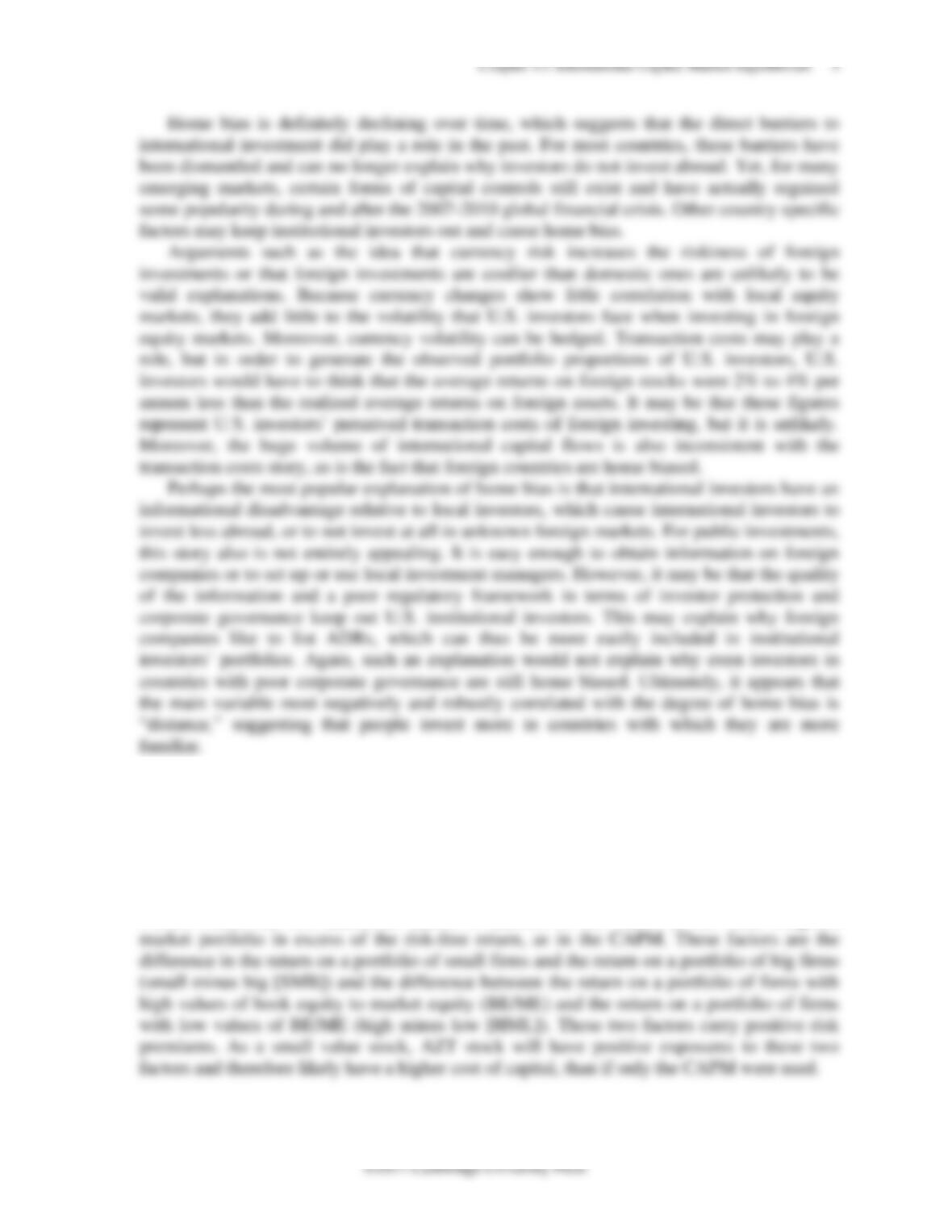
12. What accounts for the home bias phenomenon?
Answer: Home bias refers to the phenomenon that investors, even in the developed world,
have not fully internationally diversified their portfolios which are consequently heavily
invested in their own stock markets. No well-accepted explanation for why investors forego
the benefits of international diversification exists.
©2017 Cambridge University Press
13. Suppose AZT is a small value stock and that you use both the CAPM and the Fama-
French model to compute its cost of capital. Under which model is the cost of capital for
AZT likely to be higher?
Answer: It is likely to be higher under the Fama-French model. The reason is that the Fama-
French model has two additional factors in addition to the return on the value-weighted
Chapter 13: International Capital Market Equilibrium
6
PROBLEMS
1. The EAFE is the international index comprising markets in Europe, Australia, and the
Far East. Consider the following annualized stock return data:
Average U.S. index return:
14%
Average EAFE index return:
13%
Volatility of the U.S. return:
15.5%
Volatility of the EAFE return:
16.5%
Correlation of U.S return and EAFE return:
0.45
a. What would be the return and risk of a portfolio invested half in the EAFE and half
in the U.S. market?
Answer: Using standard formulas for the expected return and volatility of a portfolio of
two assets, we find:
P
1
P 2 2 2 2 2 2
1
22 2
E[r ] = (0.5)×14% + (0.5)×13% = 13.5%
VOL[r ] = [(0.5) (15.5%) + (0.5) (16.5%) + 2(0.5) 0.45(15.5%)(16.5%)]
= 0.5[(15.5%) + (16.5%) + 2 0.45 15.5% 16.5%]
13.63%
=
Note that this is lower than the volatility of either of the two indexes.
b. Market watchers have noticed slowly increasing correlations between the United
States and the EAFE index, which some ascribe to the increasing integration of
markets. Given that the volatilities remain unchanged, is it possible that the
volatility of a portfolio that is equally weighted between the two indexes has higher
volatility than the U.S. market?
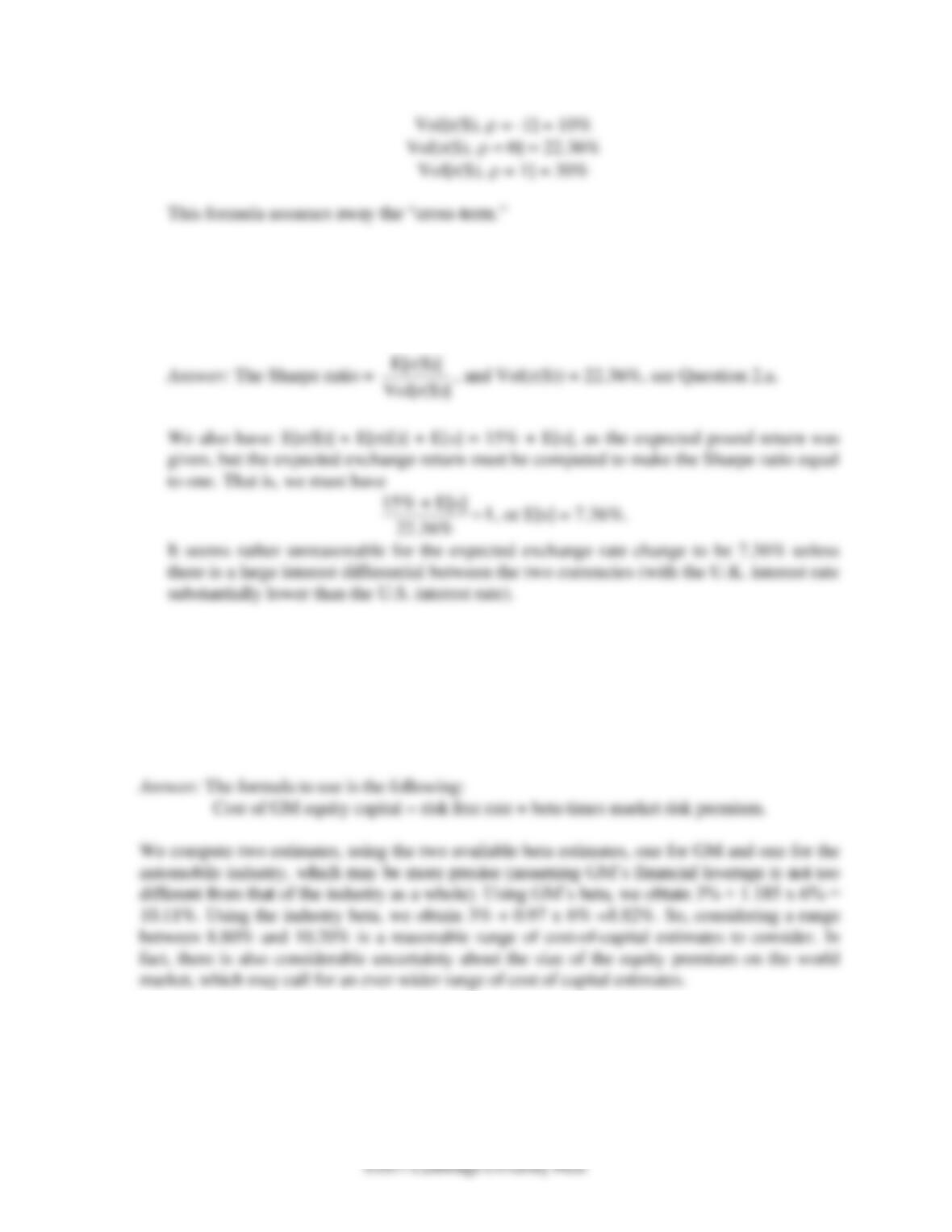
2. Let the expected pound return on a U.K. equity be 15%, and let its volatility be 20%.
The volatility of the dollar/pound exchange rate is 10%.
a. Graph the (approximate) volatility of the dollar return on the U.K. equity as a
function of the correlation between the U.K. equity’s return in pounds and changes
in the dollar / pound exchange rate.
Chapter 13: International Capital Market Equilibrium
7
b. Suppose the correlation between the U.K. equity return in pounds and the exchange
rate change is 0. What expected exchange rate change would you expect if the U.K.
equity investment is to have a Sharpe ratio of 1.00? (Assume that the risk-free rate
is 0 for a U.S. investor.) Does this seem like a reasonable expectation?
E[r($)]
3. Suppose General Motors managers would like to invest in a new production line and must
determine a cost of capital for the investment. The beta for GM is 1.185, the beta for the
automobile industry is 0.97, the equity premium on the world market is assumed to be
6%, and the risk-free rate is 3%. Propose a range of cost-of-capital estimates to consider
in the analysis.
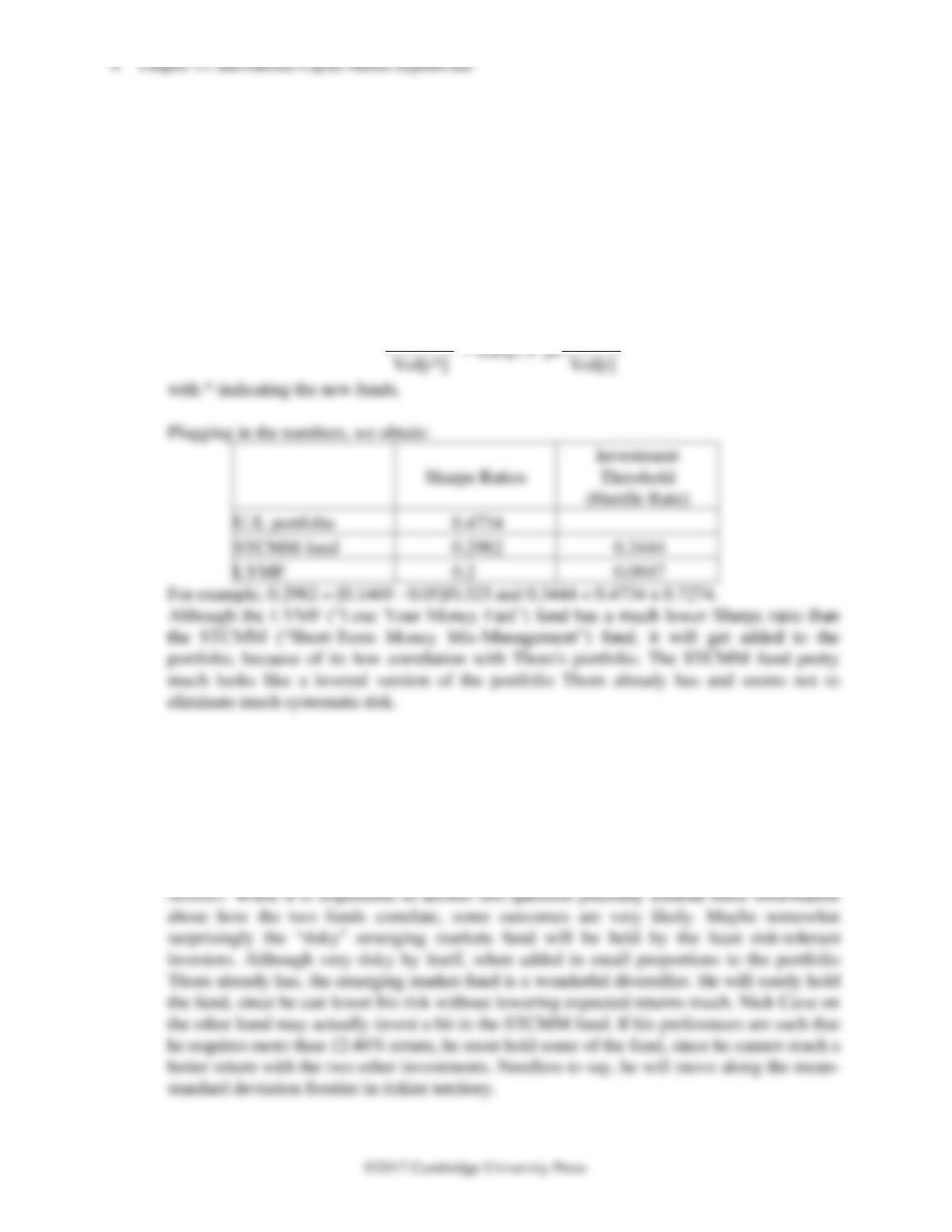
4. Thom Yorke is a typical mean-variance investor, currently invested 100% in a diversified
U.S. equity portfolio with expected return of 12.46% and volatility of 15.76%. Thom is
considering adding the STCMM fund to his portfolio. STCMM invests in U.S. small-
capitalization, high technology firms and has an expected of 14.69% and a volatility of
©2017 Cambridge University Press
6. Consider Softmike, a software company. Softmike’s world market beta is 1.75. Regressing
Softmike’s return on the world market return and the global HML factor gives betas of
1.50 and –1.2, respectively. Assume that the world equity premium is 6%, the HML
premium is 3%, and the risk-free rate is 5%. Compute the cost of equity capital using
both the CAPM and the Fama-French model. Is Softmike a value company or a growth
company?
Answer: According to the CAPM, Softmike’s cost of equity capital is:
7. Web question: Estimate the cost of capital for a project that has the same risk as the
cash flows earned by Alphabet (ticker symbol GOOGL). Hint: Go to Yahoo Finance
and find “statistics” for Alphabet, the parent of Google.
Answer: If you go to finance.yahoo.com and type “GOOGL” into the “Get Quotes” search