a. What is Electrolux’s cost of debt, after-tax, in SEK?
b. What is Electrolux’s cost of equity in SEK?
c. What is the Electrolux’s market capitalization?
Assumptions Values
Swedish kroner, government bond rate (10-year) 4.30%
Electrolux credit risk premium 1.20%
Swedish corporate tax rate 26.00%
Electrolux beta 1.30
a. Electrolux’s cost of debt, after-tax, in SEK 4.070%
kd = ( krf + credit risk premium ) x ( 1 – tax rate )
ke = krf + ( km – krf ) β
d. Electrolux’s total value of equity outstanding SEK 52,075,660,000
Share price x shares outstanding
e. What proportion of Electrolux’s capital structue is debt? 18.130%
Debt / ( Debt + Equity )
Problem 13.1 Electrolux of Sweden
Kristian Thalen has just joined the corporate treasury group at Electrolux of Sweden. The multinational
Swedish appliance maker is considering making an offer for GE’s appliance business, and wants to revise its
weighted average cost of capital for its analysis. Kristian has been assigned the task, using the following
assumptions, he goes step by step through the following questions.

a. What is McLaren’s cost of debt, after-tax in pounds?
b. What is McLaren’s cost of equity in pounds?
g. What is McLaren’s weighted average cost of capital?
h. What is McLaren’s WACC if its beta was higher, like other automotive companies, say 1.30?
Assumptions Values
U.K. risk-free cost of debt in pounds (₤) 4.20%
McLaren’s cost of debt in pounds (₤) 4.00%
U.K. corporate income tax rate 19.00%
McLaren’s prospective beta 0.85
a. What is McLaren’s cost of debt, after-tax in pounds? 3.240%
kd = ( krf + credit risk premium ) x ( 1 – tax rate )
d. What is McLaren’s total value of equity outstanding? £10,500,000,000
Share price x shares outstanding
e. What proportion of McLaren’s capital structure is debt? 4.98%
Debt / ( Debt + Equity )
Problem 13.2 McLaren’s IPO and WACC
McLaren, the famous high-performance automotive group, launched its initial public offering (IPO) on October 20,
2019. Although the share price had initially risen to over 60 pounds (£) per share, by the end of the year it had settled to
50 pounds (£). McLaren is owned by Able Group (Ireland) and had never calculated its own cost of capital independent
of Able before. It now needed to, and one of its first challenges was estimating its beta. With only two months of trading
You might notice that McLaren’s cost of debt is actually cheaper than that of the U.K. government. This was true,
and reflected McLaren’s greater-than-U.K. reach for its financial security, while also reflecting U.K.’s continuing
challenge with sovereign debt.
g. What is McLaren’s weighted average cost of capital? 7.79%
WACC = ( kd (1-tax) * D/(D+E)) + ( ke * E/(D+E))
h. What is McLaren’s WACC if its beta was higher, like other automotive
companies, say 1.30?
9.71%
Replacing the beta value above, and using the calculations that follow.
a. Aidan’s cost of equity
b. Aidan’s cost of debt
Assumptions CAPM ICAPM
Aidan’s beta, β 1.05 0.85
Risk-free rate of interest, krf 3.60% 3.60%
Company credit risk premium 4.40% 4.40%
Cost of debt, before tax, kd 8.00% 8.00%
Corporate income tax rate, t 12.5% 12.5%
a) Aidan’s cost of equity 9.270% 8.190%
ke = krf + ( km – krf ) β
b) Aidan’s cost of debt, after tax 7.000% 7.000%
kd x ( 1 – t )
Problem 13.3 Aidan’s Cost of Capital
Terry McDermott now estimates Aidan’s risk-free rate to be 3.60%, the company’s credit risk premium is 4.40%,
the domestic beta is estimated at 1.05, the international beta is estimated at 0.85, and the company’s capital
structure is now 30% debt. All other values remain the same as those presented in the section “Sample
Calculation: Aidan’s Cost of Capital.” For both the domestic CAPM and ICAPM, calculate the following:
a. 8.00% c. 5.00%
Domestic International
Assumptions CAPM ICAPM
Aidan’s beta, β 1.20 0.90
Risk-free rate of interest, krf 4.00% 4.00%
Company credit risk premium 4.40% 4.40%
Cost of debt, before tax, kd 8.40% 8.40%
Corporate income tax rate, t 12.5% 12.5%
a) Aidan’s cost of equity 14.800% 12.100%
ke = krf + ( km – krf ) β
b) Aidan’s cost of debt, after tax 7.350% 7.350%
kd x ( 1 – t )
Differing Equity Risk Premiums CAPM ICAPM
a. 8.00% 10.318% 9.198%
b. 7.00% 9.583% 8.603%
Problem 13.4 Aidan and Equity Risk Premiums
Answer for part a
Using the original weighted average cost of capital data for Aidan used in the section “Sample Calculation:
Aidan’s Cost of Capital,” calculate both the CAPM and ICAPM weighted average costs of capital for the
following equity risk premium estimates.
a. If Thunderhorse beta is estimated at 1.1, what is its weighted average cost of capital?
Assumptions a) Values b) Values
Thunderhorse’s beta 1.10 0.80
Cost of debt, before tax 7.000% 7.000%
Calculation of the WACC
Cost of debt, after-tax 5.250% 5.250%
kd x ( 1 – t )
Cost of equity, after-tax 8.500% 7.000%
ke = krf + ( km – krf ) β
Problem 13.5 Thunderhose Oil
b. If Thunderhorse’s beta is estimated at 0.8, significantly lower because of the continuing profit
prospects in the global energy sector, what is the company‘s weighted average cost of capital?
Thunderhorse Oil is a U.S. oil company. Its current cost of debt is 7%, and the 10-year U.S. Treasury
yield, the proxy for the risk-free rate of interest, is 3%. The expected return on the market portfolio is
8%. The company‘s effective tax rate is 39%. Its optimal capital structure is 60% debt and 40% equity.
a. What is Nestle’s cost of equity based on the domestic portfolio of a Swiss investor?
b. What is Nestle’s cost of equity based on a global portfolio for a Swiss investor?
Assumptions Domestic Portfolio Global Portfolio
Swiss bond index yield, the risk-free rate 0.520% 0.520%
Swiss equity market return, in Swiss francs 8.400%
Nestle’s cost of equity using CAPM 7.0210% 4.7945%
Problem 13.6 Nestle of Switzerland Revisited
Nestle of Switzerland is revisiting its cost of equity analysis in 2014. As a result of extraordinary actions
by the Swiss Central Bank, the Swiss bond index yield (10-year maturity) has dropped to a record low of
0.520%. The Swiss equity markets have been averaging 8.400% returns, while the Financial Times
a. If Corcovado’s beta is estimated at 1.1, what is its weighted average cost of capital?
Assumptions a. Values b. Values
Corcovado’s beta 1.10 0.80
Cost of debt, before tax 7.000% 7.000%
Risk-free rate of interest 3.000% 3.000%
Corporate income tax rate 25.000% 25.000%
Calculation of the WACC
Cost of debt, after-tax 5.250% 5.250%
kd x ( 1 – t )
Problem 13.7 Corcovado Pharmaceuticals
Corcovado Pharmaceutical’s cost of debt is 7%. The risk-free rate of interest is 3%. The expected return
on the market portfolio is 8%. After effective taxes, Corcovado’s effective tax rate is 25%. Its optimal
capital structure is 60% debt and 40% equity.
b. If Corcovado’s beta is estimated at 0.8, significantly lower because of the continuing profit prospects
in the global energy sector, what is its weighted average cost of capital?
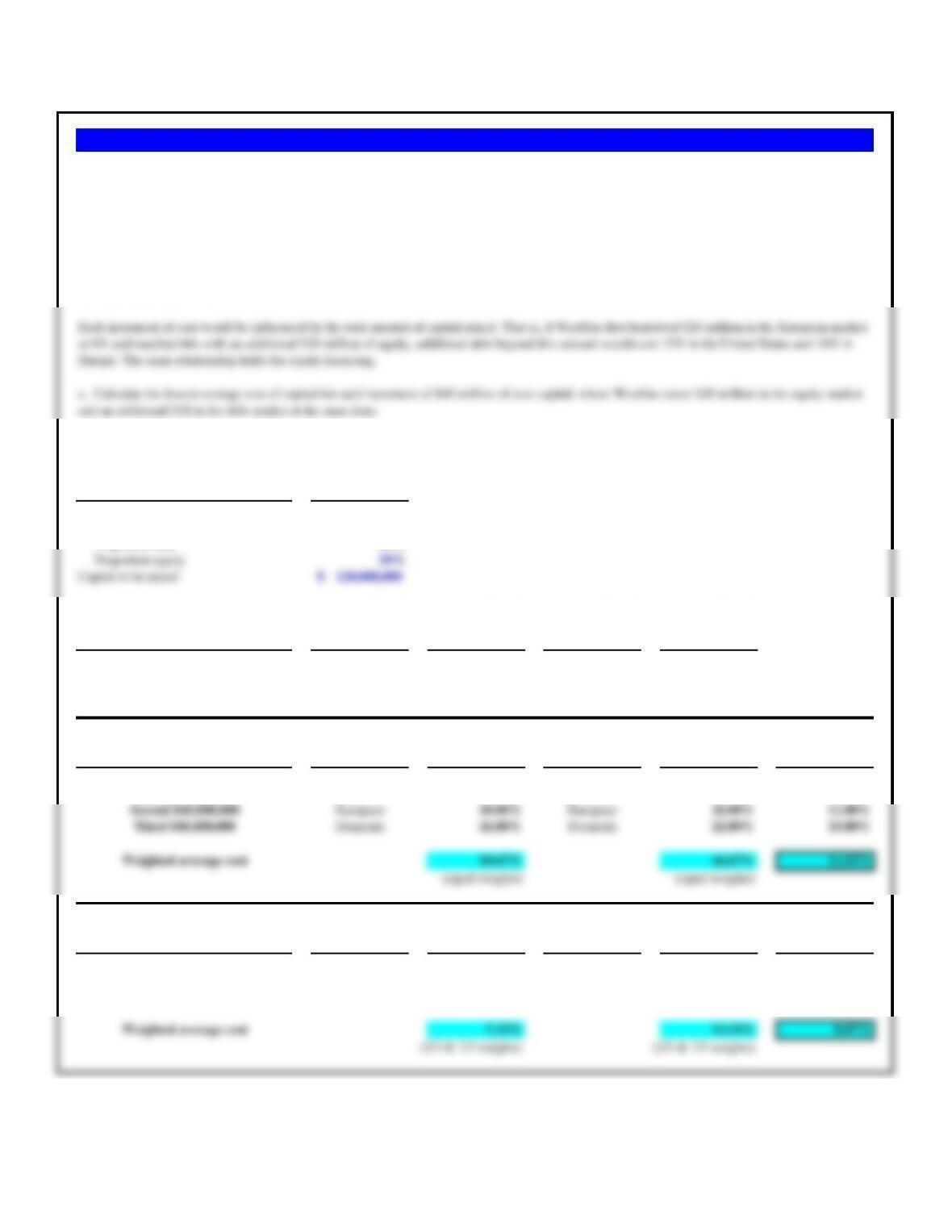
Assumptions Values
Combined federal and state tax rate 40%
Desired capital structure:
Cost of Cost of Cost of Cost of
Domestic Domestic European European
Costs of Raising Capital in the Market Equity Debt Equity Debt
Up to $40 million of new capital 12% 8% 14% 6%
$41 million to $80 million of new capital 18% 12% 16% 10%
Above $80 million 22% 16% 24% 18%
Incremental
a. To raise $120,000,000 Debt Market Debt Cost Equity Market Equity Cost WACC
First $40,000,000 European 6.00% Domestic 12.00% 7.80%
Incremental
b. To raise $60,000,000 Debt Market Debt Cost Equity Market Equity Cost WACC
First $40,000,000 European 6.00% Domestic 12.00% 7.80%
Additional $20,000,000 European 10.00% European 16.00% 11.00%
Problem 13.8 WestGas Conveyance, Inc.
A London bank advises WestGas that U.S. dollars could be raised in Europe at the following costs, also in multiples of $20 million, while maintaining
the 50/50 capital structure.
b. If WestGAs plans an expansion of only $60 million, how should that expansion be financed? What will be the weighted average cost of capital for
the expansion?
at 6% and matched this with an additional $20 million of equity, additional debt beyond this amount would cost 12% in the United States and 10% in
Europe. The same relationship holds for equity financing.
a. Calculate the lowest average cost of capital for each increment of $40 million of new capital, where WestGas raises $20 million in the equity market
and an additional $20 in the debt market at the same time.
WestGas Conveyance, Inc., is a large U.S. natural gas pipeline company that wants to raise $120 million to finance expansion. WestGas wants a capital
structure that is 50% debt and 50% equity. Its corporate combined federal and state income tax rate is 40%. WestGas finds that it can finance in the
domestic U.S. capital market at the rates listed below. Both debt and equity would have to be sold in multiples of $20 million, and these cost figures
show the component costs, each, of debt and equity if raised half by equity and half by debt.
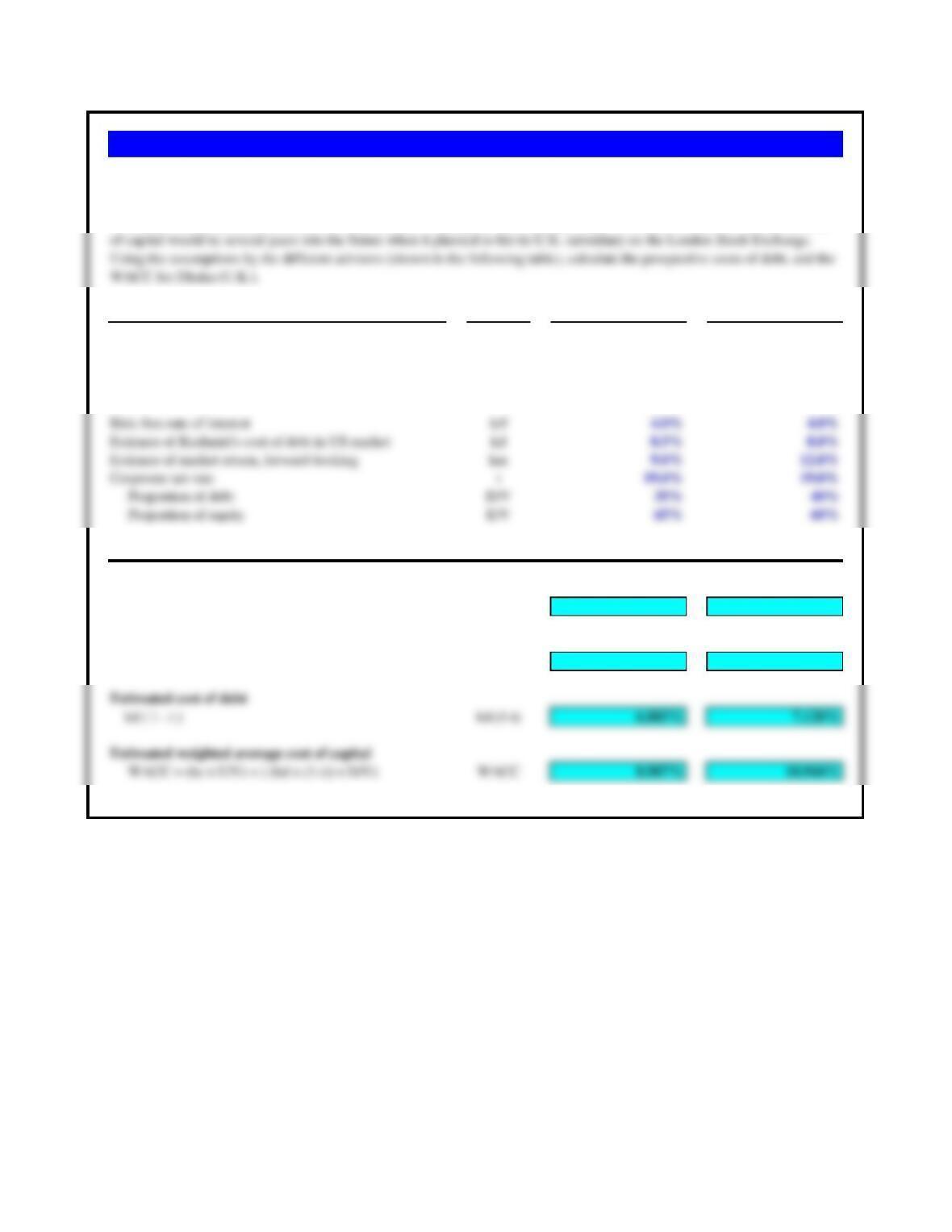
Assumptions Symbol Barclays Northwest
Components of beta: β
Estimate of correlation between security and market
ρjm 0.93 0.88
Estimate of standard deviation of Kashmiri’s returns σj 25.0% 31.0%
Estimate of standard deviation of market’s return
σm19.0% 23.0%
Estimating Costs of Capital
Estimated beta
β = ( ρjm x σj ) / ( σm ) β1.22 1.19
Estimated cost of equity
ke = krf + (km – krf) βke 10.118% 13.489%
Problem 13.9 Dhaka’s Cost of Capital
Dhaka is the largest and most successful garment maker in Dhaka, Bangladesh. It has not yet entered the European market but
is considering establishing both manufacturing and distribution facilities in the United Kingdom through a wholly owned
subsidiary. It has approached two different investment banking advisors, Barclays and NatWest, for estimates of what its cost
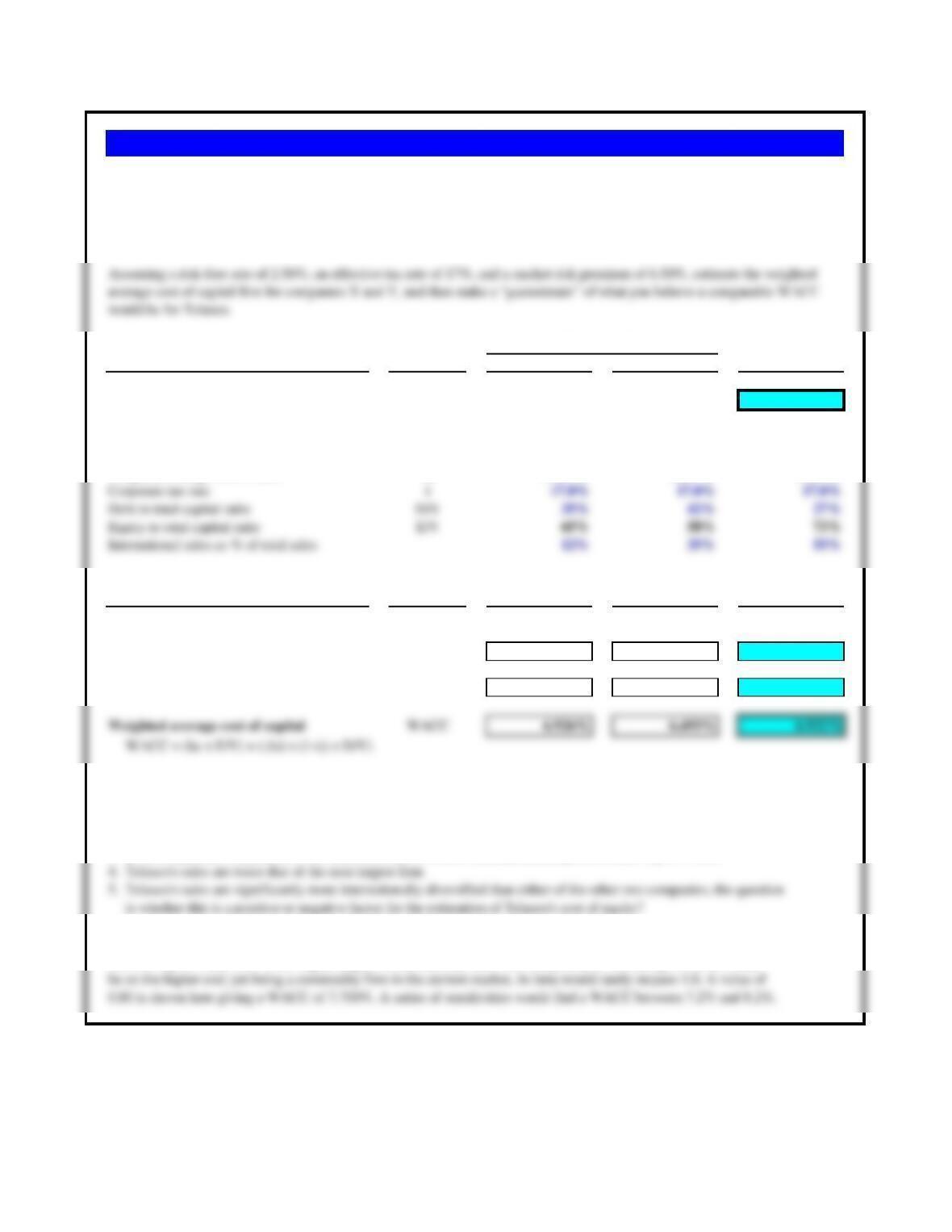
Assumptions Symbol Company X Company Y Telasco
Total sales Sales
$11.0 billion $50 billion $105 billion
Company‘s beta β
0.85 0.70 0.80
Company credit rating S&P AA AAA
Risk-free rate of interest krf 2.5% 2.5% 2.5%
Market risk premium km-krf 6.5% 6.5% 6.5%
Weighted average cost of debt kd 5.885% 6.895% 5.850%
Estimating Costs of Capital Symbol Company X Company Y Telasco
Cost of equity
ke = krf + (km – krf) βke 8.025% 7.050% 7.700%
Cost of debt, after-tax kd ( 1 – t ) 4.885% 5.723% 4.856%
Once the data is organized, the absence of a beta for Telasco is the obvious data deficiency.
A series of observations is then helpful:
1. Note that beta and credit ratings do not necessarily parallel one another
2. Credit rating and cost of debt do follow expected norms; lower the rating, the higher the cost
3. Both comparable companies, in the same industry as Telasco (commodities), possess relatively low betas
If we take the approach that the beta for Cargill has to pick up all the incremental information, the beta would then fall
between say 0.70 and 0.85. If the higher degree of international sales was interpreted as increasing risk, beta would
Problem 13.10 Telasco’s Cost of Capital
Comparables
Telasco is generally considered to be the largest privately held company in South-East Asia. Headquartered in Singapore, the
company has been averaging sales of over S$120 million per year over the past five years. Although the company does not have
publicly traded shares, it is still extremely important for it to calculate its weighted average cost of capital properly in order to
make rational decisions on new investment proposals.
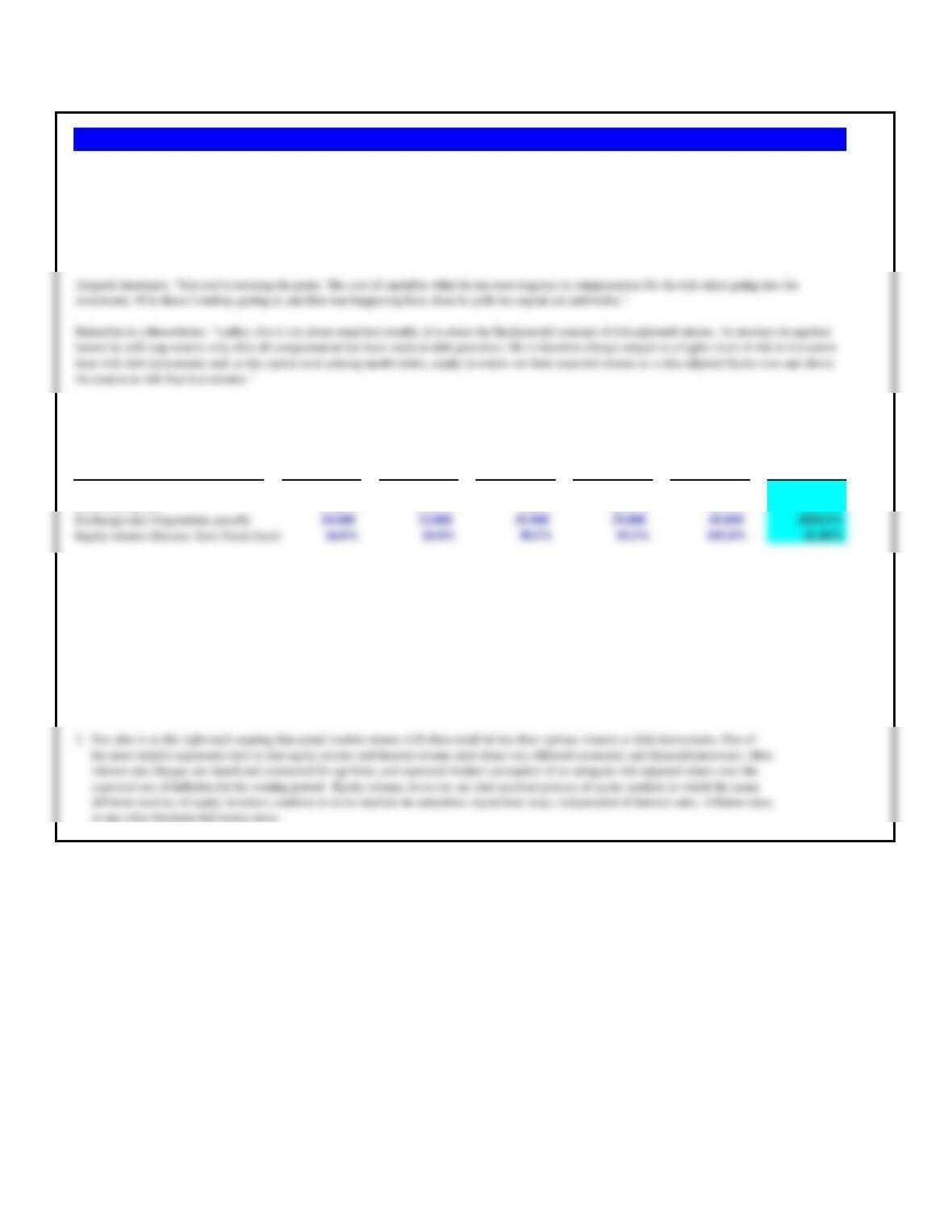
Brazilian Economic Performance 1995 1996 1997 1998 1999 Mean
Inflation rate (IPC) 5.00% 7.50% 6.40% 3.00% 8.45% 6.07%
All three are on the right track. It is mostly a matter of finding the linkages beween their individual arguments.
1. Theoretically, Babchuk is correct in that CAPM assumes that all equity returns are over and above risk-free rates. These are of course,
expected returns, and are the investor’s expectations or requirements going INTO the investment.
2. Arisgashi is also correct in arguing that regardless of what investors may EXPECT, the results are often quite different, sometimes disappointing.
Theoretically, when the investment does not yield at least the expected return, the investor should indeed liquidate their position. However,
in reality, many investors for a variety of reasons (tax implications, investment horizon, etc.), may stay in the investment and just complain
about the past and hope about the future.
Problem 13.11 The Equity
At this point, Ven and Arisgashi simply stare at Babachuk—pause—and order more drinks. Using the Argentinian data presented, comment on this week’s
debate at The Equity.
Ven argues, “It’s all about expected versus delivered. You can talk about what equity investors expect, but they often find that what is delivered for years at
a time is so small—even sometimes negative—that in effect, the cost of equity is cheaper than the cost of debt.
the returns to risk-free instruments.”
Arigashi interrupts, “But you’re missing the point. The cost of capital is what the investor requires in compensation for the risk taken going into the
investment. If he doesn’t end up getting it, and that was happening here, then he pulls his capital out and walks.”
You have joined your friends at the local tavern, The Equity, for your weekly debate on international finance. The topic this week is whether the cost of
equity can ever be cheaper than the cost of debt. The group has chosen Argentina in the mid-1990s as a subject of the debate. One of the group members
has torn out a table of data out of a book, which becomes the subject of the analysis.
Before After
Assumptions Symbol Diversification Diversification
Correlation between G-H and the market
ρjm 0.88 0.76
Standard deviation of G-H’s returns σj 28.0% 26.0%
Standard deviation of market’s returns
σm18.0% 18.0%
Risk-free rate of interest krf 3.0% 3.0%
Estimating Costs of Capital
Estimated beta
β = ( ρjm x σj ) / ( σm ) β1.37 1.10
Estimated cost of equity
ke = krf + (km – krf) βke 10.529% 9.038%
ke* = krf + (km – krf) β + RPM ke + RPM 10.529% 12.038%
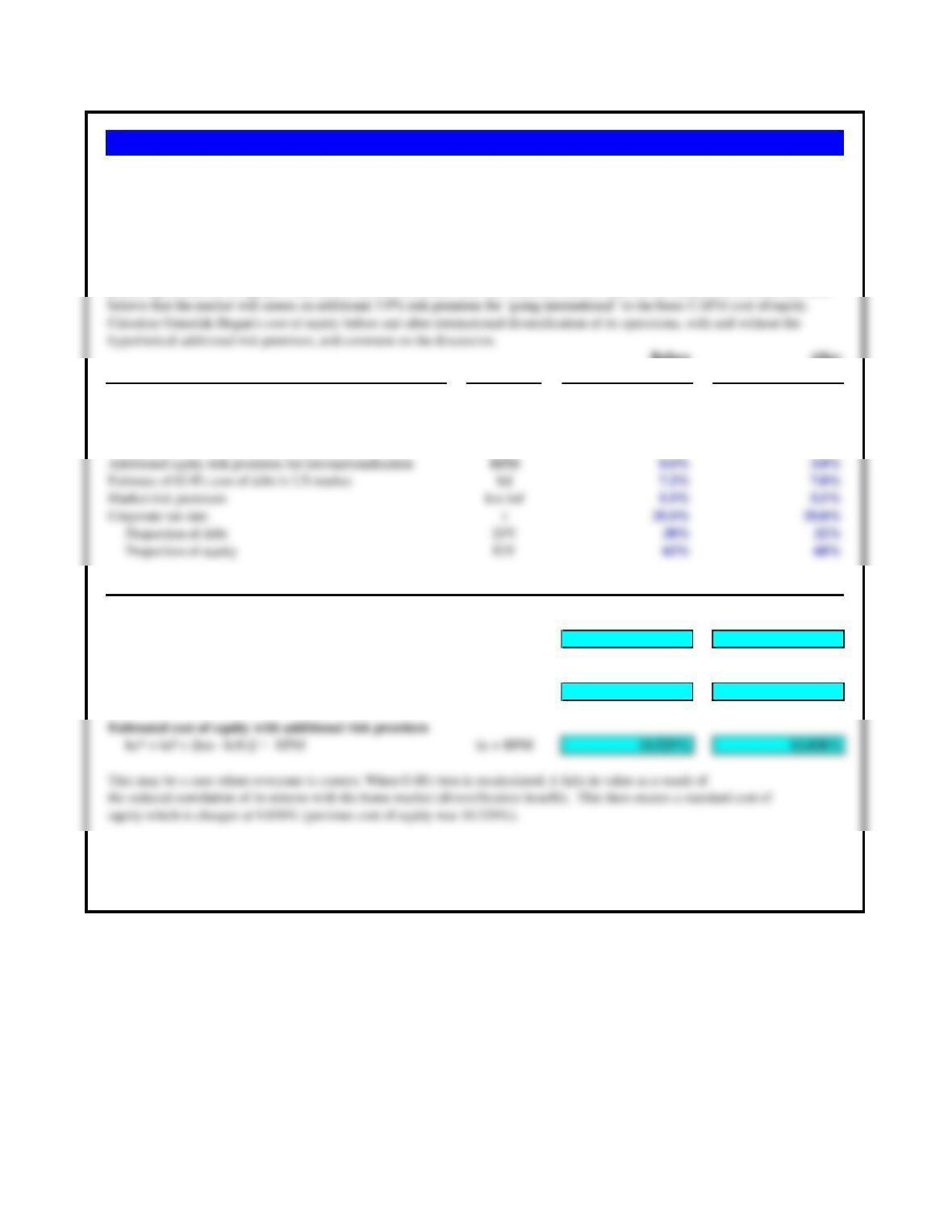
If, however, the market was to add an additional risk premium to the firm’s cost of equity as a result of internationally
diversifying operations, and if that risk premium were on the order of 3.0%, the final risk-adjusted cost of equity is
indeed higher, 12.038% to the before value of 10.529%.
Problem 13.12 Genedak-Hogan Cost of Equity
Use the following information to answer questions 10 through 12. Genedak-Hogan is an American conglomerate which is actively
debating the impacts of international diversification of its operations on its capital structure and cost of capital. The firm is planning
on reducing consolidated debt after diversification.
Senior management at Genedak-Hogan is actively debating the implications of diversification on its cost of equity. Although both
parties agree that the company’s returns will be less correlated with the reference market return in the future, the financial advisors
Calculate Genedak-Hogan’s cost of equity before and after international diversification of its operations, with and without the
hypothetical additional risk premium, and comment on the discussion.
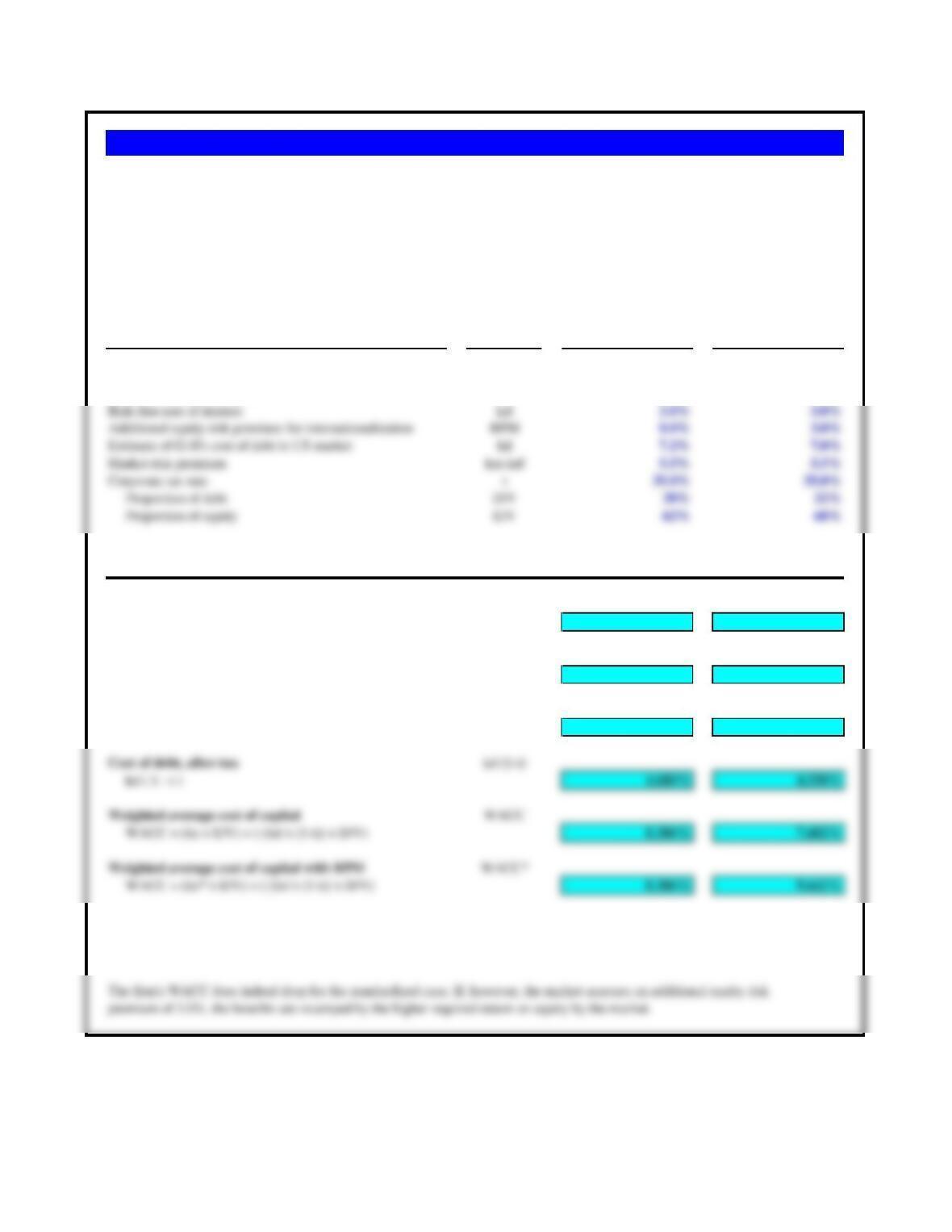
Calculate the weighted average cost of capital for Genedak-Hogan for before and after international diversification.
Before After
Assumptions Symbol Diversification Diversification
Correlation between G-H and the market
ρjm 0.88 0.76
Standard deviation of G-H’s returns σj 28.0% 26.0%
Standard deviation of market’s returns
σm18.0% 18.0%
Before After
Estimating Costs of Capital Diversification Diversification
Estimated beta
β = ( ρjm x σj ) / ( σm ) β1.37 1.10
Estimated cost of equity
ke = krf + (km – krf) βke 10.529% 9.038%
Estimated cost of equity with additional risk premium
ke* = krf + (km – krf) β + RPM ke + RPM 10.529% 12.038%
There are a number of different factors at work here. First, as a result of international diversification, their access to debt
has improved, resulting in a lower cost of debt capital. This is not fully appreciated, however, as the firm has chosen to
reduce its overall use of debt post-diversification (common among MNEs).
Problem 13.13 Genedak-Hogan’s WACC
a. Did the reduction in debt costs reduce the firm’s weighted average cost of capital? How would you describe the impact of
international diversification on its costs of capital?
b. Adding the hypothetical risk premium to the cost of equity introduced in problem 10 (an added 3.0% to the cost of equity
because of international diversification), what is the firm’s WACC?
Before After
Assumptions Symbol Diversification Diversification
Correlation between G-H and the market
ρjm 0.88 0.76
Standard deviation of G-H’s returns σj 28.0% 26.0%
Standard deviation of market’s returns
σm18.0% 18.0%
Before After
Estimating Costs of Capital Diversification Diversification
Estimated beta
β = ( ρjm x σj ) / ( σm ) β1.37 1.10
Estimated cost of equity
ke = krf + (km – krf) βke 10.529% 9.038%
ke* = krf + (km – krf) β + RPM ke + RPM 10.529% 12.038%
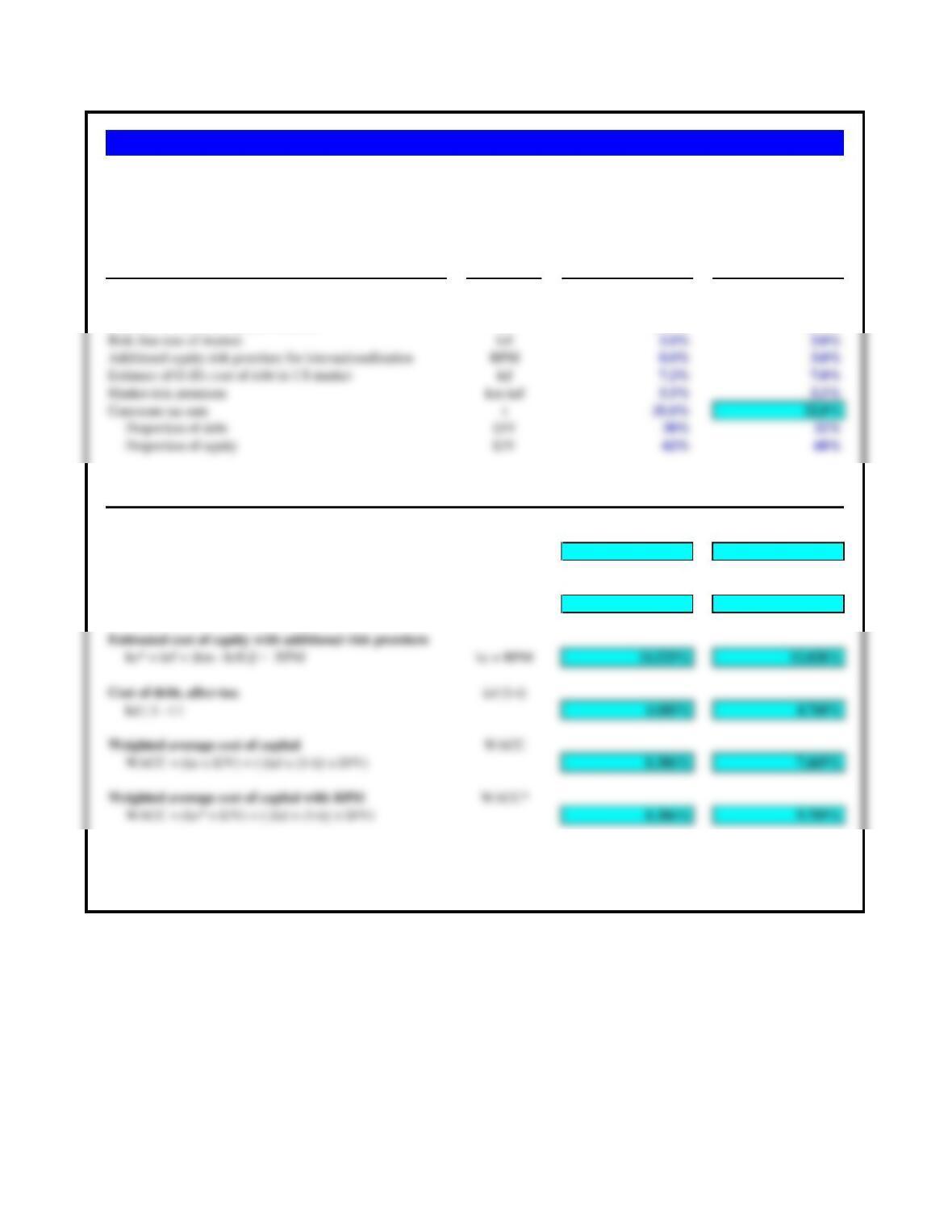
The reduction in the effective tax rate obviously impacts WACC through the cost of debt. This does have substantial
benefits in the company‘s WACC — as long as additional equity risk premiums are not assessed. Then, even the lower
effective tax rate does not offset the higher equity costs associated with the international risk premium.
Problem 13.14 Genedak-Hogan’s WACC and Effective Tax Rate
Many MNEs have greater ability to control and reduce their effective tax rates when expanding international operations. If Genedak-
Hogan was able to reduce its consolidated effective tax rate from 35% to 32%, what would be the impact on its WACC?