
INTERNATIONAL ECONOMICS, 7TH EDITION
Study Resources: Questions for Study & Review
Chapter 12
In your answers for questions 1–4 below, please identify the primary BoP account
affected and ignore the settlement side that is part of the BoP’s double-entry
accounting.
1. On August 8 2002, Brazil received a 30-billion dollar loan from the IMF. When the first
$1 billion wire was received by the Brazilian government’s treasury department,
exactly which part of the Brazilian balance of payments was affected positively or
negatively?
2. The Wall Street Journal reported on August 4 2002 that “Washington agreed to
provide a $1.5 billion short-term loan to the Uruguayan government” to provide funding
that the International Monetary Fund and the World Bank were unwilling to provide.
When the $1.5 billion wire arrived in Uruguay, exactly which part of the Uruguayan
balance of payments was affected positively or negatively?
3. In 2003, the largest category of the Mexican current account was the funds wired from
Mexican workers in the U.S. to relatives in Mexico. Exactly which aspect of the
Mexican balance of payments is affected positively or negatively by such payments?
4. Balance of payments accounts.
a. Which part of the U.S. balance of payments is affected (positively or negatively) if
U.S.-based currency traders sell the dollar and buy foreign bonds?
b. The interest income on these foreign bonds will post (as a debit or credit?) next year
as part of which category of the balance of payments?
5. Assuming zero inflation in all countries and deflation in Japan over the year, assume
also that the yen has depreciated over the year against all the other currencies.
a. Compare the relative movements of Japan’s nominal and real exchange rates with
the U.S.
b. What can you say about Japan’s real effective exchange rates with the rest of the
world including the U.S.?
c. What can you say about Japan’s international competitiveness?
6. Let PUK be the GDP deflator in Great Britain (U.K.) and PS the GDP deflator in
Switzerland. Suppose PUK = 2.5 and PS = 1.5

a. Calculate the real exchange rate (RER Switzerland/U.K. – Switzerland is the
domestic economy) corresponding to each of the following SF/£ nominal exchange
rates (E): the exchange rate quoted in Switzerland on April 12, 2007 is ESF/£ =
2.4085 and on May 12, 2007 it is ESF/£ = 2.415
b. As E increases, i. What happens to the Swiss real exchange rate above? ii. What
happens to the price of Swiss goods in terms of British goods?
c. If the price level in Great Britain increases faster than the price level in Switzerland,
i. What happens to the real exchange rate above? (assume no change in the
nominal exchange rate). ii. What happens to Swiss international competitiveness?
d. Compare your results in (b) and (c).
7. Use the bilateral exchange rate data between the euro and the British pound and
between the euro and the dollar in 2 consecutive years (5/9/2006 and 5/9/2007) to
calculate the trade weighted or multilateral exchange rate (TWI) for the euro over the
period. Set the first year as the base year, i.e. set the multilateral exchange rate for
this year as 100. Assume that, in this period, the U.K. and the U.S. are the Euro area’s
only trade partners: the share of trade of the Euro area with the U.K. – 40 percent –
remains the same over the two years considered. Fill in
the table below to show how you construct the trade-weighted index.
ER E0 Index Weight index Weighted E1 Index Weight index Weighted
£/e
$/e
TWI XX XXX XXX XX XXX XXX
Data: over the period, the €/£ exchange rate increases from E0 = 1.44 to E1 = 1.48 and
the €/$ decreases from E0 = 0.78 to E1 = 0.74. Over this period, has the euro
appreciated or depreciated with respect to the dollar, the pound, or overall?
INTERNATIONAL ECONOMICS, 7TH EDITION
Study Resources: Questions for Study & Review
Chapter 12: Answers
In your answers for questions 1–4 below, please identify the primary BoP account
affected and ignore the settlement side that is part of the BoP’s double-entry accounting.
1.
3.
5.
a. In nominal terms, the yen depreciated against the dollar. That is given in the
question. In real terms, a decrease in prices in Japan alone represents a real depreciation.
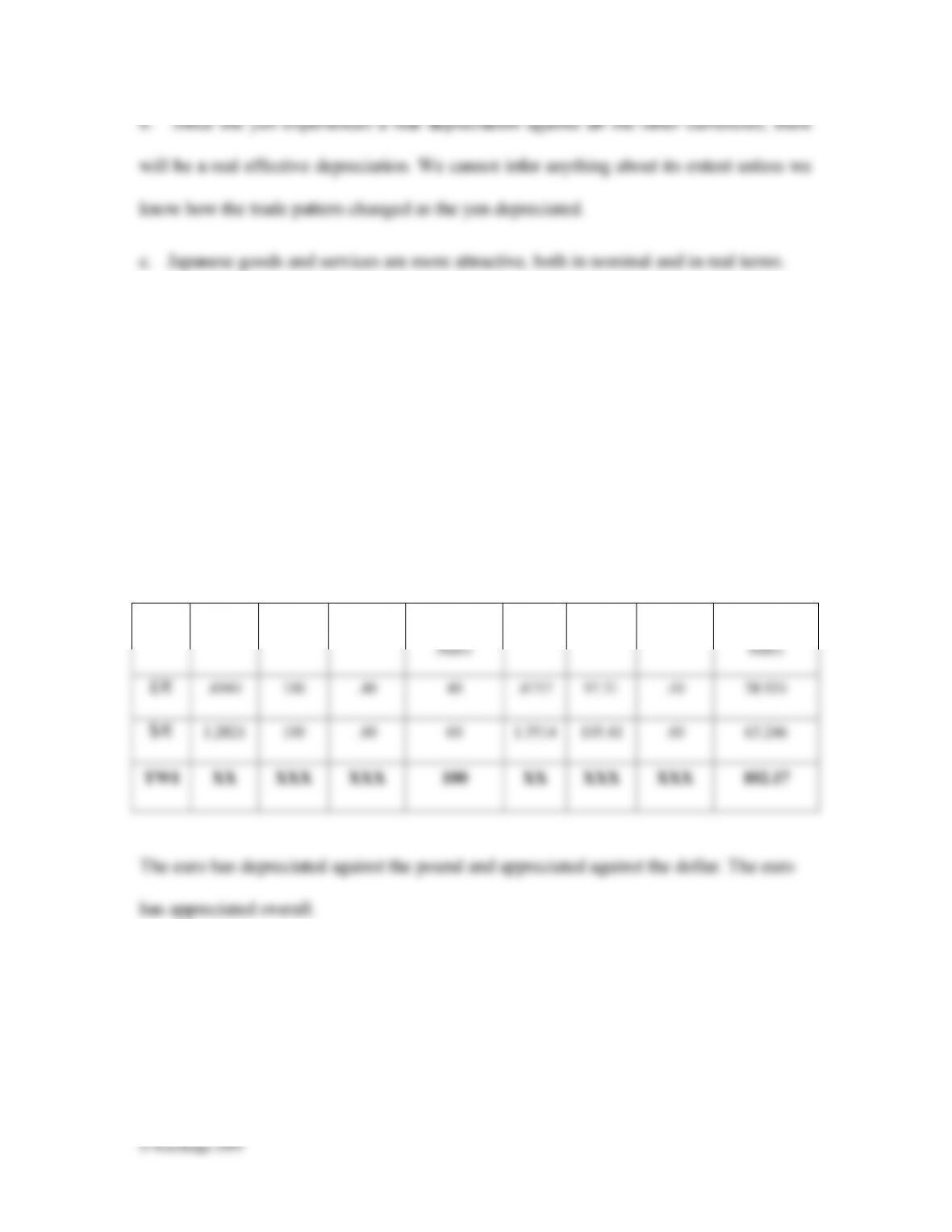
7. Trade weighted or multilateral exchange rate (TWI) for the euro over the period
between 5/9/2006 and 5/9/2007.
ER E0 Index Weight Weighted