
INTERNATIONAL ECONOMICS, 7TH EDITION
Study Resources: Questions for Study & Review
Chapter 11
1. A capital abundant country increases its capital stock by 5 percent, all else constant.
How does that change affect its production and volume of trade? Do its terms of trade
change in a way that creates a further benefit for the country?
2. A labor-abundant country increases its capital stock by 5 percent, all else constant.
How does that change affect its production and volume of trade? Do its terms of trade
change in a way that creates a further benefit for the country?
3. If a large economy grows at the same rate as the rest of the world, why are its demand
preferences important in predicting whether its terms of trade will improve or not?
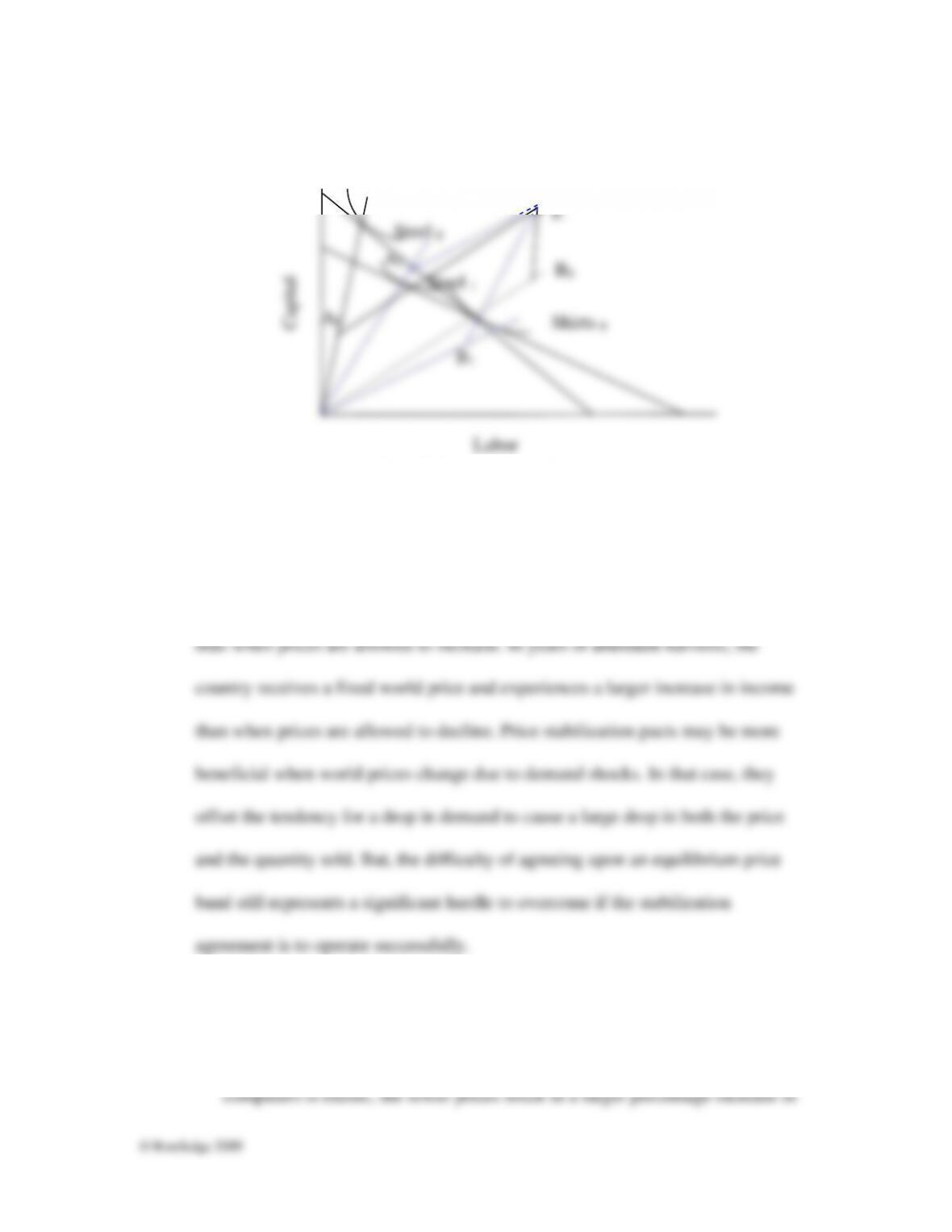
4. Use the Lerner diagram to demonstrate the expected shift in the production-possibility
curve of a country that experiences labor-using technical progress in its capital-
intensive sector. How is the capital–labor ratio in each industry affected? If the country
is large and labor-abundant, how will its terms of trade be affected?
5. Why may a price stabilization pact not be successful in reducing the volatility of the
export earnings of primary product producers, even when it successfully stabilizes
prices? What challenges do pacts face in successfully stabilizing prices?
6. Falling computer prices do not seem to be a source of hardship in industrial countries
that exported them in the 1980s and 1990s. Why are the falling prices of primary
commodities in LDCs a serious problem?
7. Vietnam increased its share of the world coffee market from 1 percent to 15 percent
over a 10-year period. Was this expansion of a primary product export likely to result in
immiserizing growth for Vietnam? When is that concern most relevant?
8. When many countries pursued policies of import substitution, their growth rates were
high in the 1960s and 1970s but fell in the 1980s. Is that evidence of the success of
these policies or the limits of these policies?
9. “LDC tariffs intended to promote an industry may in fact inhibit development of the
LDCs’ most efficient industries.” Explain how this could happen.

10. Why is it difficult for a country to pursue import substitution and export promotion at the
same time? What policies are called for under each strategy?
11. Is there an economic rationale for countries to adopt different pollution control
standards? Under what circumstances will their choices have little influence on the
location of production and trade internationally?
12. The E.U. established an Emission Trading Scheme in 2005 that applied to large
installations like power plants. The price of being allowed to emit a ton of CO2 fell in
2006 and 2007 because national governments distributed so many allowances that
little cleanup was required. If those allowances are reduced in the future, how do you
expect that to affect E.U. production and trade?
INTERNATIONAL ECONOMICS, 7TH EDITION
Study Resources: Questions for Study & Review
Chapter 11: Answers
1. In the 2-good H-O model an increase in the capital stock of 5 percent results in a
greater than 5 percent expansion of output of the capital-intensive good and a
2. At unchanged prices, an economy whose capital stock increases (all else constant)
will increase its production of capital-intensive goods and reduce its production of
3. Because a large country can influence its terms of trade, it is important to
distinguish whether the country spends a disproportionately large share of any
4. Consider a country that produces steel (capital-intensive) and shirts (labor-
intensive). A new steel production technology that is labor using will shift the unit
value isoquant for steel inward as shown, from Steel0 to Steel1. At the initial
wage-rental ratio, the new capital-labor ratio in steel is smaller. For the same
output price but a different technology, however, the wage-rental ratio will not
Steel 0
• E
5. Price stabilization pacts do not stabilize a country’s export earnings if the reason
for volatility is due to a change in its supply conditions. In years of small harvests,
the country receives the fixed world price and suffers a larger reduction in income
6. Falling computer prices may result from the declining cost of inputs because
supplying firms move down their learning curves and are able to produce
memory chips or other components more cheaply. Because demand for
7. Vietnam is unlikely to suffer from immiserizing growth as it expands its coffee
output and exports, because its initial share of the market was so small. Even
8. Rapid growth in the 1960s and 1970s under policies of import substitution
industrialization did allow the early stages of industrialization to occur. The
greater output per person achieved in the industrial sector exceeded any loss in
9. Developing country tariffs that protect intermediate inputs used in producing other
goods often create negative effective protection for goods that the country
potentially can export. If producers of the protected good can achieve economies
10. Countries cannot easily pursue import substitution and export promotion at the
same time because higher prices of protected goods often imply higher input costs
for other industries. The ERP for export industries becomes negative, unless the
11. Countries are likely to adopt different pollution control standards, because the
costs of environmental clean up or pollution abatement differ by location, and
countries may value the benefits of cleaner environment differently. If these
12. A cap and trade emission plan raises the cost of production for industries that
generate lots of CO2 emissions per unit of output. A country’s exports of such