111
CHAPTER 11
ECONOMIC GROWTH AND INTERNATIONAL TRADE
Learning Objectives:
■ Distinguish the different ways in which growth can affect trade.
■ Discuss how the source of growth affects the nature of the production-possibilities
I. Outline
Introduction
– China – A Regional Growth Pole
Classifying the Trade Effects of Economic Growth
– Trade Effects of Production Growth
– Trade Effects of Consumption Growth
II. Special Chapter Features
In the Real World: Labor and Capital Requirements per Unit of Output
In the Real World: “Spillovers” as a Contributor to Economic Growth
III. Purpose of Chapter
The purpose of this chapter is to demonstrate how economic growth affects international
trade and the possible welfare effects that accompany growth in the open economy.
IV. Teaching Tips
A. The chapter begins with an examination of the huge increase in China’s international
trade and its impact on economic growth. The interesting aspect is that the growth of Chinese
trade is also having an impact on South Korea, Taiwan, and even Japan. This is an example of
trade serving as a source of growth for an entire region.
B. In discussing the production and consumption effects of growth on international trade,
C. We chose to analyze the influence of technological change on growth only from the
standpoint of factor-neutral, commodity-specific change. If you have a special interest in growth
and trade, you might find it useful to note that economywide technological change can be factor-
specific as well. In this instance, the impact on the economy conceptually is analogous to that of
a factor-neutral change plus growth in availability of the affected factor, and can be analyzed as
such.
in per capita income associated with growth in labor alone to be effective (Concept Box 1).
G. Students find it surprising that only ultra-antitrade-biased growth shifts the offer curve to
the left (Concept Box 2). This gives you an opportunity to distinguish relative effects on trade
from absolute effects on trade.
H. Although there has been a tendency to pay less attention to the terms-of-trade issue in
1. The growth in only one factor leads, according to the Rybczynski theorem, to the
expansion of output in the good using intensively the growing factor and a contraction in output
of the good using intensively the non-growing factor. If the growing factor is the abundant
2. Yes. Because growth in the abundant factor will result in an ultra-protrade production
3. An inferior good is one whose consumption declines with growth in income. An absolute
4. The trading triangle could expand as in the small-country case as long as the Rybczynski
production effect (expansion in production of the import-competing good and contraction of the
export good) is more than offset by a sufficiently large ultra-protrade consumption effect
5. This would be the case when the country in question is a large country in terms of the
6. If constant or decreasing returns to scale characterize production of all commodities, then
increasing only one of the inputs by a given percentage, e.g., 10 percent, will result in output
rising by less than 10 percent. If the input in question is labor (population), then a 10 percent
114
7. The sluggish growth in the Japanese economy in the early 1990s meant that Japan’s
production-possibilities frontier (and hence its consumption-possibilities frontier) was not
shifting outward very rapidly. On the other hand, Japan’s major trading partners in Asia (e.g.,
8. The PPF of the unified Germany would lie outside that of the former Federal Republic of
Germany. In addition, since East Germany was relatively more labor-abundant than West
Germany, the new unified PPF will not have shifted out proportionally, but will have shifted
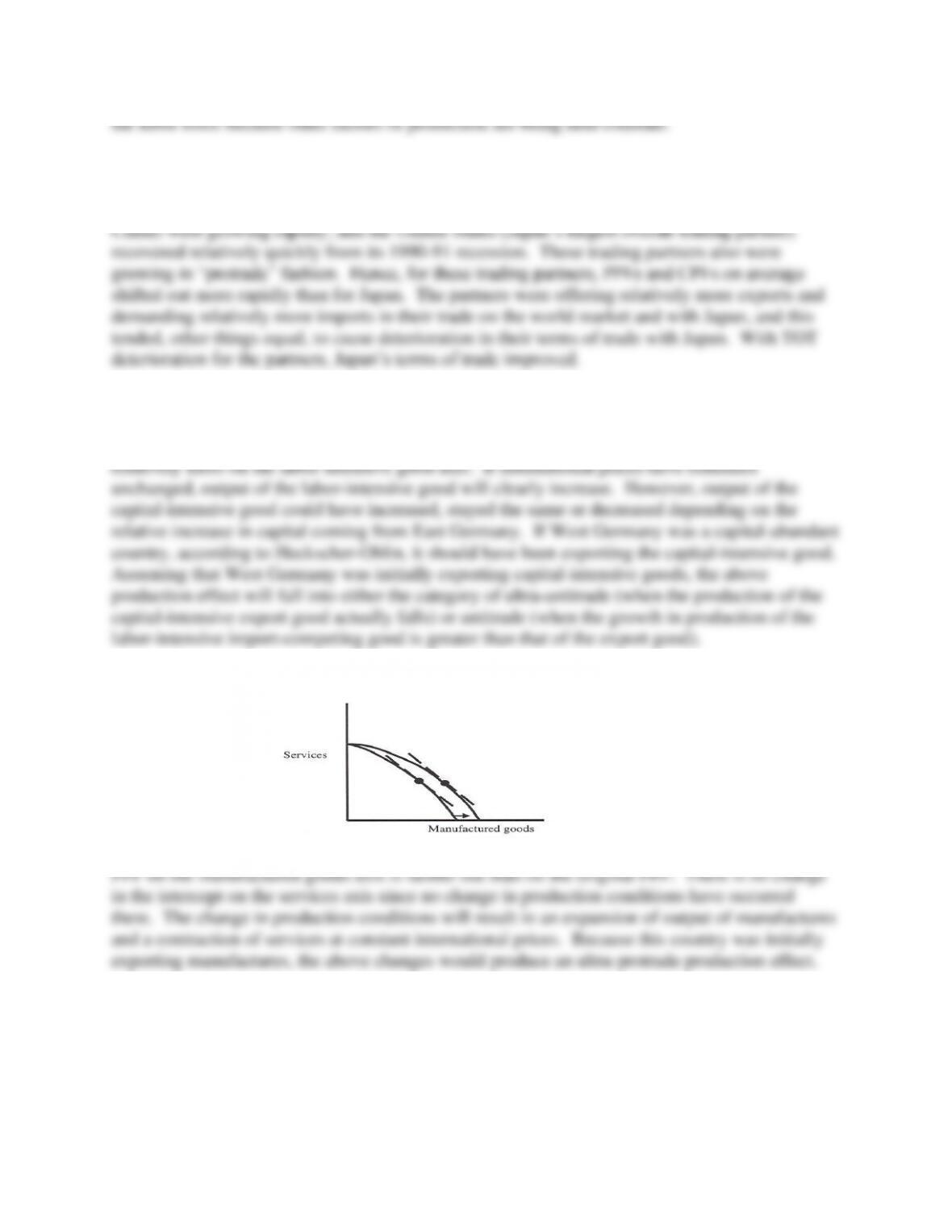
9.
Because the innovation was restricted to manufactured goods, the intercept of the new
10. (a) Volume of trade-2005: 20 units of exports of good X; 10 units of imports of good Y
Volume of trade-2010: 28 units of exports of good X; 14 units of imports of good Y
Volume of trade-2015: 30 units of exports of good X; 15 units of imports of good Y
115
(b) 2005-2010: There is a protrade production effect because although production of
both goods increased, production of the export good (X) increased by 20 percent whereas
the growth of production of the import good (Y) was only 10 percent.
11. Even if small developing countries are truly “small” in the sense that they cannot by their
own actions influence their own terms of trade, they can still experience a terms-of-trade decline
because of developments in their trading partner countries (i.e., the partners’ offer curves toward
the developing countries shift toward less willingness to trade). If demand shifts away from the
VI. Sample Exam Questions
A.
E
Es
ss
sa
ay
y
Q
Qu
ue
es
st
ti
io
on
ns
s
1. In recent decades, trade has been growing faster than income for many countries. What
combination of trade effects is sufficient for this to come about? Is this behavior consistent with
the Rybczynski theorem? Under what circumstances?
2. Why is it difficult to analyze the welfare implications of growth in the neoclassical
116
model? What proxy is often used to reach a conclusion about the effects of growth? What leads
3. Is it possible that growth in the scarce factor can actually lead to expanded trade in the
small-country case? Under what circumstances?
4. Developing countries often claim that growth and trade have left them no better off or
perhaps worse off. How might you explain this result theoretically? Could this result obtain if
the countries tended to be relatively small? Why or why not?
5. It is likely that a protrade production growth effect will lead to an expansion of trade
since the presence of inferior goods is relatively rare. Explain.
6. (a) Define the five types of “production effects” of economic growth in a country and the
five types of “consumption effects” of the economic growth. Then define the types of
possible “overall” or “net” effects of the country’s growth on the relative importance of
the trade sector.
7. (a) State the Rybczynski theorem. Then, in a two-factor, two-good Heckscher-Ohlin
context, illustrate and explain the “production effect” of growth in the labor force in a
relatively capital-abundant country, other things equal.
(b) In the situation of the labor force growth in part (a) above, suppose that the
8. (a) Define the five types of “production effects” of economic growth in a country. Other
things equal, if one factor of production in a country (either labor or capital) grows, what
are the only two types of production effects that are possible because of the growth in this
factor? Briefly explain.
(b) Define the five types of “consumption effects” of economic growth in a country?
Why can economists usually rule out two of these types when discussing likely
possibilities in the “real–world” growth of countries?