Chapter 11
International Debt Financing
QUESTIONS
1. What are the three main sources of financing for any firm?
2. What is the difference between a centralized and decentralized debt denomination
for a MNC?
3. Will a MNC issuing debt in low–interest rate currencies necessarily lower its cost of
funds? Why?
4. Should a MNC borrow primarily short term when short-term interest rates are
lower than long-term interest rates? Or should it keep the maturity the same but use
a floating-rate loan rather than a fixed-rate loan? Explain.
©2017 Cambridge University Press
5. What is financial disintermediation?
6. What are the two main segments of the international bond market, and what types
of regulations apply to them?
7. What is the difference between a foreign bond and a Eurobond?
Answer: See the answer to Question 6.
8. Why might U.S. investors continue to purchase Eurobonds, despite the fact that the
U.S. corporate bond market is well developed?
9. What is a global bond, and what role does the global bond market play in the
blurring of the distinctions in the international bond market?
Chapter 11: International Debt Financing
3
10. What are the differences between a straight bond, a floating-rate note, and a
convertible bond?
11. What is a dual-currency bond?
12. What kind of activities do international banks engage in?
13. Why is there a need for international banking regulation?
Answer: First, central banks are concerned that without an international regulatory
framework to ensure that an adequate level of capital is maintained in the international
©2017 Cambridge University Press
19. What is an offshore center?
20. What is the difference between an Edge Act bank and an international banking
facility?
Answer: Edge Act banks are federally chartered subsidiaries of U.S. banks that are
physically located in the United States but are allowed to engage in a full range of
international banking activities. Such activities include accepting deposits from foreign
21. What is the difference between a Eurocredit, a Euronote, and a Euro-medium-term
note?
©2017 Cambridge University Press
22. Why are Eurocredits not extended by one bank but by a large syndicate of banks?
23. What is the all-in cost of a 5-year loan? What are its main components?
24. What is a credit rating? What is a credit spread?
25. Should corporations issue bonds in countries where they face the lowest credit
spreads? Be very specific about the concept of credit spread you use.
Chapter 11: International Debt Financing
7
PROBLEMS
1. In 1985, R.J. Reynolds (RJR for short) acquired Nabisco Brands and financed the
deal with a variety of financial instruments, including three dual-currency
Eurobonds. The first dual-currency bond, lead-managed by Nikko, raised JPY25
billion (which was equivalent to USD105.5 million at the time of issue). Coupons
were paid in yen, but the required final principal payment was not JPY25 billion
but USD115.956 million. The coupon was 7.75%, even though a comparable fixed–
rate Euroyen bond at that time carried only a 6.375% coupon. The actual 5-year
forward rate at the time was around JPY200/USD.
a. Given the “fat” coupon, is this bond necessarily a great deal for the investors?
Answer: No, it isn’t a particularly great deal for the investor because the payment at the
end is worth substantially less than the face amount of the bond. To see this, note that the
yen value of final payment can be found by multiplying the USD115.956 million by the
forward rate: USD115.956 million
JPY200/USD = JPY23.191 billion
which is less than JPY25 billion, the original principal.
Of course, the coupon is higher than the coupon on a straight Euroyen bond, so we
shouldn’t expect the final principal payment to be JPY25 billion otherwise the rate of
return on the bond would be 7.75%. If we hedge the dual currency bond and find the
internal rate of return on the yen cash flows, we find the value, y, which sets the
discounted yen payoffs equal to the cost of the bonds:
( ) ( )
5
i5
i=1
0.0775 × ¥25billion (¥200/$) × $0.115956 billion
¥25 billion = +
1 + y 1 + y
Using Excel’s IRR command, we find that the internal rate of return on the bond is
6.48%, which is greater than the rate of return offered by the straight Euroyen bond.
Thus, the bond is a good deal for investors if they can hedge at the forward rate of
¥200/$.
b. At maturity, in August 1990, the exchange rate was actually JPY144/USD. Was
the bond a good deal for investors?
Answer: We need to calculate the return to investors if the investors were unhedged.
Chapter 11: International Debt Financing
8
by much more than was predicted by the forward rate. It is therefore also unlikely that the
“fat coupon” would have made up for this huge capital loss. In fact, it is straightforward
2. GBA Company wishes to raise $5,000,000 with debt financing. The funds will be
repaid with interest in 1 year. The treasurer of GBA Company is considering three
sources:
i. Borrow USD from Citibank at 1.50%
ii. Borrow EUR from Deutsche Bank at 3.00%
iii. Borrow GBP from Barclays at 4.00%
If the company borrows in euros or British pounds, it will not cover the foreign
exchange risk; that is, it will change foreign currency for dollars at today’s spot rate
and buy foreign currency back 1 year later at the spot rate prevailing then. The
GBA Company has no operations in Europe.
A representative of GBA contacts a local academic to provide projections of the spot
rates 1 year in the future. The academic comes up with the following table:
Currency
Spot Rate
Projected Rate 1 Year in the
Future
USD/GBP
1.5
1.55
USD/EUR
0.95
0.85
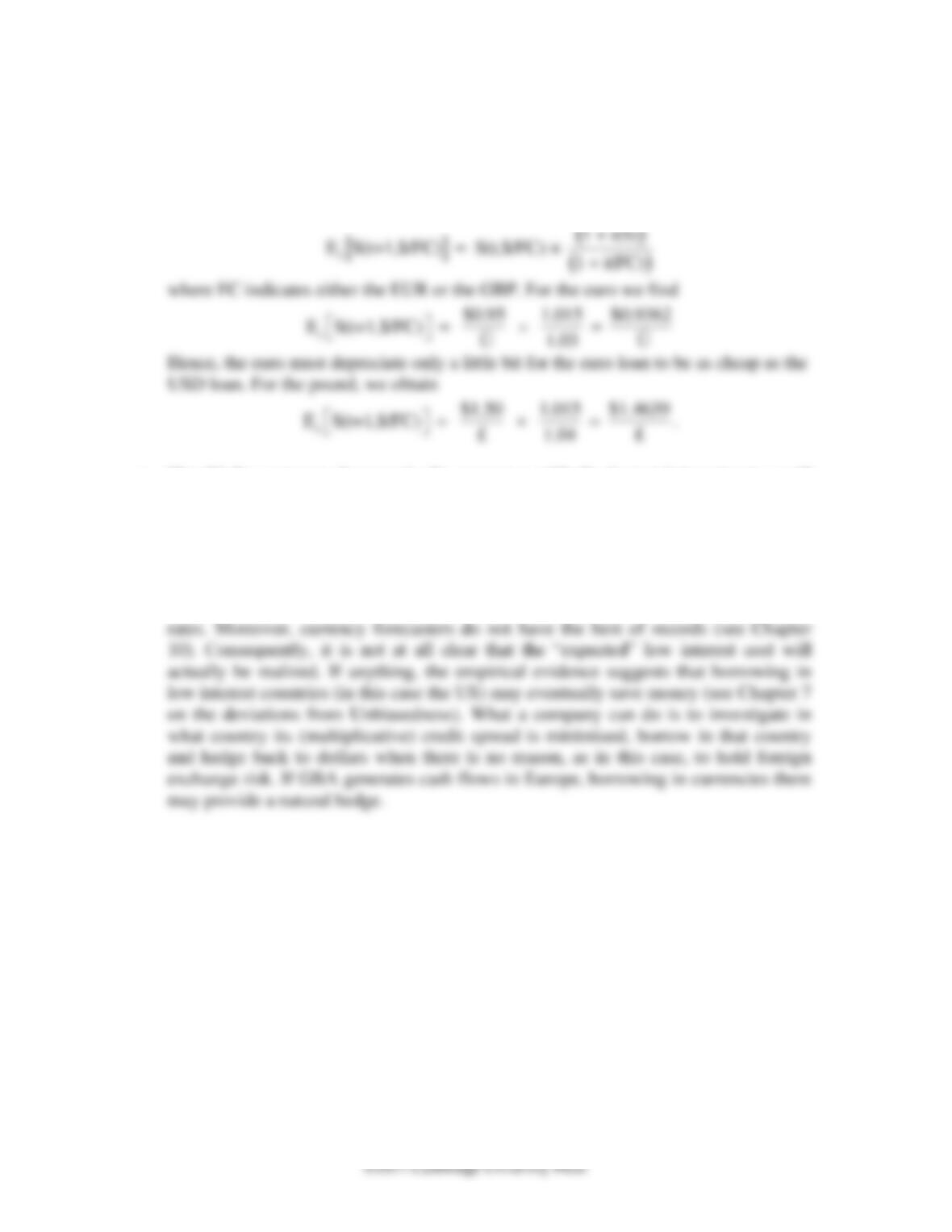
a. What is the expected interest rate cost for the loans in EUR and GBP?
Answer: For the EUR, the expected cost is
Chapter 11: International Debt Financing
9
b. What are the projected USD/GBP rate and USD/EUR rate for which the
expected interest costs would be the same for the three loans?
Answer: These are the exchange rates that satisfy Uncovered Interest Rate Parity,
( )
( )
t
1 + i($)
E S(t+1,$/FC) = S(t,$/FC) × 1 + i(FC)
where FC indicates either the EUR or the GBP. For the euro we find
EtS(t+1,$/FC)
= $0.95
Û 1.015
1.03 = $0.9362
Û
Hence, the euro must depreciate only a little bit for the euro loan to be as cheap as the
USD loan. For the pound, we obtain
EtS(t+1,$/FC)
= $1.50
£ 1.015
1.04 = $1.4639
£
.
c. Should the company borrow in the currency with the lowest interest rate cost?
Why or why not? Would your answer change if GBA did generate cash flows in
the United Kingdom and continental Europe?
Answer: When using the forecasts of the academic, the lowest interest cost occurs in
EUR. However, the academic’s forecast is quite far away from the “break–even” rates
computed in part b., which may be closely related to the market determined forward
3. FE Company wishes to raise $1,000,000 with debt financing. The treasurer of FE
Company considers two possible instruments:
i. A 2-year floating-rate note at 1% above 1-year dollar LIBOR on which interest
is paid once a year
ii. A 2-year bond with an interest rate of 5%
Currently, the dollar LIBOR is 1.50%.
a. Is it obvious which security the Treasurer should pick?
Answer: It is not at all obvious which debt to pick. While the two-year floating rate
starts out at a lower rate (2.50% versus 5%), it is not clear at all what the eventual
©2017 Cambridge University Press
4.50%. Which security has the lowest expected AIC if borrowing fees are similar
for the two instruments?
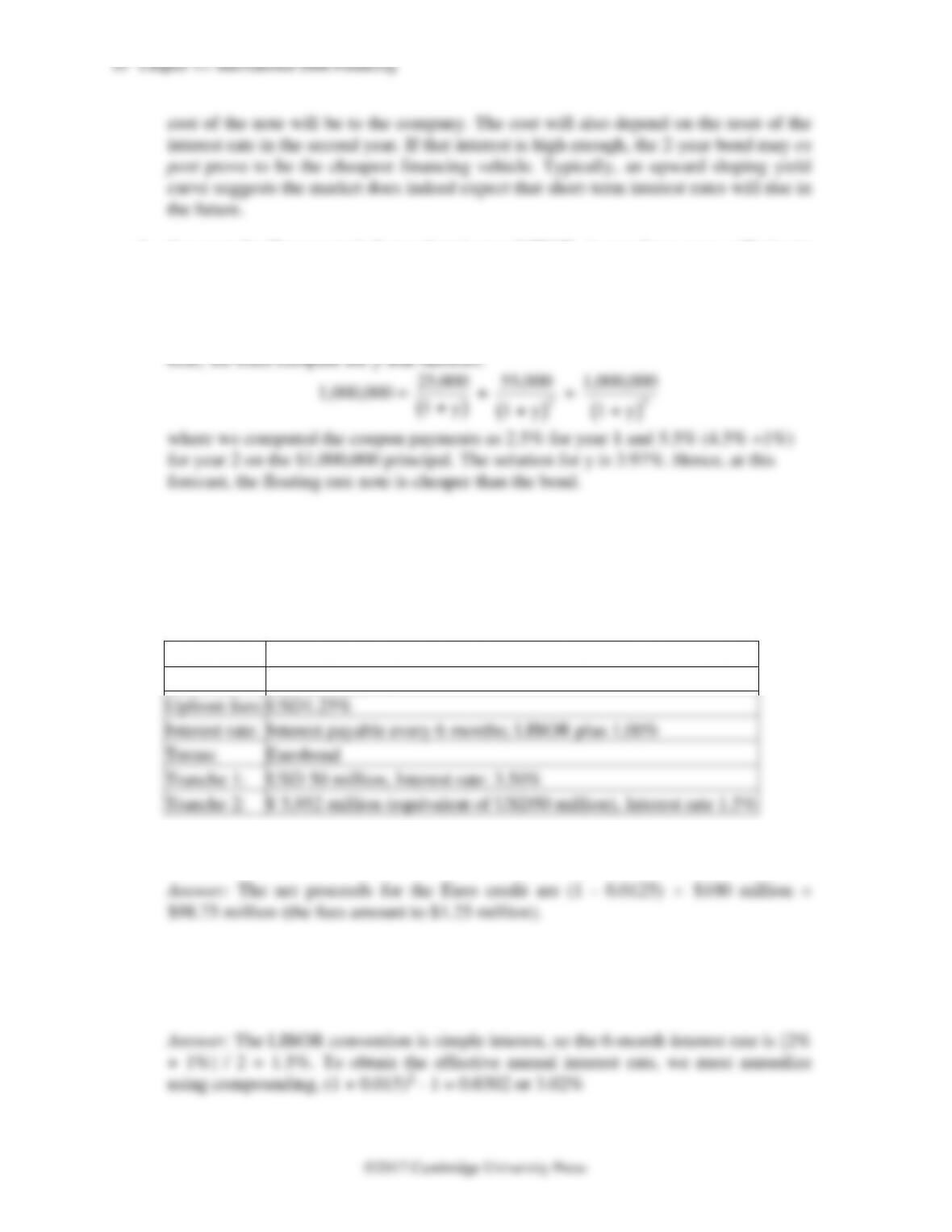
Answer: The AIC for the two-year bond is simply 5%. For the two-year floating rate
4. K3 Company wants to borrow $100 million for 5 years. Investment bankers propose
to either do a syndicated Eurocredit or issue a Eurobond. The Eurocredit would be
denominated in dollars, but the Eurobond would be denominated in different
currencies for different markets (these issues are called tranches):
Terms:
Syndicated Eurocredit
Amount:
USD100 million
Upfront fees:
USD1.25%
Interest rate:
Interest payable every 6 months; LIBOR plus 1.00%
Terms:
Eurobond
Tranche 1:
USD 50 million, Interest rate: 3.50%
Tranche 2:
¥ 5,952 million (equivalent of USD50 million), Interest rate 1.5%
a. What are the net proceeds in USD for K3 for the Eurocredit loan?
Answer: The net proceeds for the Euro credit are (1 – 0.0125)
$100 million =
$98.75 million (the fees amount to $1.25 million).
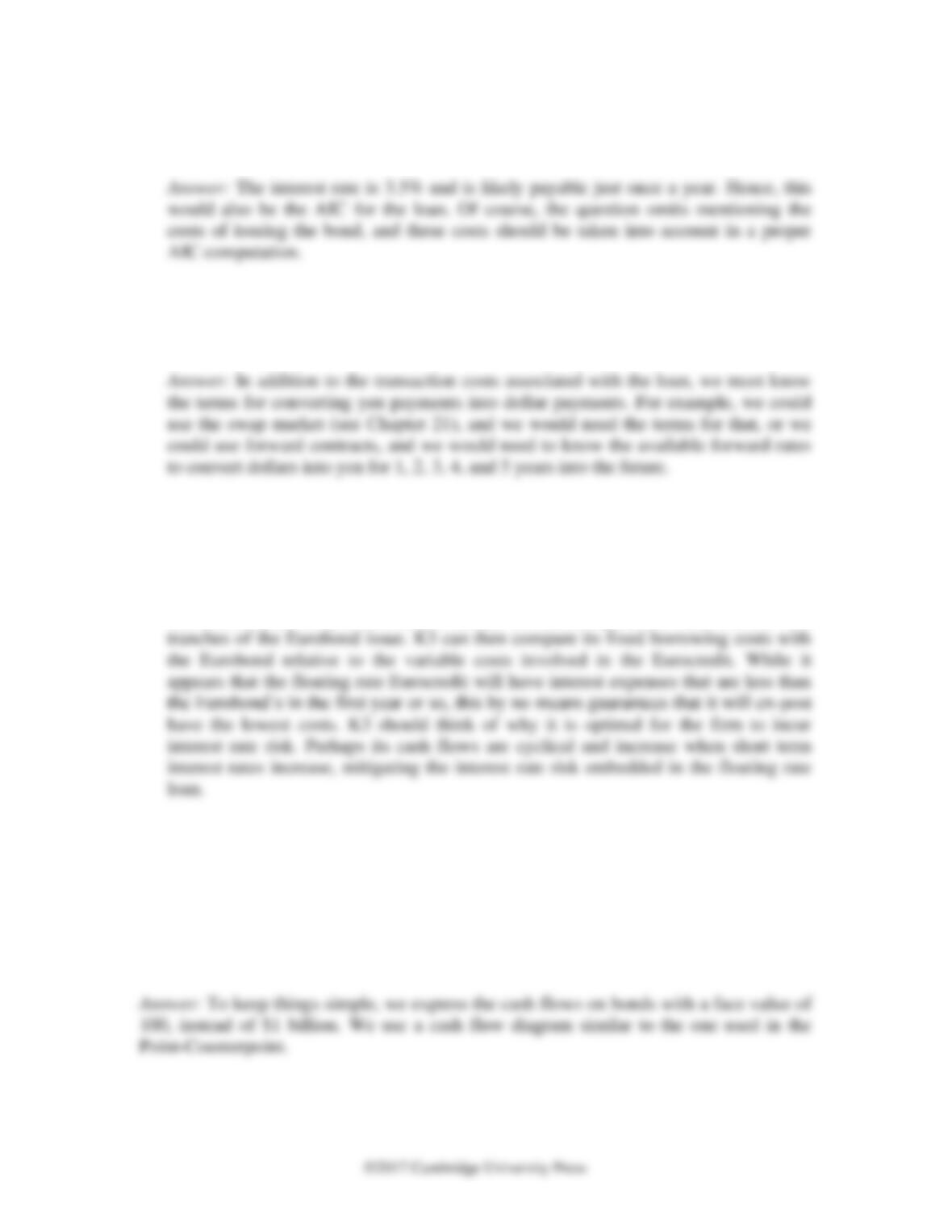
b. Assuming that the 6-month LIBOR in USD is currently at 2.00%, what is the
effective annual interest cost for K3 for the first 6 months of the loan?
Chapter 11: International Debt Financing
11
c. Compute an effective annualized interest rate cost (all-in cost) for the USD
tranche of the Eurobond.
Answer: The interest rate is 3.5% and is likely payable just once a year. Hence, this
d. What information would you need to obtain the dollar all-in cost of the yen
tranche?
Answer: In addition to the transaction costs associated with the loan, we must know
e. What elements would you take into account to choose between the two
possibilities?
Answer: With all the information given above (interest rate costs, loan issuance costs,
and information on yen conversion rates); we can compute the AICs on the two
5. Suppose Intel wishes to raise USD1 billion and is deciding between a domestic dollar
bond issue and a Eurobond issue. The U.S. bond can be issued at a 5-year maturity
with a coupon of 4.50%, paid semiannually. The underwriting, registration, and
other fees total 1.00% of the issue size. The Eurobond carries a lower annual coupon
of 4.25%, but the total costs of issuing the bond runs to 1.25% of the issue size.
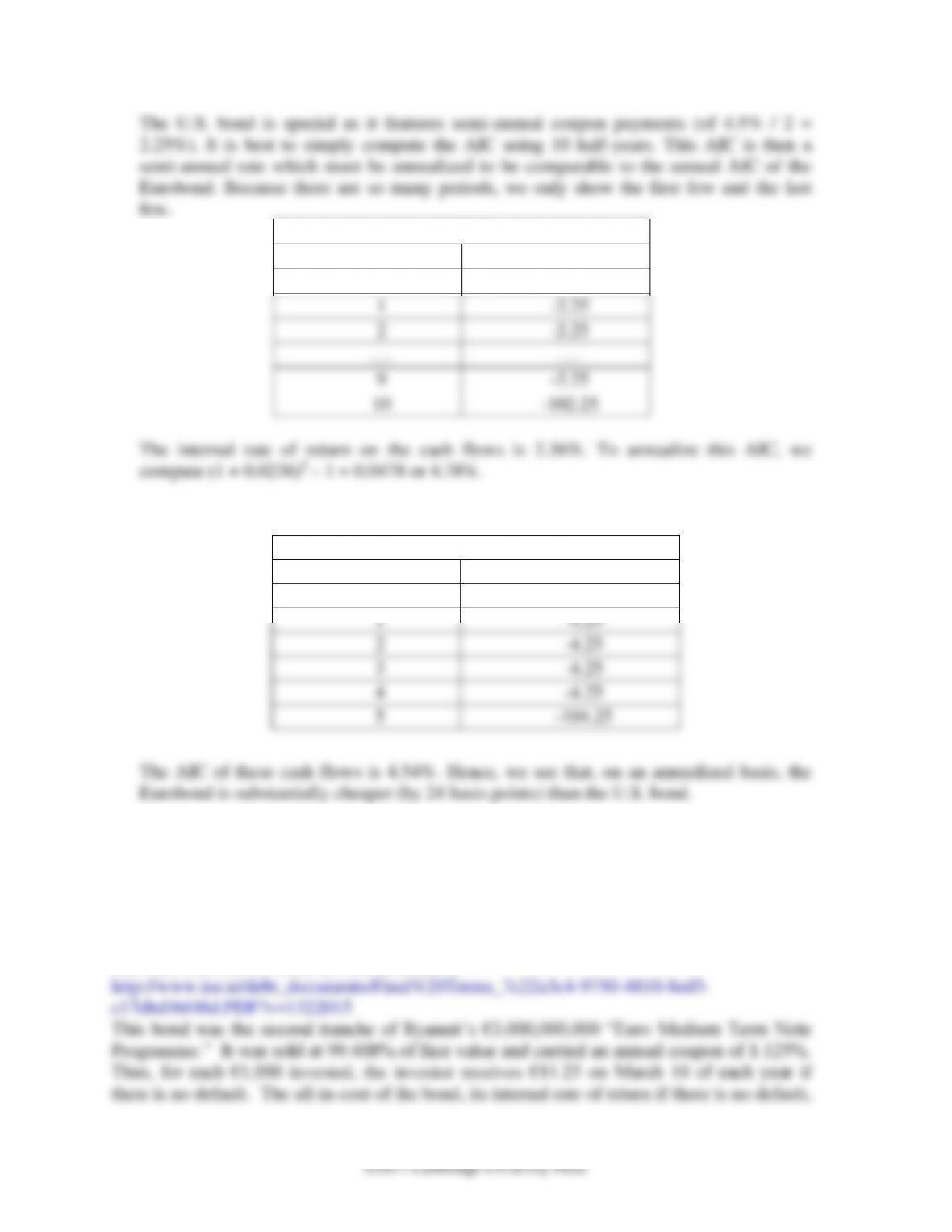
Which loan has the lowest all-in cost?
Chapter 11: International Debt Financing
12
1. US Bond
Half-Year
Dollar Cash Flows
0
100 – 1.00 = 99.00
1
-2.25
2
-2.25
….
….
9
-2.25
10
-102.25
The internal rate of return on the cash flows is 2.36%. To annualize this AIC, we
compute (1 + 0.0236)2 – 1 = 0.0478 or 4.78%.
For the Eurobond, the computations are more standard:
1
3
4
5
6. Web Question: In March 2015, Ryanair, an Irish airline company, issued a
€850 million 8-year bond. Look up more details about this issue. What type
of bond is it? How was it rated? What is the credit spread associated with the
bond?
The final terms of the bond are documented in
2. Eurobond
Year
Euro Cash Flows
0
100 – 1.25 = 98.75
©2017 Cambridge University Press