
Chapter 11
Managing Transaction Exposure
Lecture Outline
Policies for Hedging Transaction Exposure
Hedging Most of the Exposure
Selective Hedging
Hedging Exposure to Payables
Forward or Futures Hedge on Payables
Money Market Hedge on Payables
Call Option Hedge on Payables
Comparison of Techniques for Hedging Payables
Evaluating Past Decisions on Hedging Payables
Hedging Receivables
Forward or Futures Hedge
Money Market Hedge
Put Option Hedge
Limitations of Hedging
Limitation of Hedging an Uncertain Payment
Limitation of Repeated Short-term Hedging
Alternative Methods to Reduce Exchange Rate Risk
Leading and Lagging
Cross-Hedging
Currency Diversification

Managing Transaction Exposure ❖ 2
Chapter Theme
A primary objective of the chapter is to provide an overview of hedging techniques. Yet, transaction
exposure cannot always be hedged in all cases. Even when it can be hedged, the firm must decide
whether a hedge is feasible. An MNC can incorporate its expectations about future exchange rates, future
inflows and outflows, as well as its degree of risk aversion to make hedging decisions.
Topics to Stimulate Class Discussion
1. Is transaction exposure relevant?
2. Why should a firm bother identifying net transaction exposure?
3. Should management of transaction exposure be conducted at the subsidiary level or at the centralized
level? Why?
POINT/COUNTER-POINT:
Should an MNC Risk Overhedging?
POINT: Yes. MNCs have some “unanticipated” transactions that occur without any advance notice. They
should attempt to forecast the net cash flows in each currency due to unanticipated transactions based on
the previous net cash flows for that currency in a previous period. Even though it would be impossible to
forecast the volume of these unanticipated transactions per day, it may be possible to forecast the volume
on a monthly basis. For example, if an MNC has net cash flows between 3,000,000 and 4,000,000
Philippine pesos every month, it may presume that it will receive at least 3,000,000 pesos in each of the
next few months unless conditions change. In this case, it can hedge a position of 3,000,0000 in pesos by
selling that amount of pesos forward or buying put options on that amount of pesos. Any amount of net
cash flows beyond 3,000,000 pesos will not be hedged, but at least the MNC was able to hedge the
minimum expected net cash flows.
COUNTER-POINT: No. MNCs should not hedge unanticipated transactions. When they overhedge the
expected net cash flows in a foreign currency, they remain exposed to exchange rate risk. If they sell more
currency as a result of forward contracts than their net cash flows, they will be adversely affected by an
increase in the value of the currency. Their initial reasons for hedging were to protect against the
weakness of the currency, but the overhedging described here would simply shift their exposure.
Overhedging does not insulate an MNC against exchange rate risk. It just changes the means by which the
MNC is exposed.
WHO IS CORRECT? Use the Internet to learn more about this issue. Offer your own opinion on this
issue.
Managing Transaction Exposure ❖ 3
ANSWER: If the MNC is confident that it will receive net cash flows in a currency that will likely
Answers to End of Chapter Questions
1. Hedging in General. Explain the relationship between hedging (discussed in this chapter)
measuring exposure (discussed in Chapter 10).
2. Money Market Hedge on Receivables. Assume that Stevens Point Co. has net receivables of
100,000 Singapore dollars in 90 days. The spot rate of the S$ is $.50, and the Singapore interest rate
is 2% over 90 days. Suggest how the U.S. firm could implement a money market hedge. Be precise.
3. Money Market Hedge on Payables. Assume that Hampshire Co. has net payables of 200,000
Mexican pesos in 180 days. The Mexican interest rate is 7% over 180 days, and the spot rate of the
Mexican peso is $.10. Suggest how the U.S. firm could implement a money market hedge. Be
precise.
4. Net Transaction Exposure. Why should an MNC identify net exposure before hedging?
5. Hedging with Futures. Explain how a U.S. corporation could hedge net receivables in euros with
futures contracts. Explain how a U.S. corporation could hedge net payables in Japanese yen with
futures contracts.
6. Hedging with Forward Contracts. Explain how a U.S. corporation could hedge net receivables in
Malaysian ringgit with a forward contract.
Explain how a U.S. corporation could hedge payables in Canadian dollars with a forward contract.
7. Real Cost of Hedging Payables. Assume that Loras Corp. imported goods from New Zealand and
needs 100,000 New Zealand dollars 180 days from now. It is trying to determine whether to hedge
this position. Loras has developed the following probability distribution for the New Zealand dollar:
Possible Value of
New Zealand Dollar in 180 Days Probability
$.40 5%
.45 10%
.48 30%
.50 30%
.53 20%
.55 5%
The 180–day forward rate of the New Zealand dollar is $.52, and the spot rate of the New Zealand dollar is
$.49. Develop a table showing a feasibility analysis for hedging. That is, determine the possible
differences between the costs of hedging versus no hedging. What is the probability that hedging will be
more costly to the firm than not hedging? Determine the expected value of the additional cost of hedging.
ANSWER:
Possible Spot Rate
of New Zealand
Dollar
Probability
Nominal Cost of
Hedging 100,000
NZ$
Amount of U.S.
Dollars Needed to
Buy 100,000 NZ$ if
Firm Remains
Unhedged
Real Cost of
Hedging
$.40
5%
$52,000
$40,000
$12,000
$.45
10%
$52,000
$45,000
$7,000
$.48
30%
$52,000
$48,000
$4,000
$.50
30%
$52,000
$50,000
$2,000
$.53
20%
$52,000
$53,000
-$1,000
$.55
5%
$52,000
$55,000
-$3,000
ANSWER: There is a 75% probability that hedging will be more costly than no hedge.
5%($12,000) + 10%($7,000) + 30%($4,000) + 30%($2,000) + 20%(–$1,000) + 5%(–$3,000)
= $600 + $700 + $1200 + $600 – $200 – $150

© 2021 Cengage Learning. All Rights Reserved. May not be copied, scanned, or duplicated, in whole or in part, except for use as
permitted in a license distributed with a certain product or service or otherwise on a password-protected website for classroom use.
8. Benefits of Hedging. If hedging is expected to be more costly than not hedging, why would a firm
even consider hedging?
9. Real Cost of Hedging Payables. Assume that Suffolk Co. negotiated a forward contract to purchase
200,000 British pounds in 90 days. The 90-day forward rate was $1.40 per British pound. The
pounds to be purchased were to be used to purchase British supplies. On the day the pounds were
delivered in accordance with the forward contract, the spot rate of the British pound was $1.44. What
was the real cost of hedging the payables for this U.S. firm?
10. Hedging Decision. Kayla Co. imports products from Mexico, and it will make payment in pesos
in 90 days. Interest rate parity holds. The prevailing interest rate in Mexico is very high, which
reflects the high expected inflation there. Kayla expects that the Mexican peso will depreciate over
the next 90 days, yet, it plans to hedge its payables with a 90-day forward contract. Why may Kayla
believe that it will pay a smaller amount of dollars when hedging than if it remains unhedged?
11. Hedging Payables. Assume the following information:
90-day U.S. interest rate = 4%
90-day Malaysian interest rate = 3%
90-day forward rate of Malaysian ringgit = $.400
Spot rate of Malaysian ringgit = $.404
Assume that the Santa Barbara Co. in the United States will need 300,000 ringgit in 90 days. It
wishes to hedge this payables position. Would it be better off using a forward hedge or a money
market hedge? Substantiate your answer with estimated costs for each type of hedge.
ANSWER: If the firm uses the forward hedge, it will pay out 300,000($.400) = $120,000 in 90 days.
12. Hedging Decision on Receivables. Assume the following information:
180-day U.S. interest rate = 8%
180-day British interest rate = 9%
180-day forward rate of British pound = $1.50
Spot rate of British pound = $1.48
Assume that Riverside Corp. from the United States will receive 400,000 pounds in 180 days. Would
it be better off using a forward hedge or a money market hedge? Substantiate your answer with
estimated revenue for each type of hedge.
ANSWER: If the firm uses a forward hedge, it will receive 400,000($1.50) = $600,000 in 180 days.
13. Currency Options. Relate the use of currency options to hedging net payables and receivables. That
is, when should a firm purchase currency puts, and when should it purchase currency calls? Why
would Cleveland, Inc., consider hedging net payables or net receivables with currency options rather
than forward contracts? What are the disadvantages of hedging with currency options as opposed to
forward contracts?
14. Currency Options. Can Brooklyn Co. determine whether currency options will be more or less
expensive than a forward hedge when considering both hedging techniques to cover net payables in
euros? Why or why not?
15. Long-term Hedging. How can a firm hedge its long-term currency positions? Elaborate on each
method.
© 2021 Cengage Learning. All Rights Reserved. May not be copied, scanned, or duplicated, in whole or in part, except for use as
permitted in a license distributed with a certain product or service or otherwise on a password-protected website for classroom use.
16. Leading and Lagging. Under what conditions would Zona Co.’s subsidiary consider using a
“leading” strategy to reduce transaction exposure? Under what conditions would Zona Co.’s
subsidiary consider using a “lagging” strategy to reduce transaction exposure?
17. Cross-Hedging. Explain how a firm can use cross-hedging to reduce transaction exposure.
18. Currency Diversification. Explain how a firm can use currency diversification to reduce its
transaction exposure.
19. Hedging with Put Options. As treasurer of Tucson Corp. (a U.S. exporter to New Zealand), you
must decide how to hedge (if at all) future receivables of 250,000 New Zealand dollars 90 days from
now. Put options are available for a premium of $.03 per unit and an exercise price of $.49 per New
Zealand dollar. The forecasted spot rate of the NZ$ in 90 days follows:
Future Spot Rate Probability
$.44 30%
.40 50
.38 20
Given that you hedge your position with options, create a probability distribution for U.S. dollars to
be received in 90 days.
ANSWER:
Possible
Spot Rate
Put Option
Premium
Exercise
Option?
Amount per
Unit Received
Accounting
for Premium
Total Amount
Received for
NZ$250,000
Probability
$.44
$.03
Yes
$.46
$115,000
30%
$.40
$.03
Yes
$.46
$115,000
50%
$.38
$.03
Yes
$.46
$115,000
20%
20. Forward Hedge. Would Oregon Co.’s real cost of hedging Australian dollar payables every 90 days
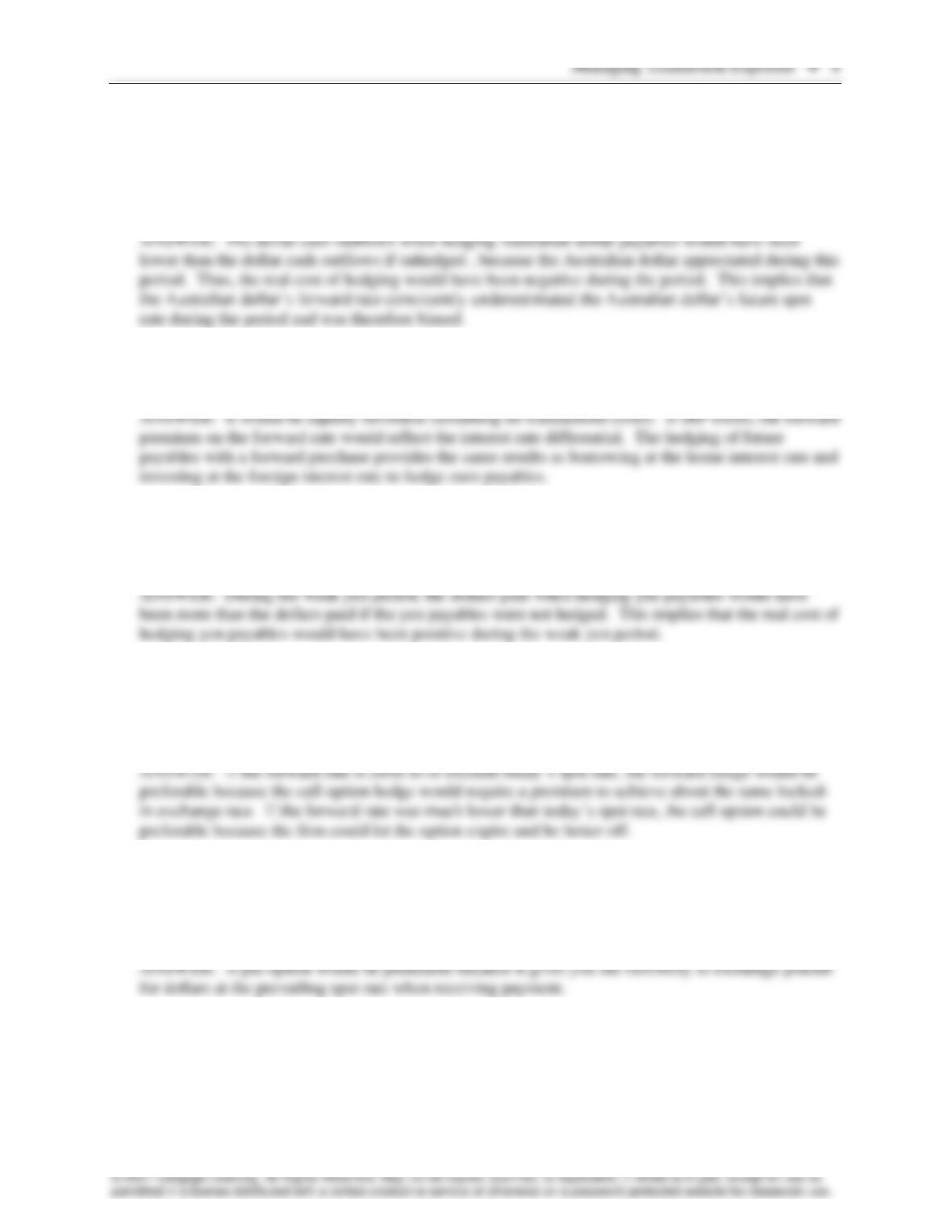
have been positive, negative, or about zero on average over a period in which the Australian dollar
strengthened consistently? What does this imply about the forward rate as an unbiased predictor of
the future spot rate? Explain.
21. Implications of IRP for Hedging. If interest rate parity exists, would a forward hedge be more
favorable than, the same as, or less favorable than a money market hedge on euro payables? Explain.
22. Real Cost of Hedging. Would Montana Co.’s real cost of hedging Japanese yen payables have been
positive, negative, or about zero on average over a period in which the yen weakened consistently?
Explain.
23. Forward versus Options Hedge on Payables. Suppose your firm is a U.S. importer of Mexican goods
and you believe that today’s forward rate of the peso is a very accurate estimate of the future spot rate.
Do you think Mexican peso call options would be a more appropriate hedge than the forward hedge?
Explain.
24. Forward versus Options Hedge on Receivables. Your firm exports of goods to the United
Kingdom, and you believe that today’s forward rate of the British pound substantially underestimates
the future spot rate. Company policy requires you to hedge your British pound receivables in some
way. Would a forward hedge or a put option hedge be more appropriate? Explain.
25. Forward Hedging. Explain how a Malaysian firm can use the forward market to hedge periodic
purchases of U.S. goods denominated in U.S. dollars. Explain how a French firm can use forward
contracts to hedge periodic sales to United States importers that are invoiced in dollars. Explain how a
British firm can use the forward market to hedge periodic purchases of Japanese goods denominated
in yen.
Managing Transaction Exposure ❖ 9
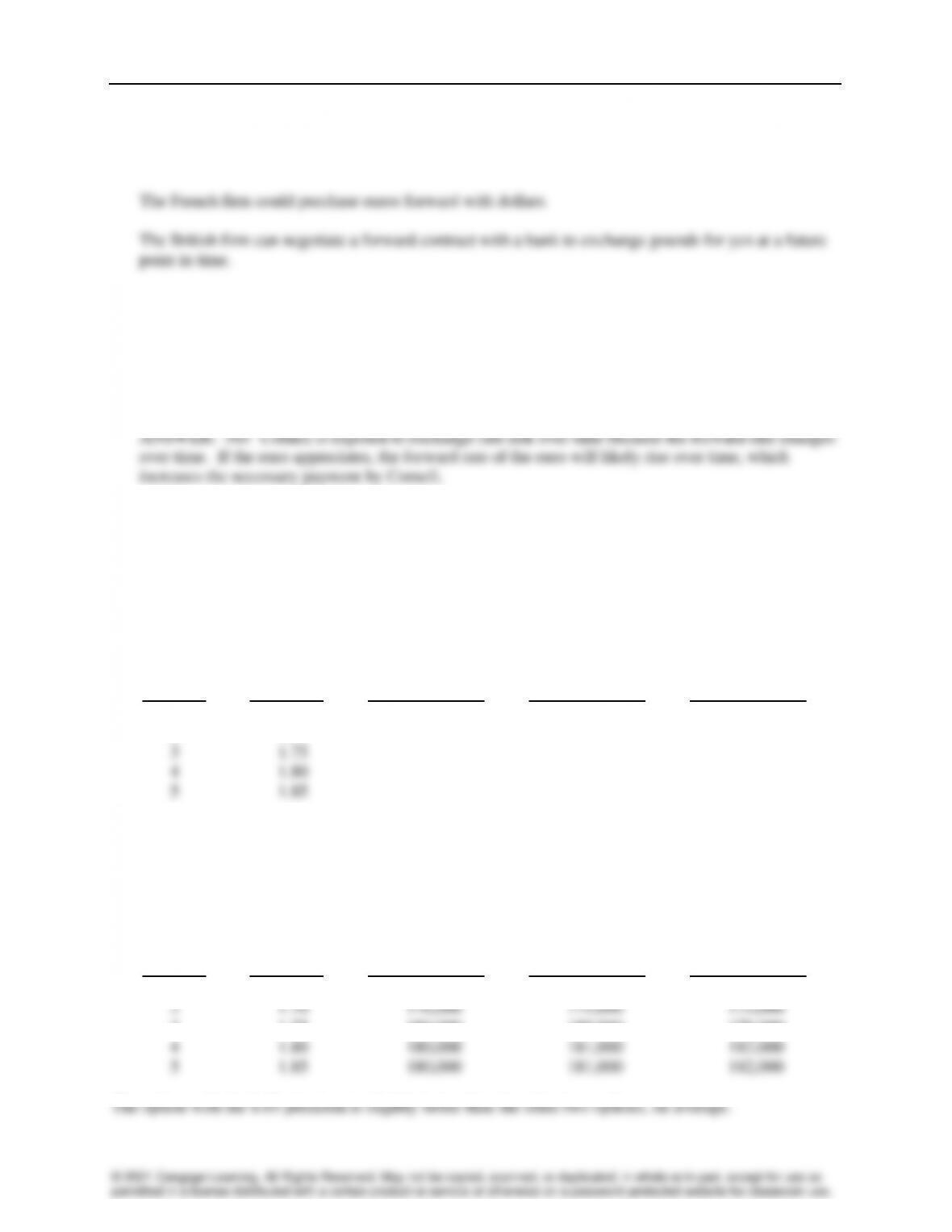
ANSWER: A Malaysian firm can purchase dollars forward with ringgit, which locks in the exchange
rate at which it trades its ringgit for dollars.
26. Continuous Hedging. Cornell Co. purchases computer chips denominated in euros on a monthly
basis from a Dutch supplier. To hedge its exchange rate risk, this U.S. firm negotiates a three-month
forward contract three months before the next order will arrive. In other words, Cornell is always
covered for the next three monthly shipments. Because Cornell consistently hedges in this manner, it
is not concerned with exchange rate movements. Is Cornell insulated from exchange rate
movements? Explain.
27. Hedging Payables with Currency Options. Malibu, Inc., is a U.S. company that imports British
goods. It plans to use call options to hedge payables of 100,000 pounds in 90 days. Three call
options are available that have an expiration date 90 days from now. Fill in the number of dollars
needed to pay for the payables (including the option premium paid) for each option available under
each possible scenario.
Spot Rate
of Pound Exercise Price Exercise Price Exercise Price
90 Days = $1.74; = $1.76; = $1.79;
Scenario from Now Premium = $.06 Premium = $.05 Premium = $.03
1 $1.65
2 1.70
If each of the five scenarios had an equal probability of occurrence, which option would you choose?
Explain.
ANSWER:
Spot Rate
of Pound Exercise Price Exercise Price Exercise Price
90 Days = $1.74; = $1.76; = $1.79;
Scenario from Now Premium = $.06 Premium = $.05 Premium = $.03
1 $1.65 $171,000 $170,000 $168,000
3 1.75 180,000 180,000 178,000
28. Forward Hedging. Wedco Technology of New Jersey exports plastics products to Europe. Wedco
decided to price its exports in dollars. Telematics International, Inc. (of Florida), exports computer
network systems to the United Kingdom (denominated in British pounds) and other countries.
Telematics decided to use hedging techniques such as forward contracts to hedge its exposure.
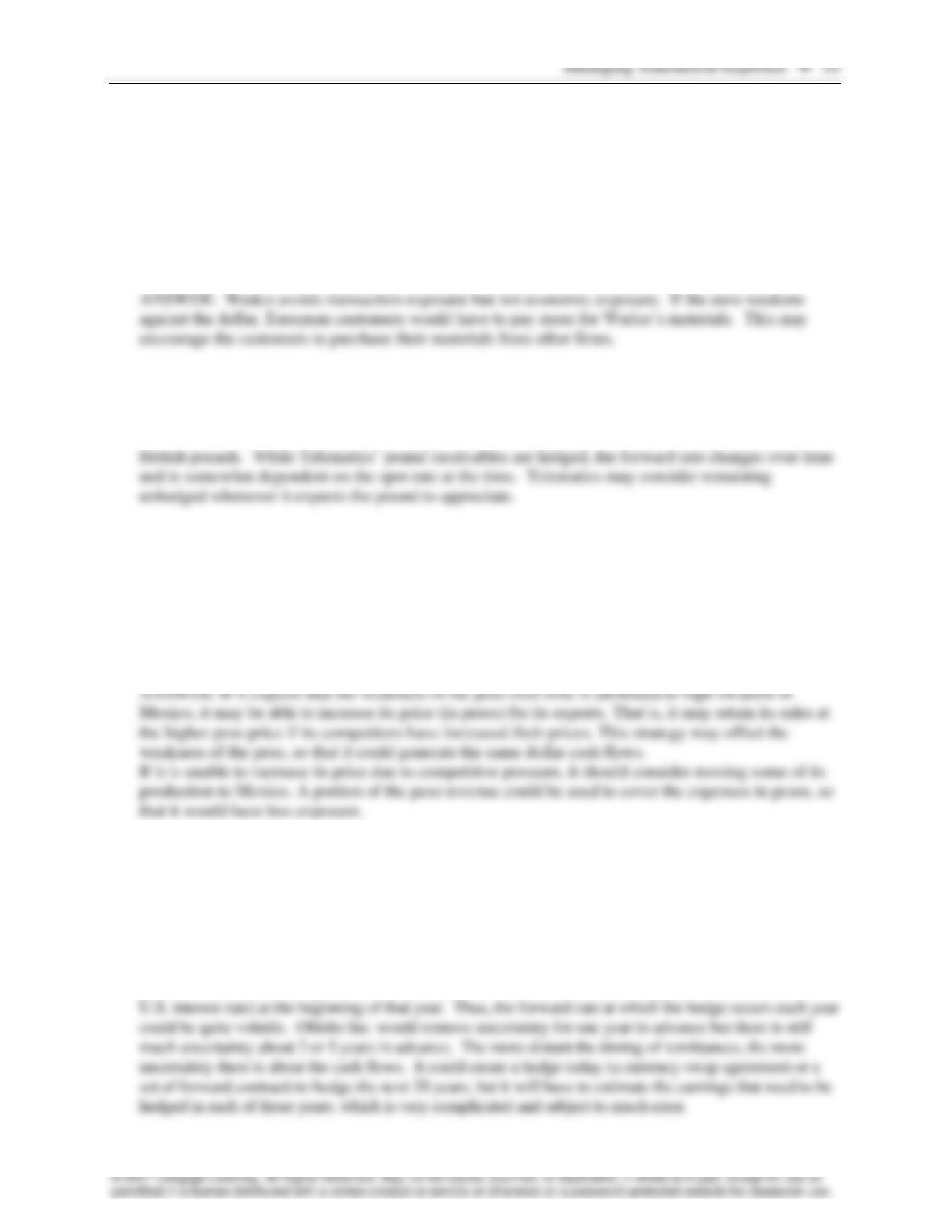
a. Does Wedco’s strategy of pricing its materials for European customers in dollars avoid economic
exposure? Explain.
b. Explain why the earnings of Telematics were affected by changes in the value of the pound. Why
might this firm leave its exposure unhedged sometimes?
ANSWER: Telematics International, Inc. has sales to European customers, which are denominated in
29. The Long-term Hedge Dilemma. St. Louis Inc., which relies on exporting, denominates its exports in
pesos and receives pesos every month. It expects the peso to weaken over time. St. Louis recognizes the
limitation of monthly hedging. It also recognizes that it could eliminate its transaction exposure by
denominating the exports in dollars but that it is still would be subject to economic exposure. The long-
term hedging techniques have limitations as the firm does not know how many pesos it will receive in
the future, so it would have difficulty even if a long-term hedging method was available. How can this
business realistically deal with this dilemma to reduce its exposure over the long-term?
30. Long-term Hedging. Since Obisbo Inc. conducts much business in Japan, it is likely to have cash
flows in yen that will periodically be remitted by its Japanese subsidiary to the U.S. parent. What are
the limitations of hedging these remittances one year in advance over each of the next 20 years?
What are the limitations of creating a hedge today that will hedge these remittances over each of the
next 20 years?
ANSWER: If Obisbo Inc. hedges one year in advance, the forward rate negotiated at the beginning of each
year will be based on the spot rate of the yen (and the difference between the Japanese interest rate and

31. Hedging during a Crisis. Describe how a crisis in Asia could reduce the cash flows of a U.S. firm
that exports products (denominated in U.S. dollars) to Asian countries. How could a U.S. firm that
exports products (denominated in U.S. dollars) to Asia insulate itself from any currency effects of a
future crisis while continuing to export to Asia?
ANSWER: The weakness of the Asian currencies would cause the Asian importers to reduce their
Advanced Questions
32. Comparison of Techniques for Hedging Receivables.
a. Assume that Carbondale Co. expects to receive S$500,000 in one year. The existing spot rate of
the Singapore dollar is $.60. The one-year forward rate of the Singapore dollar is $.62.
Carbondale created the following probability distribution for the future spot rate in one year:
Future Spot Rate Probability
$.61 20%
.63 50
.67 30
Assume that one-year put options on Singapore dollars are available, with an exercise price of
$.63 and a premium of $.04 per unit. One-year call options on Singapore dollars are available
with an exercise price of $.60 and a premium of $.03 per unit. Assume the following money
market rates:
U.S. Singapore
Deposit rate 8% 5%
Borrowing rate 9 6
Given this information, determine whether a forward hedge, money market hedge, or a currency
options hedge would be most appropriate. Then compare the most appropriate hedge to an
unhedged strategy and decide whether Carbondale should hedge its receivables position.
ANSWER:
Forward hedge
Money market hedge
Managing Transaction Exposure ❖ 12
© 2021 Cengage Learning. All Rights Reserved. May not be copied, scanned, or duplicated, in whole or in part, except for use as
permitted in a license distributed with a certain product or service or otherwise on a password-protected website for classroom use.
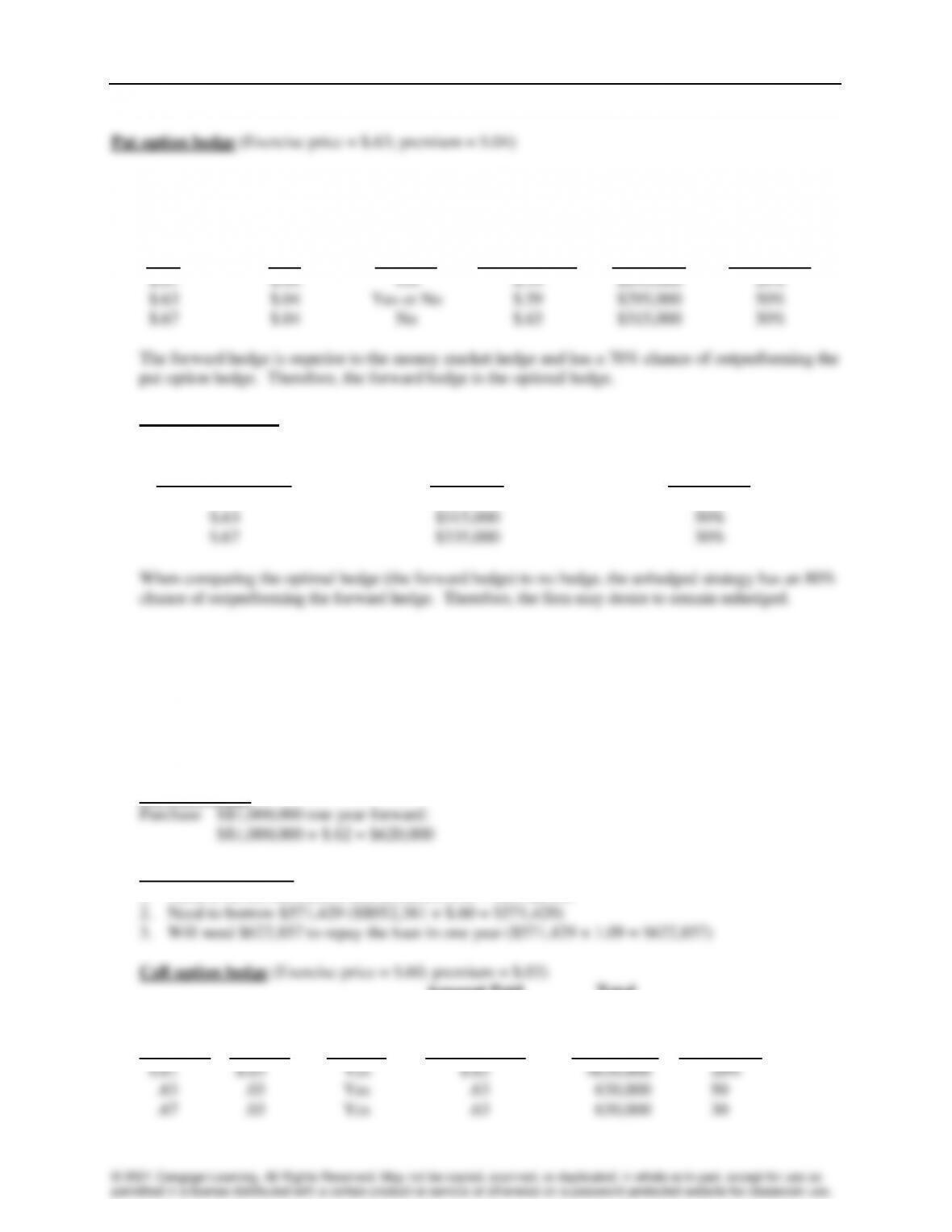
Put option hedge (Exercise price = $.63; premium = $.04)
Possible Spot
Rate
Option
Premium per
Unit
Exercise
Amount
Received per
Unit (also
accounting
for premium)
Total Amount
Received for
S$500,000
Probability
$.61
$.04
Yes
$.59
$295,000
20%
$.63
$.04
Yes or No
$.59
$295,000
50%
$.67
$.04
No
$.63
$315,000
30%
The forward hedge is superior to the money market hedge and has a 70% chance of outperforming the
put option hedge. Therefore, the forward hedge is the optimal hedge.
Unhedged Strategy
Possible Spot Rate
Total Amount Received for
S$500,000
Probability
$.61
$305,000
20%
$.63
$315,000
50%
$.67
$335,000
30%
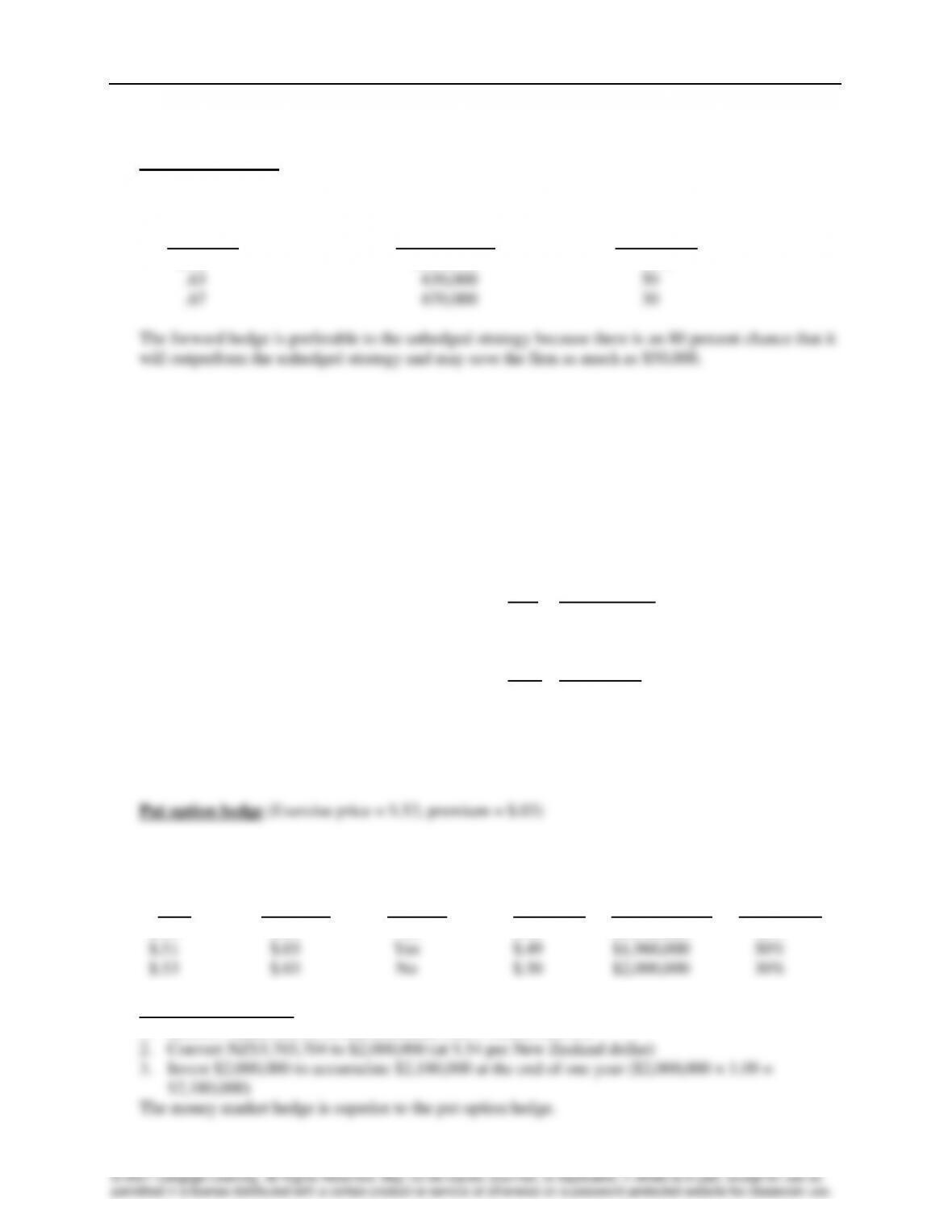
b. Assume that Baton Rouge, Inc. expects to need S$1 million in one year. Using any relevant
information in part (a) of this question, determine whether a forward hedge, a money market
hedge, or a currency options hedge would be most appropriate. Then, compare the most
appropriate hedge to an unhedged strategy, and decide whether Baton Rouge should hedge its
payables position.
ANSWER:
Forward hedge
Money market hedge
1. Need to invest S$952,381 (S$1,000,000/1.05 = S$952,381)
Amount Paid Total
Option per Unit Amount
Possible Premium Exercise (including Paid for
Spot Rate per Unit Option? the premium) S$1,000,000 Probability
Managing Transaction Exposure ❖ 13
The optimal hedge is the forward hedge.
Unhedged Strategy
Total
Possible Amount Paid
Spot Rate for S$500,000 Probability
$.61 $610,000 20%
33. Techniques for Hedging Receivables. SMU Corp. has future receivables of 4,000,000 New Zealand
dollars (NZ$) in one year. It must decide whether to use options or a money market hedge to hedge
this position. Use any of the following information to make the decision. Verify your answer by
determining the estimate (or probability distribution) of dollar revenue to be received in one year for
each type of hedge.
Spot rate of NZ$ = $.54
One-year call option: Exercise price = $.50; premium = $.07
One-year put option: Exercise price = $.52; premium = $.03
U.S. New Zealand
One-year deposit rate 9% 6%
One-year borrowing rate 11 8
Rate Probability
Forecasted spot rate of NZ$ $.50 20%
.51 50
.53 30
ANSWER:
Possible Spot
Rate
Put Option
Premium
Exercise
Option?
Amount per
Unit Received
Accounting
for Premium
Total Amount
Received
for
NZ$4,000,000
Probability
$.50
$.03
Yes
$.49
$1,960,000
20%
$.51
$.03
Yes
$.49
$1,960,000
50%
$.53
$.03
No
$.50
$2,000,000
30%
Money market hedge
1. Borrow NZ$3,703,704 (NZ$4,000,000/1.08 = NZ$3,703,704)

34. Exposure to September 11. If you were a U.S. importer of products from Europe, explain
whether the September 11, 2001 terrorist attack on the U.S. would have caused you to hedge your
payables (denominated in euros) due a few months later. Keep in mind that the attack was followed
by a reduction in U.S. interest rates.
ANSWER: The attack would have caused expectations of weak U.S. stock prices and lowered U.S.
35. Hedging with Forward versus Option Contracts. As treasurer of Tempe Corp., you are confronted
with the following problem. Assume the one-year forward rate of the British pound is $1.59. You
plan to receive 1 million pounds in one year. A one-year put option is available; it has an exercise
price of $1.61. The spot rate as of today is $1.62, and the option premium is $.04 per unit. Your
forecast of the percentage change in the spot rate was determined from the following regression
model:
et = a0 + a1DINFt-1 + a2DINTt + u
where et = percentage change in the value of the British pound over period t
DINFt-1 = differential in inflation between the United States and the United
Kingdom in period t–1
DINTt = average differential between the U.S. interest rate and the British
interest rate over period t
a0, a1, and a2 = regression coefficients
u = error term
The regression model was applied to historical annual data, and the regression coefficients were
estimated as follows:
a0 = 0.0
a1 = 1.1
a2 = 0.6
Assume last year’s inflation rates were 3 percent for the United States and 8 percent for the United
Kingdom. Also assume that the interest rate differential (DINTt) is forecasted as follows for this
year:
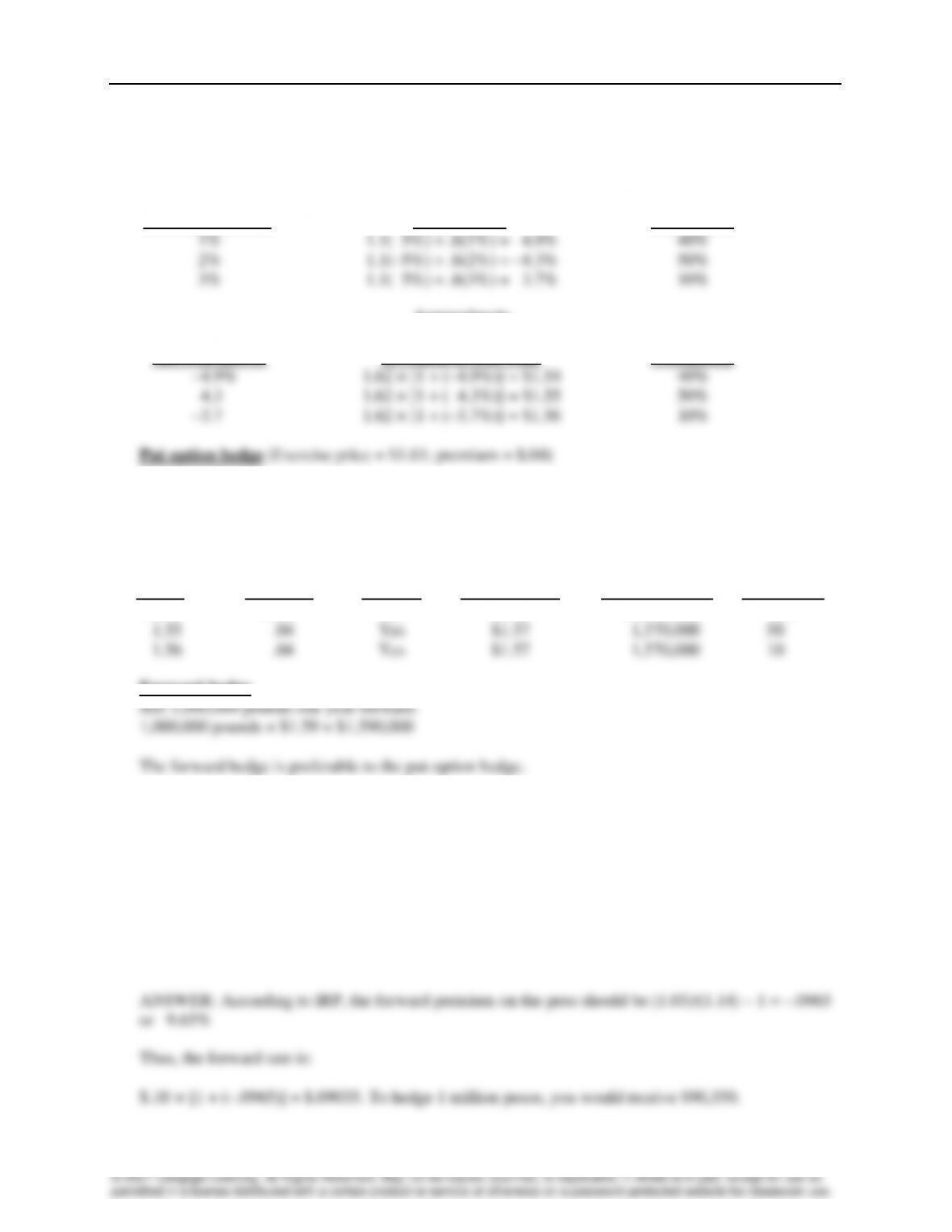
Forecast of DINTt Probability
1% 40%
2 50
3 10
Managing Transaction Exposure ❖ 15
Using any of the available information, should you as treasurer choose the forward hedge or the put
option hedge? Show your work.
ANSWER:
Forecast of DINTt Forecast of et Probability
Approximate
Forecast of et Forecasted Spot Rate
(derived above) of Pound in One Year Probability
Possible
Spot Rate of Amount
Pound in Received
One Year Put per Unit Total Amount
(derived Option Exercise (accounting Received for One
above) Premium Option? for premium) Million Pounds Probability
$1.54 $.04 Yes $1.57 $1,570,000 40%
Forward hedge
36. Hedging Decision. You believe that IRP presently exists, whereas the nominal annual interest rate in
Mexico is 14%. The nominal annual interest rate in the U.S. is 3%. You expect that annual inflation
will be about 4% in Mexico and 5% in the U.S. The spot rate of the Mexican peso is $.10. Put options
on pesos are available with a one-year expiration date, an exercise price of $.1008, and a premium of
$0.014 per unit.
You will receive 1 million pesos in one year.
a. Determine the amount of dollars that you will receive if you use a forward hedge.

Managing Transaction Exposure ❖ 16
b. Determine the expected amount of dollars that you will receive if you do not hedge and believe in
purchasing power parity (PPP).
ANSWER: The expected percentage change in the Mexican peso according to PPP is:
c. Determine the amount of dollars that you will expect to receive if you use a currency put option
hedge. Account for the premium you would pay on the put option.
ANSWER: Since the expected spot rate is $.10096 based on PPP, you could receive $.10096 per unit
37. Forecasting with IFE and Hedging. Assume that Calumet Co. will receive 10 million pesos in
15 months. It does not have a relationship with a bank at this time, and therefore can not obtain a
forward contract to hedge its receivables at this time. However, in three months, it will be able to
obtain a one-year (12-month) forward contract to hedge its receivables. Today the three-month U.S.
interest rate is 2% (not annualized), the 12-month U.S. interest rate is 8%, the three-month Mexican
peso interest rate is 5% (not annualized), and the 12-month peso interest rate is 20%. Assume that
interest rate parity exists.
Assume the international Fisher effect exists, and the existing interest rates are expected to
remain constant over time. The spot rate of the Mexican peso today is $.10. Based on this
information, estimate the amount of dollars that Calumet Co. will receive in 15 months.
ANSWER:
38. Forecasting from Regression Analysis and Hedging. You apply a regression model to annual data
in which the annual percentage change in the British pound is the dependent variable, and INF
(defined as annual U.S. inflation minus U.K. inflation) is the independent variable. A regression
analysis produces an estimate of 0.0 for the intercept and +1.4 for the slope coefficient. You believe
that your model will be useful to predict exchange rate movements in the future.
You expect that inflation in the U.S. will be 3%, versus 5% in the U.K. There is an 80% chance of
that scenario becoming reality. However, you think that oil prices could rise, and if so, the annual
U.S. inflation rate will be 8% instead of 3% (and the annual U.K. inflation will still be 5%). There is a
20% chance that this scenario will occur. You think that the inflation differential is the only variable
that will affect the British pound’s exchange rate over the next year.
Managing Transaction Exposure ❖ 17
The spot rate of the pound as of today is $1.80. The annual interest rate in the U.S. is 6% versus an
annual interest rate in the U.K. of 8%. Call options are available with an exercise price of $1.79, an
expiration date of one year from today, and a premium of $.03 per unit.
Your firm in the U.S. expects to need 1 million pounds in one year to pay for imports. You can use
any one of the following strategies to deal with the exchange rate risk:
a. unhedged strategy
b. money market hedge
c. call option hedge
Estimate the dollar cash flows you will need as a result of using each strategy. If the estimate for a
particular strategy involves a probability distribution, show the distribution. Which hedge is optimal?
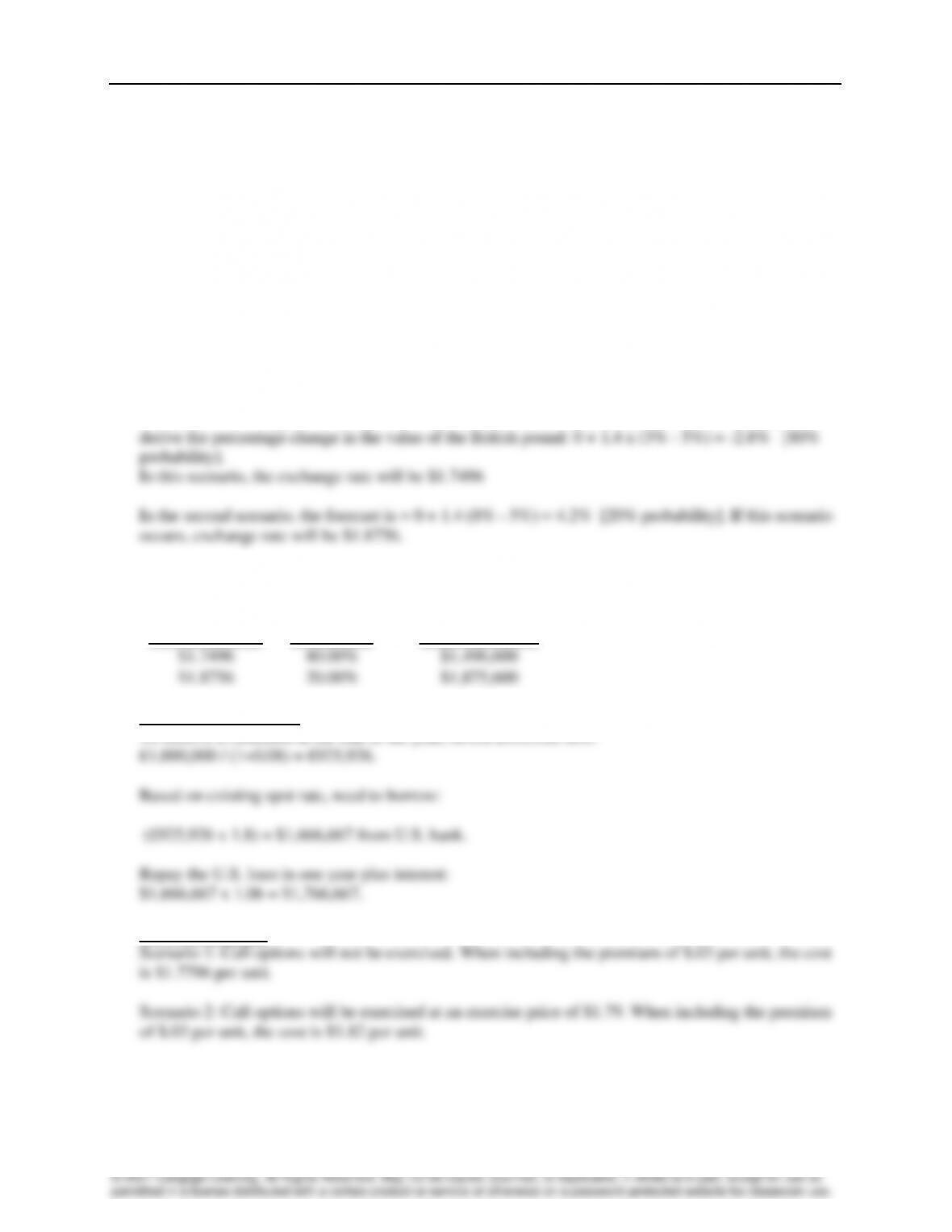
ANSWER:
The results of the regression analysis and the forecasts of the future inflation rates can be used to
Unhedged strategy:
Possible spot
rate in one year
Probability
Cost of payables
$1.7496
80.00%
$1,496,600
$1.8756
20.00%
$1,875,600
Money market hedge:
To receive £1,000,000 at the end of the year, invest £935,926 now:
Call option hedge

Managing Transaction Exposure ❖ 18
Possible spot rate
in one year
Probability
Cost of hedging
£1,000,000 (including
the option premium)
1.7496
80.00%
$1,779,600
1.8756
20.00%
$1,820,000
39. Forecasting Cash Flows and Hedging Decision. Virginia Co. has subsidiaries in both Hong Kong
and Thailand. Assume that the Hong Kong dollar is pegged at $.13 per Hong Kong dollar and it will
remain pegged. The Thai baht fluctuates against the dollar and is presently worth $.03. The firm
expects that during this year, the U.S. inflation rate will be 2%, the Thailand inflation rate will be
11%, while the Hong Kong inflation rate will be 3%. Virginia Co. expects that purchasing power
parity will hold for any exchange rate that is not fixed (pegged). The parent of Virginia Co. will
receive 10 million Thai baht and 10 million Hong Kong dollars at the end of one year from its
subsidiaries.
a. Determine the expected amount of dollars to be received by the U.S. parent from the Thai
subsidiary in one year when the baht receivables are converted to U.S. dollars.
b. The Hong Kong subsidiary will send HK$1 million to make a payment for supplies to the Thai
subsidiary. Determine the expected amount of baht that will be received by the Thai subsidiary
when the Hong Kong dollar receivables are converted to Thai baht.
c. Assume that interest rate parity exists. Also assume that the real one-year interest rate in the U.S.
is 1.0%, whereas the real interest rate in Thailand is 3.0%. Determine the expected amount of
dollars to be received by the U.S. parent if it uses a one-year forward contract today to hedge the
receivables of 10 million baht that will arrive in one year.
ANSWER:
40. Hedging Decision. Indiana Company expects to receive 5 million euros in one year from exports.
It can use any one of the following strategies to deal with the exchange rate risk. Estimate the dollar
cash flows received as a result of using the following strategies:
a. unhedged strategy
b. money market hedge
c. option hedge