Instructor Resource
Baack et al., International Marketing, 2e
SAGE Publishing, 2019
Review and Discussion Questions
Chapter 11: International Pricing
Review questions
1. Define price and name the various types of prices described in this chapter.
a. Price is the amount a person, company, or government charges for a good or service.
b. Cost-based pricing – pricing based on a careful assessment of all costs associated with
producing and selling an item.
c. Markup pricing – a pricing method that simply adds a standard mark-up to the costs
assigned to a product.
d. Target ROI pricing – a cost-based pricing technique that utilizes a desired return on
investment for a particular product.
e. Penetration pricing – setting the product’s initial price as low of a price as a company
can afford to discourage entry by competition.
Instructor Resource
Baack et al., International Marketing, 2e
SAGE Publishing, 2019
2. What three main considerations influence perceptions of prices?
a. Value considerations
3. What are the typical objectives associated with pricing programs?
a. Profitability
b. Market Share
c. Gaining new customers
4. What four factors can become the basis for a pricing program?
a. Cost-based pricing
b. Demand/supply-based pricing
5. How can a break-even analysis assist in developing an international pricing program?
This can be used to understand the relationship between price and cost. A company can
figure out how many units they would need to sell in an international market to break
6. Define price elasticity of demand, elastic demand, and inelastic demand.
a. Price elasticity of demand is a measure of the impact of price differences on demand
and sales.
b. Highly elastic demand occurs when consumers are extremely price sensitive. A small
price increase drives consumers away; a small price decrease attracts them.
Instructor Resource
Baack et al., International Marketing, 2e
SAGE Publishing, 2019
7. When pricing based on the competition, what three approaches are available?
a. below the industry average
8. Describe skimming and penetration pricing in international marketing and explain how
penetration pricing differs from dumping.
a. Skimming represents the attempt to recapture start-up costs as quickly as possible.
Setting the price as high as the market will bear allows the manufacturer or exporter to
generate the most revenue possible in a short period of time. Skimming works when a
product is unique and not easily duplicated.
9. What three circumstances match with profit–based pricing?
a. Monopolistic competitive environment
b. In the second circumstance, a company may have incurred high start-up costs and
wishes to recover them quickly. This might happen when managers believe
competitors will quickly enter the marketplace or when the start-up costs have pushed
the company to the brink of financial problems.
Instructor Resource
Baack et al., International Marketing, 2e
10. Describe the international considerations in pricing programs noted in this chapter.
a. As has been noted, pricing becomes more complicated when products are sold across
international boundaries. Variable costs rise due to additional shipping, more
expensive sales calls, tariffs and taxes, and other items.
11. Define the term capacity to consume and explain how it is part of marketing to the
bottom–of-the-pyramid.
Capacity to consume refers to the power to use goods and services in the satisfaction of
human wants. It consists of (1) wants, (2) goods and services available, (3) time and
energy, and (4) purchasing power. In the past, the method used to create the capacity to
consume among the poor has been to provide the product or service free of charge. While
12. Identify the main types of pricing discounts offered to consumers and businesses.
a. Loss leaders
b. Seasonal discounts
c. Quantity discounts
13. How is a loss leader different from dumping?
Instructor Resource
Baack et al., International Marketing, 2e
SAGE Publishing, 2019
Loss leader pricing relies on regular prices for other items in the store in order to generate
14. When making price changes, what factors should the marketing team consider?
a. Actions or reactions of competitors
domestic
foreign
b. Company status as industry leader or industry follower
domestic
foreign
15. How does Weber’s Law apply to price changes?
Weber studied the link between a physical stimulus and a desired response. Weber’s Law
has been transferred to pricing. It suggests that for a price change (a stimulus) to be
noticed, it must be greater than 10% to elicit a response. For those who believe such a
Instructor Resource
Baack et al., International Marketing, 2e
SAGE Publishing, 2019
16. How do negotiation systems and countertrade arrangement affect business-to-business
pricing programs?
a. This wasn’t really covered in the chapter
17. What four main ethical issues affect international pricing programs?
a. Collusion
b. Predatory pricing
Discussion questions
1. Discuss the value considerations, emotional considerations, and situational factors
associated with prices for the following items, specifically as they would relate to
international marketing:
Accidental death insurance policy
o In international marketing this could be a very difficult product to sell in some
countries. Some consumers may not feel comfortable discussing paying towards
death – this would relate to emotional factors. Situational factors could come into
play following another death of a family member. Finally value perceptions will
play a role, especially if the person is purchasing the insurance for themselves –
they will never know if the policy is paid out. The company must be trustworthy.
Instructor Resource
Baack et al., International Marketing, 2e
Designer undergarments
o Will include an emotional component when purchased. This provides an extra
benefit. Value consideration will be how exclusive the consumer finds the designer
and how much this brand name adds to the purchase. Finally, situational factors
will play a role – for example, consumers may be more willing to purchase these
products before Valentine’s Day.
2. A pricing perceptual map typically depicts products based on relationship involving price
and quality. Describe quality for the following items:
One night stay in a hotel in Uruguay
o Location of the hotel, cleanliness, amount of space, friendliness of the staff, room
service availability, internet access, and transportation provided.
Fishing tour guide in Cambodia
o Knowledge of the area, knowing the good fishing spots, ensuring the customers
catch the fish, size of the boat, friendliness and overall enjoyment of the fishing
trip.
Instructor Resource
Baack et al., International Marketing, 2e
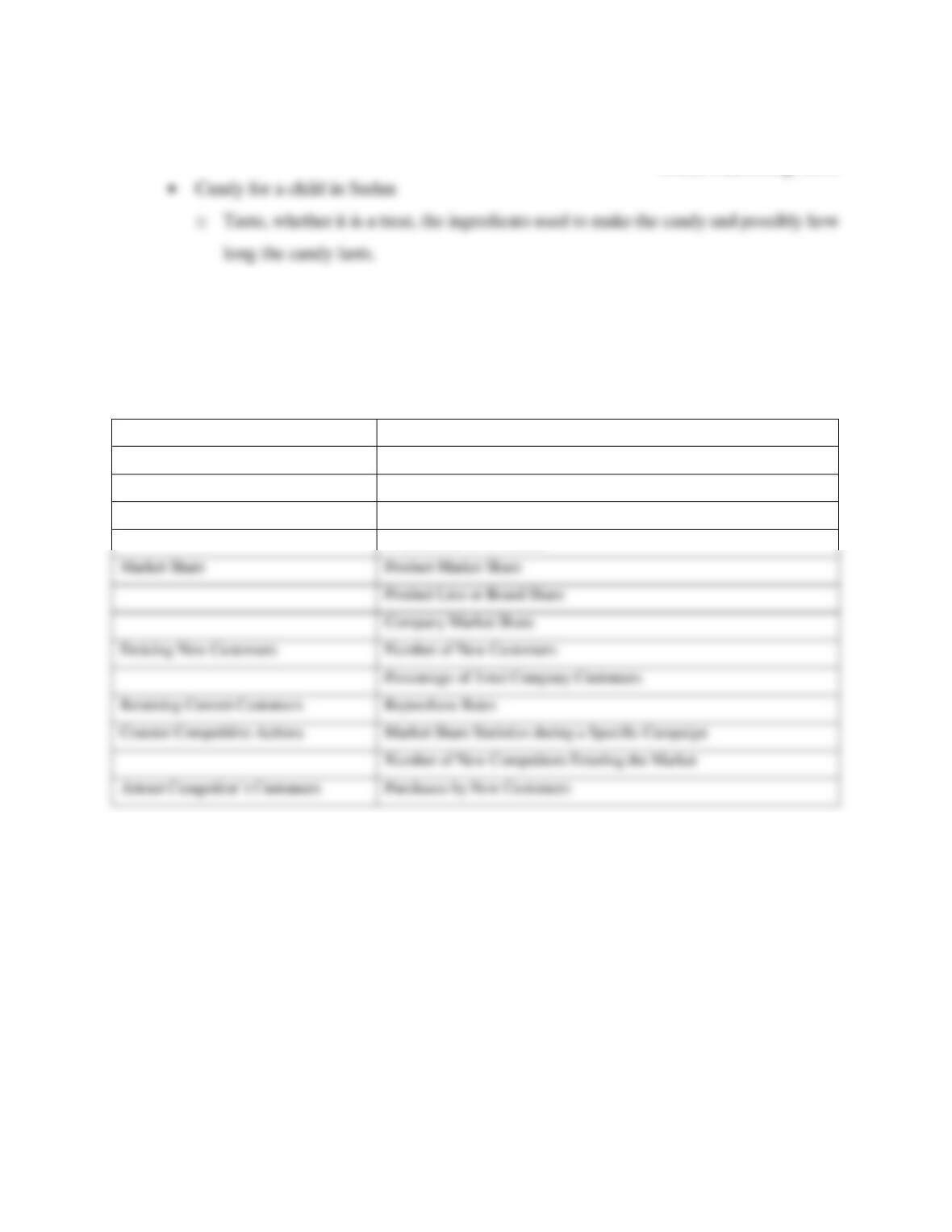
3. From the list of pricing objectives stated in Table 11.2, which would be most important
for an exporting company in the following situations? Defend your choices.
Table 11.2: Pricing Objectives
Objective
Measures
Profitability
Total Dollar Profit
Return on Investment
Percentage Increase from Previous Year
Contribution to Overhead
Product Line or Brand Share
Company Market Share
Enticing New Customers
Number of New Customers
Percentage of Total Company Customers
Counter Competitive Actions
Market Share Statistics during a Specific Campaign
Number of New Competitors Entering the Market
Purchases by New Customers
Just entering the market with an unknown brand
o Enticing new customers, the company needs to get new customers or they won’t
last.
Just entering the market with a well-known brand
o Market share, the brand name is known, now they need to capture market share in
this market.
Established company facing new domestic competitors
Instructor Resource
Baack et al., International Marketing, 2e
SAGE Publishing, 2019
o Retain current customers – they are already established, they need to keep their
current customers and not lose them to local competitors.
Established company facing new international competitors
o Counter competitor actions – they need to defend their market share and keep their
customers.
4. Which pricing method (cost, demand/supply, competition, profit-based) would you
recommend for the following items being sold in other countries? Defend your reasoning.
Tennis balls by a manufacturer in the Philippines
o Competition based pricing – determine what your competitors are charging and
either price below them (to signal a good value) or above them to signal a quality
tennis ball.
Retail store to open with 20,000 sku (stock-keeping units) in Luxembourg
o Competition based pricing – this is a big box store and they can attract customers
by offering low prices on necessities.
Instructor Resource
Baack et al., International Marketing, 2e
5. Which types of discounts should be given by each of the following companies? Explain
your answers.
Hilton International Hotels
o Seasonal discounts – attract customers in the off-season when the rooms are not
full. This will bring in additional customers.
AFLAC in Japan
o Quantity discounts – when selling insurance to companies they can offer quantity
discounts to attract larger companies with lots of employees.
6. Describe the differences and similarities between dumping, penetration pricing, and
predatory pricing. How might Weber‘s Law be relevant to this discussion?
Dumping is trying to get all of the competitors customers by selling your product at a
loss and at a lower price in a different country. This is different than the legal act of
penetration pricing, which is just selling at a very low margin to gain trial in a market.
Predatory pricing involves the direct attempt by a major competitor to drive other
companies out of business by setting prices unrealistically low. They are all similar
because they are all selling goods at a discount. Penetration pricing and predatory
pricing are both used to try to drive out competitors and businesses using these practices
will often raise the prices after the competition is eliminated.
Instructor Resource
Baack et al., International Marketing, 2e
SAGE Publishing, 2019