CHAPTER 10
POST-HECKSCHER-OHLIN THEORIES OF TRADE
AND INTRA-INDUSTRY TRADE
Learning Objectives:
I. Outline
Introduction
– A Trade Myth
Early Post-Heckscher-Ohlin Theories of Trade
More Recent Alternative Trade Theories
– The Krugman Model
– The Reciprocal Dumping Model
– Vertical Specialization-Based Trade
– Firm-Focused Theories
Appendix C: Measurement of Intra-Industry Trade
II. Special Chapter Features
III. Purpose of Chapter
100
in the literature because of the failure of the Heckscher-Ohlin model to explain empirically
important parts of world trade, specifically trade in manufactured goods. In addition, because
intra-industry trade emerges in some of these newer theories and because such trade is important
in the real world, the last part of the chapter briefly surveys possible causes of this phenomenon.
IV. Teaching Tips
A. The chapter begins with a brief discussion of the empirical evidence related to U.S.
imports from Mexico. The initial thought is often that fruits and vegetables or clothing will top
the list. In reality, electrical machinery and equipment ranks first and vehicles rank second.
These same items top the list of U.S. exports to Mexico. This is certainly not the predicted trade
patterns of the traditional models and provides a nice opening to discuss intra-industry trade and
several elements of the newer trade theories that emphasize trade in manufactures.
B. Another useful graph to employ in the presentation of Linder is one found in John
Adams, International Economics: A Self-Teaching Introduction to the Basic Concepts, 2nd ed.
the presence of economies of scale.
D. The Krugman model (introduced on page 182 and expanded in Appendix B) may be
difficult for the students. It is advisable to emphasize the general scenario while examining the
details: that trade permits a larger market, which in turn permits internal economies of scale to
be realized, which in turn permits lower consumer prices; in addition, a greater variety of
1. The length of the imitation lag would be influenced by barriers to obtaining information
regarding the production process, the existence of patents, the length of time needed to learn the
101
2. Some examples would be automobiles, tractors, clothing, television sets, textile
machinery, personal computers, and some sporting goods.
3. The Linder theory would suggest somewhat pessimistic prospects in that the per capita
income levels and thus the overlapping demands differ widely between the two sets of countries.
Indeed, Linder would suggest that the developing countries would trade most intensely with each
4. The precise countries of export and import of any particular good may not be determinate
5. Before trade begins, many monopolistically-competitive firms producing differentiated
goods are in equilibrium with zero profit. When the possibility of trade with other countries
begins, export sales of firms increase production because the size of the market has increased and
6. Greater choice for consumers may bring greater utility in and of itself. New varieties
may initially provide more utility per dollar at the margin and lead to enhanced welfare as new
7. No. As pointed out in the text, geographical location and transport costs can lead to intra-
8. It is a useful distinction if one grants that many differentiated varieties of a product are
indeed the same general “product” (i.e., the cross elasticities of demand between the varieties are
102
examining causative factors for trade patterns. If such is not granted, however, it becomes
difficult to explain the U.S. export of Budweiser and import of Corona by relying only on
different factor endowments and intensities.
9. The emergence of counterfeit goods suggests that the time lag between initial U.S.
production and subsequent production abroad is being shortened. The product cycle is speeding
up, and the displacement of U.S. exports in the “maturing product stage” is occurring more
10. In the “reciprocal dumping” model, each country’s consumers benefit from a flow of
imports of the good coming into the country at a lower price than was initially being charged by
11. The initial shift of athletic shoe production from the United States to South Korea is
consistent with the product cycle theory’s suggestion of a shift, as the product becomes more
standardized, to a new location with lower labor costs. However, it does not strictly fit the
PCT’s suggestion of an initial shift to another developed country comprised of high-income
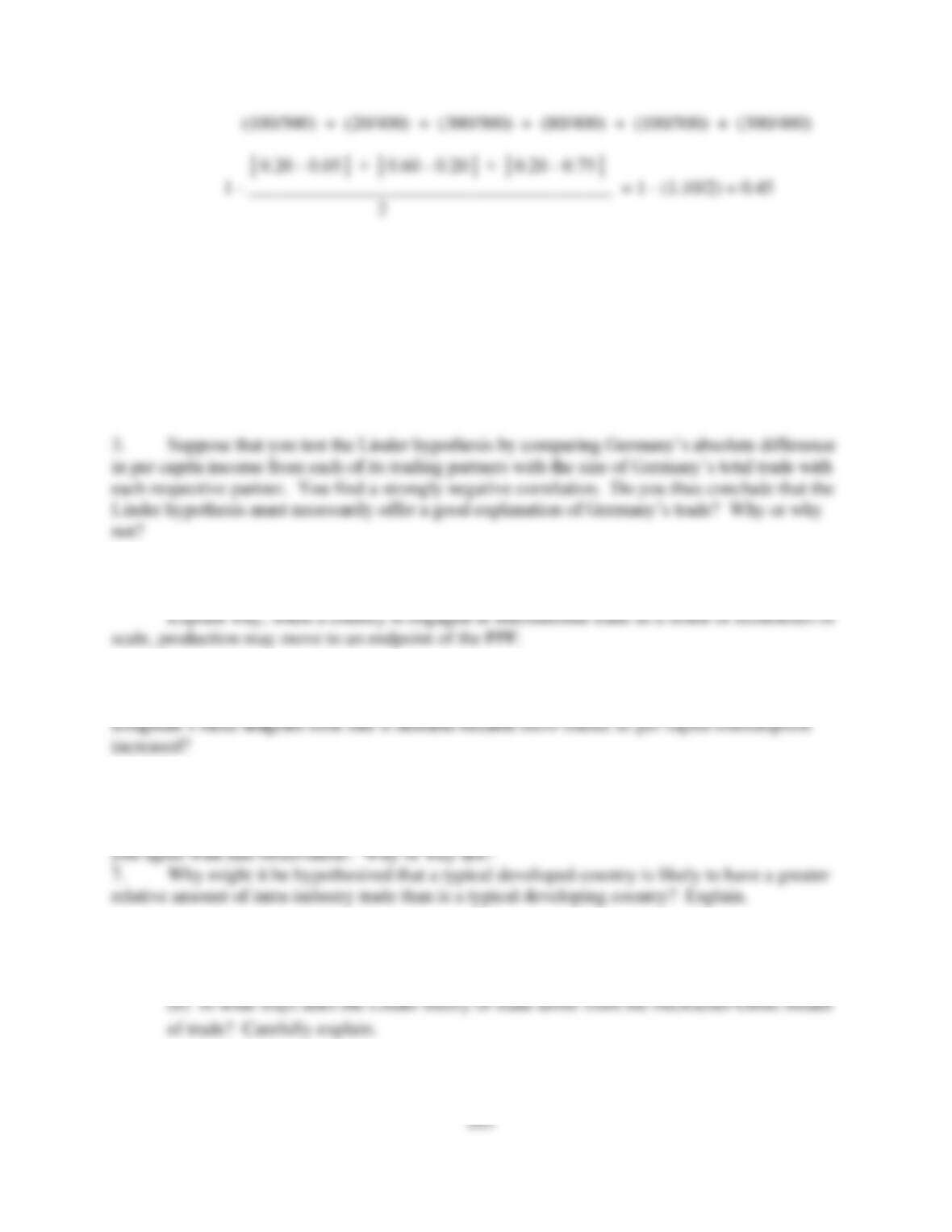
12. The index (II) is equal to:
│(100/500) – (20/400)│ + │(300/500) – (80/400)│ + │(100/500) – (300/400)│
1 – _______________________________________________________________
103
(100/500) + (20/400) + (300/500) + (80/400) + (100/500) + (300/400)
│0.20 – 0.05│ + │0.60 – 0.20│ + │0.20 – 0.75│
1 – _______________________________________ = 1 – (1.10/2) = 0.45
2
VI. Sample Exam Questions
A.
E
Es
ss
sa
ay
y
Q
Qu
ue
es
st
ti
io
on
ns
s
1. What features of the product cycle theory are at variance with the assumptions of the
Heckscher-Ohlin model? Explain.
2. How might the imitation lag hypothesis be incorporated into the product cycle theory?
4. (This question pertains to material in Appendix A.)
5. Does the assumption in the Krugman model that demand becomes less elastic as
consumption increases seem realistic to you? Why or why not? What would the PP schedule in
6. Suppose someone stated that the Heckscher-Ohlin model is best-suited for explaining
trade between developed countries and developing countries, while newer theories such as those
of Linder and Krugman are best-suited for explaining trade among developed countries. Would
8. (a) In what ways does the Krugman model of trade differ from the Heckscher-Ohlin
model of trade? Carefully explain.
9. (a) Define “intra–industry trade” and indicate several reasons why such trade can take
place in any given product category. Then indicate the characteristics of a country that

104
might lead you to expect that the country would have a substantial amount of intra-
industry trade.
(b) Thinking back over the various “post-Heckscher-Ohlin trade theories,” select one (1)
such theory that contains intra-industry trade and present criticize the theory.
10. Present in detail the following two theories/models associated with “post-Heckscher-
Ohlin” trade theory. In the case of each theory/model, be sure to indicate important