
Chapter 10 – The Foreign Exchange Market
10-1
The Foreign Exchange Market
Learning objectives
• Describe the functions of the
foreign exchange market.
• Understand what is meant by
spot exchange rates.
• Recognize the role that foreign
exchange rates play in insuring
against foreign exchange risk.
• Understand the different
theories explaining how
currency exchange rates are
determined and their relative
merits.
• Identify the merits of different
approaches towards exchange
rate forecasting.
• Compare and contrast the
differences between transaction,
translation, and economic
exposure, and what managers
do to manage each type of
exposure.
The foreign exchange market is the market where
currencies are bought and sold and currency prices
are determined. It is a network of banks, brokers
and dealers that exchange currencies 24 hours a
day.
Exchange rates determine the value of one
currency in terms of another. While dealing in
multiple currencies is a requirement of doing
business internationally, it also creates risks and
significantly impacts the attractiveness of different
investments over time.
The foreign exchange market is used for:
1. Currency conversion, 2. Currency hedging,
3. Currency arbitrage, 4.Currency speculation.
Firms can use the foreign exchange market to
minimize the risk of adverse exchange rate
movement. Such arrangements can prevent them
from benefiting from favorable movements.
The opening case explores how Australian retailer
Billabong has adapted its strategy as exchange
rates have shifted. The closing case explores the
effects of changing exchange rates on Caterpillar
Tractor’s strategy and profits.
10
Chapter 10 – The Foreign Exchange Market
10-2
OUTLINE OF CHAPTER 10: THE FOREIGN EXCHANGE
MARKET
Opening Case: Billabong
Introduction
The Functions of the Foreign Exchange Market
Currency Conversion
Insuring Against Foreign Exchange Risk
Management Focus: Volkswagen’s Hedging Strategy
The Nature of the Foreign Exchange Market
Economic Theories of Exchange Rate Determination
Prices and Exchange Rates
The Law of One Price
Interest Rates and Exchange Rates
Investor Psychology and Bandwagon Effects
Summary
Country Focus: Quantitative Easing, Inflation and the U.S. Dollar
Exchange Rate Forecasting
The Efficient Market School
The Inefficient Market School
Approaches to Forecasting
Currency Convertibility
Implications for Managers
Transaction Exposure
Translation Exposure
Economic Exposure
Reducing Translation and Transaction Exposure
Reducing Economic Exposure
Other Steps for Managing Foreign Exchange Risk
Management Focus: Dealing with the Rising Euro
Chapter Summary
Critical Thinking and Discussions Questions
Closing Case: Caterpillar Tractor

Chapter 10 – The Foreign Exchange Market
10-3
CLASSROOM DISCUSSION POINT
Give students a copy of a recent currency exchange report from the Wall Street Journal,
The New York Times or The Financial Times. Then, show students how to read the chart
and understand the difference between direct quotes and indirect quotes.
Next, give students some “money” (slips of paper designated with certain currency
values) and ask them to convert their money into a foreign currency at the “bank” and
purchase several things like a hamburger and drink.
Finally, create a shortage of a popular currency to give students a feel for how supply and
demand can affect a currency’s value.
OPENING CASE: Billabong
The opening case explores the implications of changing currency values on the profits of
Australian retailer Billabong. Billabong relies on the U.S. market for a significant share
of its total sales. Consequently, the company must continually monitor and adapt to the
changing relationship between the Australian dollar and the U.S. dollar. Discussion of the
case can revolve around the following questions:
1. What does a falling Australian dollar mean for Billabong’s ability to compete in the
global market place? How does your response change when the Australian dollar is
rising in value?
2. What type of exchange rate risk is Billabong facing? How can Billabong reduce its
exposure to foreign exchange risk?
3. Explain why exchange rates have been so volatile in recent years. What are the
implications of this volatility for companies like Billabong?
Another Perspective: To explore Billabong’s international operations in depth, go to
{http://www.billabong.com/}.
LECTURE OUTLINE
This lecture outline follows the Power Point Presentation (PPT) provided along with this
instructor’s manual. The PPT slides include additional notes that can be viewed by
clicking on “view”, then on “notes”. The following provides a brief overview of each
Power Point slide along with teaching tips, and additional perspectives.
Slide 10-3 Why is the Foreign Exchange Market Important?
This chapter:
• explains how the foreign exchange market works
Chapter 10 – The Foreign Exchange Market
10-4
• examines the forces that determine exchange rates and discusses the degree to
which it is possible to predict exchange rate movements
• maps the implications for international business of exchange rate movements and
the foreign exchange market
The foreign exchange market is a market for converting the currency of one country
into that of another country. The exchange rate is the rate at which one currency is
converted into another.
Slide 10-4 When Do Firms Use the Foreign Exchange Market?
The foreign exchange market is used:
• to convert the currency of one country into the currency of another
• to provide some insurance against foreign exchange risk – the adverse
consequences of unpredictable changes in exchange rates
Companies use the foreign exchange market:
• to convert payments they receive for exports, the income they receive from
foreign investments, or from licensing agreements with foreign firms
Another Perspective: XE.com {http://www.xe.com/} provides a real time currency cross-
rate chart, and an option to do currency conversions.
Slides 10-5 Insuring Against Foreign Exchange Risk
A second function of the foreign exchange market is to provide insurance to protect
against the possible adverse consequences of unpredictable changes in exchange rates, or
foreign exchange risk.
Slide 10-6-10-8 Spot Rates and Forward Rates
The spot exchange rate is the rate at which a foreign exchange dealer converts one
currency into another currency on a particular day.
Slide 10-9 Currency Swap
A currency swap is the simultaneous purchase and sale of a given amount of foreign
exchange for two different value dates. Swaps are transacted between international
businesses and their banks, between banks, and between governments when it is desirable
to move out of one currency into another for a limited period without incurring foreign
exchange rate risk.
Chapter 10 – The Foreign Exchange Market
10-5
Slide 10-10 The Nature of the Foreign Exchange Market
The foreign exchange market is not a place, but a network of banks, brokers, and dealers
that exchange currencies 24 hours/day.
Slides 10-11-10-12 Exchange Rates between Markets
Opportunities for arbitrage exist when exchange rates are not the same between markets.
About 85 percent of al foreign exchange transactions involve the U.S. dollar. It is a
vehicle currency.
Slide 10-13 Economic Theories of Exchange Rate Determination
Three factors have an important impact on future exchange rate movements in a
country’s currency:
• the country’s price inflation
• its interest rate
• market psychology
Another Perspective: To find out more about how various factors affect, or are affected
by, exchange rates, go to {http://www.fxcm.com/docs_pdfs/dailyfx-
article/The_5_Things_that_Move_the_Currency_Markets.pdf}.
Slides 10-14-10-17 Prices and Exchange Rates
The law of one price suggests that in competitive markets free of transportation costs and
trade barriers, identical products in different countries must sell for the same price when
their price is expressed in terms of the same currency.
Slide 10-18 Interest Rates and Exchange Rates
The International Fisher Effect states that for any two countries the spot exchange rate
should change in an equal amount but in the opposite direction to the difference in
nominal interest rates between two countries.
Slide 10-19 Investor Psychology and Bandwagon Effects
Expectations on the part of traders can turn into self-fulfilling prophecies, and traders can
joint the bandwagon and move exchange rates based on group expectations.
Slides 10-20-10-22 Exchange Rate Forecasting
The efficient market school, argues that forward exchange rates do the best possible job
Chapter 10 – The Foreign Exchange Market
10-6
An efficient market is one in which prices reflect all available information.
In an inefficient market, prices do not reflect all available information.
Slide 10-23 Approaches to Forecasting
There are two approaches to forecasting exchange rates:
• fundamental analysis – draws upon economic theories to predict future exchange
rates, including factors like interest rates, monetary policy, inflation rates, or
balance of payments information
• technical analysis – chart trends, and believe that past trends and waves are
reasonable predictors of future trends and waves
Slides 10-24-10-26 Currency Convertibility
A currency is said to be freely convertible when a government of a country allows both
residents and non-residents to purchase unlimited amounts of foreign currency with the
domestic currency.
Free convertibility is the norm in the world today, although many countries impose
restrictions on the amount of money that can be converted. The main reason to limit
convertibility is to preserve foreign exchange reserves and prevent capital flight.
Countertrade refers to a range of barter like agreements by which goods and services
can be traded for other goods and services. It can be used in international trade when a
country’s currency is nonconvertible.
Slide 10-27-10-29 Implications for Managers
There are three types of foreign exchange risk:
1. Transaction exposure
2. Translation exposure
3. Economic exposure
Transaction exposure is the extent to which the income from individual transactions is
affected by fluctuations in foreign exchange values.
Translation exposure is the impact of currency exchange rate changes on the reported
financial statements of a company.
Chapter 10 – The Foreign Exchange Market
10-7
Economic exposure is the extent to which a firm’s future international earning power is
affected by changes in exchange rates.
Slides 10-31-10-32 Reducing Translation and Transaction Exposure
Firms can minimize their foreign exchange exposure by:
• buying forward
• using swaps
Firms can reduce economic exposure by ensuring assets are not too concentrated in
countries where likely rises in currency values will lead to damaging increases in the
foreign prices of the goods and services they produced.
Slide 10-33 Other Steps for Managing Foreign Exchange Risk
To manage foreign exchange risk:
(a) central control of exposure is needed to protect resources efficiently and ensure that
each subunit adopts the correct mix of tactics and strategies
(b) firms should distinguish between transaction and translation exposure on the one
CRITICAL THINKING AND DISCUSSION QUESTIONS
QUESTION 1: The interest rate on South Korean government securities with one-year
maturity is 4% and the expected inflation rate for the coming year is 2%. The US interest
rate on government securities with one-year maturity is 7% and the expected rate of
inflation is 5%. The current spot exchange rate for Korea won is $1 = W1,200. Forecast
the spot exchange rate one year from today. Explain the logic of your answer.
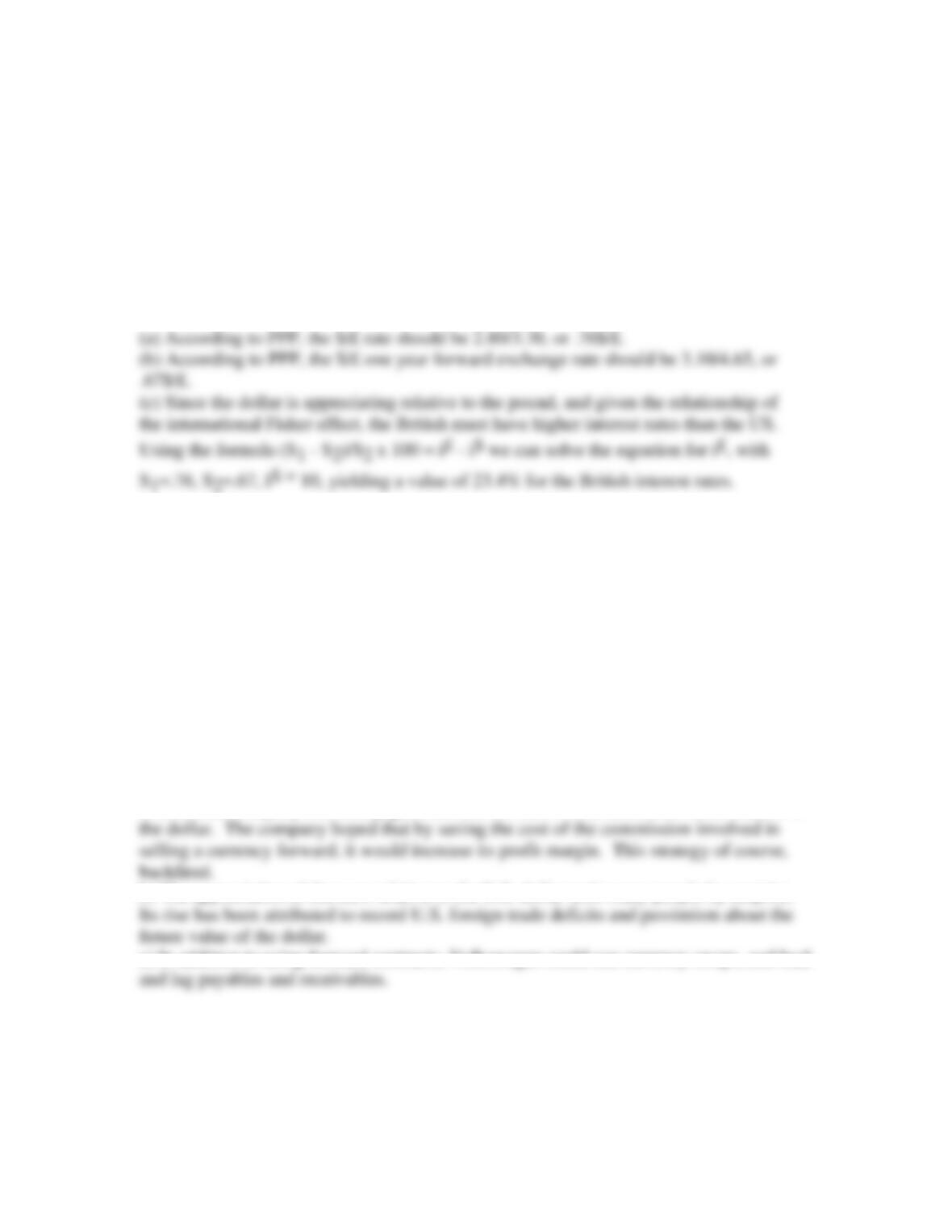
ANSWER 1: Drawing on what we know about the Fisher effect, the real interest rate in
both the US and South Korea is 2%. The international Fisher effect suggests that the
Chapter 10 – The Foreign Exchange Market
10-8
QUESTION 2: Two countries, Great Britain and the US, produce just one good: beef.
Suppose that the price of beef in the US is $2.80 per pound, and in Britain it is £3.70 per
pound.
(a) According to PPP theory, what should the $/£ spot exchange rate be?
(b) Suppose the price of beef is expected to rise to $3.10 in the US, and to £4.65 in
Britain. What should be the one year forward $/£ exchange rate?
(c) Given your answers to parts (a) and (b), and given that the current interest rate in the
US is 10%, what would you expect current interest rate to be in Britain?
ANSWER 2:
QUESTION 3: Reread the Management Focus feature on Volkswagen in this chapter,
then answer the following questions:
a) Why do you think management at Volkswagen decided to hedge only 30 percent of
their foreign currency exposure in 2003? What would have happened if they had hedged
70 percent of their exposure?
b) Why do you think the value of the U.S. dollar declined against that of the Euro in
2003?
c) Apart from hedging through the foreign exchange market, what else can Volkswagen
do to reduce its exposure to future declines in the value of the U.S. dollar against the
euro?
ANSWER 3:
a) When Volkswagen decided to hedge just 30 percent of its foreign exchange exposure
in 2003, the company essentially gambled that the euro would decline in value relative to
b) The appreciation of the euro relative to the U.S. dollar took many people by surprise.
c) In addition to using forward contracts, Volkswagen could use currency swaps, and lead
QUESTION 4: You manufacture wine goblets. In mid-June you receive an order for
10,000 goblets from Japan. Payment of ¥400,000 is due in mid-December. You expect
the yen to rise from its present rate of $1=¥130 to $1=¥100 by December. You can
borrow yen at 6% per annum. What should you do?
Chapter 10 – The Foreign Exchange Market
10-9
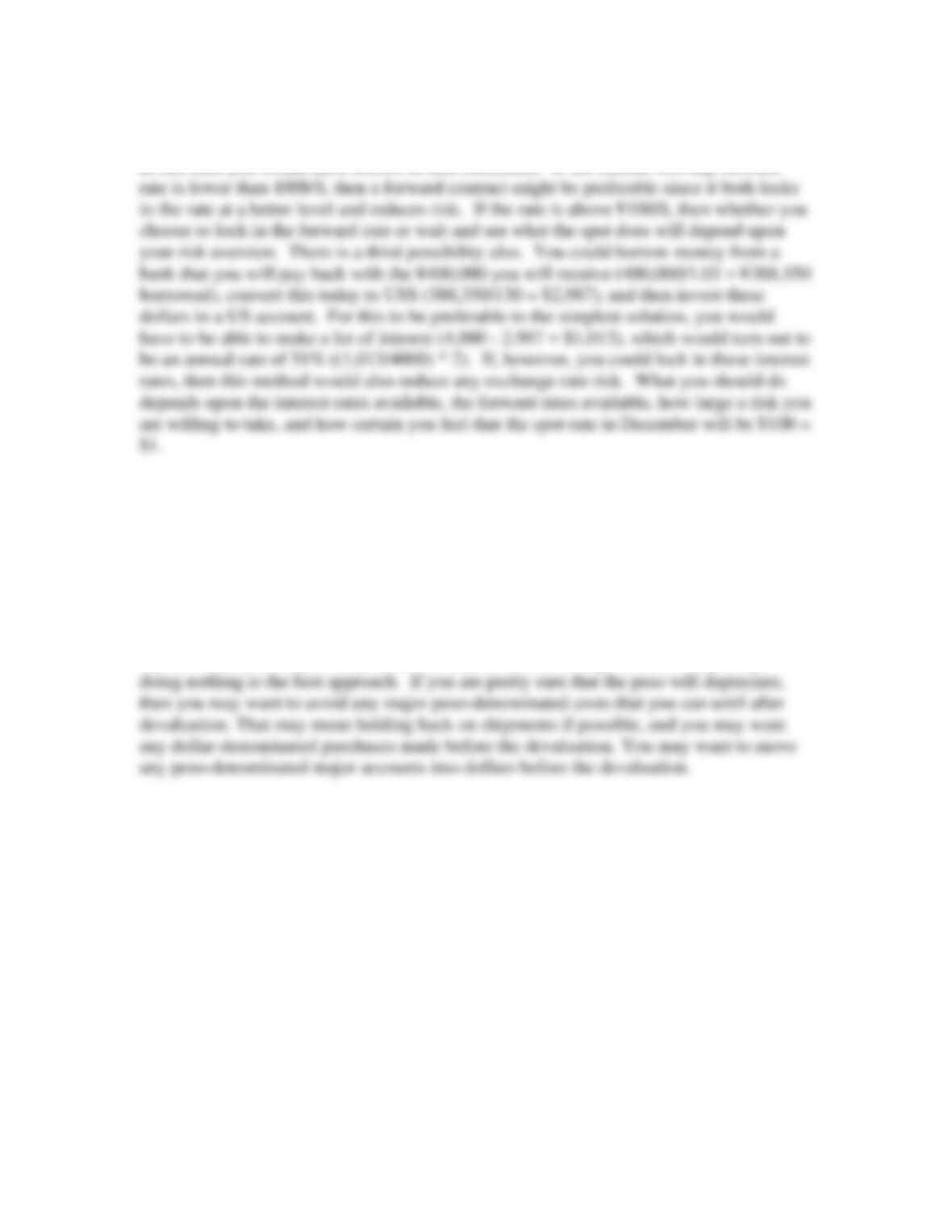
ANSWER 4: The simplest solution would be to just wait until December, take the
¥400,000 and convert it at the spot rate at that time, which you assume will be $1=¥100.
In this case you would have $4,000 in mid-December. If the current 180-day forward
QUESTION 5: You are the CFO of a US firm whose wholly owned subsidiary in Mexico
manufactures component parts for your US assembly operations. The subsidiary has been
financed by bank borrowings in the United States. One of your analysts told you that the
Mexican peso is expected to depreciate by 30 percent against the dollar on the foreign
exchange markets over the next year. What actions, if any, should you take?
ANSWER 5: Your financing and operating capital are in dollars, yet many of your costs
(labor) must be in peso. Your hard assets are all in peso, and their value will decline. On
the other hand, if the peso depreciates, then your dollars will go further. So perhaps
CLOSING CASE: Caterpillar Tractor
Summary
The closing case explores the impact of changing exchange rates on Caterpillar Tractor, a
manufacturer of large construction equipment. During the 1980s Caterpillar struggled to
contend with a strong dollar, then during the mid-2000s, the company was able to benefit
from a weak dollar. More recently, a strong dollar has actually helped boost Caterpillar’s
bottom line. Discussion of the case can revolve around the following questions.
Chapter 10 – The Foreign Exchange Market
10–10
QUESTION 1: In the 1980s a stronger dollar hurt Caterpillar’s competitive position, but
in 2008 a stronger dollar did not seem to have the same effect. What had changed?
ANSWER 1: Between the 1980s and 2000s Caterpillar was able to reduce its economic
exposure by completely changing its global strategy. In the 1980s, much of Caterpillar’s
QUESTION 2: How did Caterpillar use strategy as a “real hedge” to reduce its exposure
to foreign exchange risk? What is the downside of its approach?
ANSWER 2: To reduce its economic exposure Caterpillar established a significant
number of foreign manufacturing facilities. These were important to the company
QUESTION 3: Explain the difference between transaction exposure and translation
exposure using the material in the Caterpillar Tractor case to illustrate your answer.
ANSWER 3: Transaction exposure refers to the extent to which the income from
individual transactions is affected by fluctuations in foreign exchange rates while
Chapter 10 – The Foreign Exchange Market
10–11
INTEGRATING iGLOBES
There are several iGLOBE video clips that can be integrated with the material presented
in this chapter. In particular, you might consider the following:
Title: How Currency Choices “Made in China” Have Big Impact On Global
Economy
Run Time: 8:11
Abstract: This video explores the continuing pressure on China to revalue its currency
relative to the U.S. dollar and the effects of China’s currency policy on global trade
patterns.
Key Concepts: globalization, international monetary system, international trade,
currency values, global competition, balance of trade, national trade policy, political
economy, competitive advantage
Notes: The pressure on China to allow its currency to appreciate intensified recently in
conjunction with the visit of China’s president, Hu Jintao, to the United States to meet
with President Obama. China, which has maintained an artificially low renminbi for
some time, has resisted claims that its policies give Chinese exporters an unfair
competitive advantage in the global market place. While many countries have criticized
China’s policies on its currency, the United States has been particularly vocal because of
its large trade imbalance with the country.
The United States believes that China’s policy of keeping the renminbi at artificially low
levels rather than allowing it to float according to market forces make Chinese products
more attractive in foreign markets. Moreover, U.S. Secretary of State Hillary Clinton
argues that U.S. companies trying to export to China are at a disadvantage because of the
country’s policies. Clinton would like to see China open its markets to U.S.
manufactured goods, farm and ranch products, and services. According to Clinton,
changes in China’s policy toward its currency would not only benefit the United States,
but would also benefit the rest of the world by contributing to more balance and
predictability in the global economy and broader prosperity. U.S. Treasury Secretary
Timothy Geithner has gone as far as to suggest that if China does not take steps to
revalue its currency, it will in fact damage its relations with the rest of the world.
China however, claims that its policies on the renminbi are simply part of a larger effort
to discourage hot money in order to prevent its economy from overheating. By
prohibiting the open trading of its currency, China hopes to avoid increases in wages, raw
materials prices, and property prices that could make its finished products more
expensive in foreign markets. Yasheng Huang of the MIT Sloan School of Management
defends China’s policies noting that even if China did allow its currency to rise, the U.S.
would still continue to consume, and dollars would still flow out of the country. U.S.
consumption would simply be funded by another country such as India. For now
Chapter 10 – The Foreign Exchange Market
10–12
though, Secretary Geithner hopes to persuade China that as incomes continue to rise in
China, so will the potential for inflation, which will ultimately push prices up, and make
China’s goods less competitive. Economist Gen Xiao believes that if this trend
continues, the question of China revaluing its currency will be a moot point anyway
because eventually inflation in China will converge with a stagnating economy in the
United States and the issue will be resolved.
Discussion Questions:
1. Why was the value of China’s currency a dominant issue at the recent U.S. – China
summit? Why is the United States pushing for a higher renminbi? Why is China
reluctant to allow its currency to appreciate?
2. Reflect on how policy decisions made in China affect the strategies of U.S. companies.
What does this imply about the interdependency of the global monetary systems and
economy in general?
3. Discuss the claims by U.S. Secretary of State Hillary Clinton that policy reforms in
China would contribute to global economic balance, predictability, and prosperity. Do
you agree with Clinton? Why or why not?
4. How would inflation in China affect the competitiveness of its goods in global
markets?
INTEGRATING VIDEOS
There are also several longer video clips that can be integrated with the material
presented in this chapter. In particular, you might consider the following from
International Business DVD Volume 6:
Title: Young Indian Mogul
Learning Objectives
The purpose of this video is to help you:
❖ Explore the extreme contrasts in standards of living that exist within modern day
India and identify the challenges facing India as it attempts to capitalize on its
economic success, and at the same time help the vast number of people still living at
a subsistence level.
❖ Discuss how foreign companies might view the investment climate in India.
❖ Consider the social responsibility of successful individuals and companies toward
those who are less fortunate.
Chapter 10 – The Foreign Exchange Market
10–13
❖ Recognize the potential impact of companies from emerging markets like India on
the global market place.
Key Words
❖ Levels of economic development
❖ Social responsibility
❖ Globalization
❖ Global competition and strategy
Synopsis
Modern day India is an example of great contrasts. At one extreme are people like Suhas
Gopinath, CEO of a firm that is worth at least $100 million. At the other end of the
spectrum are a vast number of people surviving on less than a dollar per day. Suhas
Gopinath is part of the country’s growing middle and upper class. Suhas Gopinath
started his global software company, Globals Inc., at the age of 14 with little more than a
simple home computer and big ideas. Six years later, he is an incredible success story.
His company operates in eleven countries including the United States supplying software
solutions to hundreds of companies. Suhas Gopinath, who claims that he was inspired by
Bill Gates, is now a role model for other young Indians hoping to cash in on the
technology boom that is sweeping the country. Despite being offered $100 million by a
Houston-based venture capital firm for just 35 percent of his business, Suhas Gopinath
leads a relatively modest lifestyle living with his parents in Bangalore, a city that has
greatly benefitted from the technology boom, and continuing his education at a nearby
college.
However, the success of individuals like Suhas Gopinath can present a misleading picture
of India and its potential role in the global economy. Just 1,000 miles away in the
nation’s capital, Delhi, thousands of Indians are living in the midst of a giant slum
subsisting on whatever they can find. Life in the slum is very difficult. One man about
the same age as Suhas Gopinath lives with his entire family in a single room that is little
more than a shack. Flies are everywhere and malnutrition is evident. People sift through
the mounds of garbage everyday looking for things they can sell. If the man is successful
at finding salable items, he can make 2,000 rupees per month which is about $40.
Astonishingly, this makes the man better off than 300 million other Indians who live on
less than $1 a day.
Today, India is grappling with the challenges of how to capitalize on the opportunities
presented by globalization, while at the same time deal with the extreme poverty that is
so prevalent throughout the country. The country must find ways to encourage people
like Suhas Gopinath to achieve their dreams, and facilitate their success yet still ensure
that the people living in the slums of Delhi are not left behind. Attracting more foreign
investment and promoting social and economic responsibility may be the key to meeting
these challenges.

Chapter 10 – The Foreign Exchange Market
10–14
Discussion Questions
1. Discuss the vast contrasts in living standards that exist in India. What challenges do
these differences present to the Indian government?
2. How would you characterize the investment climate in India?
3. In your opinion do Indian companies like Globals Inc that are so successful have a
social responsibility to help the nation’s poor? Do foreign companies doing business in
India have any such responsibility? Why might it be in their best interest to display good
corporate citizenship?
4. Discuss the implications of the growth of companies from emerging markets on the
global market place. What does this trend mean for competitors from developed
countries? What does this trend suggest about the global market place in the future?
INCORPORATING globalEDGE™ EXERCISES
Use the globalEDGE™ site {http://globalEDGE.msu.edu/} to complete the following
exercises:
Exercise 1
One component of learning about another country or region is to understand the
relationship of its currency with others on the world currency market. As such, you are
assigned the duty of ensuring the availability of 1,000,000 yen for a payment scheduled
for next month. Considering that your company possesses only US dollars, identify the
spot and forward exchange rates. What are the factors that influence your decision to use
each? Which one would you choose? How many dollars must you spend to acquire the
amount of yen required?
Exercise 2
Sometimes, analysts use the price of specific products in different locations to compare
currency valuation and purchasing power. For example, the Big Mac Index compares the
purchasing-power parity of many countries based on the price of a Big Mac. Locate the
latest edition of this index that is accessible. Identify the five countries (and their
currencies) with the lowest purchasing-power parity according to this classification.
Which currencies, if any, are overvalued?
Chapter 10 – The Foreign Exchange Market
10–15
Answers to the Exercises
Exercise 1
The currency exchange rates can be accessed through a variety of sources. A list of these
sources is available http://globaledge.msu.edu/ResourceDesk/ and can be accessed by
searching the term “exchange rates”. The first resource listed under this search is the FX
Street website, located under the globalEDGE category “Money: Finance”. This site
Exercise 2
The Big Mac Index can be accessed by searching the term “Big Mac Index” at
http://globaledge.msu.edu/ResourceDesk/. The resource is located under the globalEDGE