Chapter 10
Exchange Rate Determination and
Forecasting
QUESTIONS
1. What is the difference between the ex ante and the ex post real interest rate?
Answer: The ex post interest rate corrects the nominal interest rate with the realized or ex
post rate of inflation; whereas the ex-ante (or expected) real interest rate corrects the nominal
interest rate for expected inflation.
Chapter 10: Exchange Rate Determination and Forecasting
2
tt
2. Suppose that the international parity conditions all hold and a country has a higher
nominal interest rate than the United States. Characterize the country’s inflation rate
compared to the United States, the country’s expected exchange rate change versus the
dollar, the country’s currency forward premium (or discount) versus the dollar, and the
country’s real interest rate compared to the U.S. real interest rate.
3. How do fundamental analysis and technical analysis differ?
4. Would technical analysis be useful if the international parity conditions held? Why or
why not?
9. Which simple statistical model yields some of the best exchange rate predictions
available? What does this imply for the value of models of exchange rate determination
to multinational businesses?
10. What is chartism?
11. What is an x% filter rule?
12. What is a moving-average crossover rule?
13. Have currency traders been successful in exploiting their exchange rate forecasts?
Answer: While there exists scant empirical evidence on the forecasting ability of exchange
rate forecasting services, the number of active currency traders, mostly organized as hedge
©2017 Cambridge University Press
14. Are devaluations of pegged exchange rates totally unexpected?
15. Construct a list of a country’s economic statistics you would assemble to help determine
the probability of a devaluation of its currency within the coming year.
Chapter 10: Exchange Rate Determination and Forecasting
6
PROBLEMS
1. Suppose the 1-year nominal interest rate in Zooropa is 9%, and Zooropa’s expected
inflation rate is 4%. What is the real interest rate in Zooropa?
2. You were recently hired by the Doolittle Corporation corporate treasury to help
oversee its expansion into Europe. Blake Francis, the CFO, wants to hire a foreign
exchange forecasting company. Blake has asked you to evaluate three different
companies, and he has obtained information on their past performances. Out of a total
of 50 forecasts for the $/€ rate, the companies reported the number of times they
correctly forecast appreciations and depreciations:
Correct Down
Forecasts
Correct Up
Forecasts
Morrissey Forex
Advisors
20
5
Pixie Exchange Land
20
4
FOREX Cures
12
12
There are a total of 35 dollar appreciations (down periods) and 15 dollar depreciations
(up periods) in the sample. Blake wants to know two things:
a. Can anything be said about the companies’ forecasting ability with the available
data?
Chapter 10: Exchange Rate Determination and Forecasting
7
b. What additional information should Blake try to obtain in order to form a better
judgment?
Answer: Directional forecasting ability in the foreign exchange market is not particularly
3. Mini-Case: Currency Turmoil in Zooropa
Fad Gadget has never worked so hard in his entire life. It is near midnight, and he is
still poring over statistics and tables. Fad recently joined Smashing Pumpkins, a
relatively young but fast-growing British firm. Smashing Pumpkins produces and
distributes an intricate device that turns fresh pumpkins into pumpkin pie in about 30
minutes. Recently, the firm has started exporting to Zooropa. Some of the largest and
tastiest pumpkins are grown in Zooropa, and Zooropa’s population boasts the highest
per capita pumpkin consumption in the world. A recent analysis of the pumpkin
market in Zooropa has left the company’s senior managers very impressed with the
profit potential.
Although Zooropa consists of 10 politically independent countries, their
currencies are linked through a system called the Currency Rate Linkage System
(CRLS) that works exactly like the former Exchange Rate Mechanism (ERM) of the
EMS worked before the currency turmoil started in September 1992. The anchor
currency is the banshee of Enigma, the leading country in Zooropa.
Initial contacts with importers in Zooropean countries indicated that they
typically insist on payment in their own local currency. About a week ago, Cab
Voltaire, the CEO of Smashing Pumpkins, expressed concerns about this development
and asked Fad to lead a research team to further examine the present state of the
currency system of Zooropa. Cab viewed the outlook for the banshee relative to the
pound quite favorably and did not predict any substantial depreciation of the banshee
against any other major currency. However, the precarious economic situation of some
of the countries in Zooropa and the growing importance of speculative pressures in
Zooropa’s currency markets last week suddenly made him suspicious about the
possibility of realignments within the system. He even doubted the long-term viability of
the system. Cab instructed Fad to examine the following issues:
Which currencies in the system exhibit the highest realignment risk?
Chapter 10: Exchange Rate Determination and Forecasting
8
If a currency realigns and gets devalued, what are the effects on our sales
and profit margins in this particular country? Can we take the realignment
possibility into account in our pricing?
Suppose a currency is forced to leave the CRLS. What are the effects on
exchange rates, interest rates, and the outlook for sales in that country?
What is the likelihood of this occurring for the different countries?
Fad Gadget felt nervous. A meeting was scheduled with Cab the day after
tomorrow. He wanted to write a thorough and insightful report. At the last
management meeting, he had the uneasy feeling that some senior managers doubted his
abilities. Some managers were naturally suspicious of a young Australian newcomer
with his MBA. His earring and punk hairdo did not exactly help either. His team of
analysts had already assembled a table with relevant macroeconomic and financial data
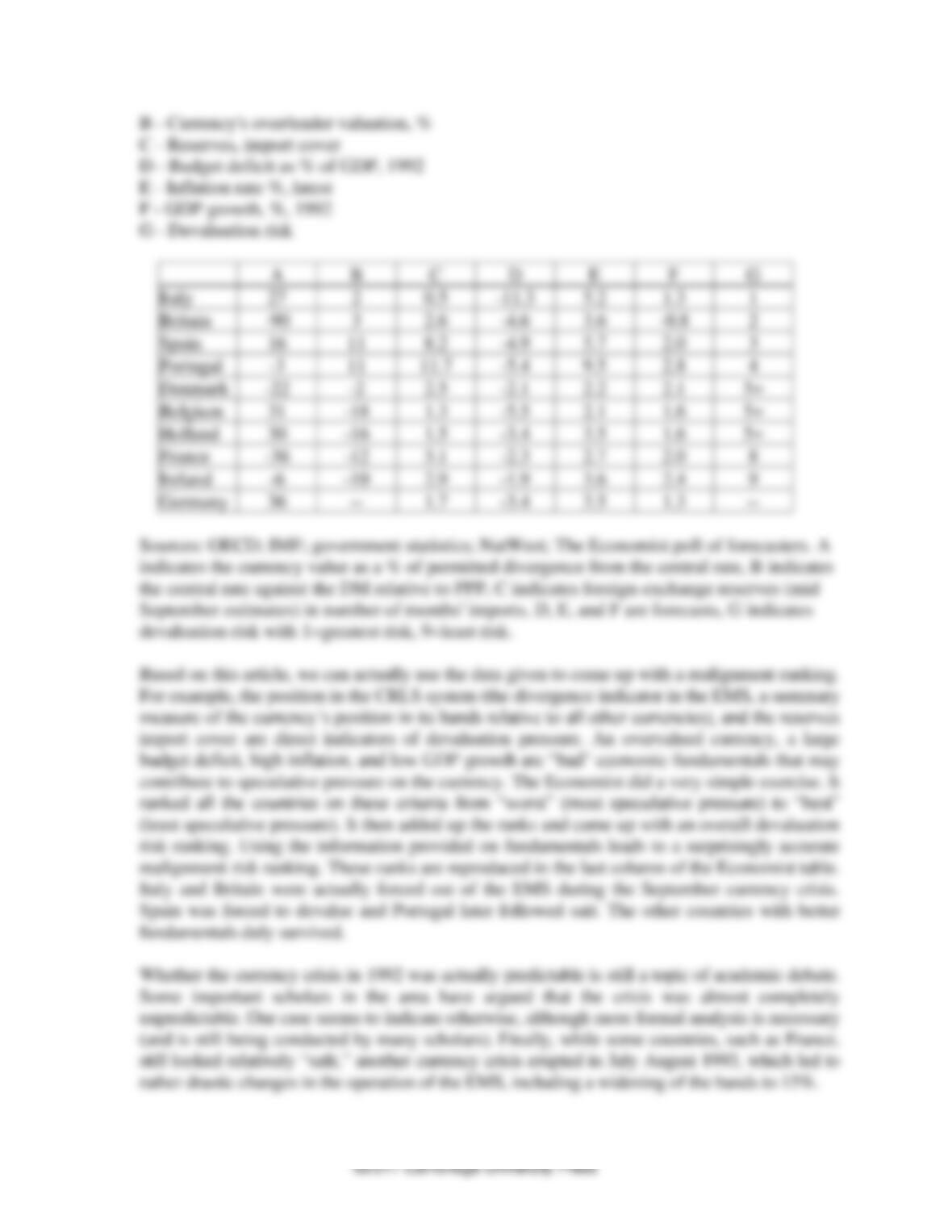
(see Exhibit 10.11). “If only I could use this to rank the different countries according to
realignment risk,” he thought.
a) Realignment rankings
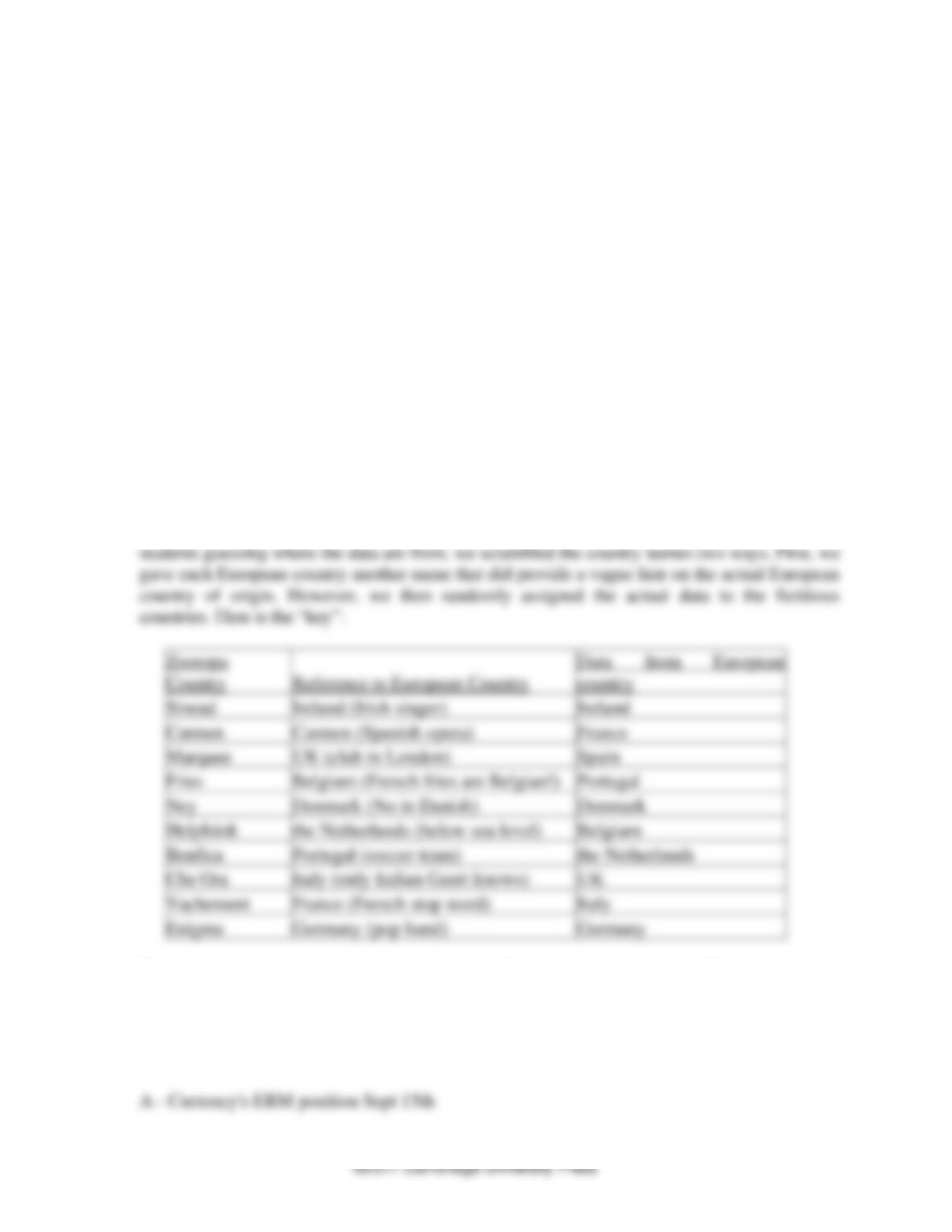
The data provided are a scrambled version of an Exhibit that appeared in the Economist of
September 19, 1992, when a currency crisis in Europe had just erupted. The Exhibit presented
macro-economic statistics for all the countries participating in the European system. To prevent
Dominoes.”
Who’s Next?
Legend for Chart:
Chapter 10: Exchange Rate Determination and Forecasting
9
Chapter 10: Exchange Rate Determination and Forecasting
10
b) Effects of Realignments/Exits for the Firm
Since the British firm agrees to local currency pricing, the risk is that the Zooropa currencies get
devalued. Two cases must be considered:
(1) The price remains fixed. In this case, the revenue per unit sold in pounds decreases and
the profit margin is squeezed because the firm’s costs are local (in pounds). Except for
“dynamic effects” (see below), there need not be any effect on the number of units sold.
c) Incorporating Realignment Risk into Pricing/Hedging
Chapter 10: Exchange Rate Determination and Forecasting
11
d) Effects of devaluation/exits on exchange and interest rates
Exchange rates fall, by definition. The effect on the interest rate however may be different in
both cases. With devaluation it is very likely that the interest rate will drop. That is because the
4. Web Problem: Consider the Big MacPPP data from Chapter 8. Pick a currency that
was overvalued versus the dollar. Go to http://www.oanda.com/ to find the current
exchange rate and determine how much you would have made or lost by speculating on
the overvaluation?
MYR3.62/USD. Betting that the ringgit would strengthen would have been a losing proposition
as the actual exchange rate on June 9, 2017 from Oanda was MYR4.26/USD. On the other hand,
the Swiss franc was 57% overvalued in 2015 with a PPP exchange rate of CHF1.36/USD and an
actual exchange rate of CHF1.36. Betting that the CHF would weaken would have made money
as the actual exchange rate on June 9, 2017 from Oanda was CHF0.9696/USD.
Mini Case: Valuing Currency Management: TOM versus US Commerce Bank
On February 19, 2009, an arbitral tribunal found that USCB Analytics, a wholly owned
subsidiary of USCB Corporation, a large U.S. based bank, had breached an exclusivity
provision of its joint venture (JV) agreement with Trend Ontledings Maatschappij (TOM),
a Dutch currency management business. Consequently, TOM claimed USCB was obligated
to compensate the firm for lost earnings that would have accrued to TOM during the life of
©2017 Cambridge University Press
2007. TOM claimed that it was owed in excess of $300 million from USCB. Both parties
assembled teams of experts to make their cases to the tribunal. The tribunal would then use
the information provided by these experts as the basis for making a decision as to the
amount of damages owed to TOM.