
Chapter 10
Measuring Exposure to Exchange Rate Fluctuations
Lecture Outline
Relevance of Exchange Rate Risk
Transaction Exposure
Estimating “Net” Cash Flows in Each Currency
Transaction Exposure of an MNC’s Portfolio
Transaction Exposure Based on Vale-at-Risk
Economic Exposure
Exposure to Foreign Currency Appreciation
Exposure to Foreign Currency Depreciation
Measuring Economic Exposure
Translation Exposure
Determinants of Translation Exposure
Exposure of an MNC‘s Stock Price to Translation Effects
Measuring Exposure to Exchange Rate Fluctuations ❖ 2
Chapter Theme
This chapter distinguishes among three forms by which MNCs are exposed to exchange rate risk:
(1) transaction exposure, (2) economic exposure, and (3) translation exposure. Each firm differs in degree
of exposure. A firm should be able to measure its degree of each type of exposure as described in this
chapter. Then, it can decide how to cover that exposure using methods described in the following two
chapters.
Topics to Stimulate Class Discussion
1. Describe in general terms how you would measure the transaction exposure of a particular MNC.
2. What is the relationship between transaction exposure and economic exposure?
POINT/COUNTER-POINT:
Should Investors Care about an MNC’s Translation Exposure?
POINT: No. The present value of an MNC’s cash flows is based on the cash flows that the parent
receives. Any impact of the exchange rates on the financial statements is not important unless cash flows
are affected. MNCs should focus their energy on assessing the exposure of their cash flows to exchange
rate movements and should not be concerned with the exposure of their financial statements to exchange
rate movements. Value is about cash flows, and investors focus on value.
COUNTER-POINT: Investors do not have sufficient financial data to derive cash flows. They commonly
use earnings as a base, and if earnings are distorted, their estimates of cash flows will likewise be
inaccurate. If they underestimate cash flows because of how exchange rates affected the reported
earnings, they may underestimate the value of the MNC. Even if the value is corrected in the future once
the market realizes how the earnings were distorted, some investors may have sold their stock by the time
the correction occurs. Investors should be concerned about an MNC’s translation exposure. They should
recognize that the earnings of MNCs with large translation exposure may be more distorted than the
earnings of MNCs with low translation exposure.
WHO IS CORRECT? Use the Internet to learn more about this issue. Which argument do you support?
Measuring Exposure to Exchange Rate Fluctuations ❖ 3
Answers to End of Chapter Questions
1. Transaction versus Economic Exposure. Compare and contrast transaction exposure and economic
exposure. Why would an MNC consider examining only its “net” cash flows in each currency when
assessing its transaction exposure?
ANSWER: Transaction exposure is due only to international transactions by a firm. Economic
exposure includes any form by which the firm’s cash flow will be affected. Foreign competition may
1. 2. Assessing Transaction Exposure. Your employer, a large MNC, has asked you to assess its
transaction exposure. Its projected cash flows are as follows for the next year: Danish krone inflows
equal DK50,000,000, while outflows equal DK40,000,000; British pound inflows equal £2,000,000,
while outflows equal £1,000,000. The spot rate of the krone is $0.15, and the spot rate of the pound
is $1.50. Assume that the movements in the Danish krone and the British pound are highly
correlated. Provide your assessment of your firm’s degree of transaction exposure (that is, whether
the exposure is high or low). Substantiate your answer.
ANSWER: The net exposure to each currency in U.S. dollars is derived below:
Foreign Currency
Net Inflows in
Foreign Currency
Current
Exchange Rate
Value of Exposure
Danish krone (DK)
+DK10,000,000
$.15
$1,500,000
British pound (£)
+£1,000,000
$1.50
$1,500,000
The krone and pound values move in tandem against the dollar. Both the krone and the pound
exposure show positive net inflows. Thus, their exposure should be magnified if their exchange rates
against the U.S. dollar continue to be highly correlated.
3. Factors That Affect a Firm’s Transaction Exposure. What factors affect a firm’s degree of
transaction exposure in a particular currency? For each factor, explain the desirable characteristics
that would reduce transaction exposure.

Measuring Exposure to Exchange Rate Fluctuations ❖ 8
© 2021 Cengage Learning. All Rights Reserved. May not be copied, scanned, or duplicated, in whole or in part, except for use as
permitted in a license distributed with a certain product or service or otherwise on a password-protected website for classroom use.
ANSWER: Breaking the database into subperiods enables one to understand how the impact of the
currency is changing over time.
c. Assume the regression coefficient based on assessing economic exposure was much higher in
the second sub period than in the first sub period. What does this tell you about the firm’s
degree of economic exposure over time? Why might such results occur?
21. Transaction Exposure. Vegas Corp. is a U.S. firm that exports most of its products to Canada.
Historically, the firm invoiced its products in Canadian dollars to accommodate the importers.
However, it was adversely affected when the Canadian dollar weakened against the U.S. dollar.
Since Vegas did not hedge, its Canadian dollar receivables were converted into a relatively small
amount of U.S. dollars. After a few more years of ongoing concern about possible exchange rate
movements, Vegas called its customers and requested that they pay for future orders with U.S. dollars
instead of Canadian dollars. At this time, the Canadian dollar was valued at $.81. The customers
decided to oblige Vegas, since the number of Canadian dollars to be converted into U.S. dollars when
importing the goods from Vegas would still be slightly smaller than the number of Canadian dollars
that would be needed to buy the product from a Canadian manufacturer. Based on this situation, has
transaction exposure changed for Vegas Corp.? Has its economic exposure changed? Explain.
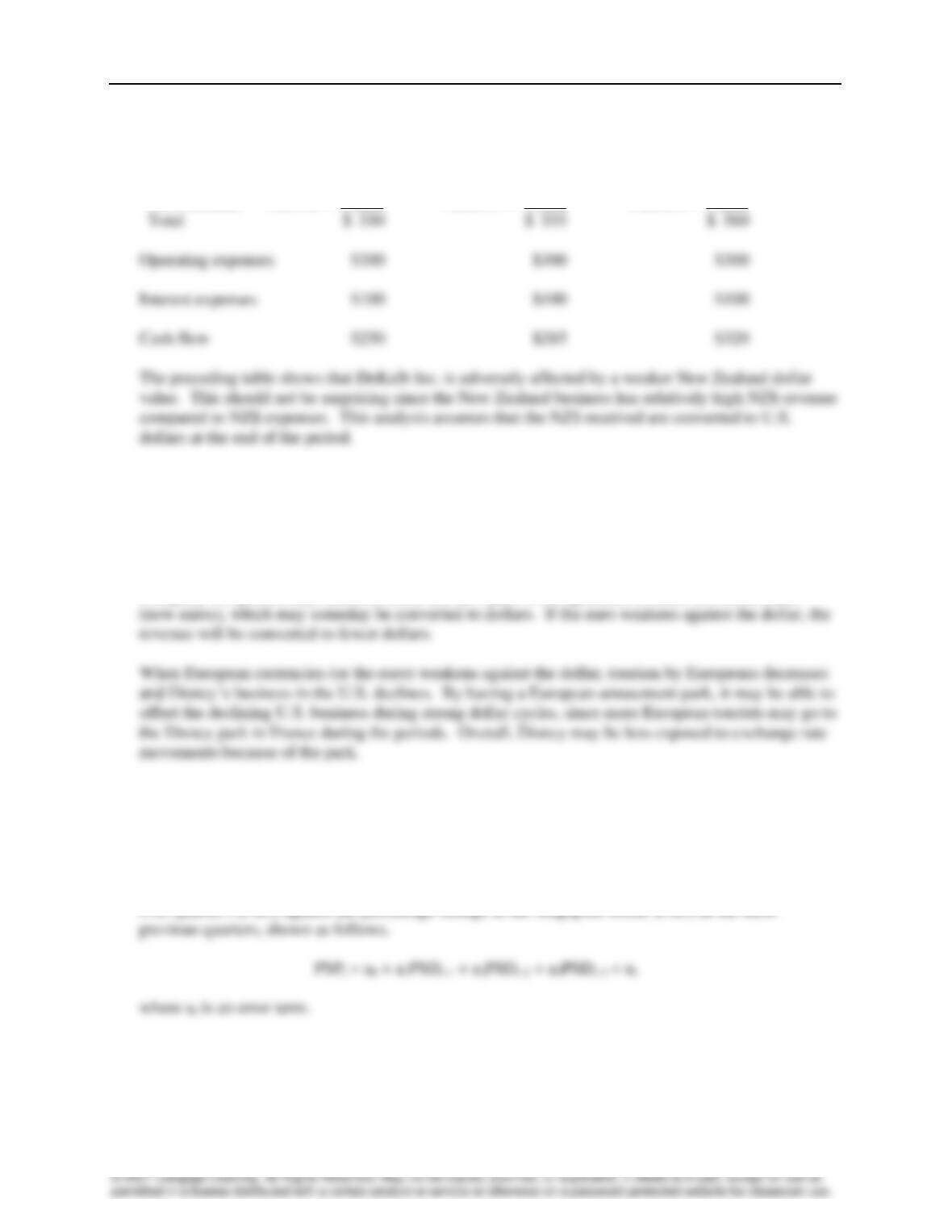
22. Measuring Economic Exposure. Using the following cost and revenue information shown for
DeKalb, Inc., determine how the costs, revenue, and cash flow would be affected by three possible
exchange rate scenarios for the New Zealand dollar (NZ$): (1) NZ$ = $.50, (2) NZ$ = $.55, and (3)
NZ$ = $.60. (Assume U.S. sales will be unaffected by the exchange rate.) Assume that NZ$
earnings will be remitted to the U.S. parent at the end of the period. Ignore possible tax effects.
Forecasted Net Cash Flows: DeKalb Inc.
(in millions of U.S. dollars and New Zealand dollars)
New Zealand
U.S. Business Business
Sales $800 NZ$800
Cost of Materials 500 100
Operating Expenses 300 0
Interest Expense 100 0
Cash Flow –$100 NZ$700
ANSWER:
(Figures are in millions)
NZ$=$.50 NZ$=$.55 NZ$=$.60
Measuring Exposure to Exchange Rate Fluctuations ❖ 9
Cost of Materials
U.S. $ 500 $ 500 $ 500
New Zealand NZ$100 = $50 NZ$100 = $55 NZ$100 = $60
23. Changes in Economic Exposure. Walt Disney World built an amusement park in France that opened
in 1992. How do you think this project has affected Disney’s economic exposure to exchange rate
movements? Think carefully before you give your final answer. There is more than one way in which
Disney’s cash flows may be affected. Explain.
ANSWER: This is a good question for class discussion. The typical first reaction is that Walt Disney
Company’s exposure may increase, since this new park would generate revenue in French francs
24. Lagged Effects of Exchange Rate Movements. Cornhusker Co. is an exporter of products to
Singapore. It wants to know how its stock price is affected by changes in the Singapore dollar’s
exchange rate. The firm believes that the impact may occur with a lag of one to three quarters. How
could regression analysis be used to assess the impact?
ANSWER: A possible regression model for this task is to regress percentage change in its stock price
over quarter t (PSPt) against the percentage change in the Singapore dollar (PSD) in the three
25. Potential Exposure Effects Due to Brexit. In 2016, the United Kingdom decided to leave
the EU (referred to as Brexit). Many analysts have made arguments about how this event will
affect firms in the U.K. Assume that the pound’s value relative to the euro is likely to be more

Measuring Exposure to Exchange Rate Fluctuations ❖ 10
volatile as a result of Brexit. For each of the following statements, insert either increase or
decrease in the first blank and complete the statement by adding a clear, short explanation.
a. The economic exposure of British firms that were heavy exporters to the eurozone would
have ___ because ___.
b. The translation exposure of firms based in the eurozone that had British subsidiaries
would have ___ because ___.
ANSWERS:
a. The economic exposure of British firms that are heavy exporters to the euro zone would increase
26. Invoicing Policy to Reduce Exposure. Celtic Co. is a U.S. firm that exports its products to England.
It faces competition from many firms in England. Its price to customers in England has generally
been lower than those of the competitors, primarily because the British pound has been strong. Celtic
has priced its exports in pounds, and then later converts the pound receivables into dollars. All of its
expenses are in the U.S. and are paid with dollars. The firm is concerned about its economic
exposure. It considers changing its pricing policy, so that it will price its products in dollars instead of
pounds. Offer your opinion on why this strategy will or will not significantly reduce Celtic’s
economic exposure.
27. Exposure to Cash Flows. Raton Co. is a U.S. company that has net inflows of 100 million Swiss
francs and net outflows of 100 million British pounds. The present exchange rate of the Swiss franc
is approximately $.70 and the present exchange rate of the pound is $1.90. Raton Co. has not hedged
these positions. The Swiss franc and British pound are highly correlated in their movements against
the dollar. Explain whether Raton will be favorably or adversely affected if the dollar weakens
against foreign currencies over time.
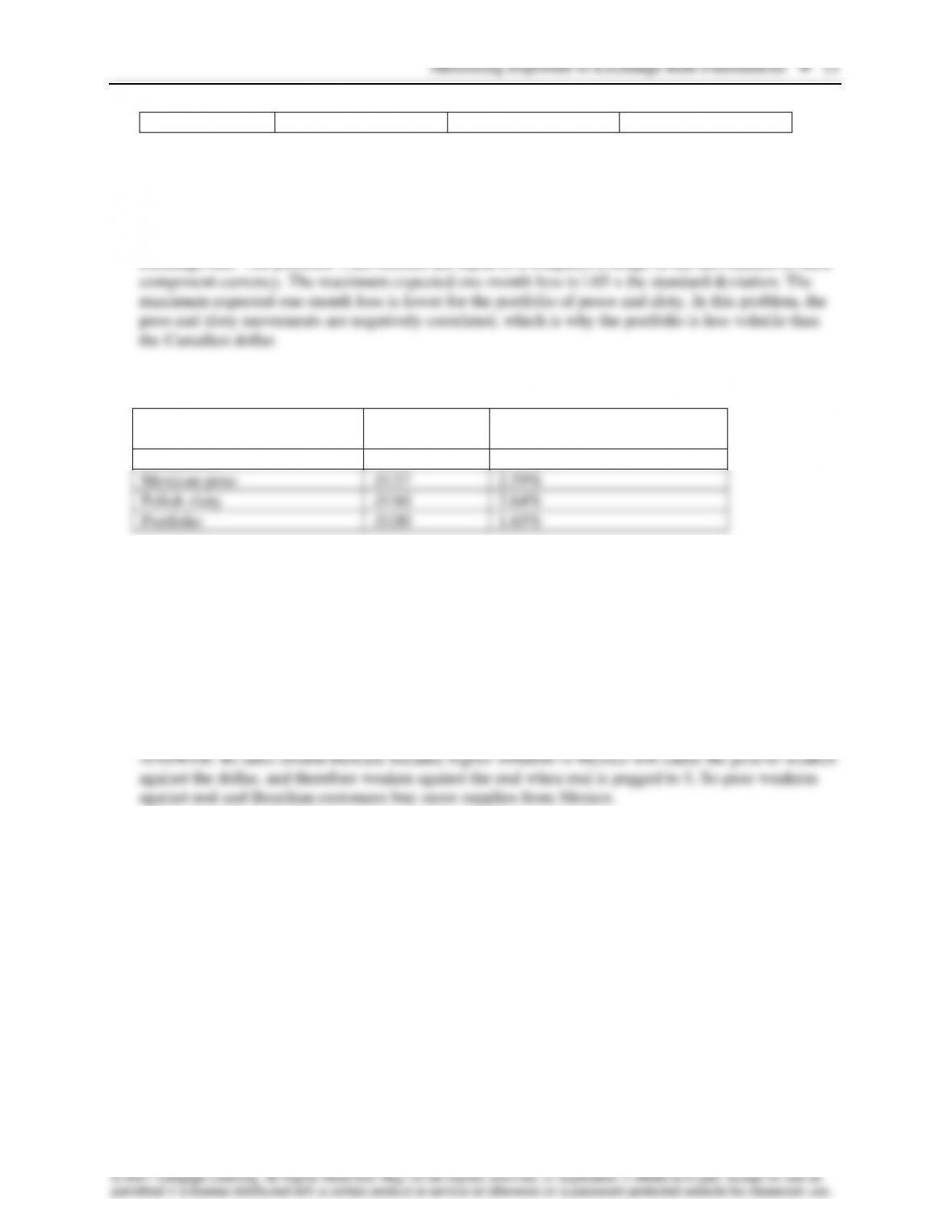
28. Assessing Exchange Rate Risk. Washington Co. and Vermont Co. have no domestic business. Both
have a similar dollar equivalent amount of international exporting business. Washington Co. exports
all of its products to Canada, whereas Vermont Co. exports its products to Poland and Mexico, with
about half of its business in each of these 2 countries. Each firm receives the currency of the country
where it sends its exports. You obtain the end-of-month spot exchange rates of the currencies
mentioned above during the end of each of the last 6 months.
End of Month
Canadian Dollar
Mexican Peso
Polish Zloty
1
$0.8142
$.09334
$.29914
2
0.8176
.09437
.29829
3
0.8395
.09241
.30187
4
0.8542
.09263
.3088
5
0.8501
.09251
.30274
Measuring Exposure to Exchange Rate Fluctuations ❖ 12
You can use the oanda.com web site (or any legitimate web site that has currency data) to obtain the
end of month direct exchange rate of the peso and the Canadian dollar in order to do your analysis.
Show your work. You can use a calculator or a spreadsheet (like excel) to do the actual computations.
31. Exposure of Net Cash Flows. Each of the following U.S. firms is expected to generate $40 million
in net cash flows (after including the estimated cash flows from international sales if there are any)
over the next year. Ignore any tax effects. Each firm has the same level of expected earnings. None of
the firms have taken any positions in exchange rate derivatives to hedge their exchange rate risk. All
payments for the international trade by each firm will occur one year from today.
Sunrise Co. has ordered imports from Austria, and its imports are invoiced in euros. The dollar value
of the payables (based on today’s exchange rate) from its imports during this year is $10 million. It
has no international sales.
Copans Co. has ordered imports from Mexico, and its imports are invoiced in U.S. dollars. The dollar
value of the payables from its imports during this year is $15 million. It has no international sales.
Yamato Co. ordered imports from Italy, and its imports are invoiced in euros. The dollar value of the
payables (based on today’s exchange rate) from its imports during this year is $12 million. In
addition, Yamato exports to Portugal and its exports are denominated in euros. The dollar value of the
receivables (based on today’s exchange rate) from its exports during this year is $8 million.
Glades Co. ordered imports from Belgium, and these imports are invoiced in euros. The dollar value
of the payables (based on today’s exchange rate) from its imports during this year is $7 million.
Glades also ordered imports from Luxembourg and these imports are denominated in dollars. The
dollar value of these payables is $30 million. Glades has no international sales.
Based on this information, which firm is exposed to the most exchange rate risk? Explain.
ANSWER:
Company
Amount of Foreign Currency Net
Cash Flows (measured in $)
Sunrise
$10 million
Copans
$0
Yamato
$4 million
Glades
$7 million
32. Cash Flow Sensitivity to Exchange Rate Movements. The Central Bank of Poland is about to
engage in indirect intervention later today, in which it will lower Poland’s interest rates substantially.
This will have an impact on the value of the Polish currency (zloty) against most currencies because it
will immediately affect capital flows. Missouri Co. has a subsidiary in Poland that sells appliances.