
Measuring Exposure to Exchange Rate Fluctuations 13
ANSWER: Its sales should increase because higher inflation in Mexico will cause the peso to
30. Assessing Currency Volatility. Zemart is a U.S. firm that plans to establish international
business in which it will export to Mexico (these exports will be denominated in pesos) and to
Canada (these exports will be denominated in Canadian dollars) once a month and will therefore
receive payments once a month. It is concerned about exchange rate risk. It wants to compare the
standard deviation of exchange rate movements of these 2 currencies against the dollar on a monthly
basis. For this reason, it asks you to
a. estimate the standard deviation of the monthly movements in the Canadian dollar against the U.S.
dollar over the last 12 months
b. estimate the standard deviation of the monthly movements in the Mexican peso against the U.S.
dollar over the last 12 months.
c. Determine which currency is less volatile
You can use the oanda.com web site (or any legitimate web site that has currency data) to obtain the
end of month direct exchange rate of the peso and the Canadian dollar in order to do your analysis.
Show your work. You can use a calculator or a spreadsheet (like excel) to do the actual
computations.
ANSWER: This problem requires students to obtain exchange rates and use an Excel spreadsheet to
31. Exposure of Net Cash Flows. Each of the following U.S. firms is expected to generate $40
million in net cash flows (after including the estimated cash flows from international sales if there
are any) over the next year. Ignore any tax effects. Each firm has the same level of expected earnings.
None of the firms have taken any positions in exchange rate derivatives to hedge their exchange rate
risk. All payments for the international trade by each firm will occur one year from today.
Sunrise Co. has ordered imports from Austria, and its imports are invoiced in euros. The dollar value
of the payables (based on today’s exchange rate) from its imports during this year is $10 million. It
has no international sales.
Copans Co. has ordered imports from Mexico, and its imports are invoiced in U.S. dollars. The dollar
value of the payables from its imports during this year is $15 million. It has no international sales.
Yamato Co. ordered imports from Italy, and its imports are invoiced in euros. The dollar value of the
payables (based on today’s exchange rate) from its imports during this year is $12 million. In
addition, Yamato exports to Portugal and its exports are denominated in euros. The dollar value of
the receivables (based on today’s exchange rate) from its exports during this year is $8 million.
Glades Co. ordered imports from Belgium, and these imports are invoiced in euros. The dollar value
of the payables (based on today’s exchange rate) from its imports during this year is $7 million.
14 Measuring Exposure to Exchange Rate Fluctuations
Glades also ordered imports from Luxembourg and these imports are denominated in dollars. The
dollar value of these payables is $30 million. Glades has no international sales.
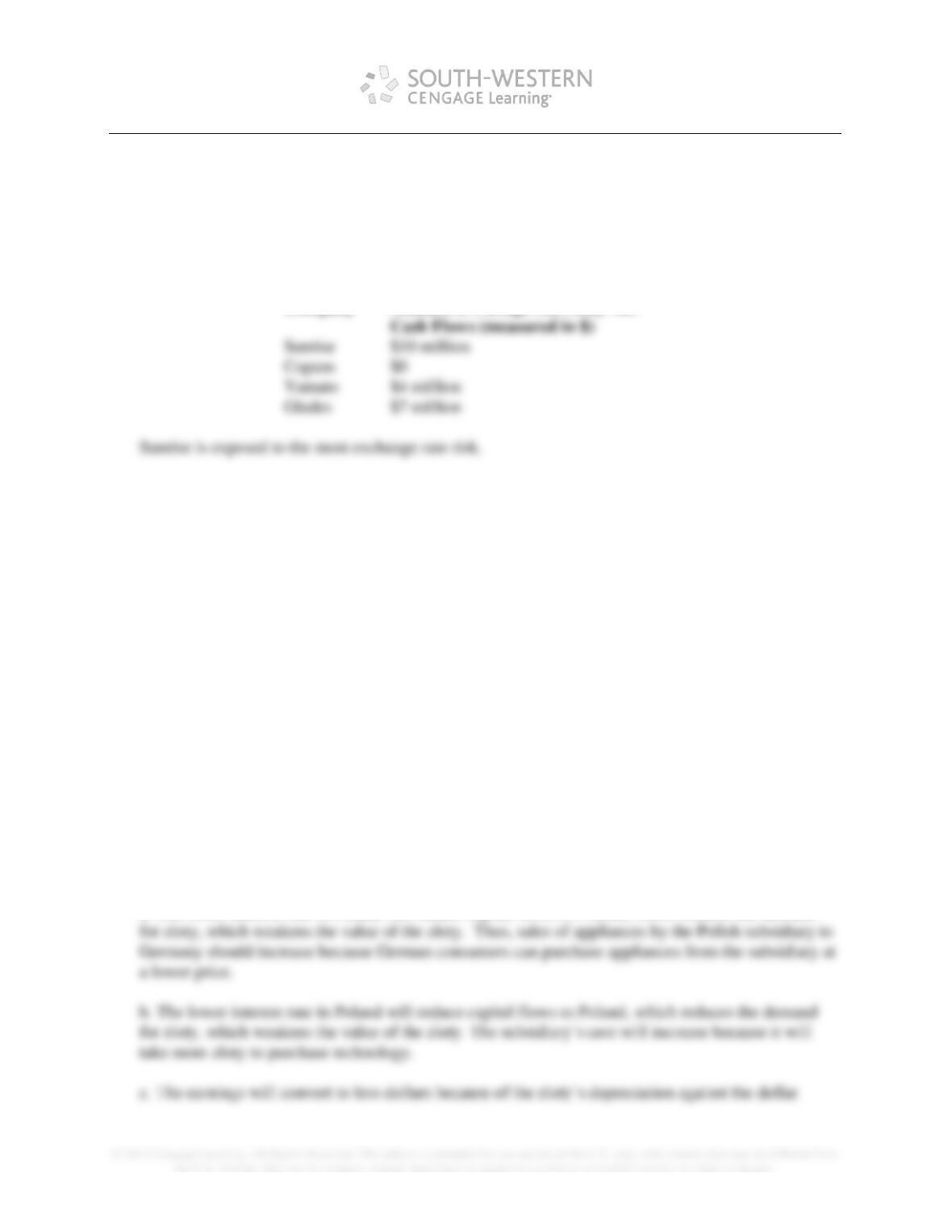
Based on this information, which firm is exposed to the most exchange rate risk? Explain.
ANSWER
Company
Amount of Foreign Currency Net
32. Cash Flow Sensitivity to Exchange Rate Movements. The Central Bank of Poland is about to
engage in indirect intervention later today, in which it will lower Poland’s interest rates substantially.
This will have an impact on the value of the Polish currency (zloty) against most currencies because
it will immediately affect capital flows. Missouri Co. has a subsidiary in Poland that sells appliances.
The demand for its appliances is not affected much by the local economy. Most of its appliances
produced in Poland are typically invoiced in zloty and are purchased by consumers from Germany.
The subsidiary’s main competition is from appliance producers in Portugal, Spain, and Italy that also
export appliances to Germany.
a. Explain how the impact on the zloty’s value will affect the sales of appliances by the Polish
subsidiary.
b. The subsidiary owes a British company 1 million British pounds for some technology that the
British company provided. Explain how the impact on the zloty’s value will affect the cost of this
technology to the subsidiary.
c. The subsidiary plans to take 2 million zloty from its recent earnings, and will remit it to the U.S.
parent in the near future. Explain how the impact on the zloty’s value will affect the amount of dollar
cash flows received by the U.S. parent due to this remittance of earnings by the subsidiary.
ANSWER
a. The lower interest rate in Poland will reduce capital flows to Poland, which reduces the demand

Measuring Exposure to Exchange Rate Fluctuations 15
33. Applying the Value-at-Risk Method. You use today’s spot rate of the Brazilian real to forecast
the spot rate of the real for one month ahead. Today’s spot rate is $.4558. Use the value–at-risk
method to determine the maximum percentage loss of the Brazilian real over the next month based on
a 95 percent confidence level. Use the spot exchange rates at the end of each of the last 6 months as
shown below to conduct your analysis. Forecast the exchange rate that would exist under these
conditions.
ANSWER:
End of
Month
Value of
Brazilian real
34. Assessing Translation Exposure. Kanab Co. and Zion Co. are U.S. companies that engage in
much business within the U.S. and are about the same size. They both conduct some international
business as well.
Kanab Co. has a subsidiary in Canada that will generate earnings of about C$20 million in each of
the next 5 years. Kanab Co. also has a U.S. business that will also receive about C$1 million (after
costs) in each of the next 5 years as a result of exporting products to Canada that are denominated in
Canadian dollars.
Zion Company has a subsidiary in Mexico that will generate earnings of about 1 million pesos in
each of the next 5 years. Zion Co. also has a business in the U.S. that will receive about 300 million
pesos (after costs) in each of the next 5 years as a result of exporting products to Mexico that are
denominated in Mexican pesos.
The salvage value of Kanab’s Canadian subsidiary and Zion’s Mexican subsidiary will be zero in 5
years. The spot rate of the Canadian dollar is $.60 while the spot rate of the Mexican peso is $.10.
Assume the Canadian dollar could appreciate or depreciate against the U.S. dollar by about 8% in
any given year, while the Mexican peso could appreciate or depreciate against the U.S. dollar by
about 12% in any given year. Which company is subject to a higher degree of translation exposure?
Explain.
ANSWER: Kanab Co. has C$20,000,000 that is subject to translation exposure, as these are the
16 Measuring Exposure to Exchange Rate Fluctuations
35. Cross-Currency Relationships. The Hong Kong dollar (HK$) is presently pegged to the U.S.
dollar and is expected to remain pegged. Some Hong Kong firms export products to Australia that are
denominated in Australian dollars and have no other business in Australia. The exports are not
hedged. The Australian dollar is presently worth 0.50 U.S. dollars but you expect that it will be worth
0.45 U.S. dollars by the end of the year. Based on your expectations, will the Hong Kong exporters
be affected favorably or unfavorably? Briefly explain.
ANSWER: Hong Kong exporters are adversely affected. If the A$ depreciates against U.S. $, it will
36. Interpreting Economic Exposure. Spratt Co. (a U.S. firm) attempts to determine its economic
exposure to movements in the British pound, by applying regression analysis to data over the last 36
quarters:
SP = b0 + b1e + u
where SP represents the percentage change in Alabama’s stock price per quarter, e represents the
percentage change in the pound value per quarter, and u is an error term. Based on the analysis, the
b0 coefficient is zero and the b1 coefficient is -.4 and is statistically significant. Assume that interest
rate parity exists. Today, the spot rate of the pound is $1.80, the 90-day British interest rate is 3%,
and the 90-day U.S. interest rate is 2%. Assume that the 90-day forward rate is expected to be an
accurate forecast of the future spot rate. Would you expect that Spratt’s value will be favorably
affected, unfavorably affected, or not affected by its economic exposure over the next quarter?
Explain.
ANSWER: The forecast based on the forward rate (assuming interest rate parity) is depreciation of
37. Assessing Translation Exposure. Assume the euro’s spot rate is presently equal to $1.00. All of
the following firms are based in New York and are the same size. While these firms concentrate on
business in the U.S., their entire foreign operations for this quarter are provided here.
Company A expects its exports to cause cash inflows of 9 million euros and imports to cause cash
outflows equal to 3 million euros.
Company B has a subsidiary in Portugal that expects revenue of 5 million euros and has expenses of
1 million euros.
Measuring Exposure to Exchange Rate Fluctuations 17
Company C expects exports to cause cash inflows of 9 million euros and imports to cause cash
outflows of 3 million euros, and will repay the balance of an existing loan equal to 2 million euros.
Company D expects zero exports and imports to cause cash outflows of 11 million euros.
Company E will repay the balance of an existing loan equal to 9 million euros.
Which of the five companies described here has the highest degree of translation exposure?
38. Exchange Rates and Market Share. Minnesota Co. is a U.S. firm that exports computer parts to
Japan. Its main competition is from firms that are based in Japan, which invoice their products in
yen. Minnesota’s exports are invoiced in U.S. dollars. The prices charged by Minnesota and its
competitors will not change during the next year. Will Minnesota’s revenue increase, decrease, or be
unaffected if the spot rate of the yen appreciates over the next year? Briefly explain.
ANSWER: The revenue will increase, since the demand by Japanese customers for Minnesota’s
39. Exchange Rates and Market Share. Harz Co. (a U.S. firm) has an arrangement with a Chinese
company in which it purchases the products from them every week at the prevailing spot rate, and
then sells the products in the U.S. invoiced in dollars. All of its competition is from U.S. firms that
have no international business. The prices charged by Harz and its competitors will not change over
the next year. Will the net cash flows generated by Harz increase, decrease, or be unaffected if the
Chinese yuan depreciates over the next year? Briefly explain.
ANSWER: If the yuan depreciates, Harz will incur lower expenses when paying for the products
40. IFE and Exposure. Assume that Maine Co. (a U.S. firm) measures its economic exposure to
movements in the British pound by applying regression analysis to data over the last 36 quarters:
SP = b0 + b1e + u
where SP represents the percentage change in Maine’s stock price per quarter, e represents the
percentage change in the British pound value per quarter, and u is an error term. Based on the
analysis, the b0 coefficient is estimated to be zero and the b1 coefficient is estimated to be 0.3 and is
statistically significant. Maine Co. believes that the movement in the value of the pound over the next
quarter will be mostly driven by the international Fisher effect. The prevailing quarterly interest rate
in the U.K. is lower than the prevailing quarterly interest rate in the U.S. Would you expect that
Maine’s value will be favorably affected, unfavorably affected, or not affected by the pound’s
movement over the next quarter? Explain.
ANSWER: Based on the IFE, the pound’s value will rise during the next quarter. Since SP is
18 Measuring Exposure to Exchange Rate Fluctuations
41. PPP and Exposure. Layton Co. (a U.S. firm) attempts to determine its economic exposure to
movements in the Japanese yen, by applying regression analysis to data over the last 36 quarters:
SP = b0 + b1e + u
where SP represents the percentage change in Layton’s stock price per quarter, e represents the
percentage change in the yen value per quarter, and u is an error term. Based on the analysis, the b0
coefficient is zero and the b1 coefficient is 0.4 and is statistically significant. Layton believes that the
inflation differential has a major effect on the value of the yen (based on purchasing power parity).
The inflation in Japan is expected to rise substantially while the U.S. inflation will remain at a low
level. Would you expect that Layton’s value will be favorably affected, unfavorably affected, or not
affected by its economic exposure over the next quarter? Explain.
ANSWER: Based on purchasing power parity, the relatively high inflation in Japan will place
42. Exposure to Cash Flows. Lance Co. is a U.S. company that has exposure to the Swiss francs (SF)
and Danish kroner (DK). It has net inflows of SF100 million and net outflows of DK500 million.
The present exchange rate of the SF is about $.80 while the present exchange rate of the DK is $.10.
Lance Co. has not hedged these positions. The SF and DK are highly correlated in their movements
against the dollar. Explain whether Lance will be favorably or adversely affected if the dollar
strengthens against foreign currencies over time.
ANSWER: Lance Co. will be adversely affected because the dollar value of its SF inflows exceeds
43. Assessing Transaction Exposure. Zebra Co. is a U.S. firm that obtains products from a U.S.
supplier and then exports them to Canadian firms. Its exports are denominated in U.S. dollars. Its
main competitor is a local company in Canada that sells similar products denominated in Canadian
dollars. Is Zebra subject to transaction exposure? Briefly explain.
44. Assessing Translation Exposure. Quartz Co. has its entire operations in Miami, Florida, and is
an exporter of products to Eurozone countries. All of its earnings are derived from its exports. The
exports are denominated in euros. Reed Co. (of the U.S.) is about the same size as Quartz Co. and
generates about the same amount of earnings in a typical year. It has a subsidiary in Germany that
typically generates about 40 percent of its total earnings. All earnings are reinvested in Germany and
therefore not remitted. The rest of Reed’s business is in the U.S. Which company has a higher degree
of translation exposure? Briefly explain.
Measuring Exposure to Exchange Rate Fluctuations 19
ANSWER: Reed Co. has a higher degree of translation exposure because its foreign subsidiary’s
45. Estimating Value at Risk. Yazoo Inc. is a U.S. firm that has substantial international business in
Japan and has cash inflows in Japanese yen. The spot rate of the yen today is $.01. The yen exchange
rate was $.008 three months ago, $.0085 two months ago, and $.009 one month ago. Yazoo uses
today’s spot rate of the yen as its forecast of the spot rate in one month. However, it wants to
determine the maximum expected percentage decline in the value of the Japanese yen in one month
based on the value at risk (VaR) method and a 95 percent probability. Use the exchange rate
information provided to derive the maximum expected decline in the yen over the next month.
46. Assessing Exposure to Net Cash Flows. Reese Co. will pay 1 million British pounds for materials
imported from the U.K. in one month. Reese Co. sells some goods to Poland, and will receive 3
million zloty (the Polish currency) for those goods in one month. The spot rate of the pound is $1.50,
while the spot rate of the zloty is about $.30. Assume that the pound and zloty are both expected to
depreciate substantially against the dollar over the next month and by the same degree (percentage).
Will this have a favorable effect, unfavorable effect or no effect on Reese Co. over the next year?
Explain.
ANSWER: The dollar value of the outflow exposure to pounds is greater than the inflow exposure to
47. Impact of Translation Exposure on Stock Valuation. Spencer Co. is a U.S. firm that has a large
subsidiary in Singapore, which generates a large amount of earnings. Spencer’s stock is commonly valued
at about 16 times its reported earnings per share. The earnings generated by the Singapore subsidiary in
this period are the same as in the previous period. The Singapore dollar has depreciated substantially
against the U.S. dollar during this period. None of the earnings generated by the Singapore subsidiary in
this period will be remitted to the U.S. parent at this time. How will the stock price of Spencer Co. be
affected (if at all) when the earnings are reported at the end of this period? Explain.
ANSWER: The stock price will decline because the consolidated earnings will decline as a result of the
20 Measuring Exposure to Exchange Rate Fluctuations
Solution to Continuing Case Problem: Blades, Inc.
1. What type(s) of exposure (i.e., transaction, economic, or translation exposure) is Blades subject to?
Why?
ANSWER: Blades is subject to transaction and economic exposure, but is not subject to translation
2. Using a spreadsheet, conduct a consolidated net cash flow assessment of Blades, Inc., and estimate
the range of net inflows and outflows for Blades for the coming year. Assume that Blades enters into
the agreement with Jogs, Ltd.
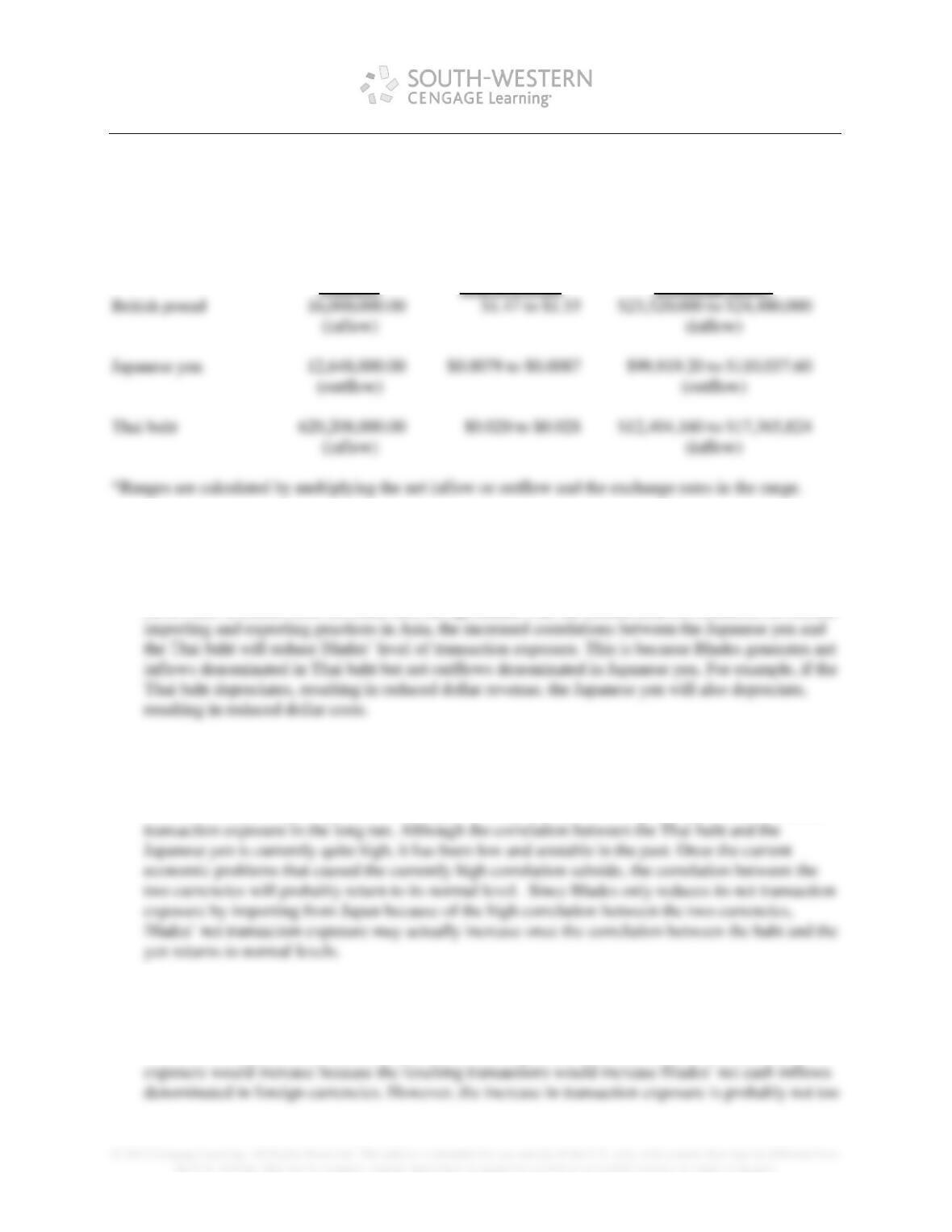
ANSWER:
Consolidated Net Cash Flow Assessment of Blades, Inc.
Net Inflow or
Net Inflow Expected Outflow as
Total Total or Exchange Measured in
Currency Inflow Outflow Outflow Rate U.S. Dollars
Measuring Exposure to Exchange Rate Fluctuations 21
Estimating the Range of Net Inflows or Outflows for Blades, Inc.
Range of Possible Net
Inflows or Outflows in
Range of Possible U.S. Dollars (Based on
Net Inflow or Exchange Rates at Range of Possible Net
Outflow End of Period Exchange Rate*
3. If Blades does not enter into the agreement with the British firm and continues to export to Thailand
and import from Thailand and Japan, do you think the increased correlations between the Japanese
yen and the Thai baht will increase or decrease Blades’ transaction exposure?
ANSWER: If Blades does not enter into the agreement with the British firm but continues its current
4. Do you think Blades should import components from Japan to reduce its net transaction exposure in
the long run? Why or why not?
ANSWER: Importing components from Japan would probably not be a good way to reduce Blades’
5. Assuming Blades enters into the agreement with Jogs, Ltd., how will its overall transaction exposure
be affected?
ANSWER: If Blades enters into the agreement with Jogs Ltd., its overall level of transaction
22 Measuring Exposure to Exchange Rate Fluctuations
6. Given that Thai roller blade manufacturers located in Thailand have begun targeting the U.S. roller
blade market, how do you think Blades’ U.S. sales were affected by the depreciation of the Thai
baht? How do you think its exports to Thailand and its imports from Thailand and Japan were
affected by the depreciation?
ANSWER: Blades’ U.S. sales were likely negatively affected by the depreciation of the baht since
Measuring Exposure to Exchange Rate Fluctuations 23
Solution to Supplemental Case: Whaler Publishing Company
a. Using the exchange rate data from the case problem in the previous chapter, scenarios for the
percentage change in each exchange rate and the forecasted spot rate in one year are determined.
Then, for each scenario, the forecasted spot rate is multiplied by the number of foreign currency units
to be received; estimate the U.S. dollar revenues to be generated from each country. These revenues
are then aggregated across the four countries to estimate total dollar revenues.
U.S. Dollar Revenues
Year Used to from All Countries in
Create a Scenario Aggregate (in thousands)
1 $129,010
2 153,443
Since each scenario has an equal probability of occurring, the expected value of U.S. dollar revenues
from all countries in aggregate is the average of these numbers, $143,982,000. The standard
b. There is some evidence of positive correlation among all currencies. The correlation coefficient
matrix is filled in below:
A$
C$
NZ$
Pound
A$
1.00
C$
.35
1.00
NZ$
.41
.39
1.00
Pound
.30
.17
.82
1.00
24 Measuring Exposure to Exchange Rate Fluctuations
c. The executive’s approach may be slightly easier to use, but is normally less reliable. Whaler does
Small Business Dilemma
Assessment of Exchange Rate Exposure by the Sports Exports Company
1. Would you describe the exposure of the Sports Exports Company to exchange rate risk as transaction
exposure? Economic exposure? Translation exposure?
ANSWER: The Sports Exports Company is subject to transaction exposure, because the business
2. Jim Logan is considering a change in the pricing policy in which the importer must pay in dollars, so
that Jim will not have to worry about converting pounds to dollars every month. If implemented,
would this policy eliminate the transaction exposure of the Sports Exports Company? Would it
eliminate Sports Exports’ economic exposure? Explain.
ANSWER: This policy would eliminate transaction exposure, because there would no longer be any
3. If Jim decides to implement the policy described in the previous question, how would the Sports
Exports Company be affected (if at all) by appreciation of the pound? By depreciation of the pound?
Would these effects on Sports Exports differ if Jim retained his original policy of pricing the exports
in British pounds?
ANSWER: If the pound appreciates, the demand for the exports produced by the Sports Exports