
CHAPTER 10
STRATEGIZING, STRUCTURING, AND LEARNING
AROUND THE WORLD
CHAPTER OUTLINE
I. OPENING CASE: Emerging Markets: GE Innovates from the Base of the Pyramid
A. Historically, new products innovated in developed economies, and then tweaked and
localized for customers in emerging economies
1. Unfortunately, a lot of these expensive products flop at the base of the pyramid
(BoP)
a. price tag
b. lack of consideration for the needs and wants of local customers
B. GE’s conventional ultrasound machines
1. Developed in the United States and Japan and sold for $100,000 and up (up to
$350,000)
2. Sold poorly in China because not every sophisticated hospital imaging center
could afford them
3. GE’s China team realized that more than 70% of China’s population relies on
poorly funded rural hospitals or clinics
4. Patients thus have to travel to urban hospitals to access ultrasound, which is
challenging
C. GE has similar experiences
1. Pioneered a $1,000 handheld electrocardiogram (ECG) device for rural India, a
cost reduction of 60% to 80%
2. In the Czech Republic, GE developed an aircraft engine for small planes that
slashes its cost by half
II. MULTINATIONAL STRATEGIES AND STRUCTURES
A. Pressures for Cost Reductions and Local Responsiveness
1. MNEs confront two sets of pressures: cost reduction and local responsiveness
2. The integration-responsiveness framework allows managers to deal with the
pressures for both global integration and local responsiveness

Chapter 10 Strategizing, Structuring, and Learning Around the World
a. Cost pressures influence global integration
b. Local responsiveness forces MNEs to adapt locally
3. Unique to international competition are the pressures for local responsiveness
4. Distribution channels also vary internationally
B. Four Strategic Choices for MNEs: (1) home replication, (2) multidomestic, (3)
global, and (4) transnational
1. The home replication strategy, by definition, emphasizes the international
replication of home country–based competencies such as production scales,
distribution efficiencies, and brand power
a. It often lacks local responsiveness as it focuses on the home country
b. In an international market may end up alienating foreign customers
2. Localization (multidomestic) strategy is an extension of the home replication
3. A global standardization strategy is the opposite of the multidomestic strategy
a. It is the development and distribution of standardized products worldwide in
order to reap the maximum benefits from low-cost advantages
b. MNEs may designate centers of excellence or subsidiaries explicitly
recognized as a source of important capabilities, with the intention that these
capabilities be leveraged by and/or disseminated to other subsidiaries
c. It obviously sacrifices local responsiveness
4. A transnational strategy aims to capture “the best of both worlds” by
C. Four Organizational Structures
1. An international division structure is typically set up when firms initially expand
abroad, often engaging in a home replication strategy
a. Although this structure is intuitively appealing, it often leads to two

2. A geographic area structure, which organizes the MNE according to different
countries and regions, is the most appropriate structure for a multidomestic
strategy
a. A geographic area can be a country or a region led by a country (or regional)
3. A global product division structure, which is the opposite of the geographic area
structure, supports the global strategy
a. Each product division as a stand-alone entity with full worldwide—as
opposed to domestic—responsibilities for its activities
b. Many MNEs have phased out the geographical area structure in favor of the
global product division structure
c. Local responsiveness suffers
4. A global matrix structure is often used to alleviate the disadvantages associated
with both geographic area and global product division structures, especially for
MNEs adopting a transnational strategy
a. The global matrix structure’s hallmark is sharing and coordinating
responsibilities between product divisions and geographic areas to be both
D. The Reciprocal Relationship Between Multinational Strategies and Structures
1. Three key ideas stand out:
a. Strategy drives structure: a misfit, such as combining a global strategy with a
geographic area structure, may have grave performance consequences
b. The relationship is two-way. To the extent that certain strategies facilitate
certain structures, a given structure also supports a particular strategy
c. Strategies and structures are not static; it is often necessary to change
strategy, structure, or both
III. A COMPREHENSIVE MODEL OF MULTINATIONAL STRATEGY,
STRUCTURE, AND LEARNING
A. Industry-Based Considerations
1. Why are MNEs structured differently?
a. The different nature of industries
(i) Industrial-products firms value technological knowledge that is not
location-specific
(ii) Consumer-goods industries, on the other hand, require deep knowledge

Chapter 10 Strategizing, Structuring, and Learning Around the World
• Threat of substitute products
B. Resource-Based Considerations
1. The actual value of innovation is important
2. Rarity is important
C. Institution-Based Considerations
1. Formal and Informal External Institutions govern external and internal
relationships
a. Formal institutions
(i) Externally, MNEs are subject to the formal institutional frameworks
erected by various home- and host-country governments
(ii) Host-country governments often encourage, or coerce MNEs into
undertaking certain activities
b. Informal institutions
2. Formal and Informal Internal Institutions
a. Formal organizational charts do not necessarily reveal the informal rules of
the game, such as organizational norms, values, and networks
IV. WORLDWIDE LEARNING, INNOVATION, AND KNOWLEDGE
MANAGEMENT
A. Knowledge management can be defined as the structures, processes, and systems
that actively develop, leverage, and transfer knowledge; some argue that knowledge
management is the defining feature of MNEs
1. Knowledge management not only depends on IT, but also on informal social
relationships within the MNE
B. Knowledge Management in Four Types of MNEs
1. Home replication strategy: The role of subsidiaries is to adapt and leverage
parent company competencies
2. Localization strategy: Interdependence is low; knowledge management centers
on local markets
3. Global standardization strategy: The interdependence is increased and uses
“centers of excellence”

Chapter 10 Strategizing, Structuring, and Learning Around the World
4. Transnational strategy – High interdependence and bi-directional flows of
knowledge
C. Globalizing Research and Development (R&D)
1. R&D emerged as an important function to be internationalized and is often
known as innovation-seeking investment
2. The intensification of competition for innovation drives the globalization of
R&D
D. Problems and Solutions in Knowledge Management
1. For large firms, there are actually diminishing returns for R&D. Consequently, a
new model, called “open innovation,” is emerging. This model relies on more
collaborative research, among various internal units and with external
organizations
2. In knowledge retention, there is the problem of employee turnover, which may
lead to knowledge leakage
3. Global virtual teams, which do not meet face to face, may have communication
and relationship barriers
V. DEBATES AND EXTENSIONS
A. Corporate Controls versus Subsidiary Initiatives
1. Arguments in favor of centralization:
a. Capability to facilitate corporate-wide coordination
b. Consistency in decision-making
B. Customer-Focused Dimensions versus Integration, Responsiveness, and Learning
1. Three primary customer-focused dimensions
a. Global account structure to supply customers across various countries
b. An industry sector structure is common for professional service firms
c. Solutions-based structure is often used

Chapter 10 Strategizing, Structuring, and Learning Around the World
2. Customer-focused dimensions cut across all three existing mainstream
dimensions, integrating on a global basis, responding to customers in single and
multiple markets, and learning how to meet customers’ needs and wants
3. One recommendation is to simplify both product and geographic scope to add the
customer-focused dimensions
VI. THE SAVVY STRATEGIST
A. To manage effectively, four implications emerge
1. Understand the nature and evolution of your industry in order to come up with
the right strategy-structure configurations
2. Managers need to actively develop learning and innovation capabilities to
leverage multinational presence

Chapter 10 Strategizing, Structuring, and Learning Around the World
CHAPTER TEN – LECTURE NOTES AND TEACHING TIPS
SUMMARY OF THE OPENING CASE: Emerging Markets: GE Innovates from the
Base of the Pyramid
The opening case shows how GE has turned product development upside down. Instead of
innovating for the developed world and downsizing for the base of the economic pyramid,
GE has found it beneficial (and profitable!) to create products for the developing world that
are also successful in developed countries.
Teaching Tip: Ask students to consider why products developed for emerging economies,
where expensive products typically flop, could be successful in developed countries, where
money is not such an issue.
MULTINATIONAL STRATEGIES AND STRUCTURES
This section first introduces the integration–responsiveness framework centered on the
Pressures for Cost Reductions and Local Responsiveness
MNEs primarily confront two sets of pressures: those for cost reductions and those for local
responsiveness. Pressures for cost reductions are almost universal, especially for firms
competing on cost leadership.
Teaching Tip: Ask students what McDonald’s could substitute for beef in their Indian
locations. Since Hindus do not eat beef, and Moslems do not eat pork, McDonald’s had to
find something to make both groups happy. McDonald’s could substitute mutton-based
products for beef in their Indian restaurants, and the substitute products are very popular.
There is talk about goat meat being introduced as goats are now being raised more
aggressively around the world. Both Hindus and Moslems eat mutton and goat; most major
creeds in the world would not object to either of these pastoral animals. This is an interesting
contrast with Nestlé, which is phasing out its multidomestic strategy to achieve scale
economies and other efficiencies.
Four Strategic Choices
Based on the integration–responsiveness framework, Figure 10.1 uses the two dimensions of
the pressures for cost reductions and local responsiveness to plot the four possible strategic
choices for MNEs: (1) home replication, (2) localization (multidomestic), (3) global
standardization, and (4) transnational.

Chapter 10 Strategizing, Structuring, and Learning Around the World
strategy suffers from a lack of local responsiveness. By default, the home replication strategy
focuses on the home country, which makes sense when the majority of a firm’s customers are
domestic. However, when the firm aspires to broaden its international scope to reach more
foreign customers, failing to be mindful of foreign customers’ needs and wants may result in
their alienation.
A localization (multidomestic) strategy is an extension of the home replication strategy.
The multidomestic strategy focuses on a number of foreign countries/regions, each of which
A global standardization strategy is the opposite of the multidomestic strategy. Its hallmark
is developing and distributing standardized products and services worldwide to reap the
maximum benefits from low-cost advantages. While both the home replication and global
strategies minimize local responsiveness, a crucial difference is that an MNE pursuing a
global strategy is not limited to basing its major operations at home. In a number of countries,
A transnational strategy aims to capture “the best of both worlds” by endeavoring to be
both cost efficient and locally responsive. Citroën not only designs cars in France, but also in
China. On a worldwide basis, it intends to produce and market luxury cars such as the
Metropolis, designed in Shanghai. In addition to cost efficiency and local responsiveness, a
third hallmark of this strategy is global learning and diffusing innovations.
Taking these two points together, MNEs that engage in a transnational strategy promote
global learning and innovation diffusion in multiple ways. Innovations not only flow from the
home country to host countries (which is the traditional flow), but also flow from host
countries to the home country and flow among subsidiaries in multiple host countries.
Connecting these geographically dispersed operations creates a flow of knowledge about
market conditions and internal capabilities.
Four Organizational Structures
Four organizational structures are appropriate for the four strategic choices outlined
previously: (1) international division structure, (2) geographical area structure, (3) global
product division structure, and (4) global matrix structure.
Chapter 10 Strategizing, Structuring, and Learning Around the World
International division structure is typically set up when firms initially expand abroad, often
engaging in a home replication strategy. Although this structure is intuitively appealing, it
A geographic area structure, which organizes the MNE according to different countries and
regions, is the most appropriate structure for a multidomestic strategy. A geographic area can
be a country or a region that is led by a country manager or regional manager alone,
containing its own set of value creation activities (such as R&D, production, and marketing).
A global product division structure, which is the opposite of the geographic area structure,
A global matrix structure is often used to alleviate the disadvantages associated with both
geographic area and global product division structures, especially for MNEs adopting a
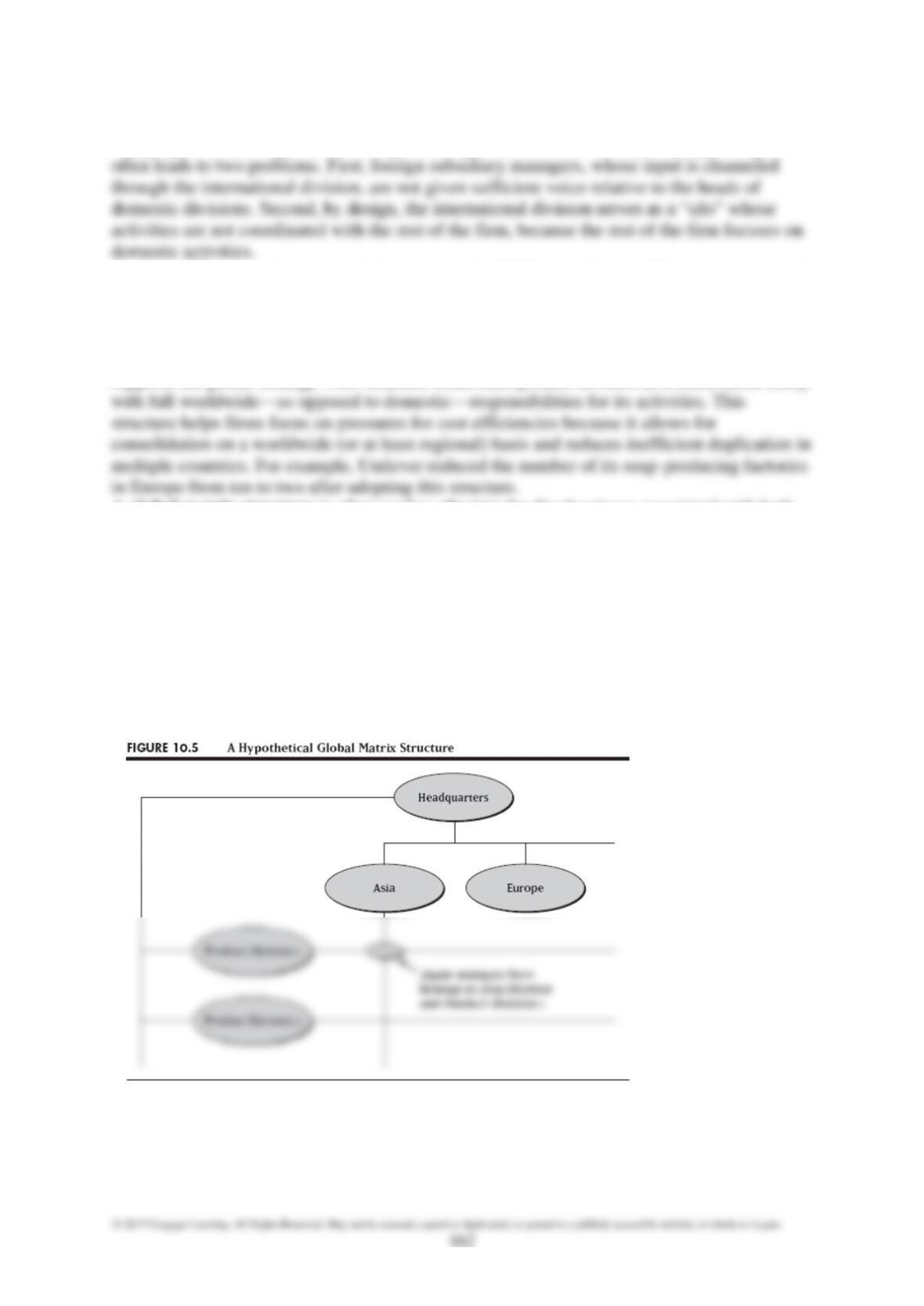
transnational strategy. Shown in Figure 10.5, its hallmark is sharing and coordinating
responsibilities between product divisions and geographic areas to be both cost efficient and
locally responsive. In this hypothetical example, the manager in charge of Japan reports to
Product Division 1 and Asia (area) Division, both of which have equal decision-making
power. In theory, the global matrix structure supports the goals of the transnational strategy.
However, in practice, this structure often has difficulty delivering. The reason is simple:
While managers (such as the Japan manager) usually find enough headaches dealing with one
boss, they do not appreciate having to deal with two bosses, who are often in conflict (!).
Taken together, the matrix structure, despite its merits, may add layers of management, slow
down decision speed, and increase costs while not showing significant performance
improvement. No conclusive evidence supports the superiority of the matrix structure.
Having experimented with the matrix structure, a number of MNEs, such as the highly visible

Chapter 10 Strategizing, Structuring, and Learning Around the World
Swiss-Swedish engineering conglomerate ABB (Asea Brown Boveri), have now moved back
to the simpler and easier-to-manage global product structure.
Overall, the positioning of the four structures is not random. They evolve from the relatively
The Reciprocal Relationship Between Multinational Strategies and Structures
The reciprocal relationship between strategies and structures, discussed earlier, can be vividly
portrayed within MNEs. Three key ideas stand out:
1. The fit between strategies and structures is crucial. A misfit, such as combining a
global strategy with a geographic area structure, may have grave performance
consequences.
A COMPREHENSIVE MODEL OF MULTINATIONAL STRATEGY, STRUCTURE,
AND LEARNING
This comprehensive model of multinational structure, learning, and innovation, as before,
draws on the three leading perspectives on strategy (see Figure 10.6).

Chapter 10 Strategizing, Structuring, and Learning Around the World
Industry-Based Considerations
Why are MNEs structured differently? For example, industrial-products firms (such as
semiconductor makers) tend to adopt global product divisions, whereas consumer-goods
companies (such as cosmetics producers) often rely on geographic area divisions. Industrial-
products firms typically emphasize technological innovations, while consumer-goods
companies place premiums on learning consumer trends and generating repackaged and
recombined products as marketing innovations.
Industrial-products firms value technological and engineering knowledge, which is not
location-specific (such as how to most efficiently make semiconductor chips). Consumer-
goods industries, on the other hand, must develop intimate knowledge about consumer tastes,
which are location-specific.
Bargaining power of suppliers and buyers also has a bearing on MNE structure, learning, and
innovation. When buyer firms move internationally, they increasingly demand that suppliers
provide integrated offerings—that is, buyer firms want to purchase the same supplies at the
same price and quality in every country in which they operate. Components suppliers are thus
encouraged to internationalize.
Teaching Tip: A well-known Harvard Business Review article by C.K. Prahalad and Allen
Hammond, “Serving the World’s Poor, Profitably” (September 2002, pp. 4–11), examines the
strategic logic and benefits to firms (and consumers) of producing lower end and smaller
versions of a product that can be purchased by customers (or villages) in the poorer parts of
the world. Sometimes these are potential low-end substitute products for established, higher
end products. The students can be asked if they can think of a product that is currently out of
reach for most poor consumers (either in their country or a remote developing one) that firms
could modify to produce a smaller, cheaper version.
Resource-Based Considerations
First, the question of value must be confronted when making structural changes.
Second is the value of innovation—the vast majority of innovations simply fail to reach the
market; and five to nine out of ten new products that do reach the market end up being
financial failures. Profitable innovators need plenty of good ideas, but also a lot of
complementary assets (such as appropriate organizational structures and marketing muscles)
as well as complementary technologies (sometimes via alliance partners) to create valuable
innovation.

Chapter 10 Strategizing, Structuring, and Learning Around the World
Institution-Based Considerations
Formal and Informal External Institutions
Externally, MNEs are subject to the formal institutional frameworks erected by various
home- and host-country governments. For instance, to protect domestic employment, home–
country governments may manipulate tax rules to encourage MNEs to invest at home.
Host-country governments, on the other hand, often attract, encourage, or coerce MNEs into
undertaking activities that they may otherwise abdicate. Advanced manufacturing, on the
other hand, moves up the value chain, generates better jobs, provides more technology
spillovers, and leads to better reputations.
Formal and Informal Internal Institutions
The internal rules of the game determine how MNEs are governed. Formally, the
organizational charts specify the primary scope of responsibilities of various parties.
However, the formal organizational charts do not reveal the informal rules of the game, such
as organizational norms, values, and networks. The nationality of the head of foreign
subsidiaries is such an example.
Nationality of top executives at the highest level (such as chairman, CEO, and board
members) seems to follow another informal rule: They are (almost always) home-country
nationals.
Some critics even argue that this “glass ceiling” reflects “corporate imperialism.”
Consequently, some leading MNEs have appointed non–homecountry nationals to top posts.

Chapter 10 Strategizing, Structuring, and Learning Around the World
WORLDWIDE LEARNING, INNOVATION, AND KNOWLEDGE MANAGEMENT
Knowledge Management in Four Types of MNEs
In MNEs pursuing a home replication strategy, such interdependence is moderate and the role
of subsidiaries is largely to adapt and leverage parent company competencies. Thus,
Globalizing Research and Development
While virtually all MNE functions need to better manage and extend their knowledge, R&D
represents an especially crucial arena for knowledge management. Relative to production and
marketing, only more recently has R&D emerged as an important function to be
internationalized—often known as innovation-seeking investment.
The theory of agglomeration or clusters of high-caliber, innovative firms within a country or
region can be used by firms in making FDI decisions. For foreign firms, an effective way to
access a cluster not present in their home markets is to locate there through FDI, as Shiseido
Teaching Tip: Students can be asked about some of the better-known strong clusters of firms
in several industries such as mobile phones (the Nordic countries and South Korea),
filmmaking (Hollywood), biotechnology (New England region of the U.S.), shoes (Italy),
software (Silicon Valley and Bangalore, India) and many others. How do they think that a
smaller firm from outside those areas could benefit from FDI into such a “cluster?” How
about firms that cannot afford FDI? How can they still take advantage of a cluster?
Problems and Solutions in Knowledge Management
Institutionally, how MNEs employ formal and informal rules of the game has a significant
bearing on the success or failure of global R&D.
Many MNEs prefer to invent everything internally. However, for large firms, there are

Chapter 10 Strategizing, Structuring, and Learning Around the World
Even when certain subsidiaries are willing to share knowledge, inappropriate transmission
channels may still torpedo effective knowledge sharing. Given the advancement in IT, it is
tempting to establish global virtual teams which do not meet face to face to transfer
knowledge. Unfortunately, such teams often have to confront tremendous communication and
relationship barriers, ranging from language and cultural differences to less-than-perfect
communication technology.
Teaching Tip: Many university professors generate knowledge about teaching (particularly
useful cases, exercises, simulations, and methods of teaching) that would be very useful to
other professors, instructors, and the teaching development unit in their universities. Yet they
often refuse—or, more diplomatically, fail—to share that knowledge, even with a single other
colleague, let alone codify it for all to use. What are the barriers to an organization such as a
university in getting such information out of a professor’s office and circulated more widely?
The instructor may note that Harvard Business School insists that its faculty make lecture
notes and related teaching materials available to all in the Business School. This material will
actually become part of a Harvard Business School professor’s tenure and promotion
application and impact his or her career.
Thus, knowledge management is best facilitated by informal social capital, which refers to
DEBATES AND EXTENSIONS
Corporate Controls versus Subsidiary Initiatives
One of the leading debates on how to manage large firms is the centralization versus
decentralization debate.
Arguments in favor of centralization include (1) capability to facilitate corporate-wide
coordination, (2) consistency in decision-making, and (3) sufficient power for corporate-level
managers to initiate necessary changes.

Chapter 10 Strategizing, Structuring, and Learning Around the World
In an MNE setting, key is central controls versus subsidiary initiatives. Subsidiaries are not
necessarily at the receiving end of commands from headquarters. For example, when
headquarters requires that certain practices (such as quality circles) be adopted, some
subsidiaries may be in full compliance, others may pay lip service to them, and still others
may refuse to adopt, citing local differences.
Customer-Focused Dimensions versus Integration, Responsiveness, and Learning
Many MNEs have added new dimensions that make their structure more complex. Often,
new, customer-focused dimensions of structure are placed on top of an existing structure,
resulting in a four- or five-dimension matrix.
There are three primary customer-focused dimensions. The first is a global account structure
to supply customers (often other MNEs) in a coordinated and consistent way across various
countries. The emphasis is to give large customers dedicated support teams that report
exclusively to a global account executive. Most original equipment manufacturers (OEMs)—
namely, contract manufacturers that produce goods that do not carrying their own brands
THE SAVVY STRATEGIST
Strategists should consider four implications. First, they should understand the nature and
evolution of their industry in order to come up with the right strategy-structure
configurations. Second, managers need to actively develop learning and innovation

Chapter 10 Strategizing, Structuring, and Learning Around the World
POSSIBLE ANSWERS TO CRITICAL DISCUSSION QUESTIONS
1. In this age of globalization, some gurus argue that all industries are becoming global and
that all firms need to adopt a global strategy. Do you agree? Why or why not?
Many will probably argue that this is too broad a statement. The multidomestic strategy
seems to be more appropriate for many consumer-related products such as fast food or
2. From time to time, a manager may be faced with the need to change the internal rules of
the game within his/her MNE. What skills and capabilities may be useful in achieving
this?
Managers have to confront two sets of the rules of the game: formal and informal rules
govern internal relationships. Formal internal rules focus on how the MNE is governed
3. ON ETHICS: If you were a CEO or a business unit head, under what conditions would
you consider moving your headquarters overseas?
Over time the best possible location for a HQ may change as changes occur in
TOPICS FOR EXPANDED PROJECTS
1. ON ETHICS: You are the head of the best-performing subsidiary in an MNE. Because
bonus is tied to subsidiary performance, your bonus is the highest among managers of all
subsidiaries. Now corporate headquarters is organizing managers from other subsidiaries
to visit and learn from your subsidiary. You worry that if your subsidiary is no longer the
star unit when other subsidiaries’ performance catches up, your bonus will go down.
What are you going to do?
The compensation system is a problem. As a higher level manager, it is possible to

Chapter 10 Strategizing, Structuring, and Learning Around the World
2. ON ETHICS: Working in pairs or small groups, research and review a high-profile case
of an MNE moving its headquarters out of your country and the media and political
outcry surrounding this move. Determine whether you are for or against the firm’s move,
and present your research in a short paper or visual presentation.
Answers might vary. There are drawbacks for the country losing a HQ and benefits to
3. ON ETHICS: You are a Peruvian national who serves as head of the Brazilian subsidiary
of a large U.S. multinational. While Brazil is theoretically attractive, the going has been
tough and chances for becoming profitable in the next five years are not great.
Headquarters has asked for your recommendation on whether to increase or decrease
investment in Brazil. If a decision to cut investment in Brazil is indeed made, it is
possible to focus on other Latin American countries, such as Peru. Since your parents are
aging, you personally would be interested in leading operations in Peru so that you can be
closer to them. What would be your recommendation?
Answers might vary. Students should consider that decreasing investment in Brazil for
personal reasons would be unethical. As the subsidiary manager, the realistic returns on