Chapter 10
Measuring Exposure to Exchange Rate Fluctuations
Lecture Outline
Relevance of Exchange Rate Risk
Transaction Exposure
Estimating ―Net‖ Cash Flows in Each Currency
Economic Exposure
Economic Exposure to Local Currency Appreciation
Translation Exposure
Determinants of Translation Exposure
Exposure of an MNC’s Stock Price to Translation Effects
2 Measuring Exposure to Exchange Rate Fluctuations
Chapter Theme
This chapter distinguishes among three forms by which MNCs are exposed to exchange rate risk: (1)
Topics to Stimulate Class Discussion
1. Describe in general terms how you would measure the transaction exposure of a particular MNC.
POINT/COUNTER-POINT:
Should Investors Care about an MNC’s Translation Exposure?
POINT: No. The present value of an MNC’s cash flows is based on the cash flows that the parent
COUNTER-POINT: Investors do not have sufficient financial data to derive cash flows. They commonly
WHO IS CORRECT? Use the Internet to learn more about this issue. Which argument do you support?
ANSWER: Translation exposure affects earnings, and therefore can affect the value of the firm. If it
Measuring Exposure to Exchange Rate Fluctuations 3
Answers to End of Chapter Questions
1. Transaction versus Economic Exposure. Compare and contrast transaction exposure and economic
exposure. Why would an MNC consider examining only its ―net‖ cash flows in each currency when
assessing its transaction exposure?
ANSWER: Transaction exposure is due only to international transactions by a firm. Economic
2. Assessing Transaction Exposure. Your employer, a large MNC, has asked you to assess its
transaction exposure. Its projected cash flows are as follows for the next year:
Currency
Total Inflow
Total Outflow
Current Exchange
Rate in U.S. Dollars
Danish krone (DK)
DK50,000,000
DK40,000,000
$.15
British pound (£)
£2,000,000
£1,000,000
$1.50
Assume that the movements in the Danish krone and the pound are highly correlated. Provide your
assessment as to your firm’s degree of transaction exposure (as to whether the exposure is high or
low). Substantiate your answer.
ANSWER: The net exposure to each currency in U.S. dollars is derived below:
Foreign Currency
Net Inflows in
Foreign Currency
Current
Exchange Rate
Value of Exposure
British pound (£)
+£1,000,000
$1,500,000
3. Factors That Affect a Firm’s Transaction Exposure. What factors affect a firm’s degree of
transaction exposure in a particular currency? For each factor, explain the desirable characteristics
that would reduce transaction exposure.
ANSWER: Currency variability—low level is desirable.
4 Measuring Exposure to Exchange Rate Fluctuations
4. Currency Correlations. Kopetsky Co. has net receivables in several currencies that are highly
correlated with each other. What does this imply about the firm’s overall degree of transaction
exposure? Are currency correlations perfectly stable over time? What does your answer imply about
Kopetsky Co. or any other firm using past data on correlations as an indicator for the future?
ANSWER: Its exposure is high since all currencies move in tandem—no offsetting effect is likely.
5. Currency Effects on Cash Flows. How should appreciation of a firm’s home currency generally
affect its cash inflows? How should depreciation of a firm’s home currency generally affect its cash
outflows?
ANSWER: Appreciation of the firm’s home currency reduces inflows since the foreign demand for
6. Transaction Exposure. Fischer Inc., exports products from Florida to Europe. It obtains supplies
and borrows funds locally. How would appreciation of the euro likely affect its net cash flows?
Why?
ANSWER: Fischer Inc. should benefit from the appreciation of the euro, because it should
7. Exposure of Domestic Firms. Why are the cash flows of a purely domestic firm exposed to
exchange rate fluctuations?
8. Measuring Economic Exposure. Memphis Co. hires you as a consultant to assess its degree of
economic exposure to exchange rate fluctuations. How would you handle this task? Be specific.
ANSWER: Regression analysis can be used to determine the relationship between the firm’s value
Measuring Exposure to Exchange Rate Fluctuations 5
9. Factors That Affect a Firm’s Translation Exposure. What factors affect a firm’s degree of
translation exposure? Explain how each factor influences translation exposure.
ANSWER: The greater the percentage of business conducted by subsidiaries, the greater is the
10. Translation Exposure. Consider a period in which the U.S. dollar weakens against the euro. How
will this affect the reported earnings of a U.S.-based MNC with European subsidiaries? Consider a
period in which the U.S. dollar strengthens against most foreign currencies. How will this affect the
reported earnings of a U.S.-based MNC with subsidiaries all over the world?
ANSWER: The consolidated earnings will be increased due to the strength of the subsidiaries’ local
11. Transaction Exposure. Aggie Co. produces chemicals. It is a major exporter to Europe, where its
main competition is from other U.S. exporters. All of these companies invoice the products in U.S.
dollars. Is Aggie’s transaction exposure likely to be significantly affected if the euro strengthens or
weakens? Explain. If the euro weakens for several years, can you think of any change that might
occur in the global chemicals market?
ANSWER: If the euro strengthens, European customers can purchase Aggie’s goods with fewer
12. Economic Exposure. Longhorn Co. produces hospital equipment. Most of its revenues are in the
United States. About half of its expenses require outflows in Philippine pesos (to pay for Philippine
materials). Most of Longhorn’s competition is from U.S. firms that have no international business at
all. How will Longhorn Co. be affected if the peso strengthens?
6 Measuring Exposure to Exchange Rate Fluctuations
ANSWER: If the peso strengthens, Longhorn will incur higher expenses when paying for the
13. Economic Exposure. Lubbock, Inc., produces furniture and has no international business. Its major
competitors import most of their furniture from Brazil and then sell it out of retail stores in the
United States. How will Lubbock, Inc., be affected if Brazil’s currency (the real) strengthens over
time?
ANSWER: If the Brazilian real strengthens, U.S. retail stores will likely have to pay higher prices
14. Economic Exposure. Sooner Co. is a U.S. wholesale company that imports expensive high-quality
luggage and sells it to retail stores around the United States. Its main competitors also import
high-quality luggage and sell it to retail stores. None of these competitors hedge their exposure to
exchange rate movements. Why might Sooner’s market share be more volatile over time if it hedges
its exposure?
ANSWER: If Sooner Company hedged its imports, then it would have an advantage over the
15. PPP and Economic Exposure. Boulder, Inc., exports chairs to Europe (invoiced in U.S. dollars) and
competes against local European companies. If purchasing power parity exists, why would Boulder
not benefit from a stronger euro?
ANSWER: If purchasing power parity exists, a stronger euro would occur only because the U.S.
16. Measuring Changes in Economic Exposure. Toyota Motor Corp. measures the sensitivity of its
exports to the yen exchange rate (relative to the U.S. dollar). Explain how regression analysis could
be used for such a task. Identify the expected sign of the regression coefficient if Toyota primarily
exports to the United States. If Toyota established plants in the United States, how might the
regression coefficient on the exchange rate variable change?
Measuring Exposure to Exchange Rate Fluctuations 7
ANSWER: The dependent variable is a percentage change (from one period to the next) in Toyota’s
17. Impact of Exchange Rates on Earnings. Cieplak, Inc., is a U.S.-based MNC that has expanded into
Asia. Its U.S. parent exports to some Asian countries, with its exports denominated in the Asian
currencies. It also has a large subsidiary in Malaysia that serves that market. Offer at least two
reasons related to exposure to exchange rates why Cieplak’s earnings were reduced during the Asian
crisis.
ANSWER: First, its receivables from its exports were converted to fewer dollars due to the
Advanced Questions
18. Speculating Based on Exposure. During the Asian crisis in 1998, there were rumors that China
would weaken its currency (the yuan) against the U.S. dollar and many European currencies. This
caused investors to sell stocks in Asian countries such as Japan, Taiwan, and Singapore. Offer an
intuitive explanation for such an effect. What types of Asian firms would have been affected the
most?
ANSWER: If China weakened its currency, importers of Asian products may purchase more Chinese
19. Comparing Transaction and Economic Exposure. Erie Co. has most of its business in the U.S.,
except that it exports to Belgium. Its exports were invoiced in euros (Belgium’s currency) last year. It
has no other economic exposure to exchange rate risk. Its main competition when selling to
Belgium’s customers is a company in Belgium that sells similar products, denominated in euros.
Starting today, Erie Co. plans to adjust its pricing strategy to invoice its exports in U.S. dollars
instead of euros. Based on the new strategy, will Erie Co. be subject to economic exposure to
exchange rate risk in the future? Briefly explain.
ANSWER: Economic exposure still exists because a weak euro would encourage Belgian customers
to switch to local competitors.
8 Measuring Exposure to Exchange Rate Fluctuations
20. Using Regression Analysis to Measure Exposure.
a. How can a U.S. company use regression analysis to assess its economic exposure to fluctuations
in the British pound?
ANSWER: A U.S. company could quantify its performance by measuring the percentage change in
b. In using regression analysis to assess the sensitivity of cash flows to exchange rate movements,
what is the purpose of breaking the database into sub periods?
ANSWER: Breaking the database into sub periods enables one to understand how the impact of the
c. Assume the regression coefficient based on assessing economic exposure was much higher in
the second sub period than in the first sub period. What does this tell you about the firm’s
degree of economic exposure over time? Why might such results occur?
ANSWER: The firm is more exposed to change in currency values. This could occur if the firm
21. Transaction Exposure. Vegas Corp. is a U.S. firm that exports most of its products to Canada. It
historically invoiced its products in Canadian dollars to accommodate the importers. However, it
was adversely affected when the Canadian dollar weakened against the U.S. dollar. Since Vegas did
not hedge, its Canadian dollar receivables were converted into a relatively small amount of U.S.
dollars. After a few more years of continual concern about possible exchange rate movements,
Vegas called its customers and requested that they pay for future orders with U.S. dollars instead of
Canadian dollars. At this time, the Canadian dollar was valued at $.81. The customers decided to
oblige, since the number of Canadian dollars to be converted into U.S. dollars when importing the
goods from Vegas was still slightly smaller than the number of Canadian dollars that would be
needed to buy the product from a Canadian manufacturer. Based on this situation, has transaction
exposure changed for Vegas Corp.? Has economic exposure changed? Explain.
ANSWER: Transaction exposure is reduced since Vegas will have less receivables in Canadian
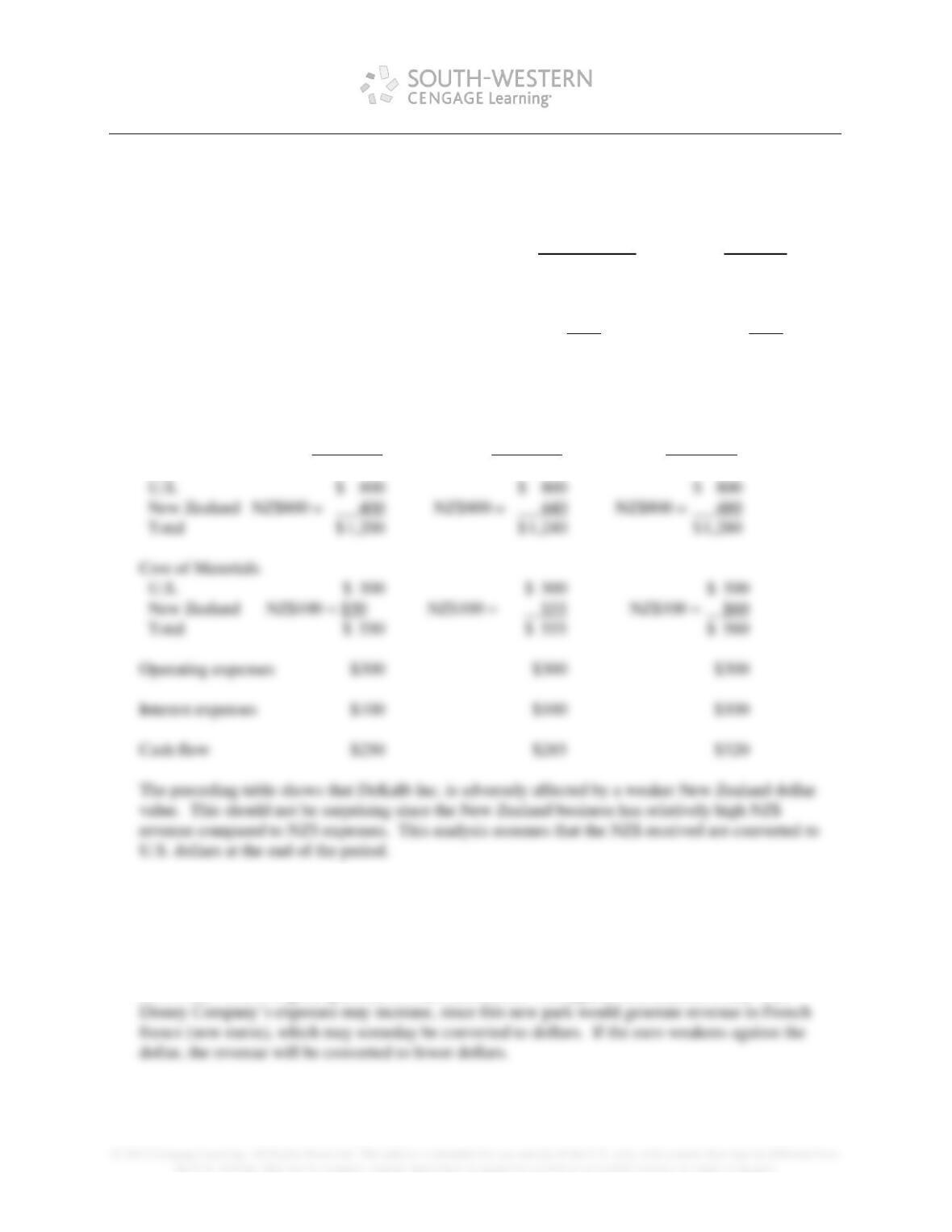
22. Measuring Economic Exposure. Using the following cost and revenue information shown for
DeKalb, Inc., determine how the costs, revenue, and cash flow would be affected by three possible
exchange rate scenarios for the New Zealand dollar (NZ$): (1) NZ$ = $.50, (2) NZ$ = $.55, and (3)
NZ$ = $.60. (Assume U.S. sales will be unaffected by the exchange rate.) Assume that NZ$
earnings will be remitted to the U.S. parent at the end of the period. Ignore possible tax effects.
Measuring Exposure to Exchange Rate Fluctuations 9
Forecasted Net Cash Flows: DeKalb Inc.
(in millions of U.S. dollars and New Zealand dollars)
New Zealand
U.S. Business Business
Sales $800 NZ$800
Cost of Materials 500 100
Operating Expenses 300 0
Interest Expense 100 0
Cash Flow –$100 NZ$700
ANSWER:
(Figures are in millions)
NZ$=$.50 NZ$=$.55 NZ$=$.60
Sales
23. Changes in Economic Exposure. Walt Disney World built an amusement park in France that
opened in 1992. How do you think this project has affected Disney’s economic exposure to
exchange rate movements? Think carefully before you give your final answer. There is more than
one way in which Disney’s cash flows may be affected. Explain.
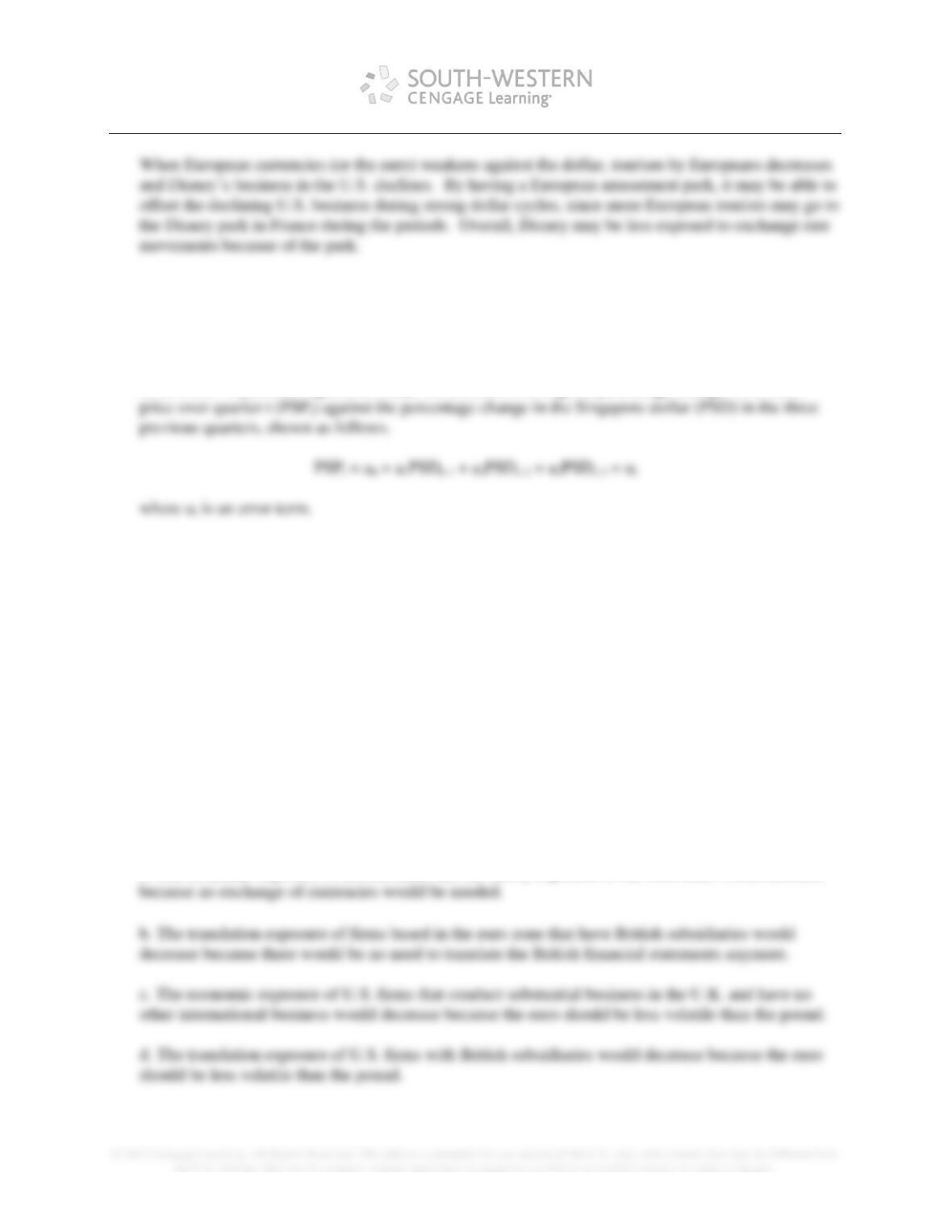
ANSWER: This is a good question for class discussion. The typical first reaction is that Walt
10 Measuring Exposure to Exchange Rate Fluctuations
24. Lagged Effects of Exchange Rate Movements. Cornhusker Co. is an exporter of products to
Singapore. It wants to know how its stock price is affected by changes in the Singapore dollar’s
exchange rate. It believes that the impact may occur with a lag of one to three quarters. How could
regression analysis be used to assess the impact?
ANSWER: A possible regression model for this task is to regress percentage change in its stock
25. Potential Effects if the United Kingdom Adopted the Euro. The U.K. still has its own currency,
the pound. The pound’s interest rate has historically been higher than the euros interest rate. The
U.K. has considered adopting the euro as its currency. There have been many arguments about
whether it should do so.
Use your knowledge and intuition to discuss the likely effects if the United Kingdom adopts the euro.
For each of the 10 statements below, insert either INCREASE or DECREASE and complete the
statement by adding a clear short explanation (perhaps one to three sentences) of why the U.K.’s
adoption of the euro would have that effect.
To help you narrow your focus, follow these guidelines. Assume that the pound is more volatile than
the euro. Do not base your answer on whether the pound would have been stronger than the euro in
the future. Also, do not base your answer on an unusual change in economic growth in the U.K. or in
the euro zone if the euro is adopted.
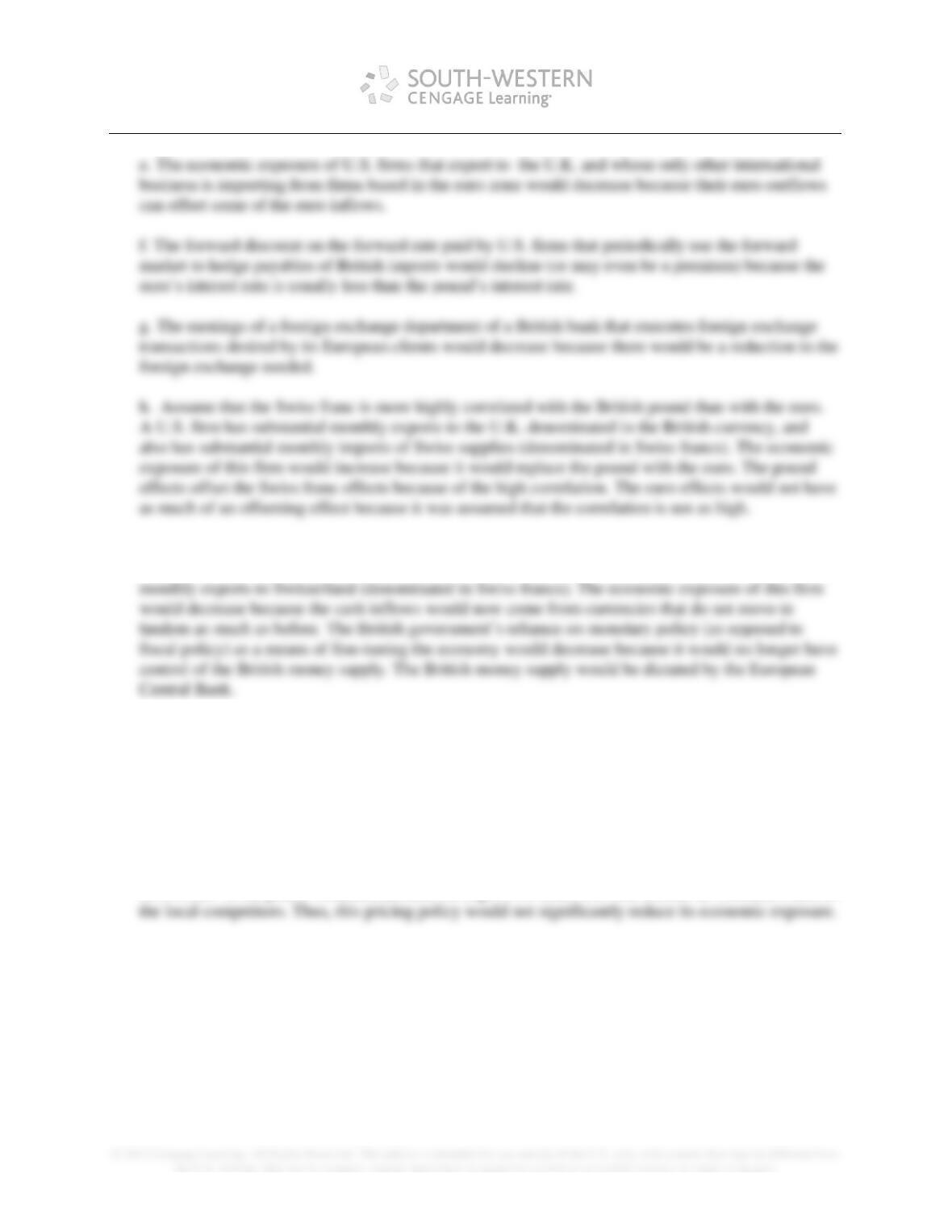
ANSWERS:
a. The economic exposure of British firms that are heavy exporters to the euro zone would decrease
Measuring Exposure to Exchange Rate Fluctuations 11
i. Assume that the Swiss franc is more highly correlated with the British pound. A U.S. firm has
substantial monthly exports to the U.K. denominated in the British currency, and also has substantial
26. Invoicing Policy to Reduce Exposure. Celtic Co. is a U.S. firm that exports its products to England.
It faces competition from many firms in England. Its price to customers in England has generally
been lower than those of the competitors, primarily because the British pound has been strong. It has
priced its exports in pounds, and then converts the pound receivables into dollars. All of its expenses
are in the U.S. and are paid with dollars. It is concerned about its economic exposure. It considers a
change in its pricing policy, in which it will price its products in dollars instead of pounds. Offer
your opinion on why this will or will not significantly reduce its economic exposure.
ANSWER: If the pound weakens, demand for exports of Celtic Co. will decline as customers shift to
27. Exposure to Cash Flows. Raton Co. is a U.S. company that has net inflows of 100 million Swiss
francs and net outflows of 100 million British pounds. The present exchange rate of the Swiss franc is
about $.70 while the present exchange rate of the pound is $1.90. Raton Co. has not hedged these
positions. The Swiss franc and British pound are highly correlated in their movements against the
dollar. Explain whether Raton will be favorably or adversely affected if the dollar weakens against
foreign currencies over time.
12 Measuring Exposure to Exchange Rate Fluctuations
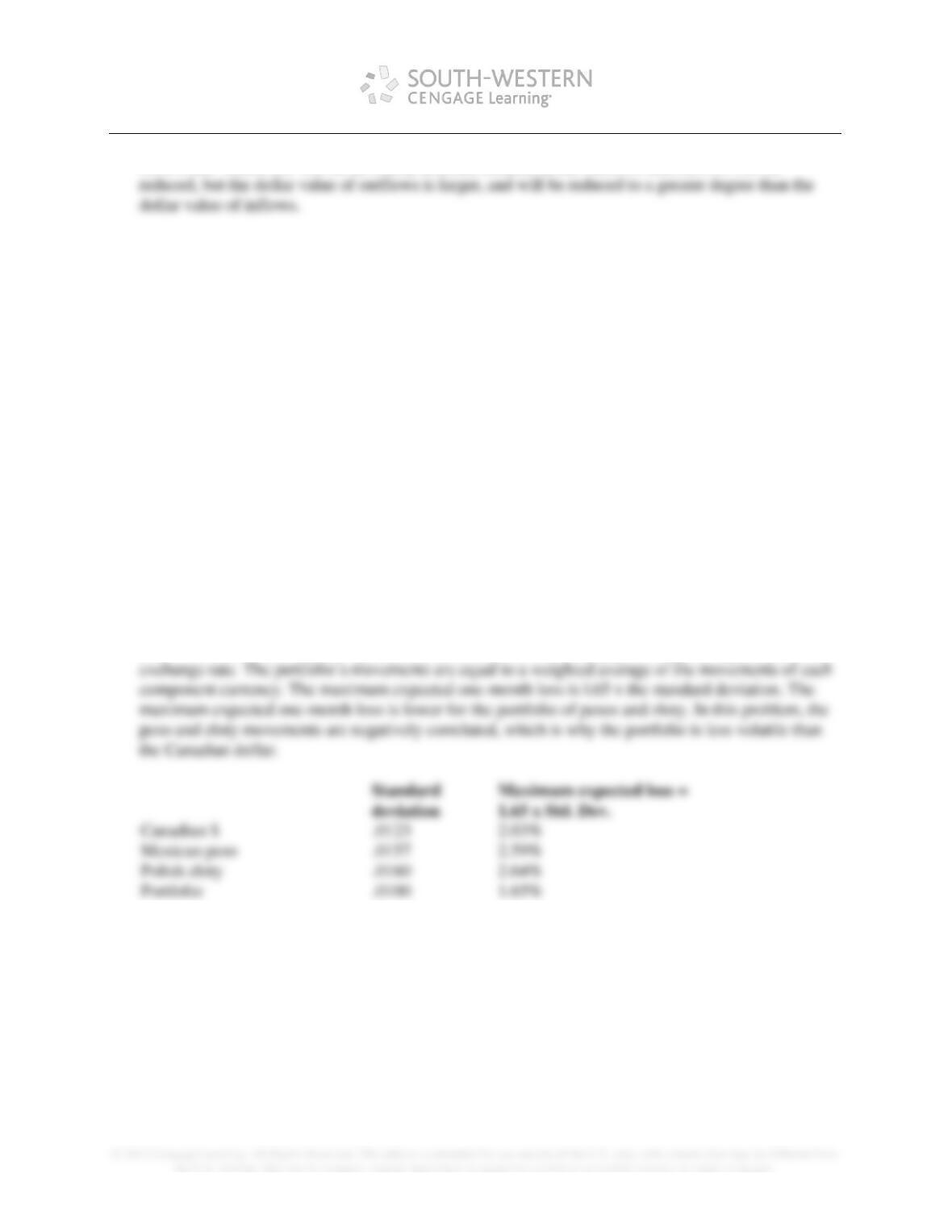
ANSWER: Raton Co. will be favorably affected because dollar outflows and inflows will be
28. Assessing Exchange Rate Risk. Washington Co. and Vermont Co. have no domestic business.
They have a similar dollar equivalent amount of international exporting business. Washington Co.
exports all of its products to Canada. Vermont Co. exports its products to Poland and Mexico, with
about half of its business in each of these 2 countries. Each firm receives the currency of the country
where it sends its exports. You obtain the end-of-month spot exchange rates of the currencies
mentioned above during the end of each of the last 6 months.
End of Month
Canadian Dollar
Mexican Peso
Polish Zloty
1
$0.8142
$.09334
$.29914
2
0.8176
.09437
.29829
3
0.8395
.09241
.30187
4
0.8542
.09263
.3088
5
0.8501
.09251
.30274
6
0.8556
.09448
.30312
You want to assess the data in a logical manner to determine which firm has a higher degree of
exchange rate risk. Show your work and write your conclusion. [HINT: The percentage change in the
portfolio of currencies is a weighted average of the percentage change in each currency in the
portfolio.]
ANSWER: First, use an excel spreadsheet to determine the monthly percentage change in the
29. Exposure to Pegged Currency System. Assume that the Mexican peso and the Brazilian
currency (called the ―real‖) have depreciated against the dollar recently, due to the high inflation
rates in those countries. Assume that inflation in these two countries is expected to continue and that
it will have a major effect on these currencies if they are still allowed to float. Assume that the
government of Brazil decides to peg its currency to the dollar and will definitely maintain the peg for
the next year. Milez Co. is based in Mexico. Its main business is to export supplies from Mexico to
Brazil. It invoices its supplies in Mexican pesos. Its main competition is from firms in Brazil that
produce similar supplies and sell them locally. How will the sales volume of Milez Co.be affected (if
at all) by the Brazilian government’s actions? Explain.