Chapter 1
Multinational Financial Management
Lecture Outline
Managing the MNC
Agency Problems
Management Structure of an MNC
Why Firms Pursue International Business
How Firms Engage in International Business
International Trade
Licensing
Franchising
Joint Ventures
Organization of the Text
2 Multinational Financial Management
Chapter Theme
This chapter introduces the multinational corporation as having similar goals to the purely domestic
corporation, but a wider variety of opportunities. With additional opportunities come potential increased
returns and other forms of risk to consider. The potential benefits and risks are introduced.
Topics to Stimulate Class Discussion
1. What is the appropriate definition of an MNC?
POINT/COUNTER-POINT:
Should an MNC Reduce Its Ethical Standards to Compete Internationally?
COUNTER-POINT: No. A U.S.-based MNC should maintain a standard code of ethics that applies to
any country, even if it is at a disadvantage in a foreign country that allows activities that might be viewed
as unethical. In this way, the MNC establishes more credibility worldwide.
WHO IS CORRECT? Use the Internet to learn more about this issue. Which argument do you support?
Offer your own opinion on this issue.
ANSWER: The issue is frequently discussed. It is easy to suggest that the MNC should maintain a
Multinational Financial Management 3
Answers to End of Chapter Questions
1. Agency Problems of MNCs.
a. Explain the agency problem of MNCs.
b. Why might agency costs be larger for an MNC than for a purely domestic firm?
ANSWER: The agency costs are normally larger for MNCs than purely domestic firms for the
2. Comparative Advantage.
a. Explain how the theory of comparative advantage relates to the need for international business.
ANSWER: The theory of comparative advantage implies that countries should specialize in
b. Explain how the product cycle theory relates to the growth of an MNC.
3. Imperfect Markets.
a. Explain how the existence of imperfect markets has led to the establishment of subsidiaries in
foreign markets.
ANSWER: Because of imperfect markets, resources cannot be easily and freely retrieved by the
b. If perfect markets existed, would wages, prices, and interest rates among countries be more similar
or less similar than under conditions of imperfect markets? Why?
ANSWER: If perfect markets existed, resources would be more mobile and could therefore be
4 Multinational Financial Management
4. International Opportunities.
a. Do you think the acquisition of a foreign firm or licensing will result in greater growth for an
MNC? Which alternative is likely to have more risk?
ANSWER: An acquisition will typically result in greater growth, but it is more risky because it
b. Describe a scenario in which the size of a corporation is not affected by access to international
opportunities.
ANSWER: Some firms may avoid opportunities because they lack knowledge about foreign markets
c. Explain why MNCs such as Coca Cola and PepsiCo, Inc., still have numerous opportunities for
international expansion.
ANSWER: Coca Cola and PepsiCo still have new international opportunities because countries are at
5. International Opportunities Due to the Internet.
a. What factors cause some firms to become more internationalized than others?
ANSWER: The operating characteristics of the firm (what it produces or sells) and the risk
b. Offer your opinion on why the Internet may result in more international business.
ANSWER: The Internet allows for easy and low-cost communication between countries, so that
Multinational Financial Management 5
6. Impact of Exchange Rate Movements. Plak Co. of Chicago has several European subsidiaries that
remit earnings to it each year. Explain how appreciation of the euro (the currency used in many
European countries) would affect Plak’s valuation.
7. Benefits and Risks of International Business. As an overall review of this chapter, identify
possible reasons for growth in international business. Then, list the various disadvantages that may
discourage international business.
ANSWER: Growth in international business can be stimulated by (1) access to foreign resources
8. Valuation of an MNC. Hudson Co., a U.S. firm, has a subsidiary in Mexico, where political risk has
recently increased. Hudson’s best guess of its future peso cash flows to be received has not changed.
However, its valuation has declined as a result of the increase in political risk. Explain.
ANSWER: The valuation of the MNC is the present value of expected cash flows. The increase in
9. Centralization and Agency Costs. Would the agency problem be more pronounced for Berkley
Corp., which has its parent company make most major decisions for its foreign subsidiaries, or
Oakland Corp., which uses a decentralized approach?
ANSWER: The agency problem would be more pronounced for Oakland because of a higher
10. Global Competition. Explain why more standardized product specifications across countries can
increase global competition.
11. Exposure to Exhange Rates. McCanna Corp., a U.S. firm, has a French subsidiary that produces
wine and exports to various European countries. All of the countries where it sells its wine use the
euro as their currency, which is the same as the currency used in France. Is McCanna Corp. exposed
to exchange rate risk?
ANSWER: The subsidiary and its customers based in countries that now use the euro as their
6 Multinational Financial Management
12. Macro versus Micro Topics. Review the table of contents and indicate whether each of the chapters
from Chapter 2 through Chapter 21 has a macro or micro perspective.
13. Methods Used to Conduct International Business. Duve, Inc., desires to penetrate a foreign market
with either a licensing agreement with a foreign firm or by acquiring a foreign firm. Explain the
differences in potential risk and return between a licensing agreement with a foreign firm, and the
acquisition of a foreign firm.
ANSWER: A licensing agreement has limited potential for return, because the foreign firm will
14. International Business Methods. Snyder Golf Co., a U.S. firm that sells high-quality golf clubs in
the U.S., wants to expand internationally by selling the same golf clubs in Brazil.
a. Describe the tradeoffs that are involved for each method (such as exporting, direct foreign
investment, etc.) that Snyder could use to achieve its goal.
ANSWER: Snyder can export the clubs, but the transportation expenses may be high. If could
b. Which method would you recommend for this firm? Justify your recommendation.
ANSWER: If the amount of golf clubs to be sold in Brazil is small, it may decide to export.
15. Impact of Political Risk. Explain why political risk may discourage international business.
ANSWER: Political risk increases the rate of return required to invest in foreign projects. Some
16. Impact of September 11. Following the terrorist attack on the U.S., the valuations of many MNCs
declined by more than 10 percent. Explain why the expected cash flows of MNCs were reduced, even
if they were not directly hit by the terrorist attacks.
Multinational Financial Management 7
ANSWER: An MNC’s cash flows could be reduced in the following ways. First, a decline in travel
Advanced Questions
17. International Joint Venture. Anheuser-Busch, the producer of Budweiser and other beers,
expanded into Japan by engaging in a joint venture with Kirin Brewery, the largest brewery in Japan.
The joint venture enables Anheuser-Busch to have its beer distributed through Kirin’s distribution
channels in Japan. In addition, it could utilize Kirin’s facilities to produce beer that would be sold
locally. In return, Anheuser-Busch provided information about the American beer market to Kirin.
a. Explain how the joint venture enabled Anheuser-Busch to achieve its objective of maximizing
shareholder wealth.
ANSWER: The joint venture creates a way for Anheuser-Busch to distribute Budweiser throughout
b. Explain how the joint venture limited the risk of the international business.
ANSWER: The joint venture has limited risk because Anheuser-Busch does not need to establish its
c. Many international joint ventures are intended to circumvent barriers that normally prevent
foreign competition. What barrier in Japan did Anheuser-Busch circumvent as a result of the
joint venture? What barrier in the United States did Kirin circumvent as a result of the joint
venture?
ANSWER: Anheuser-Busch is able to benefit from Kirin’s distribution system in Japan, which
d. Explain how Anheuser-Busch could have lost some of its market share in countries outside Japan
as a result of this particular joint venture.
ANSWER: Anheuser-Busch could lose some of its market share to Kirin as a result of explaining its
8 Multinational Financial Management
18. Impact of Eastern European Growth. The managers of Loyola Corp. recently had a meeting to
discuss new opportunities in Europe as a result of the recent integration among Eastern European
countries. They decided not to penetrate new markets because of their present focus on expanding
market share in the United States. Loyola’s financial managers have developed forecasts for
earnings based on the 12 percent market share (defined here as its percentage of total European sales)
that Loyola currently has in Eastern Europe. Is 12 percent an appropriate estimate for next year’s
Eastern European market share? If not, does it likely overestimate or underestimate the actual
Eastern European market share next year?
19. Valuation of an MNC. Birm Co., based in Alabama, is considering several international
opportunities in Europe that could affect the value of its firm. The valuation of its firm is dependent
on four factors: (1) expected cash flows in dollars, (2) expected cash flows in euros that are
ultimately converted into dollars, (3) the rate at which it can convert euros to dollars, and (4) Birm’s
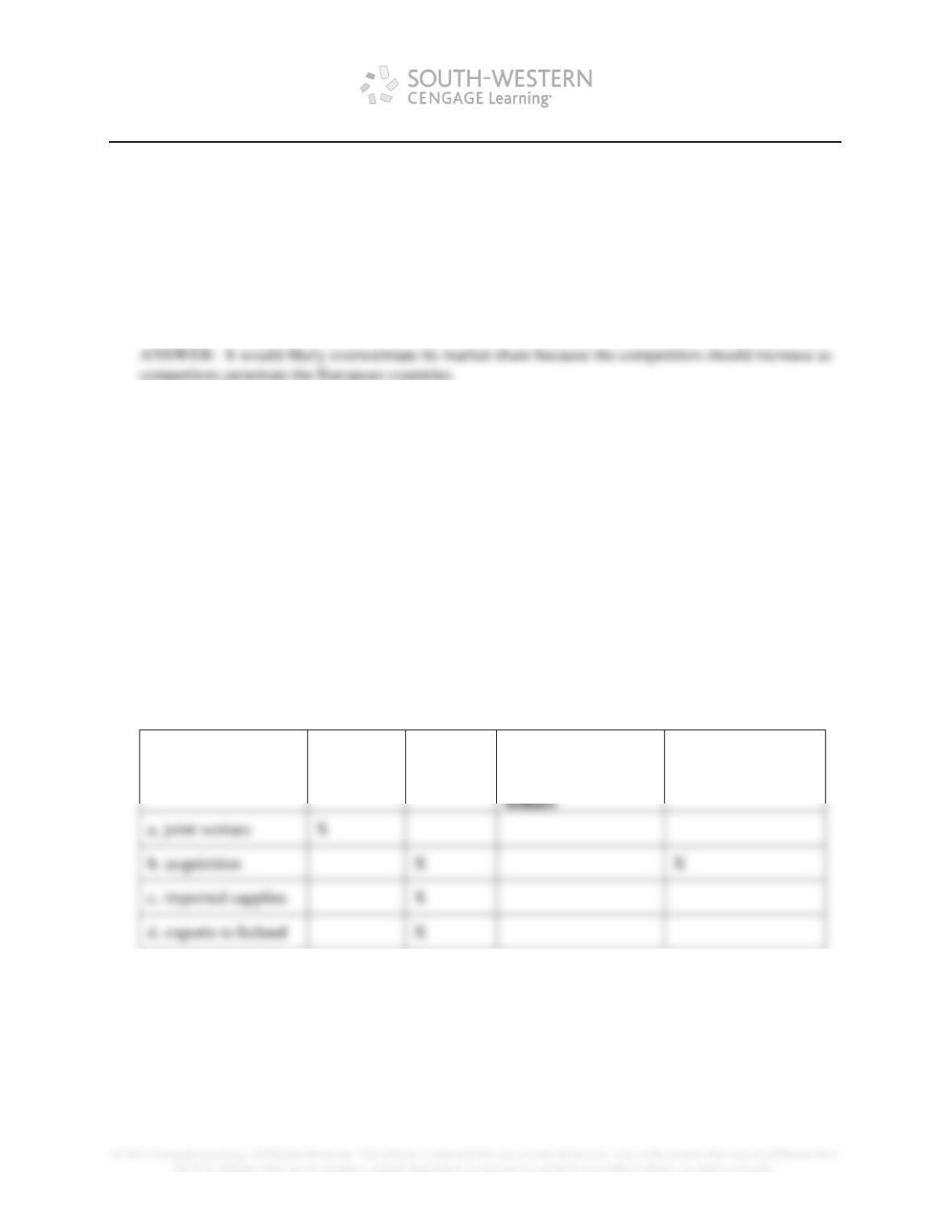
weighted average cost of capital. For each opportunity, identify the factors that would be affected.
a. Birm plans a licensing deal in which it will sell technology to a firm in Germany for $3,000,000;
the payment is invoiced in dollars, and this project has the same risk level as its existing
businesses.
b. Birm plans to acquire a large firm in Portugal that is riskier than its existing businesses.
c. Birm plans to discontinue its relationship with a U.S. supplier so that can import a small amount
of supplies (denominated in euros) at a lower cost from a Belgian supplier.
d. Birm plans to export a small amount of materials to Ireland that are denominated in euros.
ANSWER:
Opportunity
Dollar CF
Euro CF
Exchange rate at
which Birm Co.
converts euros to
Birm’s weighted
average cost of
capital
20. Assessing Motives for International Business. Fort Worth Inc. specializes in manufacturing some
basic parts for sports utility vehicles that are produced and sold in the U.S. Its main advantage in the
U.S. is that its production is efficient, and less costly than that of some other unionized
manufacturers. It has a substantial market share in the U.S. Its manufacturing process is labor–
intensive. It pays relatively low wages compared to U.S. competitors, but has guaranteed the local
workers that their positions will not be eliminated for the next 30 years. It hired a consultant to
determine whether it should set up a subsidiary in Mexico, where the parts would be produced. The
Multinational Financial Management 9
consultant suggested that Forth Worth should expand for the following reasons. Offer your opinion
on whether the consultant’s reasons are logical:
a. Theory of Competitive Advantage: There are not many SUVs sold in Mexico, so Fort Worth Inc.
would not have to face much competition there.
b. Imperfect Markets Theory: Fort Worth Inc. can not easily transfer workers to Mexico, but it can
establish a subsidiary there in order to penetrate a new market.
c. Product Cycle Theory: Fort Worth Inc. has been successful in the U.S. It has limited growth
opportunities because it already controls much of the U.S. market for the parts it produces. Thus,
the natural next step is to conduct the same business in a foreign country.
d. Exchange Rate Risk. The exchange rate of the peso has weakened recently, so this would allow
Fort Worth Inc. to build a plant at a very low cost (by exchanging dollars for the cheap pesos to
build the plant).
e. Political Risk. The political conditions in Mexico have stabilized in the last few months, so Fort
Worth should attempt to penetrate the Mexican market now.
ANSWER: None of the arguments by the consultant are logical. If SUVs are not sold in the Mexican
21. Valuation of Wal–Mart’s International Business. In addition to all of its stores in the United States,
Wal-Mart has 13 stores in Argentina, 302 stores in Brazil, 289 stores in Canada, 73 stores in China,
889 stores in Mexico, and 335 stores in the United Kingdom. Overall, it has 2,750 stores in foreign
countries. Consider the value of Wal-Mart as being composed of two parts, a U.S. part (due to
business in the United States) and a non-U.S. part (due to business in other countries). Explain how
to determine the present value (in dollars) of the non-U.S. part assuming that you had access to all the
details of Wal-Mart businesses outside the United States.
ANSWER: The non-U.S. part can be measured as the present value of future dollar cash flows
10 Multinational Financial Management
22. Impact of International Business on Cash Flows and Risk. Nantucket Travel Agency specializes
in tours for American tourists. Until recently, all of its business was in the U.S. It just established a
subsidiary in Athens, Greece, which provides tour services in the Greek islands for American
tourists. It rented a shop near the port of Athens. It also hired residents of Athens, who could speak
English and provide tours of the Greek islands. The subsidiary’s main costs are rent and salaries for
its employees and the lease of a few large boats in Athens that it uses for tours. American tourists pay
for the entire tour in dollars at Nantucket’s main U.S. office before they depart for Greece.
a. Explain why Nantucket may be able to effectively capitalize on international opportunities such
as the Greek island tours.
market with some of the same customers that it has served on tours in the U.S.
b. Nantucket is privately-owned by owners who reside in the U.S. and work in the main office.
Explain possible agency problems associated with the creation of a subsidiary in Athens, Greece.
How can Nantucket attempt to reduce these agency costs?
ANSWER: The employees of the subsidiary in Athens are not owners, and may have no incentive to
Nantucket could attempt to allow the employees a portion of the ownership of the company so that
they benefit more directly from good performance. Alternatively, Nantucket may consider having one
of its owners transfer to Athens to oversee the subsidiary’s operations.
c. Greece’s cost of labor and rent are relatively low. Explain why this information is relevant to
Nantucket’s decision to establish a tour business in Greece.
Nantucket to create the subsidiary at a low cost.
d. Explain how the cash flow situation of the Greek tour business exposes Nantucket to exchange
rate risk. Is Nantucket favorably or unfavorably affected when the euro (Greece’s currency)
appreciates against the dollar? Explain.
ANSWER: Nantucket’s tour business in Greece results in dollar cash inflows and euro cash
e. Nantucket plans to finance its Greek tour business. Its subsidiary could obtain loans in euros from
a bank in Greece to cover its rent, and its main office could pay off the loans over time.
Alternatively, its main office could borrow dollars and would periodically convert dollars to
euros to pay the expenses in Greece. Does either type of loan reduce the exposure of Nantucket
to exchange rate risk? Explain.
Multinational Financial Management 11
f. Explain how the Greek island tour business could expose Nantucket to country risk.
ANSWER: The subsidiary could be subject to government restrictions or taxes in Greece that would
23. Valuation of an MNC. Yahoo! has expanded its business by establishing portals in numerous
countries, including Argentina, Australia, China, Germany, Ireland, Japan, and the U.K. It has cash
outflows associated with the creation and administration of each portal. It also generates cash inflows
from selling advertising space on its website. Each portal results in cash flows in a different
currency. Thus, the valuation of Yahoo! is based on its expected future net cash flows in Argentine
pesos after converting them into U.S. dollars, its expected net cash flows in Australian dollars after
converting them into U.S. dollars, and so on. Explain how and why the valuation of Yahoo! would
change if most investors suddenly expected that that the dollar would weaken against most currencies
over time.
ANSWER: The valuation of Yahoo! should increase because the present value of expected dollar
24. Uncertainty Surrounding an MNC’s Valuation. Carlisle Co. is a U.S. firm that is about to
purchase a large company in Switzerland at a purchase price of $20 million. This company produces
furniture and sells it locally (in Switzerland), and it is expected to earn large profits every year. The
company will become a subsidiary of Carlisle and will periodically remit its excess cash flows due to
its profits to Carlisle Co. Assume that Carlisle Co. has no other international business. Carlisle has
$10 million that it will use to pay for part of the Swiss company and will finance the rest of its
purchase with borrowed dollars. Carlisle Co. can obtain supplies from either a U.S. supplier or a
Swiss supplier (in which case the payment would be made in Swiss francs). Both suppliers are very
reputable and there would be no exposure to country risk when using either supplier. Is the valuation
of the total cash flows of Carlisle Co. more uncertain if it obtains its supplies from a U.S. firm or a
Swiss firm? Explain briefly.
ANSWER: The valuation of Carlisle Co. is more uncertain if it uses a U.S. supplier because it will
25.Impact of Exchange Rates on MNC Value. Olmsted Co. has small computer chips assembled in
Poland and transports the final assembled products to the parent, where they are sold by the parent in
the U.S. The assembled products are invoiced in dollars. It uses Polish currency (the zloty) to
produce these chips, and assembles them in Poland. The Polish subsidiary pays the employees in the
local currency (zloty). Olmsted Co. finances its subsidiary operations with loans from a Polish bank
(in zloty). The parent of Olmsted will send sufficient monthly payments (in dollars) to the subsidiary
12 Multinational Financial Management
in order to repay the loan and other expenses incurred by the subsidiary. If the Polish zloty
depreciates against the dollar over time, will that have a favorable, unfavorable, or neutral effect on
the value of Olmsted Co.? Briefly explain.
26. Impact of Uncertainty on MNC Value. Minneapolis Co. is a major exporter of products to
Canada. Today, an event occurred that has increased the uncertainty surrounding the Canadian
dollar’s future value over the long term. Explain how this event can affect the valuation of
Minneapolis Co.
ANSWER: The future dollar cash flows of Minneapolis Co. are now more uncertain, which can
27. Exposure of MNCs to Exchange Rate Movements. Arlington Co. expects to receive 10 million
euros in each of the next 10 years. It will need to obtain 2 million Mexican pesos in each of the next
10 years. The euro exchange rate is presently valued at $1.38 and is expected to depreciate by 2
percent each year over time. The peso is valued at $.13 and is expected to depreciate by 2 percent
each year over time. Review the valuation equation for an MNC. Do you think that the exchange rate
movements will have a favorable or unfavorable effect on the MNC?
ANSWER: The movements in the euro are expected to have an unfavorable effect on Arlington’s
28. Impact of the Credit Crisis on MNC Value. Much of the attention to the credit crisis was
focused on its adverse effects on financial institutions. Yet, many other types of firms were affected
as well. Explain why the numerator of the MNC valuation equation was affected during the October
6-10, 2008 period. Explain how the denominator of the MNC valuation equation was affected during
this period.
ANSWER: The numerator of the MNC valuation equation represents cash flows. In October, 2008,
Multinational Financial Management 13
29. Exposure of MNCs to Exchange Rate Movements. Because of the low labor costs in Thailand,
Melnick Co. (based in the United States) recently established a major research and development
subsidiary there that it owns. The subsidiary was created to improve new products that the parent of
Melnick can sell in the United States (denominated in dollars) to U.S. customers. The subsidiary pays
its local employees in baht (the Thai currency). The subsidiary has a small amount of sales
denominated in baht, but its expenses are much larger than its revenue. It has just obtained a large
loan denominated in baht that will be used to expand its subsidiary. The business that the parent of
Melnick Co. conducts in the United States is not exposed to exchange rate risk. If the Thai baht
weakens over the next 3 years, will the value of Melnick Co. be favorably affected, unfavorably
affected, or not affected? Briefly explain.
ANSWER: It will be favorably affected since it needs fewer dollars over time to cover its loan
30. Shareholder Rights of Investors in MNCs. MNCs tend to expand more when they more easily
access funds by issuing stock. In some countries, shareholder rights are very limited and the MNCs
have limited ability to raise funds by issuing stock. Explain why access to funding is more severe for
MNCs based in countries where shareholder rights are limited.
ANSWER: Shareholders may be concerned that the agency problems of the local firms would be
31. MNC Cash Flows and Exchange Rate Risk. Tuscaloosa Co. is a U.S. firm that assembles phones in
Argentina and transports the final assembled products to the parent, where they are sold by the parent
in the U.S.. The assembled products are invoiced in dollars. The Argentine subsidiary obtains some
material from China, and the Chinese exporter is willing to accept Argentine pesos as payment for
these materials that it exports. The Argentine subsidiary pays its employees in the local currency
(pesos), and finances its operations with loans from an Argentine bank (in pesos). Tuscaloosa Co. has
no other international business. If the Argentine peso depreciates against the dollar over time, will
that have a favorable, unfavorable, or neutral effect on Tuscaloosa Co.? Briefly explain.
32. MNC Cash Flows and Exchange Rate Risk. Asheville Co. has a subsidiary in Mexico that
develops software for its parent. It rents a large facility in Mexico and hires many people in Mexico
to work in the facility. Ashville Co. has no other international business. All operations are presently
funded by Asheville’s parent. All the software is sold to U.S. firms by Asheville’s parent and
invoiced in U.S. dollars.
a. If the Mexican peso appreciates against the dollar, does this have a favorable effect, unfavorable
effect, or no effect on Asheville’s value?
14 Multinational Financial Management
b. Asheville Co. plans to borrow funds to support its expansion in the U.S. The Mexican interest
rates are presently lower than U.S. interest rates, so Asheville obtains a loan denominated in Mexican
pesos in order to support its expansion in the U.S. Will the borrowing of pesos increase, decrease, or
have no effect on its exposure to exchange rate risk? Briefly explain.
ANSWER:
Solution to Continuing Case Problem: Blades, Inc.
1. What are the advantages Blades could gain from importing from and/or exporting to a foreign
country such as Thailand?
ANSWER: The advantages Blades, Inc. could gain from importing from Thailand include potentially
2. What are some of the disadvantages Blades could face as a result of foreign trade in the short run? In
the long run?
ANSWER: There are several potential disadvantages Blades, Inc. should consider. First of all,
Multinational Financial Management 15
3. Which theories of international business described in this chapter apply to Blades, Inc. in the short
run? In the long run?
ANSWER: There are at least three theories of international business: the theory of comparative
4. What long-range plans other than the establishment of a subsidiary in Thailand are an option for
Blades and may be more suitable for the company?
ANSWER: Since Ben Holt is very unfamiliar with international business, and since Blades has never
Solution to Supplemental Case: Ranger Supply Company
This case is simply intended to force students to think about reasons for or against international business.
As with most cases, there are no perfect solutions, but there are some general conclusions that can be
drawn.
a. Some of the more obvious factors to consider are:
1. Competition. There are similar distributors in Canada, whereas Eastern Europe may not have an
organized system for the distribution of office supplies. Yet, some European firms (like the
British competitor) may attempt to pursue the Eastern European market.
16 Multinational Financial Management
4. Marketing Characteristics. Ranger would have an easier time adapting to the Canadian market.
The information about Eastern Europe firms would be more limited. Thus, Ranger would be
5. Exchange Rates. The future exchange rates of the Canadian dollar and currencies of Eastern
Overall, most of the factors would favor Canada as the more reasonable market to pursue.
b. Recall that the reason for Ranger to expand overseas was to offset the anticipated U.S. demand for its
Small Business Dilemma
In every chapter of this text, some of the key concepts are illustrated with an application to a small
sporting goods firm that conducts international business. The “Small Business Dilemma” in each
chapter allows students to recognize the dilemmas and possible decisions that firms (such as this
sporting goods firm) may face in a global environment. For this chapter, the application is on the
development of the sporting goods firm that would conduct international business.
Developing a Multinational Sporting Goods Corporation
1. Is Sports Exports Company a multinational corporation?
2. Why are the agency costs lower for Sports Exports Company than for most MNCs?
ANSWER: Agency costs are lower because the owner and manager are the same. The owner does
Multinational Financial Management 17
3. Does Sports Exports Company have any comparative advantage over potential competitors in foreign
countries that could produce and sell footballs there?
ANSWER: The Sports Exports Company has a comparative advantage of applying an idea that has
4. How would Jim Logan decide which foreign markets he would attempt to enter? Should he initially
focus on one or many foreign markets?
ANSWER: Jim would need to consider various factors, such as the potential demand for footballs in
5. The Sports Exports Company has no immediate plans to conduct direct foreign investment.
However, it might consider other less costly methods of establishing its business in foreign markets.
What methods might the Sports Exports Company use to increase its presence in foreign markets by
working with one or more foreign companies?
ANSWER: The Sports Exports Company may consider a licensing agreement whereby it has a
International Investing Project
This project is provided in Appendix C in the back of the text. It may be used as a project assignment
that is to be completed by the end of the semester.
18 Multinational Financial Management
Discussion in the Board Room
This exercise is provided in Appendix D in the back of the text. It may be used as a project
assignment that is to be completed by the end of the semester. Possible answers to the discussion
questions are provided at the end of this Instructor’s Manual (after Chapter 21). If you use this