CHAPTER 9
COMPRESSOR MODEL
OBJECTIVES
• Explain the principles of compression in a multi-stage centrifugal compressor.
• Identify and describe the basic components of a compressor system.
• Draw a simple block flow diagram of a compressor system.
• Describe the various safety aspects associated with working on compressed air
systems.
• Describe how instrument air is used in process control systems.
• Identify common problems associated with compressor operations.
• Operate the compressor system.
• Solve various troubleshooting scenarios associated with compressed air systems.
REVIEW QUESTIONS
1. Describe the operation and purpose of the centrifugal compressor system.
2. List he basic components of a centrifugal compressor.
3. List the basic components of the compressor system.
4. Explain the primary purpose of the receiver.
5. Describe how to operate the compressor system.
A. Ensure the area is clear of debris and all auxiliary systems are lined
up and operational.
6. Explain how to regenerate the desiccant dryer.
A desiccant dryer is used to remove moisture from compressor gases as they are
passed over a chemical desiccant, which absorbs the water. The desiccant
7. Draw and describe the pressure control system used in compressor system-100.
8. Describe how the pressure on the instrument air header is reduced and used to
operate other automatic valves.
9. List the basic principles of compression and explain how these operate
industrial valves.
The principles of compression include;
• compression decreases volume
• gases and vapors are compressible
• liquids and solids are typically considered to not be compressible
• compression generates heat
10. List the primary advantages associated with the installation and operation of
centrifugal compressor systems.
11. List the basic impeller designs used on centrifugal compressors.
Impeller designs– compressors have a variety of impeller designs including,
12. Describe the theory of compression ratio in a centrifugal compressor.
Compression ratio– the ratio of discharge pressure (psia) to suction pressure
13. Describe the names used for the impeller vane that touches the air first and last.
14. Explain how the impeller vanes, diffuser, volute, and drive shaft operate together.
During operation, air enters the compressor at the suction inlet and is
accelerated by moving impellers. Compressor-100 has one moving element, the
drive shaft and impeller. In the compressor the impeller discharges into a

NAME:____________________________ TEST A
DATE:____________________________
CHAPTER NINE
TEST “A” COMPRESSOR MODEL
1. The higher the pressure the larger the volume.
a. true
b. false
2. Liquids compress as easily as vapors or gases.
a. true
b. false
3. Compressed gases will resume _______________ when released:
a. 50 % original volume
b. 71% original volume
c. 98% original volume
d. 100 % original volume
4. As temperature increases the viscosity of a gas:
a. increases
b. decreases
c. stays the same
d. depends up specific gravity of the gas
5. The principle of compression has a measurable relationship between the
volume a set weight of gas occupies.
a. true
b. false
6. Compressors are primarily designed to:
a. compress gases and small amounts of liquid
b. compress relatively dry gases
c. compress hot fluids
d. work in closed systems
7. A desiccant dryer is used to remove moisture from compressor gases as they
are passed over a chemical called desiccant.
a. true
b. false
8. The design and operation of a compressor can usually be classified into two
groups:
a. positive displacement and dynamic
b. rotary and reciprocating
c. axial and centrifugal
d. piston and centrifugal
9. Centrifugal compressors operate by:
a. compressing the gases in a cylinder and releasing
b. accelerating the gas axially along the shaft
c. accelerating the gas and converting the energy to pressure
d. a & c
10. The typical compressor system most closely resembles the following:
a. compressor, dryer, air receiver, gas header
b. compressor, air receiver, dryer, gas header
c. compressor, gas header, air receiver, dryer
d. gas header, compressor, dryer, air receiver
11. Gas volume does not vary with temperature and pressure.
a. true
b. false
12. Liquids are considered to be:
a. non-compressible
b. compressible in low pressure operations
c. compressible during high pressure operations <500 psig
d. compressible in a PD compressor operation
13. Gases and vapors are non-compressible.
a. true
b. false
c. depends on molecular structure of gas or vapor
d. directly proportional to temperature
14. The rapid compression of a gas or vapor:
a. moves molecules closer together
b. generates heat
c. produces a cooling effect
d. a & b
e. a & c
15. Compressed gases produce heat because of molecular friction.
a. true
b. false
16. Compression ratio is best defined as:
a. the ratio of discharge pressure (psia) to suction pressure (psia).
b. force to accelerate gas and convert energy to pressure.
c. the part of the compressor impeller vane that first comes into contact with
the air.
d. the pressure on industrial systems.
17. The part of the impeller that first comes into contact with the gas is called:
a. inlet gas impeller
b. discharge vane
c. suction eye
d. suction vane tip
18. Pressure is defined as:
a. area ÷ force
b. force ÷ mass
c. force ÷ area
d. sum of partial pressures
19. Pressure ______________ impacts the boiling point of a substance.
a. indirectly
b. never
c. partially
d. directly
20. Liquids are typically considered to be non-compressible even though a ten
percent decrease in volume can be observed when a pressure of
_______________ is applied.
a. 5,000 psi
b. 25,000 psi
c. 65,000 psi
d. 105,000 psi
21. Ti-100 is located on the ___________________________________:
a. suction side of compressor 100.
b. is not located on the system.
c. compressor safety system.
d. discharge side of compressor 100.
22. PIC-100 controls the system pressure at:
a. 50 psig
b. 100 psig
c. 125 psig
d. 225 psig
23. Pi-101 is located:
a. on the suction side of the compressor.
b. between the compressor and the receiver
c. on the air header.
d. is not an instrument on the system.
24. COMPRESSOR-100 utilizes what type of impeller.
a. open back-ward-bladed impeller,
b. open radial-bladed impeller
c. closed back-ward bladed impeller
d. thin-wall, flexible vanes.
25. PCV-110 is a back-pressure regulator designed to reduce the _____ psig found
at the instrument air header to a usable _____ psig for 3-15 psig valve actuator
operation.:
a. 50 psig to 15 psig.
b. 30 psig to 15 psig.
c. 100 psig to 20 psig.
d. 225 psig to 100 psig.
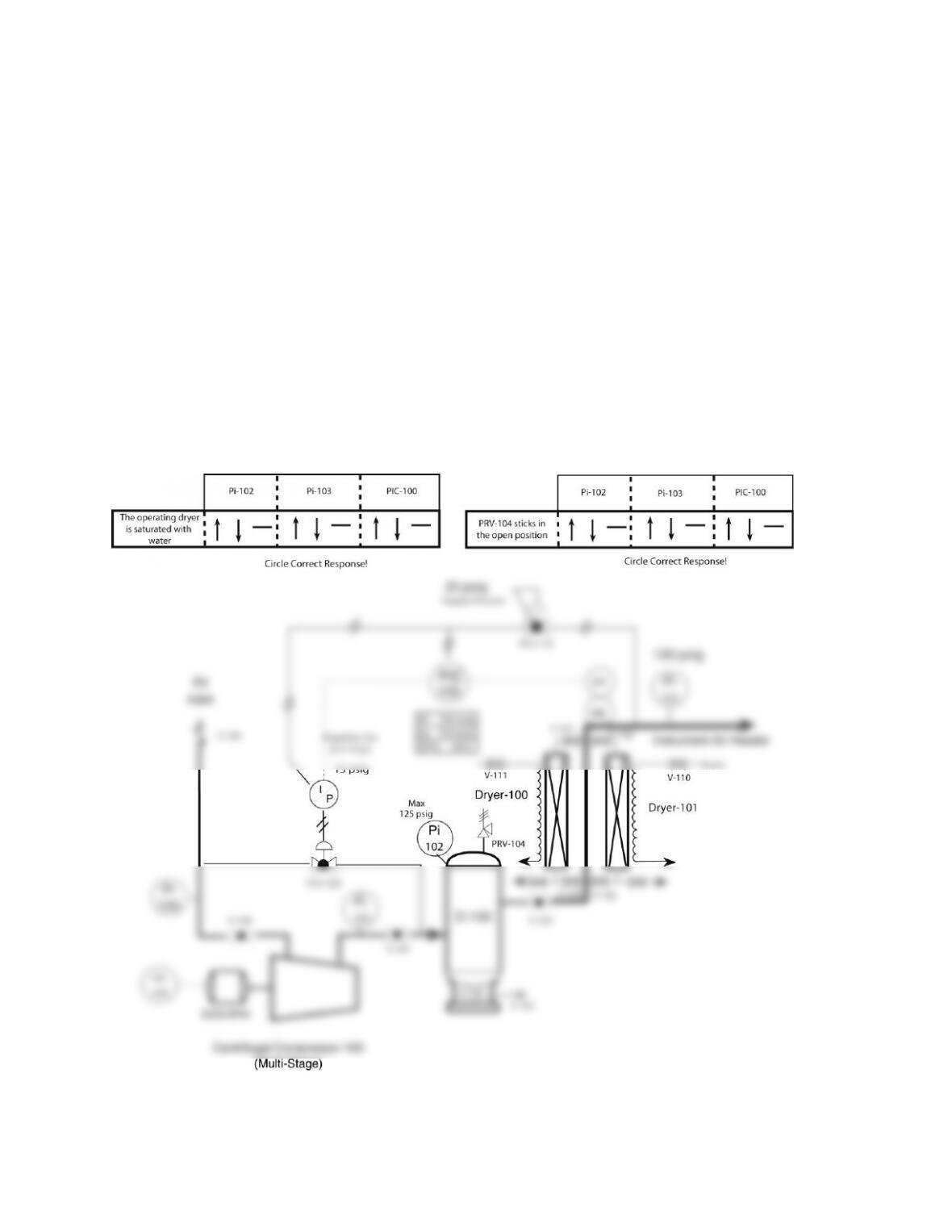
26. Compressor system TS#1
1
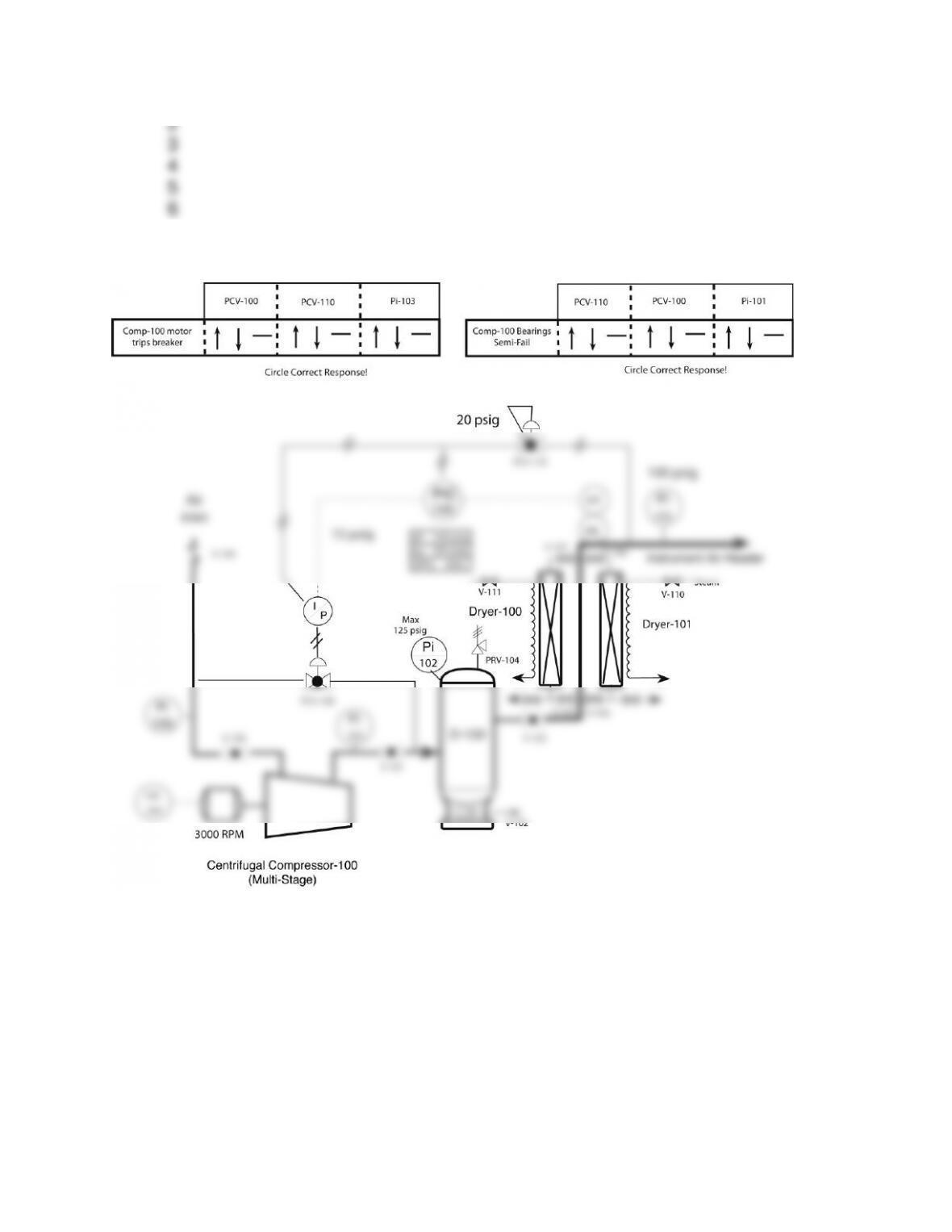
27. Compressor system TS#2
1
2
3
4
5
6
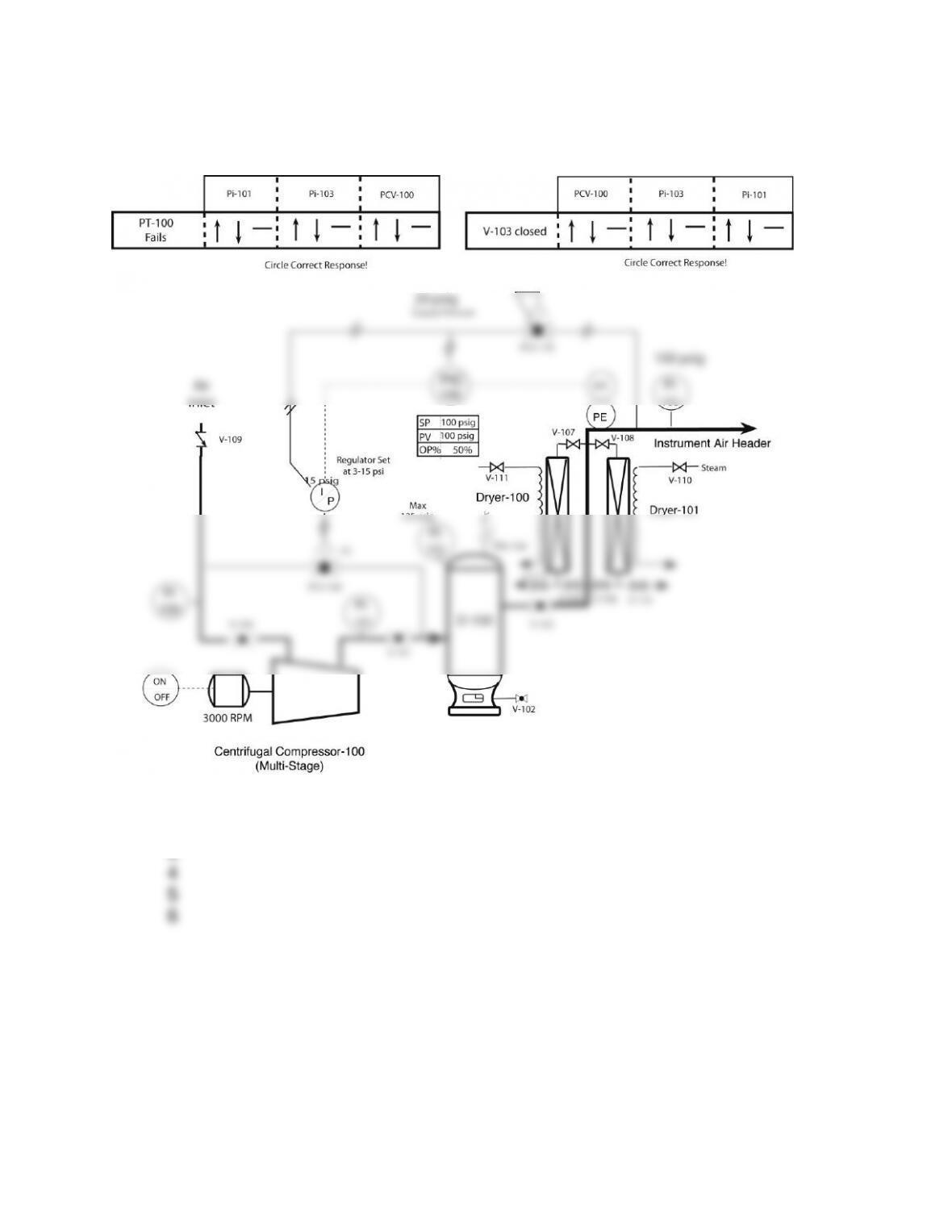
28. Compressor system TS#3
1
2
3
Answer Key CHAPTER 9 TEST A
COMPRESSOR MODEL