CHAPTER 8
PUMP MODEL
OBJECTIVES
• Describe the various components of the pump system.
• Describe the principles of fluid flow in a pump system.
• Draw a simple block flow diagram of the pump system.
• List the safety aspects associated with operating the pump system.
• List the operational specifications of the pump system; pressures, flow rates, etc.
• Solve various troubleshooting scenarios associated with pump system operations.
• Identify common problems associated with pump operations.
• Operate the pump system.
REVIEW QUESTIONS
1. Describe how NPSH and NPDH affect the operation of Pump-202.
A centrifugal pump requires sufficient NPSH in order to operate. If the
2. Describe the basic components of Pump-202.
Pump-202 is a typical horizontally mounted centrifugal pump. Basics
components include: suction, discharge, casing, impeller, volute, motor,
coupling, bearings, and seals.
Pump 202 is a horizontally mounted centrifugal pump designed to operate at 225
GPM. Suction pressure is maintained at 40 psig and the discharge pressure typically
runs at 135 psig. The differential pressure across the pump is 75 psig. This differential
is necessary in order for the system to operate properly. The pressure is obtained as
the control valve moves through 30% of its operating range on the discharge side of
the pump. A back-up pump is provided to ensure continuous flow to the system. Pump
3. Explain the basic steps required to start-up P-202.
1. Establish 75% level on TK-202 and set LIC-201 to AUTO.
3. Line-up pump 202A, open V-200, V-202A, V-202B, V-201.
4. Ensure pump 202B is in the closed position and V-202C, and V-202D are
closed.
5. Ensure FIC 202 is set at zero and closed.
6. Start pump 202A and monitor Pi-202A (40 psig) & Pi-202B (135 psig).
Establish flow.
7. Set SIC-201 to 650 RPM and put in AUTO and blend for 30 minutes.
9. Verify AT-1 is reading 36-38%.
11. Monitor system pressures.
4. Explain how a centrifugal pump builds pressure for liquid transfer.
The NPSH provides sufficient pressure so liquid is pushed into the suction
eye. Centrifugal pumps are designed to run liquid full. As liquid enters the
5. Explain how changes in NPSH effect the operation of P-202.
Changes in the NPSH directly impact pump efficiency. The height of the liquid
6. Contrast NPDH and NPSH and describe how each one effects the operation of
7. Calculate how many gallons would be left in Tank-202 if FIC-201 failed
completely.
8. Describe what happens when agitation in Tk-202 decreases or stops.
If the Mixer-200 fails, or if the agitation falls below design specifications
9. Explain how leaving a controller in manual affects the way it responds to process
changes.
10. Calculate how much feed passes through Tk-202 during a normal 24 hour period.
NAME:____________________________ TEST A
DATE:____________________________
CHAPTER EIGHT
PUMPS TEST “A” PUMP MODEL
1. The effect of temperature on liquid viscosity is generally:
a. viscosity increases as temperature decreases
b. viscosity decreases as temperature decreases
c. viscosity increases as temperature increases
d. viscosity is not affected by temperature
2. NPSH stands for:
a. normal positive suction head
b. national positive suction height
c. net positive standard head
d. net positive suction head
3. The first true centrifugal pump was not invented until:
a. 1600
b. 1851
c. 200BC
d. 100AD
4. The advantages of a centrifugal pump include all of the following except:
a. cheaper
b. deliver a more constant rate
c. easier to install
d. work well with liquid & gas phase
5. The impeller design on a centrifugal pump is available in all the following
designs except:
a. inlet vane tip
b. open
c. closed
d. semi-open
6. A pump curve identifies:
a. a pumps unique characteristics
b. the best operating condition for a pump
c. life time rates for pumps
d. PD pump and centrifugal pump comparisons
7. The major components of a centrifugal pump system include all of the following
except:
a. volute h. shaft
b. outer casing i. shaft coupling
c. suction eye j. discharge
d. impellers k. pressure gauges
e. wear rings l. flow control system
f. lobes m. shaft bearings and seals
g. motor n. inlet/outlet valves
8. The factors that effect a centrifugal pumps suction pressure include all of the
following except:
a. temperature
b. viscosity
c. pressure
d. size of pump
9. The best operating condition for a pump can be found on a(n):
a. flow chart trend
b. SPC chart
c. efficiency curve
d. partial correlation curve
10. Viscosity is defined as:
a. the thickness of a fluid
b. a fluids resistance to flow
c. amount of heat a fluid can absorb
d. fluid density
11. In a centrifugal pump, liquid is ___________ into the suction eye.
a. sucked
b. pushed
12. Cavitation occurs when:
a. suction pressure drops below NPSH
b. suction pressure drops below NPDH
c. liquid in the pumping chamber boils
d. a & c
13. Internal slip is defined as:
a. fluctuations of suction pressure created by the intake stroke.
b. % of fluid that leaks by the internal clearances over a given time.
c. difference between how much liquid a pump can move versus how much it
actually does.
d. b & c

14. The basic components of a centrifugal pump include all of the following except:
a. volute
b. impeller
c. piston
d. suction eye
15. The inlet side of a pump is often referred to by operators as the:
a. discharge side
b. suction side
c. volute eye side
d. process lift side
16. A ________________ consists of two sealing elements; one is stationary, usually
carbon, the other rotates with the shaft providing an air tight seal that requires
little maintenance.
a. labyrinth seal
b. radial bearing
c. packing gland and packing
d. mechanical seal
17. Which side of the impeller in a centrifugal pump exerts the most force on the
shaft:
a. suction
b. discharge
c. balanced force on each side
18. NPDH stands for:
a. normal positive discharge height
b. negative positive drop height
c. net positive discharge head
d. net positive differential head
19. The level on the feed tank is controlled at:
a. 25%
b. 33%
c. 50%
d. 75%
20. The high level alarm on the feed tank goes off at:
a. 25%
b. 50%
c. 75%
d. 85%
21. The low level alarm on the feed tank goes off at:
a. 65%
b. 33%
c. 25%
d. 50%
22. FIC-201 has a set point of:
a. 200 GPM
b. 225 GPH
c. 225 GPS
d. 225 GPM
23. FIC-201 is typically set in:
a. MAN
b. AUTO
c. CASCADE
d. Proportional
24. FIC-202 is typically set at :
a. 125 GPM
b. 50 GPH
c. 225 GPS
d. 225 GPM
25. AT–1 set point is:
a. 17%
b. 23%
c. 38%
d. 40%
26. SIC-201 has a set point of:
a. 650 RPM
b. 500 RPM
c. 255 RPM
d. 55 RPM
27. The suction pressure on P-202 typically operates at:
a. 15 psig
b. 25 psig
c. 35 psig
d. 40 psig
28. The discharge pressure on P-202 typically operates at:
a. 40 psig
b. 65 psig
c. 135 psig
d. 150 psig
29. The pressure relief valve on Tk-202 is set at:
a. 40 psig
b. 65 psig
c. 135 psig
d. 150 psig
30. Ti-202a typically reads:
a. 40ºF
b. 80ºF
c. 120ºF
d. 160ºF
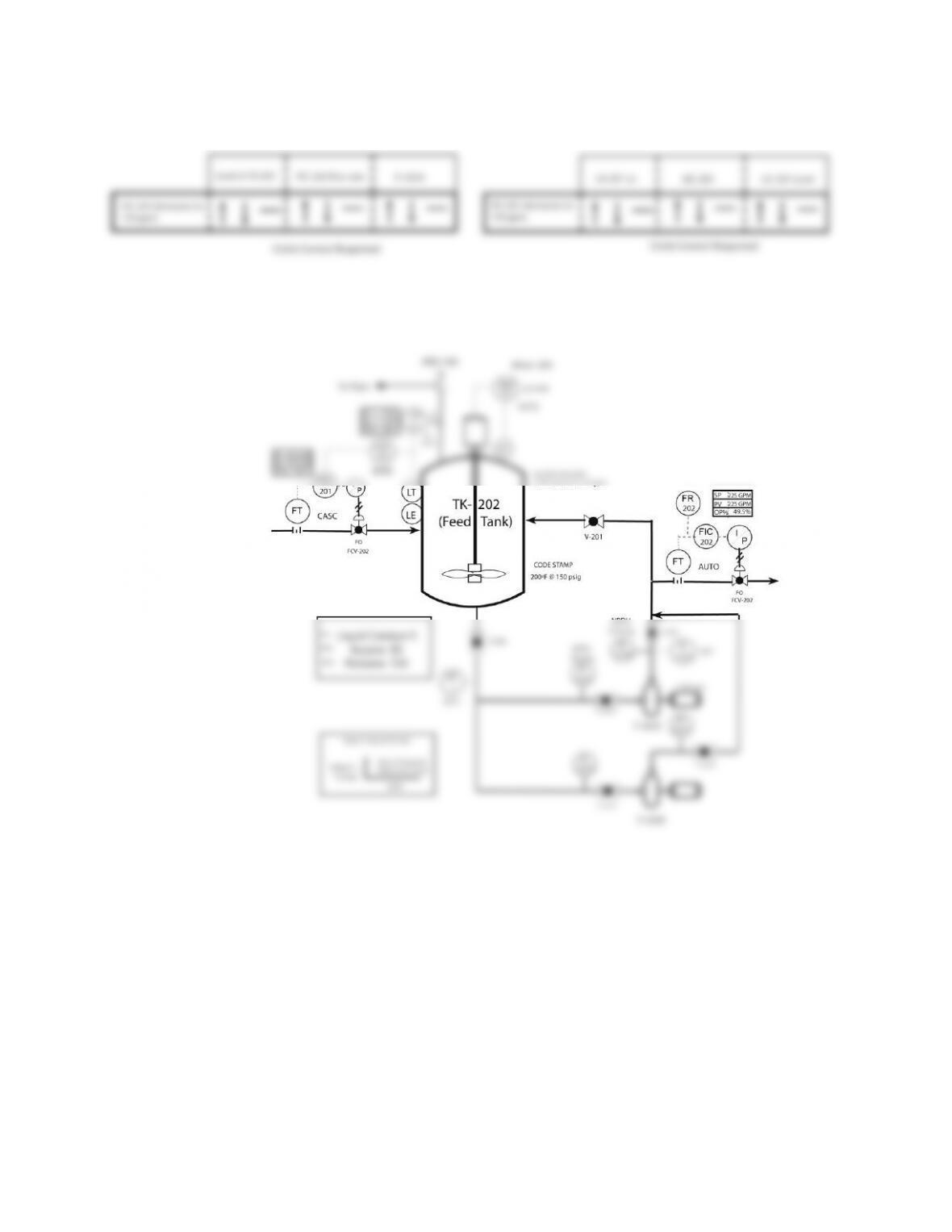
31. Pump TS # 1
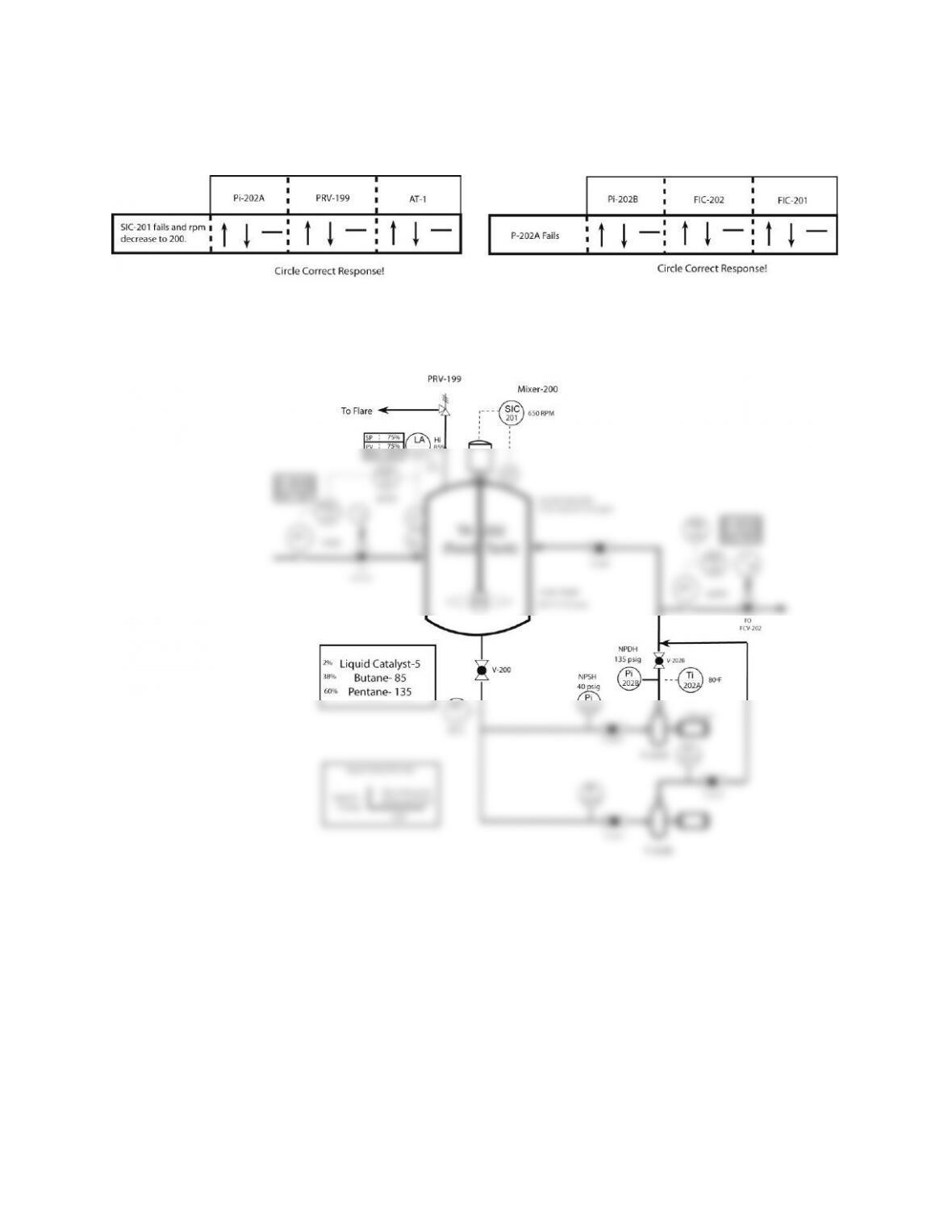
32. Pump TS # 2
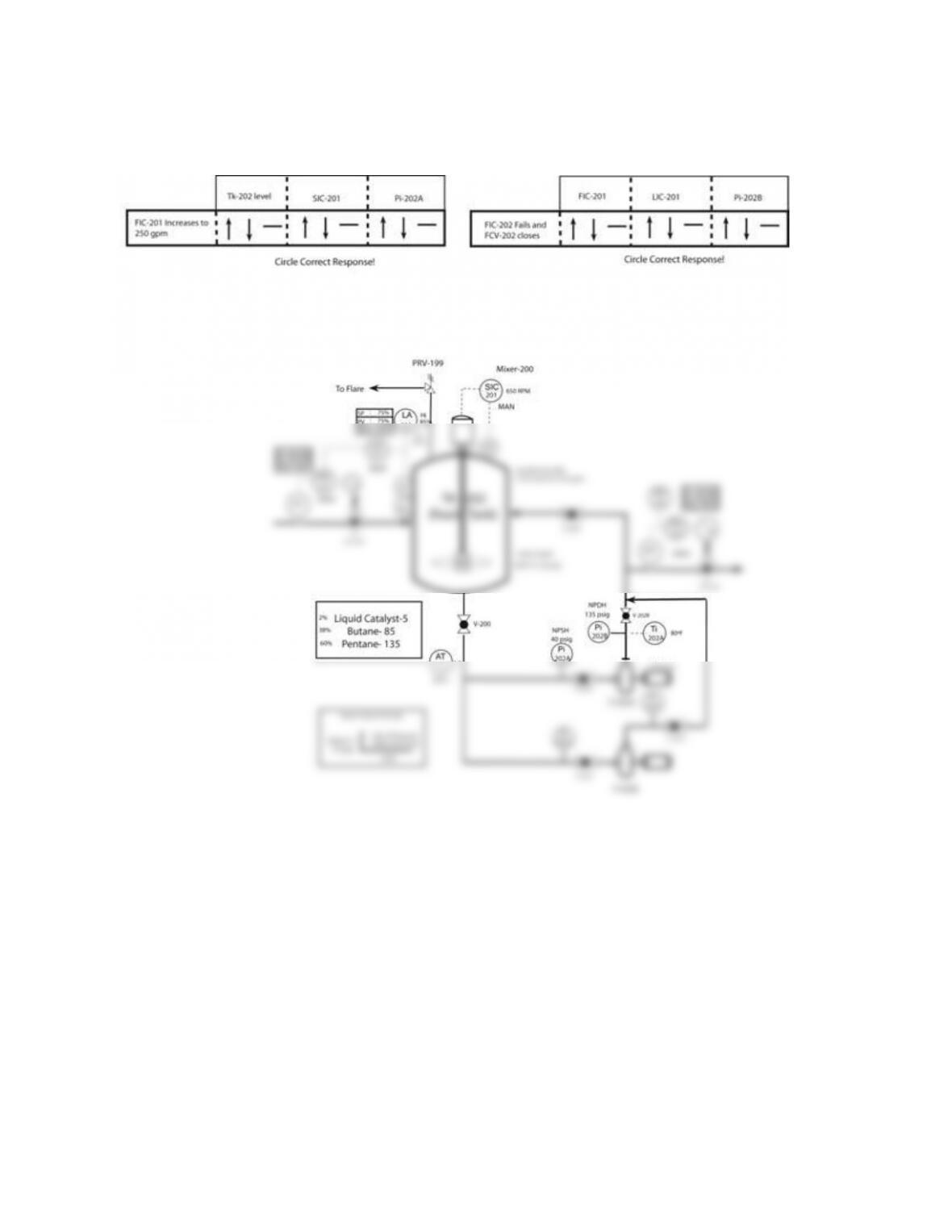
33. Pump TS # 3
Answer Key CHAPTER 8 TEST A
PUMP MODEL